A marketing agency contract should translate the commercial agreement into testable obligations. It should identify the services and dependencies, distinguish agency compensation from media and third-party costs, document platform roles and access, allocate intellectual-property and data-protection responsibilities, and define what happens when the engagement ends. The goal is not to make every contract identical. It is to ensure that both sides understand the operating model, the risks they accept and the evidence that shows an obligation has been completed.
Operator guidance from an agency that signs and honours these contracts — not legal advice. Check specifics with a lawyer for your jurisdiction and situation.
TL;DR
- Scope needs boundaries and dependencies. Define deliverables, assumptions, client inputs, approvals, acceptance criteria and the change-control process.
- Show the money flow clearly. Separate agency compensation, platform media, production, software, taxes and any mark-ups or rebates, including who contracts with and pays each supplier.
- Platform control is a permissions problem as well as a contract problem. Record account IDs, administrators, billing arrangements, connected assets and the access required at exit.
- Notice and offboarding must work together. The appropriate term depends on the engagement; the contract should make the notice calculation, charges, handover and transition timetable unambiguous.
- Renewal terms should be visible and operational. Record the renewal date, notice window and responsible owner instead of relying on memory.
- IP treatment is a commercial and jurisdiction-specific choice. State whether each deliverable is assigned or licensed, when rights take effect and which pre-existing components are excluded.
- A DPA is usually required where the agency handles personal data on your behalf.
- The thesis: the contract, platform configuration and handover inventory must describe the same operating model.
The anatomy of a marketing agency contract
A complete marketing agency contract covers twelve areas. Each is a place a relationship can go wrong, and each should be explicit rather than assumed.
- Parties and services — who is contracting, and what the agency will do.
- Scope of work (SOW) — the specific deliverables, and what is out of scope.
- Fees and payment — the management fee, model and terms.
- Ad spend — separated from the fee, defined as the client's cost paid to the platform.
- Account and data ownership — who owns the accounts, data, pixels and audiences.
- Intellectual property — who owns the creative, content and code.
- Term and termination — duration, notice period and how the relationship ends.
- Offboarding — how access and assets are handed back, and how fast.
- Reporting, KPIs and SLAs — what will be reported and what is promised.
- Confidentiality and NDA — how sensitive information is protected.
- Data protection (DPA) — how personal data is handled under GDPR/UK GDPR.
- Liability and platform risk — who bears which risks.
The rest of this guide takes the load-bearing clauses one at a time — the ones where vague wording costs you money or your assets.

Scope of work: make expectations testable
The SOW governs day-to-day delivery. It should state which channels and markets are covered, the deliverables and cadence, the service period, and what is excluded. It should also record the assumptions behind the fee: available media budget, number of brands or accounts, languages, required integrations and expected volume of creative or landing-page work.
A useful SOW identifies client dependencies as carefully as agency duties. Who supplies product information and substantiates claims? Who approves creative, and within how many business days? What happens to milestones when access or feedback is late? Define how either party can request a change, what information an estimate must contain, and who can authorise the extra cost. A reviewer unfamiliar with the project should be able to determine whether a task is included and whether a deliverable has passed acceptance.
Fees and ad spend: keep them separate
The contract should make the economics legible. A client may pay a platform directly, reimburse an agency, or buy media through an agency under a disclosed arrangement. Those structures have different tax, credit, cash-flow and platform consequences. Whatever the model, the proposal and invoice should allow the client to distinguish agency compensation from platform media and other third-party costs.
The contract should:
- State each fee and cost category separately, including production, technology, expenses, taxes and currencies.
- Define who contracts with and pays the platform, who carries credit risk, what happens if a payment fails and how billing changes at exit.
- Disclose mark-ups, commissions, rebates and credits, including how platform refunds or make-goods are treated.
- For spend-based fees, define the calculation base and tiers — for example, whether tax, credits and committed but unspent media are included.
- For performance fees, define the event, source, attribution window, validation, exclusions, corrections and dispute process.
| Billing model | How it works | Watch for |
|---|---|---|
| Retainer | Fixed monthly fee for a defined scope | Scope creep eroding value; unclear deliverables |
| Percentage of ad spend | Fee scales with a defined media-spend base | Calculation base, tiers and incentive alignment |
| Project / one-off | Fixed fee for a defined deliverable | Ongoing needs billed piecemeal |
| Performance | Fee tied to results | Attribution definition; who controls the variables |
The deeper treatment of these models — including a fair performance clause — is in marketing retainer vs project vs performance.
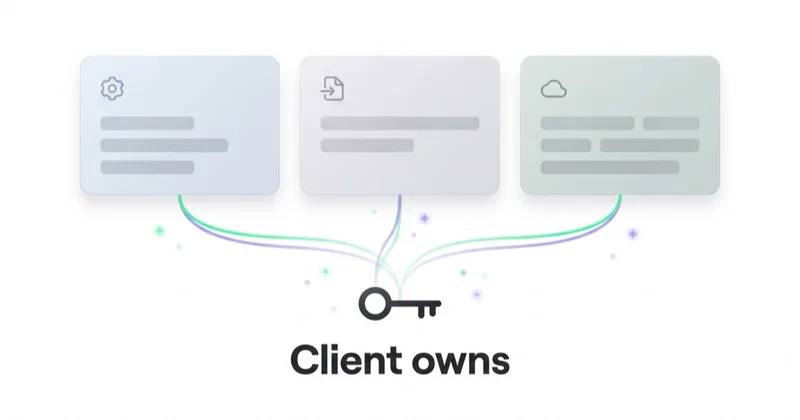
Account and data ownership: the clause that matters most
If you read only one clause carefully, make it this one. When the relationship ends, the single question that determines whether you keep or lose years of work is: who owns the accounts and data? The right answer, in almost every case, is you — the client owns the ad accounts, the analytics, the pixels and the audiences, and the agency manages them through revocable access.
The critical distinction is access is not the same as contractual rights, platform administration or billing control. Platforms use their own role models and terms, so a generic sentence saying “the client owns the data” is not enough. The contract should identify the relevant account IDs, legal or business entity, direct client administrators, manager or partner links, payment profile, connected assets and any restrictions on transfer or export.
For Google Ads, linking an existing client account to a manager account does not change the original users, history or payment method by default. Google also uses the term “owner” for a manager permission level, but explicitly says that this does not take data ownership or administrative rights away from the client account; a client administrator can unlink the manager. This is why the operational safeguard is direct client admin access and a documented billing transition, not an oversimplified claim that billing alone determines ownership.
This extends across every platform, not just Google Ads:
- Google Ads — keep direct client administrators, document the manager relationship and record any monthly-invoicing or payment-profile dependencies.
- Meta — record the business portfolio, people and partner access, Page, ad account, dataset, domain and payment method; verify current transfer restrictions for each asset rather than assuming they all behave alike.
- GA4 — keep client administrators, record property and account IDs, connected products, data retention settings and the feasibility and consequences of moving a property.
- Google Search Console, Merchant Center, Tag Manager — yours, with agency access.
- Browser and server-side measurement — document pixels, datasets, API connections, containers, cloud projects, domains, consent configuration and secrets, plus who can operate them after handover.
- TikTok, CMS, and other platforms — same principle: client-owned, agency-accessed.
Historical configuration and performance data can be valuable for analysis and platform optimisation, but audience and event data remain subject to platform terms, privacy law, retention and technical restrictions. Require continuity where the platform permits it, a documented export where it does not, and a tested handover plan. The full platform-by-platform mechanics are in who owns your Google Ads, Meta and GA4 when you leave an agency.
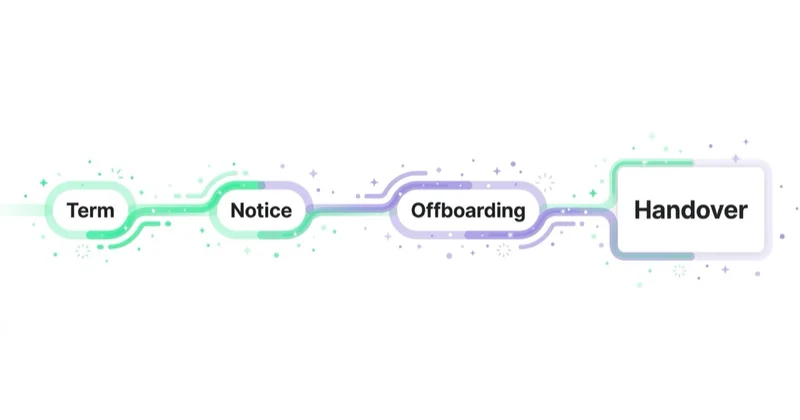
Term, notice and offboarding: how you leave
The exit clauses are tested exactly when the relationship is worst — when you have decided to leave — so they must be fair and specific. Three elements:
- Term — start date, initial term, renewal basis and any minimum commitments required to recover setup or production costs.
- Termination rights — notice for convenience, termination for breach, cure periods, insolvency or compliance events, and the exact method and effective date of notice.
- Financial consequences — fees during notice, non-cancellable media or supplier commitments, approved work in progress and final reconciliation.
- Offboarding schedule — priority access changes, final deliverables, exports, documentation, knowledge transfer and deletion or return of personal data, each with an owner and deadline.
Do not wait for termination to discover what can be transferred. Attach an asset register and test client administration during onboarding. The contract should address both sides' legitimate interests: continuity of access and return of client materials, payment of undisputed invoices, handling of disputed sums, security, legal retention and deletion duties. Ask local counsel whether any suspension, lien or withholding language is enforceable and proportionate.
Auto-renewal: the most common trap
An auto-renewal clause continues the agreement unless one party gives notice within a specified window. Its effect depends on the wording, governing law and whether the customer is a business or consumer. Operationally, the risk is simple: a team overlooks the window and commits to a term it did not intend to renew.
Auto-renewal is not automatically unfair — continuity has value — but it must be transparent: a reasonable renewal term, a clear notice window, and ideally a reminder before it triggers. Watch for the combination that traps clients: a long term, a long notice period, and an auto-renewal with a narrow window. Read the renewal clause before signing, and diarise the notice window the day you sign.
Intellectual property: assign on payment
Payment alone does not necessarily transfer copyright. The contract must state whether bespoke work is assigned or licensed, the territory and duration of any licence, permitted channels and adaptations, and when the rights take effect. The correct model depends on the deliverable and price: a full assignment may suit bespoke brand assets, while a sufficiently broad licence may be appropriate when work includes reusable agency systems or licensed components.
List source files separately because the final output does not automatically imply delivery of editable working files. Distinguish bespoke client work from pre-existing tools, templates, fonts, stock media, software and open-source components. Address third-party licence limits, portfolio use, moral rights where relevant and the agency's duty to obtain rights from employees and subcontractors. In the US, commissioned work is not automatically a “work made for hire”; the Copyright Office explains that statutory categories and a signed agreement apply.
Reporting, KPIs and the limits of guarantees
The contract should define what will be reported, how often, and against which KPIs — but it should also be honest about what can be guaranteed. A credible agency commits to activities and effort (best-efforts / duty of care), not to guaranteed outcomes it cannot control. Be wary of any contract guaranteeing a specific result — a #1 ranking, a fixed number of leads, a guaranteed ROAS — because the variables (competition, platform changes, your own conversion rate) are not fully in the agency's hands. What a good contract promises is defined deliverables, transparent reporting, and KPIs framed as targets with a clear attribution method, not as guarantees.
Confidentiality, DPA and liability
Calling an agency a “processor” in the contract does not settle the role. The factual question is who determines the purposes and essential means of each processing activity. An agency acting only on documented client instructions will usually need an Article 28 processor agreement. If it reuses personal data for its own purpose, it may become a separate controller for that operation.
The DPA should cover subject matter, duration, purpose, data and data-subject categories, confidentiality, security, sub-processors, rights requests, incident support, audits, and deletion or return at exit. The European Commission's controller–processor standard clauses provide an official Article 28 reference. UK programs need the UK GDPR version and current ICO guidance; international transfers require a separate transfer mechanism analysis.
The acceptance and offboarding matrix
A contract becomes operational when every deliverable has an acceptance test and post-handover owner:
| Asset | Acceptance test | Owner after acceptance | Handover format |
|---|---|---|---|
| Ad account | client admins and billing control verified | client | account ID, role list, unlink instructions |
| Creative | matches brief and technical specification | per assignment or license | final files plus agreed source files |
| Data and dashboard | metric definitions and access validated | client / roles documented in DPA | export, data dictionary, integration inventory |
| Automation | agreed user-acceptance test passes | client or named vendor | configuration, logic, and securely transferred credentials |
IP language must match the governing law. A US work-made-for-hire clause is not a universal substitute for assignment. UK and EU agreements should separate bespoke client work from the agency's pre-existing tools, templates, libraries, stock licenses, and open-source components. Moral rights, source files, portfolio use, and rights effective on payment need explicit treatment.
Three protective clauses round out the contract:
- Confidentiality / NDA — protects your sensitive business information both ways.
- Data protection (DPA) — where the agency processes personal data on your behalf (customer lists, lead data, audiences), a Data Processing Agreement is usually required under GDPR/UK GDPR, defining the agency as processor and you as controller. An NDA is not a substitute for a DPA. The role can be more complex than it looks — some activities make the agency a joint controller — which is covered in is your marketing agency a data controller or a processor.
- Liability — who bears which risks, including platform risks (account suspensions, policy changes) that neither side fully controls. Reasonable liability clauses allocate these fairly rather than dumping all risk on one side.
Glossary
- SOW (scope of work) — the specific deliverables and boundaries of the engagement.
- MSA (master services agreement) — the overarching contract terms, often with SOWs attached per project.
- Management fee — the agency's revenue, distinct from ad spend.
- Ad spend — the client's cost paid to the platform, never the agency's revenue.
- Account ownership — who the ad account and its billing profile belong to (versus who has access).
- MCC (manager account) — Google Ads manager account an agency links to a client's account for access.
- DPA (data processing agreement) — the contract governing personal-data handling under GDPR.
- Auto-renewal — a clause renewing the contract unless notice is given in a set window.
Red-flag clauses to strike
| Red flag | Why it's a problem | What to require instead |
|---|---|---|
| No direct client administrators or asset register | Exit depends on people outside the client's control | Named client admins, account IDs and verified access |
| Media and fees shown as one unexplained amount | The client cannot reconcile what was bought | Separate cost categories and disclose mark-ups, rebates and credits |
| Notice mechanics are ambiguous | The parties disagree about timing and charges | Exact notice method, window, effective date and consequences |
| Renewal date has no internal owner | An unwanted renewal is easy to miss | Visible renewal terms, owner and calendar control |
| Handover promised without formats or deadlines | Exit cannot be tested or enforced operationally | Asset-level owner, format, acceptance test and timetable |
| IP clause ignores background and third-party material | The promised rights may be incomplete or unusable | Assignment/licence schedule plus exclusions and licence evidence |
| KPI guarantee lacks dependencies and measurement rules | Payment and performance disputes become likely | Targets, assumptions, source, attribution and correction process |
| DPA conflicts with actual data flows | Contract labels do not match legal roles | Data-flow review, Article 28 terms and transfer assessment |
How Space Ads approaches the agency contract
Our review starts by matching the commercial proposal to the actual operating model. We map scope and dependencies, platform administration and billing, approvals, data flows, IP components, reporting definitions and exit assets. This exposes contradictions such as a client ownership clause paired with no direct client administrator, or a performance fee paired with no agreed source of truth.
The preferred structure is transparent and testable: direct client administration where the platform permits it, clearly separated fees and third-party costs, rights appropriate to each deliverable, explicit data roles and an asset-level offboarding schedule. The exact term, notice and liability allocation must fit the scope and governing law. That operational clarity supports performance marketing; a fractional CMO can coordinate the same decisions across marketing, finance, legal and procurement.
FAQ
What should be in a marketing agency contract?
A marketing agency contract should cover scope and client dependencies, fees and third-party costs, platform access and billing, intellectual-property rights, approvals, reporting and measurement, confidentiality, data protection, liability, term, termination and asset-level offboarding. Each material obligation needs an owner, deadline and acceptance test.
Who owns my Google Ads account under an agency contract?
The client should normally retain direct administrative access and continuity of the individual account, while the agency works through an agreed manager relationship. Google says linking an existing account does not change its original users, history or payment method by default. Its separate manager “owner” role grants administrative privileges but does not take the client account's data ownership or right to unlink. Document both permissions and billing dependencies.
Who pays for ad spend — the agency or the client?
The client ultimately funds media, but the payment route varies: direct platform billing, reimbursement or an agreed agency media-buying arrangement. The contract and invoices should distinguish agency compensation from media, production, technology, taxes and other third-party costs, and disclose mark-ups, rebates, credits and payment-failure consequences.
What is a normal notice period in a marketing agency contract?
There is no universal standard. The appropriate period depends on scope, setup investment, committed media, staffing and governing law. Assess it together with the initial term, renewal window, termination-for-breach rights, charges during notice and offboarding timetable; a short notice period can still produce a poor exit if those provisions are unclear.
What is the auto-renewal trap?
Auto-renewal silently renews the contract for another full term unless you give notice within a narrow window before the renewal date. The trap is a long term combined with a long notice period and a narrow renewal window, which re-locks you by default if you miss it. Require a transparent renewal clause with a clear window, and diarise it when you sign.
Do I own the creative and content the agency produces?
Only if the contract and applicable law provide for it. State whether each deliverable is assigned or licensed, when rights take effect and what uses are permitted. List source files, pre-existing agency material and third-party components separately. A broad licence can be commercially sufficient in some engagements; bespoke core assets may justify assignment.
Do I need a DPA with my marketing agency?
Usually, when the agency processes personal data on the client's documented instructions under GDPR or UK GDPR. The factual activity determines whether the agency is a processor, separate controller or joint controller; the label in the MSA does not. An NDA is not a substitute for the required Article 28 terms or any separate international-transfer mechanism.
Can a marketing agency guarantee results in the contract?
A credible agency commits to activities, effort and defined deliverables — not to guaranteed outcomes like a specific ranking, lead volume or ROAS, because the variables are not fully in its control. A contract guaranteeing a specific result is a red flag; what to require instead is transparent reporting and KPIs framed as targets with a clear attribution method.
Key takeaways
- Make scope, dependencies, money flows, platform roles, data duties, IP rights and exit testable rather than implied.
- Keep direct client administrators and an asset register; do not rely on a generic ownership sentence.
- Separate agency compensation from media and other third-party costs and disclose mark-ups, rebates and credits.
- Negotiate term, renewal, notice and offboarding as one system, with exact mechanics and asset-level deadlines.
- Match the IP and DPA wording to the real materials, data flows, governing law and platform restrictions.
Sources and further reading
- Google Ads Help — About manager accounts (MCC)
- Google Ads Help — About ownership of client accounts
- Google Ads Help — About linking an existing account
- Meta Business Help — Business Manager and asset ownership
- ICO (UK) — Contracts and liabilities between controllers and processors
- EUR-Lex — GDPR Article 28
- European Commission — Controller–processor standard clauses 2021/915
- US Copyright Office — Works Made for Hire, Circular 30
Continue learning
- Who owns your Google Ads, Meta and GA4 when you leave an agency?
- SEO contract: what to look for, the red flags, and why 'no lock-in' matters
- Marketing retainer vs project vs performance: how agencies bill
- Is your marketing agency a data controller or a processor?
- Questions to ask a marketing agency before you hire
- Performance marketing, run on client-owned accounts
Continue reading
Who Owns Your Google Ads, Meta, and GA4 When You Leave an Agency?
Your company should control its ad and analytics assets while the agency receives revocable access. This guide separates legal rights, platform roles, billing and infrastructure, then shows what to verify before an agency change.
Marketing Retainer vs Project vs Performance: How Agencies Bill
Agencies commonly bill through retainers, projects, performance components or hybrids. This guide shows how to compare total cost, separate the agency fee from media, define measurable outcomes and write practical scope, ownership and handover clauses.

Lead Generation for Online Courses and Education Providers
Education lead generation must connect an honest promise with learner fit, enrolment and course starts—not just form volume. Learn how to design the journey, evidence claims and measure each intake.