
Agency pricing is often simplified into three models: a monthly retainer, a fixed project fee and a performance-based fee. In practice, agreements may also use hourly rates, cost-plus pricing, media commissions, licence fees and hybrids. The label alone does not tell you whether a proposal is fair. You need to know what work is included, what sits outside scope, how media is billed, who carries each operational dependency and how any variable fee is validated.
A retainer buys defined ongoing capacity or services. A project buys agreed deliverables and acceptance criteria. A performance component links part of the fee to an agreed outcome. None of these models moves all risk to one side: the client still controls factors such as product, pricing, stock and sales follow-up, while the agency still carries delivery, staffing and execution risk.
Commercial guidance, not legal, tax or accounting advice. Review the final agreement with qualified advisers for your situation.
TL;DR
- Three models: retainer (ongoing capacity), project (defined deliverable), performance (fee tied to results); plus hybrids.
- Each distributes risk differently. A retainer creates capacity and scope risk, a project creates estimation and acceptance risk, and a performance component creates measurement and dependency risk.
- Make the agency fee and media cost separately visible. If the agency pays or re-bills media, the agreement should also disclose markups, taxes, foreign-exchange treatment, credits and payment liability.
- A percentage-of-spend fee can create tension at scale unless tiers, caps, approval rights and the work associated with higher spend are clear.
- A fair performance clause defines the billable outcome and validation up front, uses an appropriate baseline or control method, and states how external factors affect the calculation.
- Ownership and handover clauses apply regardless of billing model. The agreement should say who owns each account, dataset, source file and deliverable, and what remains licensed agency IP.
- Match the model to the work and the risk you want to hold, not to whichever number looks smallest.
The three billing models
| Model | How it works | Useful when | Main uncertainty | Common failure mode |
|---|---|---|---|---|
| Retainer | Fixed recurring fee for defined ongoing services or capacity | Continuous work and recurring governance | scope, utilisation and changing priorities | scope creep, idle capacity or under-delivery |
| Project | Fixed or staged fee for defined deliverables | Bounded work with acceptance criteria | estimation, dependencies and change requests | vague acceptance or fragmented follow-on work |
| Performance | Variable fee tied to validated outcomes | measurable outcomes with enough shared control and reliable data | attribution, incrementality, validation and external dependencies | paying for low-quality volume or disputed credit |
Retainers fit recurring work when the scope, team access and governance rhythm are clear. Projects fit bounded work such as an audit, migration, launch or defined build. Performance components can align incentives, but only when the billed outcome is commercially meaningful and can be validated without relying on one party's interpretation. Paying for raw leads, attributed platform revenue or spend is not automatically the same as paying for profitable growth.
Hybrid models combine a fixed base with a variable component. They can cover minimum delivery capacity while rewarding an agreed outcome, but they are not automatically fairer. A poor KPI, weak baseline or uncapped bonus can create the same problems as a pure performance contract.
A core transparency test: fee vs ad spend
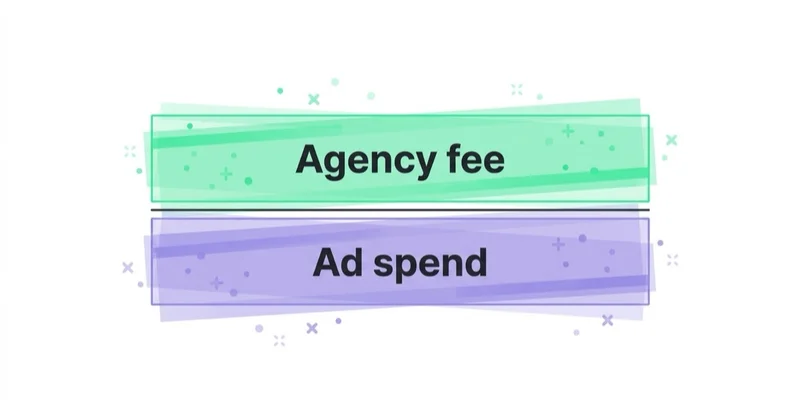
Whatever the model, the proposal should make the agency fee and media cost separately visible. A single "media budget" number prevents the buyer from seeing how much funds platform delivery and how much pays for strategy, management, production, technology or financing. It also makes proposals difficult to compare.

The contract should:
- Show the management fee and ad spend as separate line items.
- Say who contracts with and pays the platform. Direct client billing can simplify continuity and visibility, but agency invoicing, consolidated billing and credit arrangements also exist.
- Disclose every addition to media cost. This includes markups, service charges, tax, foreign-exchange treatment, financing costs and any minimum commitments.
- Define credits, rebates and invalid-traffic adjustments. Say who receives them and how they appear in reconciliation.
- Identify the payments profile and account administrators. In Google Ads, the payments profile identifies the person or organisation legally responsible for advertising costs; changing it may require a billing transfer.
- Reconcile planned, invoiced and platform-reported spend. State the frequency, source and treatment of late platform adjustments.
The preferred structure depends on geography, tax, credit and procurement requirements. The control objective is consistent: the client should know the platform account, payer, actual media cost, fee and exit procedure. The ownership reasoning is covered in who owns your Google Ads, Meta and GA4.

The percentage-of-spend trap
A percentage-of-spend fee is a media-remuneration model, not a performance fee: the fee increases with spend even if business outcomes do not. It is simple to calculate and can reflect additional workload as markets, campaigns and creative volume expand. The tension appears when the fee rises mechanically but the scope and results do not.
It is not automatically wrong — it is a reasonable way to price management effort that scales with account size — but it needs guardrails:
- A cap or tiered rate, with thresholds and examples showing the fee at different spend levels.
- Defined services at each tier, so a larger fee corresponds to agreed additional work or complexity.
- Commercial review metrics, such as contribution margin, qualified pipeline or customer acquisition cost, even when those metrics do not directly determine the invoice.
- Client approval rights, including who may raise budgets, by how much and through which written process.
- Treatment of overspend and platform credits, including whether either changes the fee calculation.
The fair performance clause
A performance clause needs a measurement schedule, not a slogan. It should define the eligible outcome, source system, baseline where relevant, attribution or incrementality method, validation window, refunds and cancellations, new-versus-existing customer treatment, currency, tax and dispute process. Both parties should have appropriate access to the records that determine the fee, with privacy and access controls for customer data.
In a hybrid model, a base fee can pay for minimum team capacity and governance while a variable component rewards an outcome inside the agency's influence. Caps and floors limit invoice volatility when demand, inventory, pricing, sales follow-up or tracking changes.
Worked example: a bonus based on qualified pipeline should define qualification fields in the CRM, exclude duplicates and existing opportunities, wait through the agreed validation period, and reconcile reversed or rejected records. “10% of revenue generated” without those rules invites conflict rather than alignment.
The usefulness of a performance fee depends on how "performance" is defined. A vague definition creates avoidable billing risk, so the clause should resolve the ambiguity before any money is at stake:
- Define the KPIs precisely — what counts as a lead, a qualified lead, a conversion, revenue — with the exact events and thresholds.
- Agree the attribution methodology up front — which model, which window, which platform is the source of truth — because attribution is where "results" are contested (the reasons are in marketing attribution for executives).
- Agree a baseline or control method where needed — use a dated snapshot, comparison period, holdout, geo test or another method appropriate to the KPI. A simple baseline may be misleading when the business is seasonal or changing quickly.
- Define how external factors are handled — seasonality, pricing, promotions, stock, sales capacity, PR and outages may require adjustment, a pause, a separate calculation or no adjustment at all. State the rule instead of arguing after the event.
- Say what happens if tracking breaks — a fallback measure or a pause, so a broken pixel does not become a billing argument.
The clause should also specify the calculation with a worked example. If a bonus is based on qualified pipeline, show a sample month with duplicates, rejected opportunities, cancellations, currency conversion, the validation lag, cap, floor and final invoice. A buyer should be able to reproduce the result from the agreed source data.
Scope, term and ownership apply to every model
Four areas are model-independent and matter regardless of how you are billed:
- Scope and change control — a clear statement of work should list services, deliverables, cadence, assumptions, client dependencies and exclusions in language a third party can apply. It should also explain who may request extra work, how it is estimated and when work begins.
- Term, notice and renewal — state the initial term, notice period, renewal mechanism, early-termination rights and fees in calendar terms. The appropriate notice depends on staffing, commitments and handover complexity; there is no universal 30-day rule.
- Account, data and deliverable rights — define client-owned platform accounts and data, agency access, commissioned deliverables, source files, third-party licences, stock assets, pre-existing agency IP and reusable tools. Do not assume every output or working file transfers automatically.
- Handover — list the access, exports, documentation, open work, credentials process and delivery deadline, plus any paid transition support.
These are covered in full in the marketing agency contract checklist. A billing label does not determine ownership or offboarding; the written agreement does.
Glossary
- Retainer — a fixed recurring fee for ongoing scope and capacity.
- Project fee — a fixed fee for a defined, bounded deliverable.
- Performance fee — a fee tied to results (leads, revenue, or a share of outcomes).
- Percentage of ad spend — a management fee set as a share of media budget.
- Hybrid model — a combination of fixed, project, usage or outcome-based components.
- Management fee — the agency's revenue, separate from ad spend.
- Baseline — an agreed reference period or starting measurement used where appropriate to assess change.
- Attribution methodology — the agreed rules for crediting results, fixed before billing.
- Validation window — the period allowed for duplicates, cancellations, returns or rejected outcomes to be identified before billing is final.
How to choose the model
The right model depends on the work and the risk you want to hold:
- Continuous, defined marketing operations → consider a retainer with service levels, capacity and governance clearly stated.
- A bounded build or diagnosis → consider a project fee with dependencies, milestones and acceptance criteria.
- A measurable outcome with reliable validation and enough shared control → consider a performance component with caps and a fallback for broken measurement.
- An uncertain scope or new relationship → consider a paid discovery phase, pilot or short initial term before committing to a complex incentive model.
The wrong way to choose is by the headline number. A cheap retainer with vague deliverables can cost more than a higher one with clear scope; a pure performance deal can be expensive if the agency prices heavily for the risk it carries. Judge the model on how it aligns incentives and where it puts the risk, not on which invoice looks smallest.
How a Space Ads engagement can be structured
A Space Ads proposal can separate agency fees, platform media, production, technology and other approved costs so the buyer can see the total investment. The statement of work should connect each recurring or project fee to a defined scope, cadence, client dependency and change-control process.
Where a variable component is appropriate, the agreement can define the KPI, source system, validation lag, treatment of external factors, cap, floor and a worked calculation. The billing and account setup should also state who pays each platform and what happens during handover. The final structure depends on the engagement rather than a universal pricing template. That is the commercial layer of performance marketing; the separate budget question is covered in what percentage of revenue to spend on marketing, while broader senior ownership may fit a fractional CMO engagement.
Stop doing / Do instead
| Stop doing | Do instead |
|---|---|
| Blending fee and ad spend into one number | Separate them as line items |
| Uncapped percentage-of-spend fee | Cap or tier it, define approval rights and the added scope |
| Vague "results" in a performance deal | Define the KPI, validation and an appropriate baseline or control method |
| Choosing the model by headline price | Choose by incentive alignment and risk |
| Ignoring external factors in performance | Define how seasonality, pricing, stock, PR and outages affect the calculation |
| Assuming ownership from the billing model | Define account, data, deliverable, source-file and licence rights explicitly |
FAQ
What is the difference between a retainer, project and performance fee?
A retainer is a recurring fee for defined ongoing services or capacity. A project fee covers defined deliverables and acceptance criteria. A performance fee varies with validated outcomes such as qualified opportunities or revenue under agreed rules. Each distributes scope, estimation, dependency and measurement risk differently; hybrid agreements combine two or more components.
How do marketing agencies charge for ad spend?
The proposal and reconciliation should show agency fees and actual platform media as distinct line items. Direct advertiser billing is often straightforward, but agencies may also use monthly invoicing, consolidated billing or other approved structures. In those cases, the contract should disclose the payer, markup, taxes, foreign exchange, credits, payment liability and billing-transfer process.
What percentage of ad spend do agencies charge?
There is no useful universal percentage. The rate depends on scope, spend, markets, channel mix, creative volume, technology and service level. Ask for a worked fee table at several spend levels, the services added at each tier, a cap or decreasing tiers where appropriate, and written budget approval rights.
How do you structure a fair performance clause?
Define the billable event, exclusions, source system, attribution or incrementality method, validation window, baseline or control method, cap, floor, tax and dispute process. State how seasonality, pricing, promotions, stock, sales follow-up and outages affect the calculation, and what happens if tracking breaks. Include a worked example that both parties can reproduce.
Should ad spend be included in the retainer or separate?
They should be separately visible even if one invoice collects both. The buyer should be able to reconcile the agency fee, platform media, production, technology, tax, foreign exchange and adjustments. Direct platform payment can simplify continuity, but the right setup depends on the advertiser's tax, procurement and credit arrangements.
Which billing model is best for a marketing agency relationship?
It depends on the work, dependencies and data. A retainer can fit recurring operations, a project fee can fit a bounded build, and a performance component can fit a commercially meaningful outcome with reliable validation and enough shared control. For a new or uncertain scope, a paid discovery phase, pilot or short initial term may be safer than a complex bonus formula.
Key takeaways
- Agencies bill on retainer, project or performance models, plus hybrids; each places risk differently.
- The cost schedule should show agency fees, platform media and other approved costs separately, including any re-billing adjustments.
- Percentage-of-spend fees need transparent tiers, approval rights and a clear link between spend growth and added work.
- A fair performance clause defines the outcome, validation, attribution or incrementality, external-factor rules and a reproducible calculation.
- Scope, term, account access, IP and handover clauses apply regardless of model; none should be inferred from the invoice format.
Need to map scope, media, measurement and commercial terms before scaling acquisition? Explore the Space Ads performance marketing service. The billing model, platform payment setup and responsibilities are defined for each engagement.
Sources and further reading
- Google Ads Help — Payments profile
- Google Ads Help — Make a billing transfer for monthly invoicing accounts
- Google Ads Help — Manager accounts and ownership of client accounts
- World Federation of Advertisers — Future of Media Agency Remuneration
- Association of National Advertisers — 2025 Trends in Agency Compensation
Continue learning
- What should be in a marketing agency contract? A founder's checklist
- Who owns your Google Ads, Meta and GA4 when you leave an agency?
- What % of revenue should you spend on marketing?
- Marketing attribution for executives
- How much does a fractional CMO cost?
- Performance marketing, billed transparently
Continue reading

What Should Be in a Marketing Agency Contract? A Founder's Checklist
A marketing agency contract should turn expectations into testable obligations: scope, fees and media costs, platform access, data roles, IP rights, approvals, liability and exit. Use this practical checklist to identify decisions that need precise wording and local legal review.

How to Choose a Lead Generation Agency (Questions to Ask, Red Flags)
A practical framework for comparing lead generation agencies: scope, measurement, pricing, account ownership, security, contracts and the questions worth asking before you sign.

Lead Generation for Online Courses and Education Providers
Education lead generation must connect an honest promise with learner fit, enrolment and course starts—not just form volume. Learn how to design the journey, evidence claims and measure each intake.


































