An inexpensive self-paced course, a professional certificate, a bootcamp and a degree programme do not share one enrolment journey. The buyer may be the learner, a parent, an employer or a procurement team. Consideration may take minutes or months, and the decision may depend on schedule, prerequisites, recognition, teaching format, total cost and evidence of outcomes.

That is why education lead generation should not be reduced to collecting emails for a deadline sequence. It must help the right prospective learner understand the programme, make an informed choice and move through a measurable admissions or purchase process.
This guide explains how to design the offer, channels, qualification, claims and measurement without optimising for enquiries that never start the course.
In short
- Define the programme, learner, payer and decision process before selecting channels or a “lead magnet.”
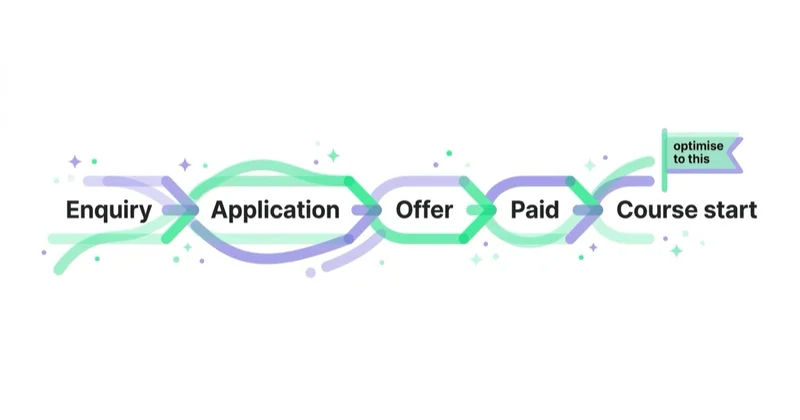
- A lead is not an enrolment. Track valid enquiry, application, offer, payment, cancellation or refund, course start and—where useful—progression or completion.
- Search, paid social, video, events, partners and content perform different jobs. None is automatically the best or highest-intent source for every course.
- A sample lesson can reduce uncertainty, but a syllabus, assessment, open day, adviser call or employer pack may better match the decision.
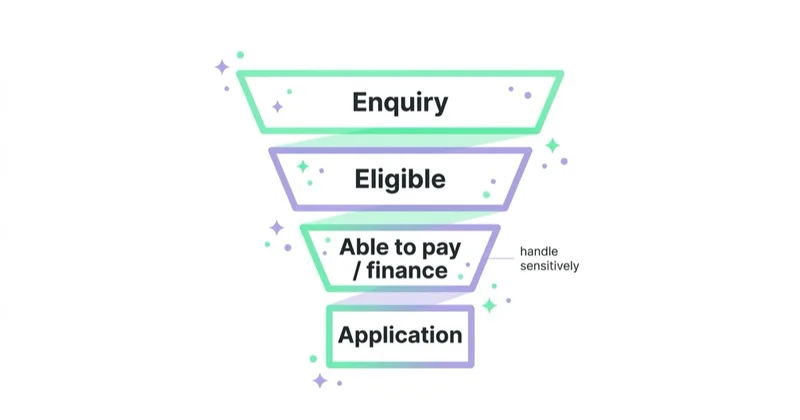
- Qualify for educational and operational fit. Handle affordability, financing and sensitive financial information through a transparent, appropriate process—not an advertising form.
- Claims about earnings, jobs, completion, accreditation and typical outcomes require evidence, context and current methodology.
- Genuine intake dates and capacity can guide a decision. Invented scarcity and constantly resetting deadlines undermine trust and may be misleading.
- If under-18s may respond, advertising, consent, data collection and communication need additional safeguards.
Start by defining the education offer
Document the factors a prospective learner needs to evaluate:
- subject, level and learning outcomes;
- delivery format, workload, duration and timetable;
- prerequisites, language and technical requirements;
- educator or institution, awarding body and accreditation status where relevant;
- total price, mandatory fees, subscription or renewal terms;
- cancellation, refund, deferral and access rules;
- support, assessment and certificate conditions;
- realistic next steps after completion.
Do not imply accreditation, employer recognition or eligibility for a regulated role unless the claim is accurate for the location and current programme. If a course is a preparation resource rather than the official qualification, say so plainly.
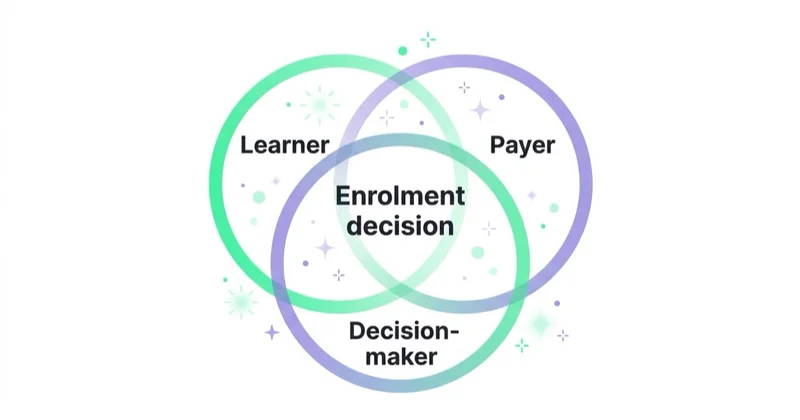
The target audience should identify the learner, payer and decision participants. A career changer buying personally needs a different journey from an L&D team purchasing seats for employees or a parent comparing programmes for a child.
Map the enrolment lifecycle
Use stages that reflect the actual programme:
visitor → enquiry → valid prospective learner → application or checkout → accepted/eligible → paid or funded → started → retained/completed
Not every provider needs every stage. A short self-serve course may move directly from checkout to start. A degree or selective bootcamp may require application, evidence, interview and offer.
For each stage, define:
- the event and source of truth;
- required data and owner;
- expected next action and service level;
- rejection, withdrawal and deferral reasons;
- the reporting delay before the cohort is mature.
This prevents marketing from reporting every download as an enrolment lead and admissions from using an undefined “poor quality” label.
Choose channels by the learner's job
Search and Google Ads
Search can answer queries about a subject, course type, provider, qualification, schedule, price or comparison. The query “free Python tutorial” does not carry the same intent as “part-time accredited data course London.” Segment meaning and direct each ad to a page that answers the specific decision.
Brand, category and competitor-comparison traffic should be reported separately. High query intent does not guarantee eligibility, affordability or a start.
SEO and educational content
Useful content can explain the field, prerequisites, curriculum, learning format, assessment and career context. It should demonstrate expertise without disguising a sales page as independent guidance. Publish authorship, sources, review dates and limitations where claims may change.
Some resources should remain open. Gating every syllabus, fee page or essential eligibility detail adds friction to an informed decision and can create low-value leads.
Video and online events
Video can show an instructor's style, lesson structure and platform experience. A webinar or open class can support evaluation, but registration is not attendance and attendance is not purchase intent. Report those stages separately.
Paid social
Paid social can introduce a programme before a direct search and distribute proof, lessons or events. Audience, age and personalisation controls must follow platform rules and applicable law. Avoid creative that implies knowledge of a person's hardship, financial status or guaranteed future.
Partnerships, employers and communities
Professional bodies, schools, employers, alumni and relevant communities may add context and trust. Define referral disclosure, data-sharing permissions, ownership and cost. A partner logo must not imply accreditation or endorsement that does not exist.
The appropriate mix follows the market and decision journey. Test channels on enrolment and starts by cohort, not a generic ranking.
Design the right pre-enrolment offer
The offer should resolve a real uncertainty:
| Offer | Question it helps answer | What to measure |
|---|---|---|
| Sample lesson or module | Do I understand and value this teaching format? | Start, meaningful completion and next action |
| Syllabus and programme guide | What will I study and under what conditions? | Qualified visits, applications and assisted conversions |
| Open day or webinar | Who teaches, how does it work and can I ask questions? | Registration, attendance and subsequent application |
| Skills or readiness assessment | What level am I at and what should I learn next? | Completion, recommended path and eligible enquiry |
| Adviser or admissions call | Does the programme fit my goal and constraints? | Held qualified calls and application progression |
| Employer pack | What value, delivery and procurement information does an organisation need? | Qualified accounts and opportunities |
A free lesson is not universally the best lead magnet. It may attract learners who want only free material, while a transparent timetable or eligibility checker may better support a serious decision. The correct test is not downloads; it is progression among appropriate learners.
Deliver the promised value without turning every resource request into an unexpected sales call. Marketing consent and the fulfilment of a resource request may require separate treatment depending on the market.
Qualify without turning admissions into a barrier
Qualification should determine the appropriate next step, not rank a person's worth. Relevant factors may include:
- programme and level of interest;
- required prerequisites or prior study;
- language, location and delivery eligibility;
- schedule, start date and workload compatibility;
- need for accessibility or learning support;
- whether the enquiry comes from a learner, parent, employer or other party;
- the action requested: information, application help or a sales conversation.
Ask only for information that changes the response. A course-download form rarely needs income, detailed employment history or extensive personal data. Financing eligibility and payment information should move to a secure, clearly explained process with the appropriate provider and disclosures.
Do not infer “genuine intent” from stereotypes such as age, employment status or a personal email domain. Use declared needs and meaningful actions, then validate the model against starts and outcomes.
Follow-up, nurturing and admissions handoff
Response should match the request. A booked admissions call needs prompt confirmation and routing; a syllabus download may need only delivery and optional, properly consented follow-up.
Useful communication can cover:
- curriculum, workload and teaching format;
- educator credentials and learner support;
- application steps and genuine deadlines;
- fees, cancellation and financing information;
- examples of work and evidence-based outcomes;
- open sessions and answers to common questions.
Avoid pressure sequences built around artificial scarcity. If an intake has a real capacity or assessment deadline, explain what the date controls and what alternatives exist. Keep a suppression process for people who decline marketing.
The handoff record should include source, programme, requested action, answers, consent context, owner, next step and later disposition. Admissions should record reasons such as ineligible, wrong programme, no response, deferred, accepted, paid, withdrawn or started rather than a generic “bad lead.”
Substantiate education and earnings claims
Claims about salary, jobs, promotion, completion, pass rates and learner outcomes can materially influence a purchase. A few exceptional testimonials do not establish what a typical learner is likely to achieve.
For any numerical outcome, retain:
- the defined cohort and eligibility for inclusion;
- dates, geography, course version and sample size;
- numerator, denominator and missing-data treatment;
- whether outcomes were verified or self-reported;
- timeframe after completion;
- material conditions and limitations.
The UK ASA/CAP has specifically warned course advertisers against implying that unusually high earnings or rapid success are typical without adequate substantiation. The US FTC likewise states that unusually successful outcomes from a small number of people do not establish what others are likely to earn.
Testimonials should be genuine, permissioned and presented with representative context. A disclaimer cannot rescue a headline that creates a misleading overall impression.
Minors and learner data
If prospective learners may be under 18, review age targeting, parental or guardian involvement, consent and the language used in forms. Google applies additional ad-serving protections to teens, including disabling personalisation on relevant accounts. Under the GDPR, organisations relying on consent to process a child's data may need parental authorisation up to the age set by the relevant member state, and information for children must be clear and accessible.
Do not send learning records, assessment answers, disability information, detailed finances or other sensitive context to advertising platforms without a specific, reviewed purpose and permitted implementation. Collect the minimum required data, separate marketing from admissions records and control retention and access.
Measure from enquiry to course start
Useful measures include:
- cost per valid enquiry and eligible prospective learner;
- application or checkout start and completion;
- offer, acceptance, payment and funding status;
- cancellation, refund, withdrawal and deferral;
- enrolment and actual course start;
- cost per started learner and contribution margin;
- progression, completion or renewal where marketing quality is being evaluated over a longer horizon.
Use acquisition cohorts. A learner starting this intake may have first enquired months earlier. Compare programme, start date, source, segment and offer with sufficient sample size. Do not divide this month's media cost by starts generated from old campaigns.
Platforms can support form and conversion measurement, but CRM or student systems should remain the source for eligibility, enrolment and starts. Import deeper events only after definitions, consent, deduplication and data handling have been reviewed.
A practical optimisation plan
- Validate tracking and reconcile forms with admissions records.
- Analyse invalid, ineligible, withdrawn and no-start reasons by source.
- Check whether ads and pages accurately explain format, cost, prerequisites and outcome.
- Test one uncertainty at a time: audience, promise, sample experience, page or handoff.
- Evaluate enrolment and starts after the appropriate lag, with refunds or cancellations included.
- Review downstream learner experience before scaling acquisition into a programme with poor retention.
Common mistakes
- Treating every resource download as a request for an admissions call.
- Hiding total cost, workload, prerequisites or cancellation terms until late in the journey.
- Using a constantly resetting deadline or unsupported “places almost gone” message.
- Showing exceptional earnings or job outcomes as though they are typical.
- Measuring webinar registration as attendance or enrolment.
- Asking for financial or sensitive learner information in an advertising form.
- Sending minors into an adult acquisition flow without additional safeguards.
- Optimising to cheap enquiries while admissions rejects most of them.
- Counting paid enrolments without refunds, withdrawals or actual starts.
- Scaling acquisition while learner activation or retention remains unresolved.
How to approach education lead generation with an agency
A professional scope should identify the programme, learner, payer, real claims, admissions process and source of truth before media starts. It should state which party owns curriculum accuracy, regulatory review, forms, CRM or student-system integration, follow-up and outcome data.
Channel and offer choices should follow the decision journey rather than a preset funnel. Reporting should connect spend to valid prospective learners, applications, enrolments and starts where the client can provide reliable data. This is how lead generation can support education without reducing learner choice to a form metric.
Common questions
What is the best channel for course lead generation? It depends on programme awareness, audience, price and decision process. Search can capture expressed demand; paid social and video can explain a new offer; content and partners can support evaluation. Compare channels by enrolment and starts, not lead volume alone.
What should count as an education lead? Define the stage explicitly. A valid prospective learner should normally have usable data, interest in a relevant programme and eligibility for the next step. A download or webinar registration is an earlier interaction, not automatically an admissions-ready lead.
Is a free lesson always the best lead magnet? No. It is useful when teaching experience is the main uncertainty. A syllabus, readiness assessment, open day, adviser call or employer pack may better answer the actual decision question.
Can we advertise graduate salaries or job outcomes? Only with evidence and appropriate context. Define the cohort, dates, denominator, verification method and timeframe, and do not present exceptional outcomes as typical.
Should a form ask whether someone can afford the course? Usually not as a crude qualification question. Explain total price and available routes clearly, then handle financing eligibility in a secure and appropriate process. Do not collect unnecessary financial data in ad forms.
How should we use enrolment deadlines? Communicate genuine application, assessment, capacity and start dates accurately. Explain what happens after the deadline. Do not manufacture or repeatedly reset scarcity.
What is the most useful final acquisition metric? Cost per started learner is often more informative than cost per form or paid enrolment, but the right endpoint depends on refunds, funding, programme length and when the provider can act on the data.
Sources
- Google Ads — Advertising policies
- Google Ads — Data collection and use
- Google Ads — Ad-serving protections for teens
- UK Advertising Standards Authority — Money-making courses: stick to the facts
- US Federal Trade Commission — Back up earnings claims
- European Commission — Safeguards for children's data
Continue learning
Continue reading
How to Choose a Lead Generation Agency (Questions to Ask, Red Flags)
A practical framework for comparing lead generation agencies: scope, measurement, pricing, account ownership, security, contracts and the questions worth asking before you sign.
Cost Per Lead (CPL): Benchmarks, What's 'Good', and How to Set Your Target
CPL is easy to calculate and easy to misuse. Learn how to compare valid benchmarks, separate media CPL from fully loaded CPQL, and derive an affordable target from your own unit economics.
How to Choose a Performance Marketing Agency
Choose a performance marketing agency with a defined brief, evidence-based scorecard and clear commercial safeguards. This guide covers team evaluation, measurement, account access, fees, contracts and handover.