When an answer engine explains what a company does or compares vendors, it may cite pages the company does not own: a forum thread, an encyclopedia entry, a directory, a review profile or a trade publication. It may also cite the company's own documentation. The mix varies by product, query, language, location and date, and providers do not publish a universal hierarchy of sources. The useful task is therefore not to guess which domain “carries the most weight”, but to audit the sources actually shown for relevant questions and improve the accuracy of the public record without trying to manufacture independence.

TL;DR
- Separate three questions: what a model may have encountered during training, what a search-enabled product retrieves now, and which sources it displays as citations. A visible citation does not reveal the training set.
- Source selection is query- and product-specific. Google AI features, ChatGPT search and other assistants use different systems, and results can change between runs.
- Audit six useful source groups: communities, encyclopedias and knowledge bases, directories, review platforms, trade media, and first-party documentation. This is an audit framework, not a published ranking-factor list.
- Independent evidence can corroborate a claim, but repetition is not proof. Several copied or sponsored pages are not several independent sources.
- Wikipedia and Wikidata have notability, sourcing and conflict-of-interest rules. A brand does not qualify for an entry because it wants AI visibility.
- A Google knowledge panel is a separate Search feature, not evidence that every assistant understands the entity correctly. It can be claimed where available and corrected through Google's documented process.
- Manipulation creates platform, legal and reputational risk. Use disclosed participation, neutral review requests and genuine editorial evidence.
- Measurement is a separate discipline — see brand mention monitoring in AI answers.
Why answer engines lean on sources a brand does not own
There are at least three layers to distinguish. A model may contain information learned during training, but users and site owners generally cannot inspect which training document produced a particular sentence. A search-enabled product may retrieve current pages in response to a prompt. It may then display some of those pages as citations or related sources. Those layers can overlap, but they are not interchangeable: a citation shows support selected for that answer, not proof that the cited page was part of training or that every sentence came from it.
Third-party material becomes particularly relevant for claims that require independent evidence: customer experience, market recognition, certification, partnerships or category comparisons. First-party pages remain the appropriate source for product specifications, official policies, service scope and original research. Several genuinely independent sources can make a claim easier to check, but providers do not disclose a simple “number of mentions” formula, and repeated syndication should not be treated as corroboration.
Google states that a page must be indexed and eligible for a Search snippet to be eligible as a supporting link in AI Overviews or AI Mode; it does not require special AI markup and does not guarantee inclusion. OpenAI says that availability in ChatGPT search requires allowing OAI-SearchBot and that ranking uses multiple factors, with no guaranteed placement. These are product-specific eligibility statements, not a general law for every answer engine. The AI Overviews and GEO guide covers technical discovery in more detail.
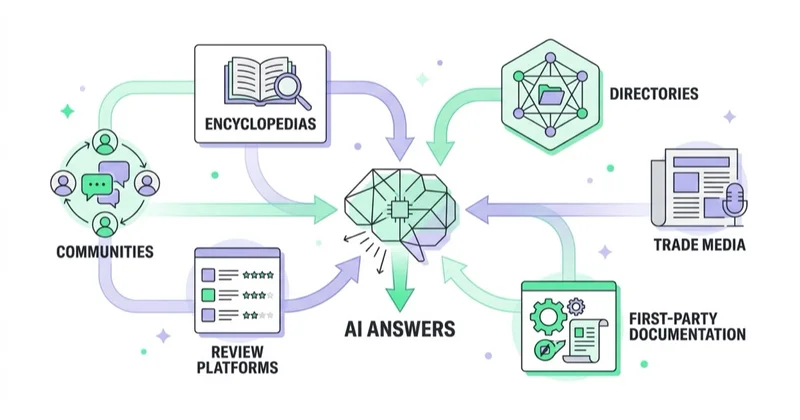
Six source types worth auditing
These categories commonly appear in the public record around a brand. Whether a particular page is retrieved or cited must be measured for the actual prompt set; no category has guaranteed priority.
| Source type | What it can evidence | Legitimate move | Avoid |
|---|---|---|---|
| Communities and forums | First-hand experience, practical language and objections | Answer relevant questions under a disclosed identity | Sockpuppets, seeded endorsements, spam or vote manipulation |
| Encyclopedias and knowledge bases | Sourced facts about notable entities and relationships | Correct errors through the documented process and disclose conflicts | Promotional editing, undisclosed paid contributions or manufacturing notability |
| Directories and comparison portals | Structured category, location and service information | Keep relevant listings accurate and current | Treating paid placement as an independent verdict |
| Review platforms | Customer experience and recurring themes | Request reviews from a neutral eligible cohort under platform rules; respond constructively | Buying, gating or fabricating reviews |
| Trade media and publications | Editorial gatekeeping — a named author took responsibility | Offer original data, a checkable method, or expert commentary | Paid articles presented as editorial |
| Own documentation and data | Official specifications, policies, methodology and original evidence | Publish clear claims with dates, scope and verifiable methods | Unsupported superlatives or fabricated statistics |
Communities and forums
Community discussion can be useful for experience-led questions because it uses the language of real problems, alternatives and objections. That does not make every thread reliable: identity may be unclear, anecdotes may not generalise, facts can become stale and coordinated promotion can resemble genuine consensus. Treat a cited thread as evidence of what participants said, not automatic proof that their conclusion is correct.
What gets called Reddit SEO is better treated as a participation decision: is there a relevant community whose rules allow a practitioner to contribute, and can they help without turning the thread into an advert? Disclose material affiliation, answer the question fully, avoid coordinated voting and follow the rules of the specific community as well as the platform. A useful contribution may later be found or cited, but there is no guarantee and no honest way to force that outcome.
Wikipedia, Wikidata and the entity layer
Wikipedia and Wikidata provide structured and sourced information about entities that meet their respective inclusion criteria. They may be useful reference sources, but neither Wikimedia nor major answer-engine providers promise that creating or editing an entry will improve AI visibility. “Wikipedia SEO” is therefore the wrong objective; accuracy, notability and policy compliance come first.
The English Wikipedia's conflict-of-interest guideline strongly discourages direct editing about yourself, your organisation or your clients. The Wikimedia Foundation's Terms of Use require paid contributors to disclose their employer, client and affiliation; local projects may impose additional rules. Wikidata has its own notability and sourcing policies. Commissioning a page does not make a company notable, and disclosure does not make promotional content acceptable.
If an existing article contains an error, a conflicted contributor should disclose the relationship and propose a concise, sourced correction on the talk page or use the project's requested-edit process. Independent editors decide what belongs. If no article exists, focus on doing work that merits independent coverage rather than manufacturing sources for an entry. Primary documents can verify routine facts, but they do not establish notability by themselves.
Directories and comparison portals
Directories present structured fields such as category, location, services and contact details, so they can help buyers compare a market. Their quality varies sharply. Maintain listings that customers or professional communities actually use, that moderate submissions and that provide a stable record; ignore bulk directories created mainly to sell placement or links.
The work is mostly hygiene. Names, locations and core services should describe the same business, while wording and categories may legitimately vary with each platform's taxonomy. Remove discontinued offers, correct duplicates and label paid or sponsored visibility accurately. Consistency helps reduce ambiguity, but exact repetition across profiles is neither necessary nor evidence of independence.
Review platforms
Review platforms can show recurring customer themes, but their coverage and moderation differ, and ratings can be affected by selection bias. Evaluate the review text, dates, sample and response pattern rather than treating an aggregate score as objective market truth.
Use a neutral rule for who receives a request — for example, all customers who completed a defined service stage — and follow the destination platform's rules on incentives and solicitation. Do not suppress requests after a private satisfaction screen, prescribe the rating or ask staff and undisclosed partners to pose as customers. Responses to criticism should protect personal and confidential information while explaining what the company can do next. Consumer-protection obligations vary by market, so legal review is appropriate for a scaled review programme.
Trade media and publications
Genuine editorial coverage can provide independent context, while sponsored or partner content can still be useful if its commercial nature is clear. A byline alone does not prove editorial independence, accuracy or authority, so evaluate the publication, author, sourcing and disclosure together.
Useful pitches give an editor something they can verify: original data with a documented method, a qualified expert, a relevant case with permission, or a clear interpretation of a current development. Paid placement must be disclosed and links should follow applicable Search policies. Aim for accurate coverage that helps the publication's audience; a citation or link is a possible consequence, not the editorial brief.
Own documentation and data
The last source type is under full control, and it is the origin of most facts the other five can carry. Published methodology, definitions, pricing logic, technical documentation and original analysis give every other source something concrete to cite. This is where content work and AI SEO services meet: a brand that has documented how it works gives journalists something to quote, community members something to link, and directory editors something to categorise correctly.
Glossary
- Third-party citation — a reference to a source outside the brand's own domain that an AI system uses to support a claim about that brand.
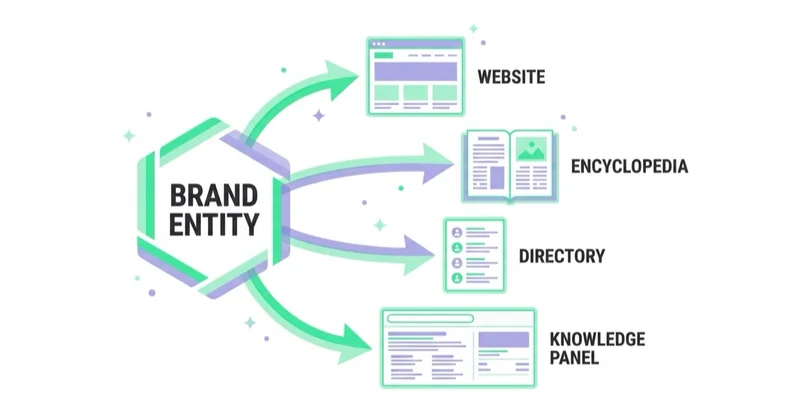
- Entity — a distinct company, person, place, product or concept represented in a system. Providers do not publish one universal entity-resolution process for answer engines.
- Corroboration — support for the same claim from genuinely independent evidence; copied, syndicated or sponsored repetitions do not provide the same assurance.
- Knowledge panel — the information box Google shows for a recognised entity, assembled from publicly available sources rather than from a submitted profile.
- Digital PR — earning relevant editorial coverage and expert mentions through newsworthy evidence, expertise or stories; it may support reputation, referral traffic, discovery and search visibility.
The knowledge panel and fact consistency
A Google knowledge panel is generated automatically from several sources. Google says these can include open-web sources, licensed data partners and feedback from verified entities. A panel is therefore useful evidence of Google's current understanding, but it is not a universal score of entity authority and it does not expose how other answer engines represent the brand.
Where Google offers the option, an official representative can claim a panel and suggest changes; other users can also submit feedback. Google reviews those inputs rather than giving the claimant direct control. Before submitting a correction, update the authoritative source you control and provide public supporting URLs where requested. Local businesses should manage the separate Google Business Profile workflow.
| Fact | Where it must agree | Common failure |
|---|---|---|
| Legal and trading name | Website, legal details, relevant profiles | Legal and trading names used without explaining their relationship |
| Category and services | Service pages, directory categories, partner pages | The site says performance marketing; an old listing still says web design |
| Address and contact channel | Website, business profile, directories | A moved office corrected on the site but not in listings |
| Founding date and size | About page, business profiles, editorial bios | Different definitions — incorporation, launch or rebrand — presented as the same date |
| Named people and roles | About page, author bios, conference programmes | A person leading one discipline on the site and another elsewhere |
| Relationships and certifications | Both sides of every partnership, certification directories | A partnership claimed on one side only |
The test: write the small set of facts a buyer most needs to verify and record the authoritative source for each. Check material profiles for contradictions, stale claims and unexplained naming differences. Do not force every platform to repeat identical copy; correct the facts through each platform's documented process.
How this differs from classic link building
The two disciplines share tactics and diverge on what counts as success. Confusing them produces campaigns that generate links nobody reads and sentences nobody can quote.
| Dimension | Classic link building | Source work for AI citation |
|---|---|---|
| Unit of value | A relevant editorial link that helps discovery and users | An accurate passage or evidence a system may retrieve and cite |
| Success metric | Qualified referral traffic, relevant earned links and Search outcomes | Citation accuracy, source mix, visibility and downstream qualified actions |
| Ideal placement | A relevant page with real editorial and audience value | A source appropriate to the claim and trusted by the intended audience |
| Link attributes | Must follow Google's spam and qualification guidance | Still relevant to Search compliance; they do not guarantee or prevent AI citation |
| Volume logic | Relevance and quality over manufactured volume | Coverage of important claims over repeated thin mentions |
| Failure mode | Link schemes, irrelevant placements and wasted spend | Unsupported, stale or conflicting claims and manipulative participation |
| Time to effect | Variable; crawling and ranking are not guaranteed | Variable by product and prompt; retrieval and citation are not guaranteed |
The practical consequence: brief digital PR on the claim to substantiate, the evidence available, the audience who needs it and the action the coverage should support. Do not turn a desired sentence into a script that supposedly independent outlets must repeat.
The ethical boundary, and why crossing it is expensive
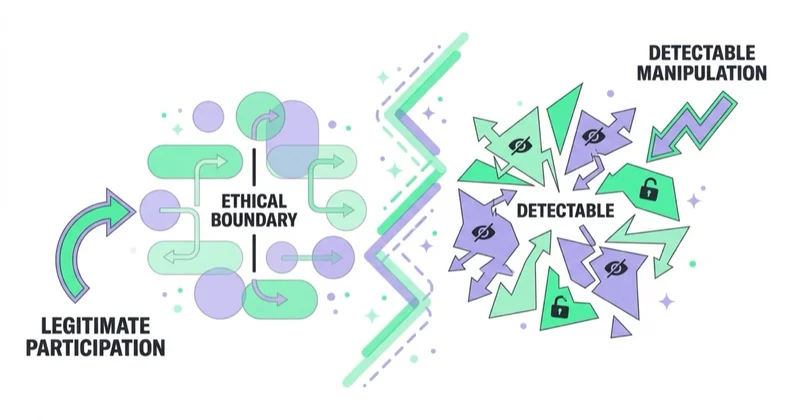
Every source type above has a shortcut, and every shortcut is documented as a violation by the platform that owns the surface. This is a risk assessment, not only a principle.
| Shortcut | Whose rule it breaks | Cost when it surfaces |
|---|---|---|
| Fabricated accounts and seeded threads | Community policies on spam, vote manipulation and deceptive accounts | Bans; the exposure thread outlives the campaign |
| Undisclosed or promotional encyclopedia editing | Conflict-of-interest guidance; paid-contribution disclosure in the Terms of Use | Reverted edits, account restrictions and a public edit history |
| Purchased, fabricated or improperly incentivised reviews | Platform contribution policies, plus consumer-protection law in many markets | Review removal, profile penalties and possible regulatory exposure |
| Mass-distributed identical articles | Google's link spam and site reputation abuse policies | Loss of the benefit that motivated it; material that reads as promotional |
| Fabricated statistics in owned content | No platform rule — every citation norm | Once one number is shown to be invented, every other claim becomes suspect |
Detection can create durable records — moderation notes, removed reviews, investigative coverage or public edit histories — that remain discoverable. Even before enforcement, manipulation produces unreliable measurement: a team cannot tell whether genuine customers recognise the brand or whether it is reading its own manufactured signal back through another interface.
How Space Ads approaches this
At Space Ads, we start with a defined set of buyer questions and capture the sources that different search and answer products actually show. We then compare those citations with the brand's authoritative facts, identify stale or unsupported claims, and separate sources the brand controls from sources that require an editorial correction or disclosed outreach. The objective is not identical wording everywhere. It is a public record that is accurate, sufficiently evidenced and useful to a buyer. Anything that depends on hiding the brand's involvement is excluded from the plan.
Action plan
- Define a prompt set and capture a baseline. Include branded facts, category discovery, comparisons, objections and high-intent questions. Record product, model or mode, language, location where relevant, date, answer and displayed citations.
- Inventory the cited and material public record. Add relevant directories, review profiles, partner pages, professional profiles, conference records, editorial mentions and community threads. Do not try to catalogue the entire web.
- Extract claims and authoritative sources. Record what each page says about services, location, people, credentials and relationships, then identify the source that can legitimately verify each fact.
- Fix controlled sources first. Correct the website, Business Profile and relevant listings. Keep structured data aligned with visible content and use
sameAsonly for profiles that clearly represent the same entity; markup helps describe information but does not guarantee citation. - Use the correct route for third-party corrections. Follow directory support, review-response, publisher correction, partner update or Wikipedia requested-edit processes. Disclose the relationship.
- Create evidence worth referencing. Publish dated methodology, definitions, original analysis, case evidence with permission or reference documentation an independent source can check.
- Participate where the team has genuine standing. Choose communities and publications by audience relevance, not assumed AI authority, and follow their disclosure and contribution rules.
- Measure again under comparable conditions. Track source presence and factual accuracy over time, but report variability and do not claim causality from one changed answer.
Common mistakes
| Common mistake | Do this instead |
|---|---|
| Treating the website as the only relevant source | Compare owned facts with the external sources actually cited for priority questions |
| Treating a knowledge panel as an AI visibility score | Use Google's claim and feedback routes for accuracy; measure answer products separately |
| Commissioning an encyclopedia entry | Respect notability and sourcing rules; use disclosed requested edits for an existing inaccurate article |
| Buying reviews or asking only happy customers | Use a neutral eligible cohort under the destination platform's rules |
| Briefing digital PR on link or mention volume | Brief it on the audience, verifiable evidence and useful outcome |
| Posting promotional comments in communities | Send practitioners to answer real questions with disclosed affiliation, or stay out |
FAQ
Where do AI answers get their sources from?
The answer depends on the product and mode. A model may use information learned during training; a search-enabled product may retrieve current web pages; and the interface may display selected pages as citations or related sources. Those sources can include first-party documentation, publications, communities, encyclopedias, directories, reviews and licensed or structured data. A visible citation does not reveal the training source.
Why do AI systems cite Reddit and other forums so often?
Forums can match experience-led, troubleshooting and comparison questions because their threads contain practical language and first-hand accounts. Whether Reddit or another forum appears depends on the query, index, product and time. Treat the thread as a collection of claims to evaluate, not verified truth simply because an assistant cited it.
Does having a Wikipedia article improve AI visibility?
It may provide a structured, sourced reference about a notable organisation, but providers do not promise that a Wikipedia article improves visibility or categorisation in their answer products. Do not create an entry as an optimization tactic. Wikipedia's notability, sourcing and conflict-of-interest rules apply, and paid contributors must disclose their relationship under the Wikimedia Terms of Use.
Can a company edit its own Wikipedia entry?
Direct editing is strongly discouraged when the company, employee or agency has a conflict of interest; it is not accurately summarised as a blanket technical prohibition. Paid contributors must disclose their employer, client and affiliation. The safer route is to declare the conflict and submit a concise, sourced request on the article's talk page so independent editors can review it.
How do you get a Google knowledge panel?
Google generates knowledge panels automatically from sources that can include open-web content, licensed data and feedback from verified entities. You cannot order a panel. Where available, an official representative can claim an existing panel and suggest corrections; local businesses should manage their Google Business Profile. Appearance and acceptance of changes remain Google's decision.
Is digital PR the same as link building for AI search?
They overlap but are not identical. Ethical digital PR starts with a relevant audience and newsworthy, verifiable material; it may earn mentions, links, referral traffic and citations. Search link attributes and spam policies still apply. No link, attribute or quoted sentence guarantees selection by an answer engine.
Can buying reviews or seeding forum posts actually work?
Fabricated reviews and deceptive forum participation may produce short-lived visibility, but they breach platform rules and can trigger removal, account action, consumer-protection risk and reputational damage. They also corrupt measurement: the brand can no longer distinguish genuine demand from its own manufactured activity.
In short
- Training data, live retrieval and displayed citations are different layers; do not infer one from another.
- Source selection varies by product and prompt, so build a repeatable baseline before changing content.
- Audit communities, encyclopedias, directories, reviews, publications and first-party documentation as source groups, not as a universal ranking hierarchy.
- Match each claim to the right evidence: official specifications may be first-party, while reputation and customer experience need genuinely independent support.
- A Google knowledge panel is a separate Search feature, not a universal measure of how answer engines understand the brand.
- Improve accuracy through owned updates, disclosed corrections, genuine participation and verifiable evidence — never manufactured independence.
Sources and further reading
- Wikipedia — Conflict of interest guideline
- Wikidata — Notability policy
- Wikimedia Foundation — Terms of Use, including paid-contribution disclosure
- Reddit — Content Policy
- OpenAI — ChatGPT search and website inclusion
- Google Search Central — Spam policies for Google web search
- Google Search Central — AI features and your website
- Google — About knowledge panels
- Google — Prohibited and restricted content in Google contributions
Platform policies and Google Search features here reflect documentation as of July 2026; providers revise policies and reporting surfaces, so check current documentation before acting on a specific rule.
Continue learning
Continue reading

Brand Mentions in AI Answers: How to Measure Traffic and Citations
AI visibility requires three evidence layers: recognised assistant traffic in analytics, impressions in Google's generative Search features, and sampled brand presence in third-party answers. Learn what each source proves and how to build a repeatable monitoring method.
Entity SEO: How Models Decide What Your Brand Is
Before a model can recommend a company it has to decide which company it is. Entity SEO is the work of making that decision unambiguous and the resulting description correct.

LLM SEO: How to Make Your Brand Easier for AI Tools to Cite
LLM SEO helps language models understand, describe and cite a brand correctly. This guide covers entities, crawlability, answer-ready content, sources, prompt monitoring and commercial paths.