Entity SEO is the work of making a brand identifiable as one specific organisation and making its public facts easy to verify. A company can control its own site, markup and profiles, but not every source or every answer generated from them. Google describes one concrete part of this work in its Organization structured data documentation: the markup can help Google understand administrative details and disambiguate one organisation from another in search results.
This article is about that decision and the work that shapes it. Entities at a general level, alongside crawlability and citable content, are covered in LLM SEO; the umbrella discipline sits in AI SEO. What follows goes one level down: how resolution actually fails, which identifiers stop it failing, what the on-site entity layer consists of, and how to find out what a model currently believes about a brand — including how to catch one specific wrong sentence and trace it back to whatever produced it.
TL;DR
- An entity is a thing, not a phrase. Keyword work optimises the match between a query and a page. Entity work optimises whether a system can tell which organisation is being referred to at all.
- Google names the job "disambiguation". Its Organization documentation says
urlhelps it uniquely identify the organisation, and that identifiers such asiso6523andnaicsare used behind the scenes to disambiguate one organisation from another. - Ambiguity can produce a wrong match or a blended answer. Similar names, stale profiles and unfinished rebrands make those errors more likely, but no public checklist guarantees how every model will resolve a brand.
- Consistent naming reduces avoidable ambiguity. A common-word name or a close namesake needs more context: category, location, domain, legal identity and named people.
- Identifiers add precision that a name alone cannot. The canonical website, relevant
sameAsprofiles and applicable business identifiers connect public facts to the right organisation. An encyclopedia entry is optional and must satisfy the publisher's independent rules. - The site should be the clearest first-party source. Maintain one primary organisation page, a stable factual description, clear service architecture and internal links that reflect the real offer.
- Consistency means agreement on facts, not duplicate copy. Profiles may need different lengths and wording, but the category, offer, ownership, location and contact details should not contradict one another.
- A knowledge panel is a readout, not a lever. Google creates panels automatically when there is enough information on the open web; the panel reflects how coherent the public record is.
- Sample answers directly, but treat them as observations. An identity prompt set — what is X, what does X sell, who owns X, is X the same as Y — can surface wrong facts worth tracing, not reveal a model's permanent internal record.
An entity is not a keyword
The distinction matters because the two disciplines fail in different ways, and the fix for one does nothing for the other.
A keyword is a string. Optimising for it means making a page the best available match for that string. A brand can rank for its own name and still be described wrongly in an answer — because ranking is about which document to show, and description is about which thing the document is about.
An entity is a specific thing with an identity, attributes and relationships to other things. Search engines and answer systems may use entity representations, retrieval, structured data and other signals, but their exact pipelines differ and are not fully public. The useful operational point is simpler: if available sources do not distinguish your company from a namesake, an answer can attach the wrong facts to the right-looking name.
| Dimension | Keyword thinking | Entity thinking |
|---|---|---|
| Unit of work | A query and a matching page | An organisation and its public description |
| Question being answered | Which page should rank for this phrase? | Which organisation is this, and what is true of it? |
| Typical failure | The page does not rank | The right page ranks, and the answer describes the wrong company |
| What wins | Relevance, quality, links, intent match | Unique naming, consistent attributes, resolvable identifiers |
| How progress is read | Positions, clicks, impressions | Whether descriptions of the brand agree across sources and answers |
| How progress is checked | Search performance over time | Agreement of key facts across the site, profiles, search features and sampled answers |
Both matter. They are not substitutes, and a brand can be excellent at one and structurally broken at the other.
What resolution actually involves
One practical way to analyse the problem is as a candidate-matching sequence. A name may refer to several organisations. Attributes such as category, location, domain, people and sector help distinguish them. This is a diagnostic model for planning content and markup, not a claim that every search engine or LLM implements the same hidden sequence.
When a name is crowded and the distinguishing attributes are inconsistent, systems and users have less reliable evidence. The result may be a wrong match, an outdated description, an answer that mixes facts, or no confident answer at all. This is why entity work focuses on specific contradictions rather than on a vague goal of “building authority”.
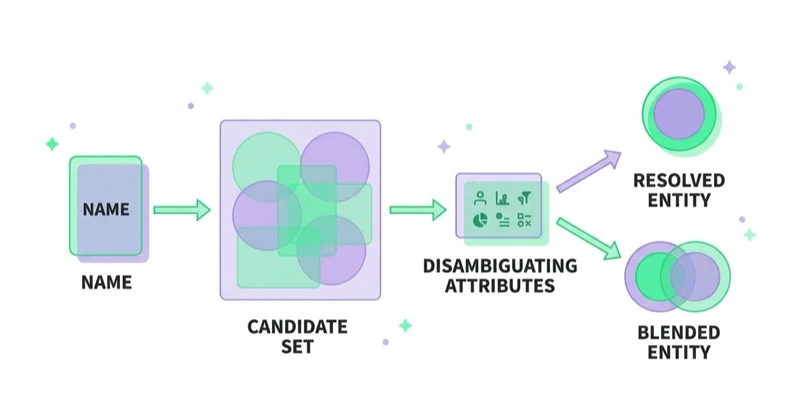
This is why Google's own wording is the most useful specification available. Its Organization documentation recommends placing organisation information on the home page or a single page describing the organisation, such as an about page. It states that the url property helps Google uniquely identify your organization. It advises using the same name and alternateName as the site name. And it notes that some identifiers — it names iso6523 and naics — are used behind the scenes to disambiguate one organisation from another. That is not stylistic advice. It is a description of a matching problem and the inputs that solve it.
The markup layer that carries these properties is its own subject, covered in schema markup and structured data for AI search; what matters here is that the properties exist because disambiguation is a real and stated problem, not because a validator wants fields filled in.
Identifiers: the difference between a name and a handle
A name is a label that several things may share. An identifier is a handle that resolves to exactly one. Entity work is largely the process of attaching handles to a name.
| Identifier type | What it pins down | Where it lives | Cost of not having it |
|---|---|---|---|
| Canonical domain and URL | The organisation's primary web presence | The site itself, and the url property in markup |
The strongest available signal of identity is missing or split across hosts |
| Organisation markup on a primary page | A machine-readable statement of name, alternate name, URL and profiles | Home page or a single organisation page, per Google's recommendation | Google has less explicit structured information to use for organisation details |
| Links to authoritative profiles | The connection between your site and profiles that describe you elsewhere | The sameAs property, pointing at pages with more information about the organisation |
Independent sources stay unlinked to each other, so agreement cannot be established |
| Registry identifiers | Legal identity, sector, jurisdiction | Company registry number, VAT or business identifier schemes, industry classification codes | Two similarly named companies stay indistinguishable at the legal level |
| Independent reference, where earned | A public reference maintained under an independent publisher's rules | An eligible industry database, regulator, trade body or knowledge base | Fewer independent sources through which a user can verify the organisation |
| Named people | Who is associated with the organisation and in what role | About page, author bios, external speaker and contributor pages | Expertise signals attach to nobody, and person-level confusion spreads to the company |
Registry identifiers are useful where they apply, particularly for legal-name collisions and regulated businesses. Independent knowledge-base coverage can also help, but it is neither required nor something a company should manufacture. Wikipedia and Wikidata have their own notability, sourcing and conflict-of-interest rules; do not create promotional entries simply to complete an SEO checklist.
Glossary
- Entity — a specific thing, such as an organisation, person or product, with attributes and relationships, as distinct from the words used to name it.
- Resolution — matching a name or reference to the specific entity it is intended to describe.
- Disambiguation — narrowing several possible referents of the same name to one, using attributes that only one of them shares.
- Entity blending — a useful label for an answer that merges attributes of two organisations and is accurate to neither; it is an observed output problem, not a public product metric.
- Identifier — a value or URL that resolves to exactly one entity, unlike a name, which may be shared.
- Entity home — the single page a brand designates as the canonical description of the organisation, which every other source can point at.
- Core description — an approved factual statement of what the organisation is and does, adapted to the format of each profile without changing the underlying claims.
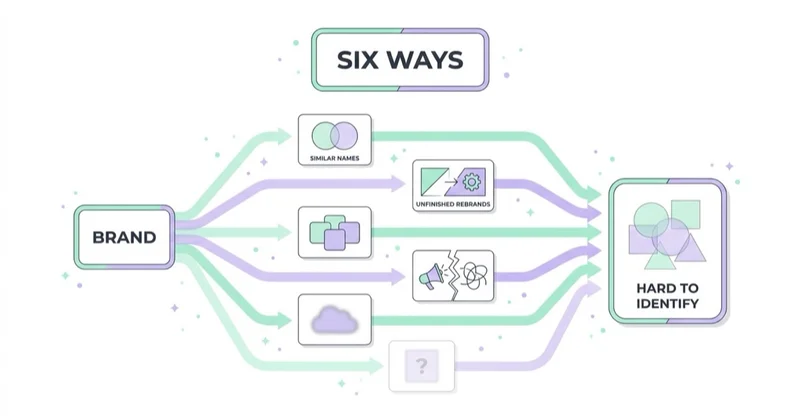
Six ways brands become hard to identify
These are the recurring patterns. Most brands have at least one; a brand with three has an entity problem regardless of how good its content is.
Two companies with similar names
A common and persistent case is two organisations with the same or near-identical name, sometimes in adjacent sectors, sometimes in different countries. The name alone does not distinguish them, so contextual attributes become important: category, location, sector, named people and domain.
The work is to make the contrast explicit rather than hoping the difference is inferred. State the category in the same sentence as the name on the pages that matter. Attach registry identifiers and a location. Make sure external profiles state the same category. If the other company is well known and you are not, expect answers to default to them for some time — the correct response is to become describable, not to complain about the outcome.
A brand name that is also a common word
If the name is a dictionary word, a category term or a common phrase, systems must first decide whether the name is even being used as a name. Queries containing it are ambiguous between the brand and the ordinary meaning.
The practical response is context. Place the name beside a useful disambiguating term where a reader needs it — the category, location, legal suffix or a distinguishing second word. Site name and Organization markup should agree with the identity the brand actually uses. A common-word name is not automatically an SEO defect, but it does make context and consistent first-party information more important.
Sub-brands, product names and the parent company
A group with a parent company, several trading brands and a product that shares a name with one of them produces a candidate set that is entirely self-inflicted. Answers then attribute the product's attributes to the parent, or a client of one brand to another.
Model the hierarchy explicitly instead of leaving it implied by navigation. Material brands and products should have an appropriate page or section, a clear description and a stated relationship to the parent. When two entities share a name, use distinguishing context wherever confusion is plausible.
A rebrand nobody finished
Rebrands are the largest single source of entity contradiction, because they are typically 80% complete forever. The site uses the new name; an old profile, an old directory listing, an old press mention and a partner page use the old one. Both names have attributes attached, and the two sets diverge over time.
The technical part is a redirect map from old URLs to their new equivalents and a stated relationship between the former and current name — an alternateName where appropriate, and a plain sentence saying the organisation was formerly known as X. Google recommends keeping site-move redirects for as long as possible and generally for at least a year; useful redirects may remain indefinitely for users and old links. The operational part is the inventory of external profiles still carrying the former identity.
Legal name versus trading name
A site that trades under one name while contracts, invoices, registries and some profiles carry the legal entity name gives systems two names with partially overlapping attributes. Read literally, that is two organisations. Resolve it by stating both, once, in a place designed for it — the organisation page and the footer — and by keeping the trading name as the consistent public name everywhere else. The relationship needs to be stated somewhere machine-readable; leaving it to be inferred from a VAT number in an image is not stating it.
One brand, several domains and regional sites
Country domains, a legacy marketing microsite, a separate careers domain and a product subdomain can each accumulate a different company description. Designate one domain as the organisation's primary home and point relevant markup and profiles there consistently. Use hreflang between equivalent language or regional page variants, not merely because two domains belong to the same company. A microsite may have a distinct purpose, but its company facts should not contradict the primary site.
What it looks like when resolution fails
Symptoms show up in answers long before anyone connects them to an entity problem.
| Symptom in an AI answer | Most likely cause | First fix |
|---|---|---|
| Describes a different company with your name | Name collision with a better-described organisation | State category and location beside the name on the entity home; add registry identifiers |
| Merges facts from two companies | Entity blending from overlapping signals | Add attributes that only you have, and make the contrast explicit |
| Uses an old company name | Unfinished rebrand | Inventory external profiles and directories still carrying the former name |
| Gets the category wrong | An outdated category stated somewhere authoritative | Update the old directory category or profile bio; retire legacy service pages |
| Says you are in the wrong place | A stale address in a listing after a move | Correct the authoritative and controlled profiles; make the underlying details agree with the site |
| Names a service you no longer offer | Retired page still live and indexable, or an old listing | Remove or redirect the page; update the listing |
| Cannot say what you do | No single page states it plainly | Publish an indexable entity home page that states it in plain sentences |
| Attributes your work to a competitor | Ambiguous or missing first-party evidence; possible source error | Publish verifiable ownership and authorship evidence, then trace the answer's cited source where available |
| Confuses two people at the company | Person-level ambiguity spreading upward | Fix author bios, role statements and external speaker profiles |
| Asserts a fact with no findable source | Inference from thin or ambiguous signals | State the correct fact plainly on the entity home and in the profiles that get cited |
On-site work: making the site the entity's home
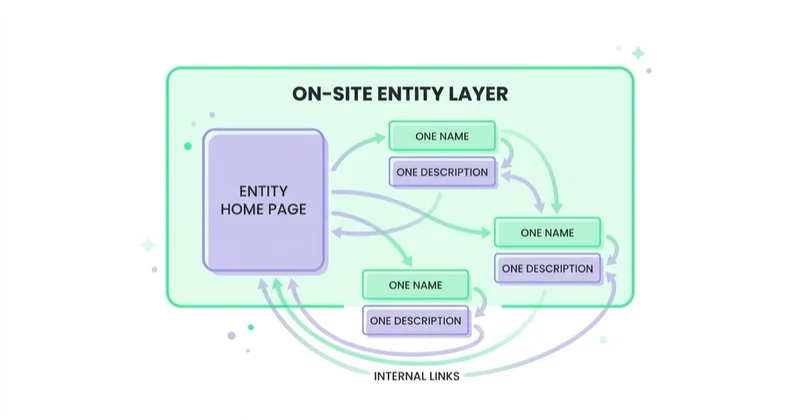
Off-site consistency matters and is a separate discipline, covered in where AI gets its sources. The site is the first-party reference the company can control. The following six artefacts make that reference easier for users and systems to interpret.
One page that is the entity's home. A single indexable page whose subject is the organisation itself: what it is, what it does, who runs it, where it is, since when, and how to contact it. Not a values page. Google recommends putting organisation information on the home page or one page describing the organisation, which makes the choice a decision to record rather than a matter of taste. Everything else — markup, external profiles, press kit — points at that URL.
One approved factual description. Maintain a concise statement of the category, audience and offer so teams do not invent a different positioning for every profile. Adapt it to the context and character limit rather than forcing identical copy everywhere. The facts should remain stable even when the phrasing changes.
One primary name per service, with aliases explained. A service may have legitimate synonyms because customers search and speak differently. The problem is not varied language; it is unclear product architecture. Choose a stable primary name for navigation and the service page, state important aliases naturally in the copy, and make old and new names explicit when a service is renamed.
Internal linking that mirrors the actual offer. Internal links are a readable statement of structure. If the offer is five services with supporting topics beneath them, the link graph should look like that: each service page linked from its supporting articles with a descriptive anchor, and each service page linking to the topics it genuinely covers. A flat mesh where everything links to everything states nothing. This is also the mechanism that connects an article to its commercial page — the reason the AI SEO service page is linked from articles about entities and citation rather than from a generic footer block.
Named people as entities. Author names with roles and areas of expertise, consistent between the site and external profiles. People-level ambiguity propagates upward: if two similarly named people are confused, so are their employers.
Category stated next to the name. On pages where the name could be ambiguous, place it beside a plain category description in the opening copy. This helps both a first-time visitor and any system extracting a short description understand what kind of organisation the page describes.
Technical checklist for the entity layer
This is a technical SEO checklist scoped to identity rather than to crawl efficiency or performance; the broader version belongs in a full SEO audit. Every line below exists because breaking it makes the organisation harder to identify, not slower to load.
- The entity home page returns 200, is indexable, and is not blocked by robots directives or bot protection.
- The organisation's name and category appear in server-rendered HTML, not only in an image, a logo file or client-side JavaScript.
- One primary page — usually the home page or organisation page — carries complete organisation markup. Google says it does not need to appear on every page.
- The markup
nameandalternateNamematch the site name actually in use. - The
urlproperty points at the canonical domain, in the canonical form — one choice ofwww, one protocol, one trailing-slash convention. -
sameAslists relevant external pages that genuinely provide additional information about the organisation. - Registry and industry identifiers are present where they apply.
- Other company, team and contact pages have distinct purposes and do not contradict the primary organisation page.
- Contact details agree across controlled profiles; harmless formatting differences are not treated as errors.
- Equivalent language and regional page variants use valid
hreflangannotations. - Old URLs from a rebrand or migration redirect to relevant current equivalents for at least the search-engine migration period and longer where users still need them.
- Retired service pages are updated, consolidated, redirected or removed according to their remaining user value; they are not presented as current offers.
- Author pages exist for named contributors, with roles, and are linked from their articles.
- Structured data validates, and — more importantly — every value in it matches what the visible page says.
- The XML sitemap includes the entity home and the service pages, and excludes the retired ones.
The last item on validation deserves emphasis. A validator confirms syntax. It cannot tell you that the markup claims a category the business left three years ago. Checking that markup matches reality is a human step, and it is the step that catches real entity errors.
Off-site consistency, in one paragraph
The off-site half of this work — communities, encyclopedias, directories, review platforms and trade media — is covered in where AI gets its sources. When a controlled listing contradicts the site, correct the listing at source. If a search feature also offers an official correction route, such as a claimed knowledge panel, use it as well. First make sure the site states the relevant facts unambiguously, because it is the source the business can maintain directly.
The knowledge panel as a diagnostic readout
Google states that knowledge panels are created automatically by its systems when there is enough information available on the open web, that facts come from a variety of sources, and that a verified representative can claim a panel and suggest changes. The mechanics of claiming and suggesting are covered in the sources article linked above.
For entity work, a panel can be a diagnostic, but its absence is not proof of a problem: Google does not promise one for every organisation. An incorrect panel is a reason to review the sources Google cites and the facts the company publishes. A verified representative can claim a panel and suggest changes, but the durable work is to correct inaccurate source information rather than to treat panel ownership as a ranking tactic.
How to check what a model says about you today
The identity-resolution prompt battery
Commercial visibility questions — which agency should I use for X — are a different test with different design requirements, and the measurement method for those is covered in brand mention monitoring in AI answers. An identity battery is narrower: it samples how a product describes the organisation under defined conditions.
| Prompt type | Example shape | What a wrong answer reveals |
|---|---|---|
| Existence and category | What is [brand]? | Whether the name resolves at all, and to the right kind of organisation |
| Offer | What does [brand] sell or do? | Whether the service set is current and correctly named |
| Ownership and structure | Who owns [brand]? Is it part of a group? | Parent, sub-brand and group confusion |
| Location | Where is [brand] based? | Stale addresses in external listings |
| People | Who runs [brand]? Who founded it? | Person-level ambiguity and outdated leadership facts |
| Disambiguation | Is [brand] the same company as [similar name]? | Whether a collision is being resolved or blended |
| History | Was [brand] previously called something else? | Whether an unfinished rebrand left two entities |
| Boundary | What does [brand] not do? | Whether attributes of another organisation have attached to yours |
| Comparison set | Which companies are similar to [brand]? | Which category the model has actually filed you under |
Run the battery under documented conditions: assistant and product surface, model if shown, date, language, location or market settings, personalisation state and whether web search was active. Repeat important prompts because answers can vary between runs. A single response is not evidence of a permanent model belief. Record the wording and visible citations so the error can be traced.
Detecting a specific error and tracing it
The valuable output of this exercise is not a score. It is a list of specific wrong sentences, each traced to something fixable.
- Quote the error exactly, with the assistant, date, market and prompt. Paraphrasing loses the detail that identifies the source.
- Classify it. Wrong category, wrong ownership, wrong location, merged with another organisation, outdated fact, or an invented fact with no visible origin.
- Check your own site first. A surprising share of "the model is wrong" cases turn out to be the model correctly repeating a stale sentence on a page nobody has read in two years.
- Search the claim itself. Take the wrong fact and look for pages asserting it. A repeated wrong fact usually has one findable origin, often an old profile or a directory entry copied onward.
- Correct at the origin, then everywhere it propagated. One correction on the site rarely settles it if three listings still say otherwise.
- Re-test after a period, not immediately. Sources are re-fetched on their own schedules, and an immediate re-test tells you nothing.
The symptom table earlier in this article maps each error class to its most likely cause and first fix; use it as the triage step between classifying an error and going looking for its origin.
How Space Ads approaches this
In an entity-focused AI visibility review, Space Ads can begin with an identity sample before moving to competitive recommendation prompts. The purpose is triage: if answers repeatedly confuse the organisation, its offer or its ownership, first-party facts and source consistency need attention before broader citation work can be interpreted reliably.
The first pass is an evidence inventory: which pages describe the business, where the statements conflict, which former services still appear as current, and which controlled profiles predate the present positioning. Each discrepancy becomes a concrete task with a source URL and owner. This is more defensible than assuming that publishing another article will overwrite a contradictory company profile.
Once a name is in market, its implementation also becomes a technical concern. We define a primary service name and its accepted aliases, an approved set of company facts, a primary organisation page and a maintained redirect map. Where a name collides with another organisation, the plan uses distinguishing attributes and verifiable identifiers rather than promising that content volume will remove the ambiguity. Access, structured data, citable content and measurement form the rest of our AI SEO work.
Entity consistency checklist
The on-site artefacts, in the order we check them. This is deliberately about what your own pages establish; the question of which facts must agree across external sources is handled in the sources article linked earlier.
- One page is designated the entity home, and everyone on the team can name its URL.
- That page states category, offer, location, founding and contact details in plain sentences.
- One approved set of company facts exists, with descriptions adapted to each profile without changing those facts.
- Name and category appear together in the first sentence of the home page and the entity home page.
- Each service has one primary name; important aliases are documented and used without creating a second, competing offer.
- Retired services are clearly marked, updated, consolidated or redirected according to user value; none is described as a current offer.
- Internal links mirror the offer structure, with descriptive anchors rather than generic ones.
- Named people have roles, expertise areas and consistent naming between site and external profiles.
- The former name, if any, is stated once as a former name.
- Legal name and trading name are both stated once, in a place designed for it, with the relationship explicit.
- Identity checks have a cadence proportionate to risk and are rerun after a rebrand, merger, repositioning or material offer change; the error list has owners.
Common mistakes
| Common mistake | What to do instead |
|---|---|
| Treating entity work as a markup task | Fix the naming and the facts first; markup states what the pages already say |
| Optimising the knowledge panel | Read the panel as a diagnostic and correct the source of each wrong fact |
| Renaming a service as a copy edit | Treat a rename as a coordinated change: page, navigation, aliases, anchors, profiles and redirects where URLs change |
| Leaving retired service pages unchanged because they still get traffic | Preserve their user value while stating the current status; update, consolidate or redirect to a relevant alternative |
| Assuming a rebrand ended when the site launched | Inventory every external surface carrying the old name and finish the job |
| Publishing more content to fix a wrong description | Correct the fact at its source; volume does not overwrite a contradiction |
| Running one prompt and concluding the model has a fixed belief | Repeat prompts under documented market, language, personalisation and web-search conditions; record answers and citations |
| Ignoring a name collision because the name is already in market | Plan around it: distinctive attributes, identifiers, explicit contrast |
FAQ
What is entity SEO?
Entity SEO is the practice of making a brand identifiable as one specific organisation, with correct and consistent attributes, so search and answer-generating systems resolve its name to the right thing before describing it. It differs from keyword work in its unit: keyword work matches queries to pages, while entity work establishes what an organisation is, what it offers and how it differs from similarly named organisations.
Does a brand need a Wikipedia entry to be recognised as an entity?
No. An encyclopedia entry is a useful third-party anchor, but it is not a requirement and it is not something a brand can grant itself — public knowledge bases apply their own notability criteria and their own rules about editing entries concerning yourself or your clients. Registry identifiers, a canonical domain, organisation markup and consistent profiles establish identity without one.
How do you get a knowledge panel?
Google states that knowledge panels are created automatically by its systems when there is enough information available on the open web, and that facts in the Knowledge Graph come from a variety of sources. A verified representative can claim a panel and suggest changes, but a panel cannot be requested into existence. In practice the panel reflects how complete and consistent the public record about an organisation is.
What should be on a technical SEO checklist for entities?
An indexable primary organisation page returning 200; the organisation name and category in rendered HTML; complete organisation markup on the home page or a dedicated organisation page; name and alternateName aligned with the site name in use; url pointing to the canonical domain; relevant sameAs pages; applicable legal or business identifiers; equivalent language and regional pages connected with valid hreflang; relevant redirects from rebrands; former services no longer presented as current; and every markup value checked against visible, current facts.
Two companies share our name. Can that be fixed?
Not eliminated, but it can be managed. The name stops being the deciding signal and attributes take over, so the work is to make the contrast explicit: category stated next to the name, location, registry identifiers, named people, and consistent external profiles. If the other organisation is better documented, expect answers to default to it for a period. The response is to become more describable rather than to expect the collision to resolve on its own.
Our brand name is also a common word. What changes?
Use disambiguating context where confusion is plausible — the category, location, legal suffix or a distinguishing second word. Site name and markup name should agree with how the brand identifies itself. On high-value company and service pages, a plain opening sentence that connects the name with the category helps users understand the business without forcing an awkward qualifier into every mention.
How often should you test what models say about your brand?
Set the cadence by risk. A stable local business may review controlled profiles and sampled answers a few times a year; a rebrand, merger, leadership change or high-volume reputation issue justifies closer monitoring. Re-testing immediately after a correction rarely proves that downstream systems have refreshed. Record the change date, watch whether the corrected source is recrawled where that information is available, and compare repeated samples over time.
Does entity work help classic Google rankings too?
It can improve the clarity of brand search results and the information Google can use for elements such as the site name, logo and knowledge panel. Google documents that Organization markup can help it understand and disambiguate an organisation, but it does not promise a ranking increase or a knowledge panel. Entity work is not a substitute for useful content, technical accessibility or the other systems involved in ranking.
Sources and further reading
- Google Search Central — Organization structured data (placement,
name,alternateName,url,sameAsand the identifiers used for disambiguation). - Google Search Central — Site names in Google Search.
- Google Search Central — Site moves with URL changes.
- schema.org — Organization and sameAs.
- Google Knowledge Panel Help — How knowledge panels are created.
- Wikidata — Notability policy.
- Google Search Central — AI features and your website.
Documentation for structured data properties and knowledge panel behaviour changes. Verify against these pages before implementing markup or making a commitment about how an entity will be presented.
In short
- Entity SEO answers a different question from keyword SEO: not which page ranks, but which organisation a name refers to and what is true of it.
- Google describes the job as disambiguation, and names the properties it uses — canonical URL, name and alternate name, external profiles, registry identifiers.
- Ambiguity produces blended descriptions rather than silence, which is why a wrong answer often reads fluently.
- Six patterns cause most trouble: similar names, brand names that are common words, sub-brand collisions, unfinished rebrands, legal versus trading names, and multiple domains.
- The on-site layer is a primary organisation page, consistent company facts, a clear primary name for each service, internal links that reflect the offer, named people and a category stated beside the brand where context requires it.
- A knowledge panel is a readout of the public record's coherence, not a control surface.
- Test resolution with an identity prompt battery, quote errors verbatim, trace each to its origin, and correct it there.
Continue learning
- AI SEO: how to optimize for search engines, AI Overviews and LLMs — the umbrella discipline the entity layer belongs to.
- LLM SEO: how to make your brand easier for AI tools to cite — entities, crawlability and citable content at a general level.
- Where AI gets its sources: Reddit, Wikipedia and third-party citations — the off-site half, and which facts must agree across sources.
- Brand mentions in AI answers: how to measure traffic and citations — the measurement method for commercial visibility questions.
- Schema markup and structured data for AI search — the markup layer that carries entity properties.
- What is an SEO audit and how to do it properly — the wider technical checklist this one is a subset of.
Continue reading
Brand Mentions in AI Answers: How to Measure Traffic and Citations
AI visibility requires three evidence layers: recognised assistant traffic in analytics, impressions in Google's generative Search features, and sampled brand presence in third-party answers. Learn what each source proves and how to build a repeatable monitoring method.
Where AI Gets Its Sources: Reddit, Wikipedia and Third-Party Citations
AI answers may cite communities, encyclopedias, directories, reviews, publications and first-party pages. Learn how live citations differ from training data, how to audit the public record and what a brand can improve without manipulation.
LLM SEO: How to Make Your Brand Easier for AI Tools to Cite
LLM SEO helps language models understand, describe and cite a brand correctly. This guide covers entities, crawlability, answer-ready content, sources, prompt monitoring and commercial paths.