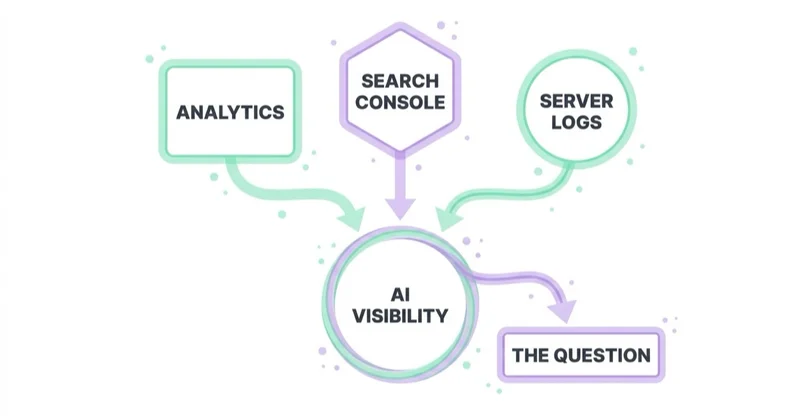
Brand mention monitoring in AI answers combines three different evidence layers. Analytics can identify some visits referred by assistants. Search Console and Bing Webmaster Tools provide platform-side visibility for supported Google and Microsoft AI experiences. A controlled prompt panel samples whether and how a brand appears in answers on platforms that do not provide a complete owner report. Each layer answers a different question, and none describes the full buyer journey or the entire population of AI answers.
This article is about method. It assumes the discipline itself is familiar — the umbrella view sits in AI SEO, and the question of which third-party sources AI answers lean on is covered separately in where AI gets its sources. What follows is the measurement layer: which data exists, what it genuinely proves, where it stops, and how to build a citation sample that survives someone senior asking how the number was produced.
TL;DR
- Two measurements, not one. Sessions from assistants and appearances inside AI answers are different objects with different data sources. Blending them into one "AI visibility" figure destroys both.
- GA4 now names assistant traffic on its own. Google Analytics has an
AI Assistantsdefault channel group, populated when the referrer matches Google's list of assistants, with medium set toai-assistant. - That channel excludes Google's own AI surfaces. Analytics Help defines Organic Search as non-ad links in organic-search results including AI Overviews and AI Mode — so Google AI traffic is not separable from classic organic in GA4.
- Search Console has a Generative AI performance report. It shows impressions of your URLs inside AI Overviews and AI Mode. Impressions only: no clicks, no position, no split between the two features, and it is still rolling out per property.
- The sources must not be added into one score. GA4 counts recognised visits from third-party assistants; Search Console counts link impressions in supported Google AI features. They describe different stages and platforms.
- Bing AI Performance adds Microsoft-side citation data. In public preview, it reports total citations, cited pages and sampled grounding queries across supported Microsoft AI experiences; it is not a report of all assistant answers.
- Nobody publishes a citation share for third-party assistants. OpenAI, Anthropic and Perplexity do not report how often a brand appears in their answers. Any percentage you see is a sample someone took, not a figure a platform disclosed.
- A single run is an observation, not a trend. A defensible series needs a versioned prompt list, consistent sampling depth, controlled market and login state, and the assistant mode or model version where the interface exposes it.
- Most self-deception happens in the denominator. "Share of answers" is meaningless until you state share of what — prompts asked, answers returned, or answers where any vendor was named.
- Report presence, direction and specific factual errors. Those three are honest and actionable. A precise-looking percentage from an uncontrolled sample is neither.
The two questions people conflate
Almost every request for "AI visibility reporting" is actually two requests wearing one label. Separating them at the start prevents a quarter of wasted work.
The first is commercial: are people arriving here from AI assistants, and what do they do? That is a traffic question, answered with analytics, and it behaves like any other acquisition channel. The second is positional: when a buyer asks an assistant about our category, are we in the answer? That is not answered by analytics at all, because most AI answers produce no click — a correct, complete, flattering answer about a company can generate zero sessions and still move the buyer.
| Question | What it measures | Where the data comes from | What it cannot tell you |
|---|---|---|---|
| Are people arriving from assistants? | Sessions, engagement, conversions | Analytics (GA4 AI Assistants channel, referral data) |
Which question produced the visit; anything about answers that ended without a click |
| Do we appear inside Google's AI features? | Impressions of your URLs | Search Console Generative AI performance report | Whether you were quoted or merely linked; what the answer actually said |
| Is Microsoft citing our pages in supported AI experiences? | Citations, cited pages and sampled grounding queries | Bing Webmaster Tools AI Performance | The full answer population, placement or the role of a page within an individual answer |
| Do assistants recommend us for commercial questions? | Presence, description, competitors named | A sample you run yourself | A guaranteed share of all answers, because no provider exposes one |
| Did a client claiming an AI user-agent request this page? | Request, time, path and response | Origin, CDN or edge logs | Provider identity without verification; which question was asked; whether an answer used the page |
Read the fourth column before the second. It is the part that gets left out of dashboards, and it is where most exaggerated reporting starts.
Half one: measuring traffic from AI assistants
What analytics reports without any setup
The workaround era for this is largely over. Google Analytics 4 ships an AI Assistants default channel group, documented in Analytics Help as the channel by which users arrive from sources like ChatGPT, Gemini, DeepSeek, Copilot or Grok. The mechanism is worth knowing precisely, because it explains the channel's limits: when the referrer matches Google's list of AI assistants, Analytics sets the medium to ai-assistant and the campaign to (ai-assistant), and the channel group definition matches on that medium.
Three consequences follow from that mechanism, and each one bounds what the channel can be used for.
It depends on a referrer arriving. If the assistant sends no referrer — an app that opens links in an internal browser, a session where the referrer is stripped, a person copying the URL into a fresh tab — the visit lands in Direct, and no channel group can rescue it. This is not a flaw in Analytics; it is what happens when the information never reaches the server.
It depends on Google's list. An assistant Google has not listed will still arrive as an ordinary referral under its own hostname. That is the remaining legitimate use for a custom channel group: catching referrers outside the maintained list so they roll up with the rest instead of hiding in generic referral traffic. Before promising anyone a backfilled trend, check the data-availability rules for custom channel groups in Analytics Help — how far back a new definition applies is a property of the tool, not something to assume.
It says nothing about the question. No assistant passes the prompt that produced the click. There is no equivalent of a search query report here, and there will not be one, because the query is a private conversation held on someone else's product.
The part that cannot be separated at all
The single most useful sentence in the Analytics documentation for this topic is the definition of Organic Search: non-ad links in organic-search results, including Google's AI Overviews and AI Mode. The AI Assistants channel explicitly excludes them.
So Google's own AI surfaces are, in analytics terms, organic search. A click from an AI Overview and a click from a blue link arrive in the same channel, with the same source and medium, indistinguishable. If a stakeholder asks how much traffic AI Mode sends, the honest answer in GA4 is that the platform does not expose it. What Google exposes instead is on the impression side, in Search Console — a different metric answering a different question. The mechanics of that surface, including query fan-out, are covered in the piece on Google AI Mode.
This is also why a clean acquisition report matters more here than it used to. If Direct is a landfill and referral exclusions were never reviewed, an assistant channel sitting next to them inherits the same noise. Getting the channel definitions, referral exclusions and conversion events trustworthy before layering AI reporting on top is ordinary web analytics work, and skipping it produces a dashboard that is precise about a number nobody should trust.
Search Console: appearances, not sessions
Google Search Console now has a Generative AI performance report for Search, introduced on the Search Central blog in June 2026. It is the first source that reports, from the platform side, how often a site's URLs appeared inside generative AI features. Read the specification closely, because the limits are the interesting part.
| Property of the report | What the documentation states |
|---|---|
| Metric | Impressions only — how often links to the site appeared in generative AI features |
| Features covered | AI Overviews and AI Mode on Google Search |
| Excluded | Search Labs experiments, which remain in active development |
| Dimensions | Pages, countries, dates, devices |
| Feature breakdown | None — AI Overviews and AI Mode are not split apart |
| Clicks, CTR, position | Not in the report |
| Underlying data | Drawn from the Web search type of the standard Performance report, with the same 1,000-row limit and aggregation rules |
| Availability | Rolling out over time; not all properties have access, and a property needs enough impressions to appear |
| Recent data | Preliminary, shown as dotted lines, and may change |
A separate report exists for generative AI features in Discover. In the standard Performance report, AI feature data continues to count toward overall Search totals rather than sitting in its own bucket — which is why the site-wide organic line can move without any individual query moving in a way that explains it.
Google is also rolling out a Search generative AI control to a subset of properties. It allows a site owner to include or exclude links and content from supported generative AI features in Search and Discover, with inclusion as the default. This is separate from Google-Extended, which does not control Search inclusion. Report availability and control availability should be checked in the property rather than assumed.
What the report does not settle: whether a URL was quoted in the answer text or merely listed as a source, what the answer said about the brand, and whether a competitor was named alongside. Impressions are a presence signal, not a description of the answer, and the report covers Google only.
Bing Webmaster Tools: citations across supported Microsoft AI experiences
Bing AI Performance, introduced in public preview in February 2026, provides a different platform-side view. It reports total citations, average cited pages, URL-level citation activity, trends and a sample of grounding queries across Microsoft Copilot, AI-generated summaries in Bing and selected partner integrations. Microsoft explicitly notes that citations do not indicate placement, authority or the role of a page within an individual answer, and that grounding queries are sampled.
This is more direct than inferring Microsoft visibility from referral traffic, but it remains a bounded provider report. It does not cover ChatGPT, Claude, Perplexity or the entire population of Microsoft-assisted interactions. Keep it as its own evidence layer rather than blending it with Google impressions or a prompt-panel share.
Server logs: direct evidence of request handling
Logs answer a narrow question the other sources cannot: what requested a page from your infrastructure and which response it received. The user-agent string is self-declared, so provider identity must be verified through the operator's documented IP ranges or DNS procedure where one exists. This still matters because access failures are often silent — a bot-protection rule returning 403 or a challenge to a genuine fetcher can prevent it from receiving the content.
For measurement purposes what matters is not the list of names but the job each agent does. OpenAI, Anthropic and Perplexity all document separate agents for foundation-model training, for building a search index, and for fetches triggered while answering somebody's question — and both OpenAI and Perplexity note that the user-triggered agent behaves differently from a scheduled crawler with respect to robots directives. The full agent map, with what blocking each one costs, is in AI crawlers: GPTBot, ClaudeBot, PerplexityBot and what to allow. State of play as of July 2026 — providers rename and add agents, so verify current names against the provider documentation linked at the end before writing a log filter or a robots rule.
A verified user-triggered fetch indicates that an assistant requested the page in response to user activity. It still exposes no prompt, user identity or proof that the answer used the retrieved content. Treat it as an access check and directional request signal, never as a citation or conversion. The tooling that automates log analysis is covered in AI SEO tools and visibility platforms.
Glossary
- AI Assistants channel — the GA4 default channel group populated when a visit's referrer matches Google's list of AI assistants, identified by medium
ai-assistant. - Impression, Search Console sense — a recorded appearance of a URL in a result surface, independent of whether anyone clicked it.
- Operational definition — the exact rule that decides whether a run counts as a hit, written down before measuring, so two people scoring the same answer agree.
- Run — one execution of one prompt on one assistant under stated conditions, the atomic unit of a citation sample.
- Denominator — the total a share is calculated against; the most common place a reported percentage becomes meaningless.
- Series break — a change to the instrument or the platform that makes readings before and after non-comparable, so they must be charted as two baselines rather than one trend.
- Signed-out run — a run performed without an account session, so personalization and stored memory do not influence the answer.
Half two: measuring citations and mentions
Decide what you are counting before you count anything
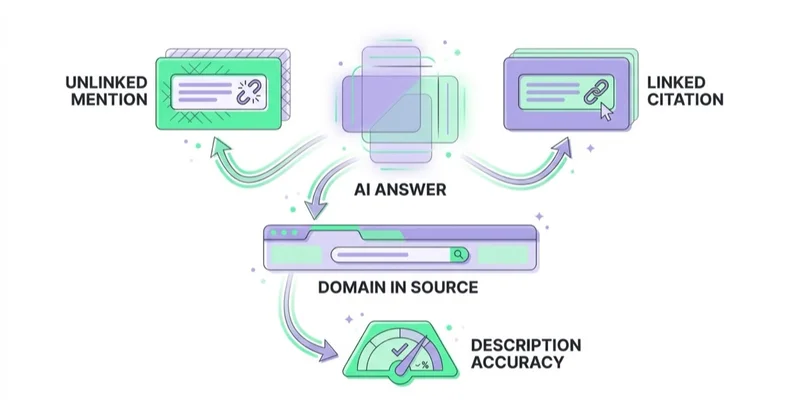
"Are we mentioned in AI answers?" hides four different measurements. They correlate loosely, they move independently, and mixing them across periods is the fastest way to produce a trend that is an artefact of scoring rather than of visibility.
| Unit of measurement | What counts as a hit | Why it matters commercially | Why it is easy to abuse |
|---|---|---|---|
| Unlinked mention | The brand name appears in the answer text | The buyer sees the name at the moment of consideration | Inflates fastest; a passing mention scores the same as a recommendation |
| Linked citation | A URL from your domain is shown as a source | Traceable, and occasionally produces a click | Being cited as a source does not mean being recommended |
| Domain in the source panel | Your domain appears in the displayed source list | Evidence that the platform associated the domain with the answer | It does not prove a real-time fetch or that the answer relied materially on the page |
| Description accuracy | The answer describes the brand correctly | The only unit that catches active harm | Requires judgement, so scoring drifts unless the rule is written down |
Pick one as the headline number and track the others as secondary columns. Whichever you pick, write the rule down in one sentence — for example: a hit is the brand name appearing in the answer body, excluding source lists. An unwritten rule quietly loosens over a quarter, always in the flattering direction.
Why the same question returns different answers
Non-determinism here is not a bug to control away; it is a property of the systems being measured, and any method that ignores it produces noise dressed as insight. The variation has several independent sources stacked on top of each other.
Generation is probabilistic, so wording and the set of examples chosen can differ between two identical requests. Retrieval is dynamic: the assistant may issue several sub-queries and pull a different set of pages each time, particularly for questions where fresh content exists. Personalization and stored memory shift answers for signed-in users. Region and language change both the retrieval set and the vendors considered relevant. Providers route requests across model versions and update those versions without notice. And the same provider offers several surfaces — a chat answer, a search-mode answer, an app widget — which do not behave identically.
The practical conclusion is uncomfortable but freeing: one screenshot proves nothing, in either direction. A competitor's screenshot showing them named and you absent is a single draw from a distribution. So is yours.
Designing a sample you can defend
The prompt list itself — how to choose the questions, the column layout for logging results, and the argument for starting with a sheet rather than a licence — is set out in AI SEO tools and visibility platforms. Two design decisions sit around that log, and they are what determine whether the resulting numbers mean anything.
A fixed run count per prompt. One run is an anecdote; repeating the same prompt several times per period turns it into a rate. There is no published correct number, and inventing a benchmark would be dishonest — the operating rule that matters is that the count stays identical across periods, because a period with more runs will look better or worse purely from sampling.
Controls, recorded every time. Market and language. Signed-out session, or signed-in with memory and personalization disabled and that fact noted. Fresh session rather than a continued conversation. Assistant and, where the interface shows it, the mode and model version. The same person or script scoring hits against the written definition. Every one of these is a variable that changes the answer, so leaving any of them unrecorded means the run cannot be repeated.
State the denominator or the number means nothing
"We appear in 40% of answers" is three different claims depending on what sits underneath, and the difference is not academic — the same raw data can yield very different percentages.
| Denominator | What the share actually says | When it is the right choice |
|---|---|---|
| Prompts in the set | Coverage of the questions you decided matter | Reporting progress on a fixed strategic question list |
| Runs executed | Presence rate accounting for run-to-run variance | Comparing periods where run counts are equal |
| Answers naming any vendor | Share of the consideration set | Competitive positioning within a category |
| Answers where a citation appeared at all | Citation share among cited answers | Diagnosing whether the issue is being cited or being cited instead |
Choose one, write it into the report template, and never change it mid-year without re-baselining. Silently switching denominators is the most common form of AI visibility inflation, and it usually happens with no bad intent — someone rebuilds the sheet and picks whichever total is closest to hand.
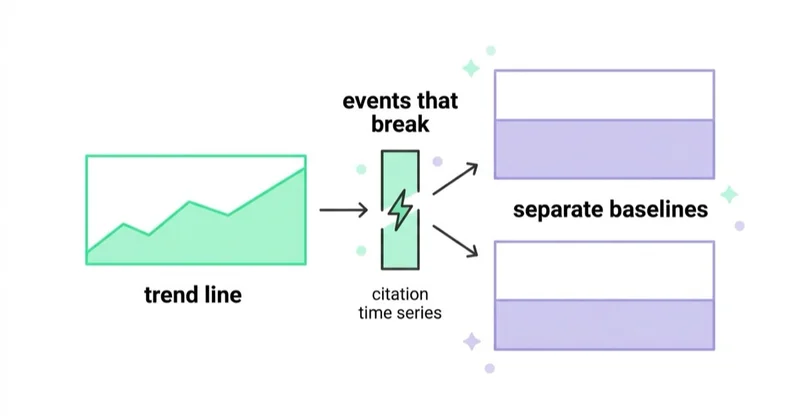
What breaks a time series
Some changes make readings before and after simply non-comparable. Charting straight through them creates a trend that describes your instrument rather than your visibility.
| Event | Effect on the data | What to do |
|---|---|---|
| Provider ships a new model version | Retrieval and phrasing behaviour change together | Annotate the date, keep charting, treat a step change as suspect until the next period confirms it |
| A prompt is reworded, even slightly | That prompt's history ends | Add the new wording as a new prompt; retire the old one rather than editing it |
| Prompts added or removed | The denominator changes | Re-baseline, and report the old and new set sizes side by side |
| Market, language or login state changes | A different retrieval and personalization context | Treat as a separate series, not a continuation |
| Provider changes the surface or UI | Source panels and link behaviour change | Re-check the operational definition still describes what you see |
| Scorer changes | Judgement calls drift | Re-score a sample of the previous period against the written rule |
| Your own site changes materially | The intended cause of movement | Note the deploy date so the effect can be read against it |
Only the last row is the effect you want to observe. The other six are reasons a chart moves for no commercial reason at all.
How not to fool yourself with your own report
Two habits keep the reading honest. Read direction over magnitude — from a small sample, "present in more answers than last period, and described more accurately" is defensible, while "up 12 percentage points" implies a precision the sample does not carry. And report the instrument with the number, every time: prompt set version, run count, assistants, market, language, login state, dates, and the operational definition of a hit. A number without its instrument is not a measurement.
The list below is what goes wrong after that. Every item has been produced by a well-intentioned team rather than a dishonest one, which is exactly why each is worth naming.
| Self-deception | How it happens | The correction |
|---|---|---|
| Cherry-picked screenshot | Someone runs a prompt, gets a good answer, and pastes it into the deck | Report rates from the full set; use screenshots only as illustration of a scored run |
| Prompt drift toward flattery | Rewording a prompt slightly to describe the niche more precisely, which happens to be the niche you win | Freeze wording in version control; new wording becomes a new prompt |
| Growing the set with wins | Adding prompts you already appear in because they seemed relevant | Add prompts for commercial reasons only, and re-baseline the denominator |
| Quiet retirement of losses | Dropping prompts that never return a mention as "not relevant after all" | Keep losing prompts in the set; they are the working list for content and entity fixes |
| Unequal sample sizes | Five runs in a busy month, twenty in a quiet one | Fix the run count; if it slips, report presence rather than percentages |
| Uncontrolled conditions | Testing on a signed-in work account, from wherever the analyst happens to sit | Signed-out runs by default, market and language set explicitly, both stated in the report |
| Presenting a share as a ranking | "We are third for this query" | Report sampled presence, with the instrument attached |
| No competitor line | Measuring only yourself | Two or three named competitors on the identical set |
| Assuming zero sessions means zero visibility | Reading the analytics channel and stopping there | Read impressions and sampled presence alongside it; most answers end without a click |
What no one can give you
This needs saying precisely, because both the overclaim and the overcorrection are common.
For third-party assistants, there is no published citation share. OpenAI, Anthropic and Perplexity do not report how often a brand appears in their answers, and no access route exists to a population-level figure. Every percentage in circulation is somebody's sample, and its value depends entirely on the sampling design. A vendor that cannot describe its prompt set, run count, market and login handling is quoting a number, not measuring one.
For Google's own AI features, the position changed and it is worth stating accurately: Search Console reports impressions of your URLs inside AI Overviews and AI Mode where the property has access to the report. That is a platform-reported figure, not a sample. What it is not is a citation share, and it contains no clicks and no split by feature — so it tells you that you appeared, not how often you were chosen over someone else.
The honest deliverable is therefore three things, and they are enough to run a programme on: presence on the questions the business decided matter, direction over time on a stable instrument, and specific factual errors in how assistants describe the brand. The third is the most actionable of the three, because a wrong fact in an answer can usually be traced to a source and corrected — which is where measurement stops and AI SEO work starts.
How Space Ads approaches this
At Space Ads, we keep four evidence layers separate: recognised assistant traffic in analytics, Google generative impressions, Microsoft citations and sampled brand presence in answers. Traffic is evaluated on landing pages and business outcomes. Provider reports retain their documented dimensions and limitations. Prompt monitoring carries the instrument beside every result: prompt-set version, sampling depth, platform, market, language, login state, dates and scoring rule.
The prompt set is built from real buying decisions without inserting the measured brand into discovery questions. We record linked sources, co-mentioned organisations and the exact claim made about the brand, then convert discrepancies into a backlog: correct a source, clarify an entity, create a missing decision resource or fix technical access. The headline is therefore not an opaque visibility score but a traceable relationship between evidence, finding and action.
Action plan
- Write a representative question set. Cover the commercial decisions a buyer makes on the way to choosing a supplier, across the relevant markets and languages. This set is the specification for everything downstream.
- Write the operational definition. One sentence stating what counts as a hit. Circulate it, because it is the thing people will later disagree about.
- Fix the analytics foundation first. Referral exclusions, channel definitions, conversion events, Direct hygiene. An assistant channel inherits whatever noise already exists.
- Confirm what the platforms already report. Check the
AI Assistantschannel in the acquisition reports, adding a custom channel group only for referrers outside Google's maintained list, and check whether the property has the Search Console Generative AI report. Where it does, baseline impressions by page and country; where it does not, note the rollout status rather than substituting an estimate. - Verify access in the logs. Filter for documented AI agents, verify identity where supported and inspect successful or blocked responses on the templates that matter. Correcting an unintended edge rule may require engineering or security work, but it precedes content remediation.
- Run the baseline by hand. Full prompt set, fixed run count, signed out, market and language set, raw answers pasted, competitors on the identical set.
- Record the instrument alongside the results. Prompt set version, run count, assistants and modes, dates, scorer. Without this the baseline cannot be repeated.
- Set the cadence, keep an annotation log, and report presence, direction and errors. Pick a rhythm you can sustain, keep a dated log of model changes, prompt changes and your own deploys next to the chart, and then work the error list: correct each wrong fact at its source, and build the page for the question you have no answer for.
Common mistakes
| Common mistake | What to do instead |
|---|---|
| Presenting one blended AI visibility score | Report traffic and presence as two measurements with two data sources |
| Assuming AI Overviews traffic is separable in analytics | Read Google AI surfaces as organic search in GA4, and use Search Console impressions for the presence side |
| Building a regex workaround before checking the platform | Confirm the AI Assistants channel first; use custom groups only for unlisted referrers |
| Treating Search Console AI impressions as citations | Read them as appearances; they contain no clicks and no per-feature split |
| Quoting a citation share for ChatGPT or Perplexity as fact | State that no provider publishes one, and present your own sample with its design |
| Charting straight through a model version change | Annotate series breaks and re-baseline rather than smoothing over them |
| Changing the denominator between reports | Fix the denominator in the template and re-baseline explicitly when it must change |
| Measuring only your own brand, signed in on a personalized account | Run the identical set for named competitors, signed out, with the login state stated |
| Concluding low sessions means low visibility | Most AI answers end without a click; measure presence separately |
FAQ
How do you measure traffic from AI assistants in Google Analytics?
Google Analytics 4 has an AI Assistants default channel group, documented in Analytics Help as covering arrivals from sources like ChatGPT, Gemini, DeepSeek, Copilot and Grok. It is populated when the visit's referrer matches Google's list of AI assistants, which sets the medium to ai-assistant. Visits that arrive without a referrer — copied URLs, some in-app browsers — still land in Direct, and no channel configuration can recover them.
Can you separate AI Overviews and AI Mode traffic from organic search?
Not in Google Analytics. Analytics Help defines Organic Search as non-ad links in organic-search results including Google's AI Overviews and AI Mode, and the AI Assistants channel explicitly excludes them. The available split is on the impression side: Search Console's Generative AI performance report shows how often a site's URLs appeared in those features, without clicks or a breakdown between them.
What does the Search Console generative AI performance report show?
It reports impressions of a site's URLs inside AI Overviews and AI Mode on Google Search, broken down by pages, countries, dates and devices. It excludes Search Labs experiments, contains no clicks, no click-through rate and no position, does not separate AI Overviews from AI Mode, draws on the Web search type of the standard Performance report with the same 1,000-row limit, and is still rolling out — not every property has access, and a property needs enough impressions to appear.
Is there a reliable way to know your share of AI answers?
No provider publishes one for third-party assistants. OpenAI, Anthropic and Perplexity do not report how often a brand appears in their answers, so every share figure in circulation is a sample. A sample can be perfectly usable, but only if the prompt set, run count, market, language and login state are stated — those parameters determine the result more than the brand's actual visibility does.
Why do AI assistants give different answers to the same question?
Generation is probabilistic, retrieval is dynamic and may pull different pages on each attempt, personalization and stored memory shift answers for signed-in users, region and language change both the retrieval set and the vendors considered relevant, and providers update model versions without notice. This is why a single run cannot support a conclusion in either direction, and why measurement requires repeated runs under stated conditions.
How many times should each prompt be run?
There is no published correct figure, and any specific number presented as a benchmark should be treated as invented. The rule that matters is constancy: pick a run count you can sustain and keep it identical between periods, because a period with more runs will look different for purely statistical reasons. If the count slips, report presence rather than percentages for that period.
Can server logs prove that an assistant used your page in an answer?
No. Logs show that a client claiming a user-agent token requested a URL and what response it received. After provider verification, that is useful access evidence. It still does not reveal the prompt, the user or whether the retrieved content influenced an answer. Training crawlers, search agents and user-triggered fetchers must also be analysed separately.
Does a brand mention without a link have any value?
It can. An assistant may accurately describe a company or include it among alternatives without linking to the site. That is exposure at a consideration stage, but its commercial effect is not directly observable and should not be assigned a universal monetary value. Track unlinked mentions separately from linked citations and traffic.
Sources and further reading
- Google Analytics Help — Default channel group definitions (the
AI Assistantsand Organic Search definitions). - Google Search Central Blog — Introducing Search generative AI performance reports in Search Console, June 2026.
- Search Console Help — Generative AI performance report (Search).
- Search Console Help — Search generative AI control.
- Bing Webmaster Blog — AI Performance in Bing Webmaster Tools.
- OpenAI — Bots and crawlers documentation.
- Anthropic — Does Anthropic crawl data from the web, and how can site owners block the crawler.
- Perplexity — Bots documentation.
Agent names and report availability change. Verify against these pages before writing a log filter, a robots rule or a reporting commitment.
In short
- AI visibility needs separate evidence for recognised assistant traffic, Google generative impressions, Microsoft citations and sampled presence in other answers.
- GA4's
AI Assistantschannel names third-party assistant traffic automatically; Google's own AI Overviews and AI Mode traffic remains inside Organic Search and cannot be separated there. - Search Console's Generative AI performance report gives platform-reported impressions for AI Overviews and AI Mode — impressions only, no clicks, no feature split, still rolling out.
- Bing AI Performance provides citation and cited-page data for supported Microsoft experiences, with sampled grounding queries and explicit interpretation limits.
- No provider publishes a citation share for third-party assistants, so any percentage is a sample and only as good as its design.
- A defensible sample needs a versioned prompt list, consistent sampling depth, controlled market, language and login state, the model or mode where visible, and a named competitor baseline.
- Most inflation happens in the denominator and in quiet edits to the prompt set; fix both in a template and annotate every series break.
- Report presence, direction and specific factual errors. The error list is the most useful output of the first measurement pass.
Continue learning
- AI SEO: how to optimize for search engines, AI Overviews and LLMs — the umbrella discipline this measurement serves.
- Where AI gets its sources: Reddit, Wikipedia and third-party citations — what to fix once the measurement finds a factual error.
- AI SEO tools and visibility platforms: what they do not fix — the tooling market and the log layout for a manual prompt set.
- LLM SEO: how to make your brand easier for AI tools to cite — the content and entity work behind presence.
- Google AI Mode: what it means for brands — how the surface that folds into organic search actually behaves.
- AI Overviews and GEO: how AI picks brand citations — the selection side of the same problem.
Continue reading
Entity SEO: How Models Decide What Your Brand Is
Before a model can recommend a company it has to decide which company it is. Entity SEO is the work of making that decision unambiguous and the resulting description correct.

Where AI Gets Its Sources: Reddit, Wikipedia and Third-Party Citations
AI answers may cite communities, encyclopedias, directories, reviews, publications and first-party pages. Learn how live citations differ from training data, how to audit the public record and what a brand can improve without manipulation.

LLM SEO: How to Make Your Brand Easier for AI Tools to Cite
LLM SEO helps language models understand, describe and cite a brand correctly. This guide covers entities, crawlability, answer-ready content, sources, prompt monitoring and commercial paths.