A useful Google Ads launch plan does not promise that every account will be profitable by day 90. It creates a controlled path from business assumptions to evidence: define what a profitable conversion is, validate the measurement, launch the campaign types that fit how customers buy, and expand only when the data supports it.
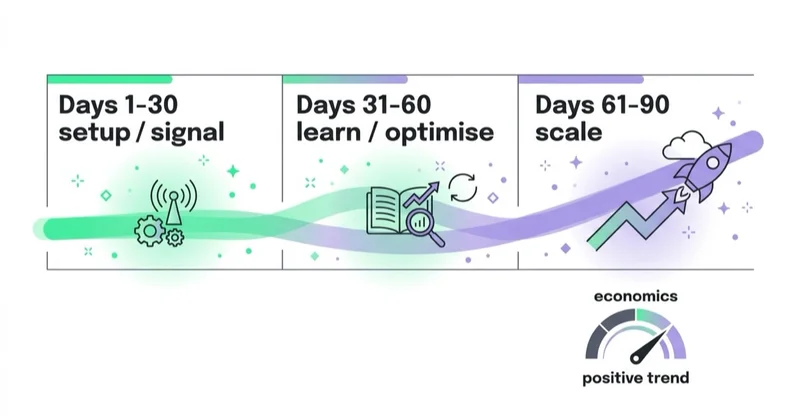
The timeline below is an operating framework, not a universal calendar. A local service with a short lead cycle may learn quickly. A B2B company with a 60-day sales process will need more time and CRM data. An ecommerce store may sensibly begin with Shopping or Performance Max rather than Search alone. The sequence matters, but so do budget, demand, margins, website quality and conversion volume.
TL;DR
- Before launch: agree the commercial target. Know the allowable customer-acquisition cost or contribution-margin target, not just the desired ROAS.
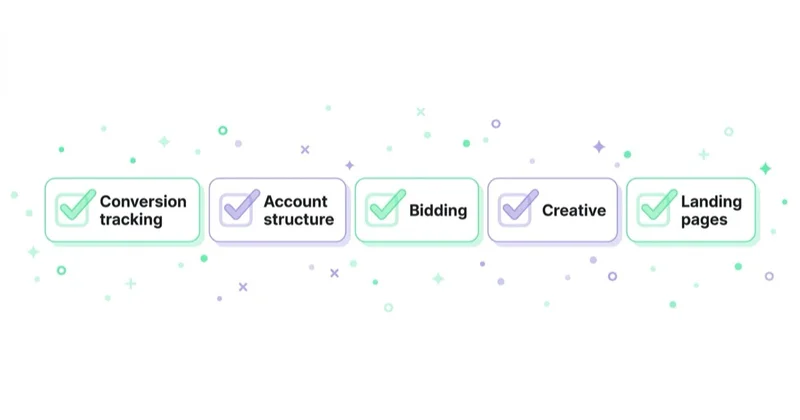
- Days 1-7: validate conversion actions, values, deduplication, consent handling and the path from ad to purchase or qualified lead.
- Days 8-30: launch a focused campaign mix matched to the business. Keep brand demand separate from new-customer acquisition so the results remain readable.
- Days 31-60: use matured conversion data to improve queries, ads, landing pages, product data and bidding. Avoid reacting to incomplete recent data.
- Days 61-90: test the next constraint with a clear hypothesis. Expand budget, coverage or campaign types only when the unit economics support it.
- Throughout: distinguish platform-attributed conversions from incremental business growth.
Why sequence and economics both matter
Launching many campaigns at once creates a diagnosis problem. If results are weak, you cannot easily tell whether the constraint is measurement, demand, the offer, the landing page, product data, creative, bidding or budget. A staged launch limits the number of unknowns and makes each decision easier to explain.
That does not make budget secondary. A campaign that generates too few clicks or conversions cannot answer questions quickly, while a target that ignores margin can make apparently strong ROAS unprofitable. Before launch, model average order value, gross or contribution margin, lead-to-sale rate, sales value and the acceptable payback period. These inputs determine what the account should optimise for and how much evidence it can realistically collect.
Days 1-7: establish a trustworthy baseline
Start with the business outcome. For ecommerce, the primary action will usually be a purchase with the correct value and currency. For lead generation, a form submission may be only an interim signal; qualified opportunity or closed sale data from the CRM is more useful when it can be imported reliably. Keep diagnostic actions such as page views, scrolls and add-to-cart events out of the primary conversion goal unless there is a specific, documented reason to bid toward them.
Test the complete journey rather than checking only whether a tag fires. Verify values, currency, transaction IDs or lead identifiers, duplicate prevention, attribution settings and the distinction between primary and secondary actions. Where appropriate and legally supported, enhanced conversions can improve measurement by using hashed first-party data. Consent and privacy configuration must reflect the markets in which the company operates; it is not a box to copy from another account.
Commercial readiness belongs in the same phase. Confirm that ads lead to a relevant, working page; forms reach the CRM; phone calls can be handled; products are in stock; and prices and shipping information agree across the site and Merchant Center. Ecommerce teams should resolve product disapprovals and material feed errors before asking bidding to compensate for poor inputs.
Days 8-30: launch a focused, measurable campaign mix
Choose the first campaigns from the buying journey, not from a universal template. A service business may begin with tightly themed Search campaigns around commercially relevant needs. A retailer with a healthy product feed may start with Shopping or Performance Max alongside Search. A business creating a new category may need video or Demand Gen to build demand before search volume exists.
Keep the initial scope narrow enough to interpret. Separate branded searches from non-brand acquisition, because brand campaigns often capture existing demand and can make the whole account appear more efficient than its growth activity. Group products or services according to meaningful differences in margin, geography, availability or business priority. Write ads and choose landing pages for those specific intents.
Smart Bidding does not always require a preliminary month of manual bidding. Google supports conversion-based automated bidding in new campaigns, provided conversion tracking is enabled. The appropriate strategy depends on the objective and available data: maximising conversions is different from maximising conversion value, and adding an aggressive CPA or ROAS target can constrain delivery. Document the initial choice and the reason for it instead of treating automation as either inherently safe or inherently risky.
Glossary
- Primary conversion — the business outcome used in the campaign's bidding and reporting column.
- Conversion value — the monetary or assigned value passed with a conversion; it should represent business value consistently.
- Conversion cycle — the time between an ad interaction and the resulting conversion, including import delay for offline outcomes.
- Smart Bidding — Google's auction-time bidding strategies that optimise for conversions or conversion value.
- Search term — the query that caused an ad to show; it is not necessarily identical to the keyword in the account.
- Incrementality — the additional outcome caused by advertising, beyond what would have happened without it.
Days 31-60: diagnose with mature data
By the second month, the account should have enough activity to expose its first constraints. Start with data maturity: if customers often convert days or weeks after a click, the latest period will understate conversions and overstate CPA. Google reports conversion-delay information for eligible campaigns, so compare cohorts only after allowing for the normal conversion cycle.
Review the search terms report and search-term insights. Add negative keywords for clearly irrelevant intent, but do not build sweeping exclusion lists from a handful of clicks: negative match works differently from positive match and can remove valuable reach. For ecommerce, review product approval status, feed attributes, price consistency and performance by meaningful product group. For every model, examine the ad-to-page message, conversion rate and lead or order quality—not only CTR and platform CPA.
Automated bidding may display a learning status after a new strategy or material setting and composition changes. Google states that calibration can take up to three weeks or one to two conversion cycles, depending on conversion volume, cycle length and strategy. That is a reason to plan changes, annotate them and wait for mature evidence—not a reason to leave obvious tracking errors or uncontrolled spend untouched. Use the bid-strategy report and Smart Bidding diagnostics rather than applying a fixed waiting rule.
Days 61-90: expand deliberately, one thing at a time
Use the final month to address the largest evidenced constraint. If profitable demand is being lost to budget, test a controlled budget increase. If coverage is narrow, test broader matching or another campaign type. If traffic is relevant but conversion rate is weak, prioritise the offer or landing page before buying more visits. If ecommerce products are approved but underexposed, improve product data and segmentation before simply raising the budget.
Write a hypothesis, success metric, guardrail and decision date before changing the account. Where volume permits, Google Ads experiments can split traffic between a base and trial campaign, making a bidding, matching or landing-page test more informative than a simple before-and-after comparison. Run one material test at a time when tests could interfere with each other, and accept “inconclusive” as a valid result.
Evaluate expansion with platform and business data together. Google Ads can show attributed conversion value, but finance and CRM data reveal contribution margin, cancellations, lead quality, repeat purchases and blended acquisition cost. Incrementality requires a suitable experiment or lift study; it cannot be inferred from platform ROAS alone.
How Space Ads approaches a Google Ads launch
Our launch framework connects three layers: business economics, dependable measurement and campaign execution. The practical sequence is to define the outcome, validate the signal, choose the campaign mix around actual demand, and then test the next growth constraint. The exact mix differs between ecommerce, lead generation and long-cycle B2B.
Before calling a launch successful, we reconcile campaign results with sales or CRM outcomes and check whether the economics remain viable after margin and lead quality. We document important changes, respect conversion delay and separate brand capture from acquisition. This makes the account easier to scale, audit and explain. The same principles underpin our Google Ads and performance marketing work.
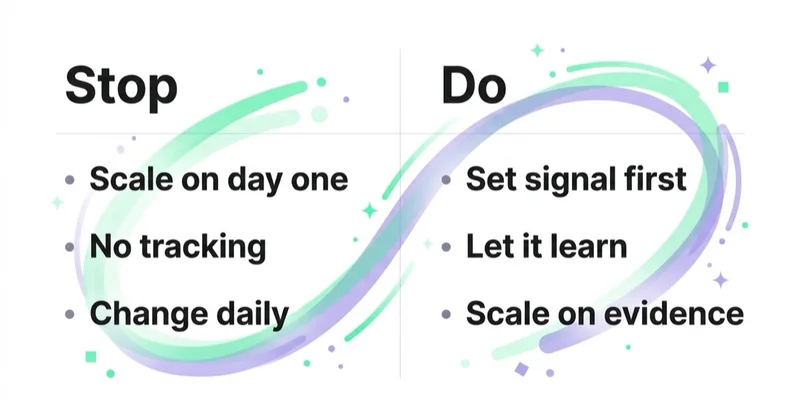
Stop doing / Do instead
| Stop doing | Do instead |
|---|---|
| Launching every available campaign type | Start with the smallest mix that can test the commercial hypothesis |
| Optimising to all recorded actions | Bid toward clearly defined primary business outcomes |
| Mixing brand and non-brand results | Report existing-demand capture separately from acquisition |
| Assuming manual bidding is always safer | Choose bidding from the goal, tracking quality and available data |
| Judging recent days as complete | Account for conversion and offline-import delay |
| Raising budget because platform ROAS looks strong | Check margin, lead quality and blended business results |
| Making several major changes together | Test the largest constraint with a documented hypothesis |
FAQ
What should I do first when launching a Google Ads account?
Define the economic target and the primary conversion, then test the complete measurement path before meaningful spend begins. Confirm that purchase or lead values, currency, identifiers, duplicate prevention and CRM hand-off work as intended. Also check the landing page, stock or lead capacity, consent handling and—where relevant—Merchant Center product status.
How should I structure the first 90 days of Google Ads?
Use four phases: establish economics and measurement; launch a focused campaign mix; diagnose using mature conversion and business data; then test the most important constraint. The day ranges are checkpoints, not deadlines. Adjust them to search volume, budget, conversion cycle and the speed at which offline outcomes return to Google Ads.
Should I start Google Ads with a big budget?
Start with a budget that the business can sustain through the expected learning and conversion cycle and that can generate enough activity to answer the launch question. There is no universal minimum. Estimate likely CPC, conversion rate, lead-to-sale rate, margin and conversion delay, then model a base, downside and upside case. If the available budget cannot produce decision-useful data, narrow the geography, product set or objective rather than pretending the test is conclusive.
When should I switch to Smart Bidding on a new account?
Smart Bidding can be used at launch when conversion tracking is reliable and the selected strategy fits the objective; Google does not require every new campaign to begin with manual CPC. Avoid imposing an unrealistic CPA or ROAS target without supporting history. Monitor bid-strategy status, conversion volume and delay, and evaluate performance after the strategy has had time to calibrate to the goal.
How long before I judge whether Google Ads is working?
Judge against pre-agreed checkpoints, not an arbitrary number of days. Tracking integrity and obvious query irrelevance can be assessed immediately. CPA or ROAS needs enough clicks, conversions and elapsed conversion cycles; qualified pipeline or revenue may take longer still. Google notes that automated bidding calibration can take up to three weeks or one to two conversion cycles after relevant changes, although the actual duration varies.
Why do new Google Ads accounts fail in the first months?
Failure rarely has one cause. Common constraints include weak demand, an uncompetitive offer, poor landing-page experience, tracking errors, insufficient budget for the scope, low-quality product data, irrelevant queries, unrealistic bid targets and slow lead follow-up. A staged launch helps isolate which constraint matters instead of attributing every weak result to “the algorithm.”
Key takeaways
- Treat 90 days as a decision framework, not a promise or a universal learning period.
- Define profitable growth and primary conversions before selecting campaigns or bidding.
- Match the launch mix to the buying journey; Search-first is not right for every business.
- Read performance only after accounting for conversion delay and offline outcome quality.
- Expand by testing the largest evidenced constraint, not by enabling every Google Ads product.
Sources and further reading
- Google Ads Help — Conversion tracking setup
- Google Ads Help — Set up Smart Bidding
- Google Ads Help — Duration of the learning period
- Google Ads Help — About the search terms report
- Google Ads Help — About negative keywords
- Google Ads Help — About Google Ads experiments
- Google Merchant Center Help — Products overview and data health
Continue learning
Continue reading

AI for Google Ads in 2026: Google's Native AI vs a Control Layer on Top
Google's AI and third-party AI tools solve different problems. This guide draws the line between platform automation that already controls bidding and creative assembly, and external control layers that audit, explain, propose changes and help teams govern execution.
Google Local Services Ads: The Pay-Per-Lead Channel for Local Businesses
A current guide to Google Local Services Ads and pay-per-lead Performance Max: eligibility, Google Verified, screening, billing, ranking, lead credits, migration and measurement beyond raw leads.
Google Ads Benchmarks by Industry (CTR, CPC, Conversion Rate)
Google Ads benchmarks can provide context, but only when the campaign type, market, conversion action, attribution and time period match. Learn how to make a valid comparison and turn it into a useful decision.