Lead scoring is useful when demand exceeds the team's ability to review every enquiry in the same way or at the same time. It can help prioritise work, route prospects and create a shared language between marketing and sales. It cannot repair a weak offer, unreliable data or a sales process that never records outcomes.
The aim is not to award points for as many activities as possible. It is to make a limited, testable prediction: which leads deserve which next action, based on information you can collect lawfully and validate against real sales outcomes?
This guide explains the difference between qualification and scoring, how MQL and SQL stages can work, and how to build a model without turning an arbitrary threshold into false certainty.
TL;DR
- Qualification applies agreed criteria to decide a lead's stage and next action. Scoring ranks or groups leads; it is one input to qualification, not the same process.
- MQL and SQL are internal operating labels, not universal standards. Define them so another person can audit the decision.
- Separate fit, need or use case, readiness and engagement. A high score in one dimension should not always compensate for failure in another.
- Start with a transparent rules-based model if data is limited. More complex predictive scoring needs sufficient historical outcomes, monitoring and governance.
- Test the model against accepted leads, opportunities and customers before allowing it to control routing automatically.
- Marketing and sales need explicit ownership, response expectations and rejection reasons for the handoff to improve.
- Use personal and behavioural data proportionately, with an appropriate lawful basis, access controls and human oversight where needed.
Lead qualification, scoring and routing are different jobs
These terms are often used interchangeably, which creates avoidable confusion:
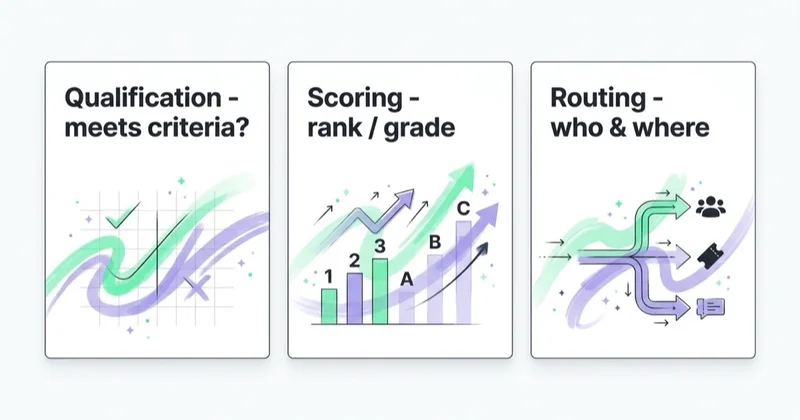
- Qualification decides whether an enquiry meets the criteria for a defined stage or action.
- Scoring assigns a number, band or grade to selected evidence. It can estimate fit, engagement, readiness or another useful outcome.
- Prioritisation determines the order in which leads receive attention.
- Routing sends a lead to a person, queue or nurture path based on factors such as territory, product, capacity and score.
- Disqualification records why a lead should not progress now, or at all.
A score does not need to determine every decision. A high-value inbound request may go directly to the appropriate team. A strategic account might require manual review. A low-readiness prospect that fits the target market may enter nurture rather than being rejected.
MQL vs SQL: define the decision, not just the acronym
MQL usually means marketing-qualified lead: marketing believes the person or account meets agreed criteria for a closer review or sales action. SQL usually means sales-qualified lead: sales has validated enough information to pursue a commercial conversation. Those are useful starting points, but they do not tell your team how to make the decision.
A possible lifecycle is:
| Stage | What it means | Who owns it |
|---|---|---|
| Enquiry or known person/account | A contact or account has been captured, but no qualification claim has been made | Marketing or shared |
| MQL | Agreed marketing criteria and any mandatory conditions have been met | Marketing |
| Sales accepted lead (SAL) | Sales confirms that the handoff is valid and assigns an owner | Shared boundary |
| SQL | Sales validates the agreed fit, problem and buying-readiness criteria | Sales |
| Opportunity | A potential deal meets the organisation's opportunity-entry criteria and has a recorded next step | Sales |
You may need fewer stages, different names or an account-based process. In a low-volume consultancy, a person can review every enquiry without an MQL stage. In product-led software, usage signals may trigger sales action. In a high-volume service business, validity, location, service need and availability may matter more than job title.
For every stage, document four things:
- entry criteria;
- the owner and required next action;
- the permitted exit routes;
- the fields or evidence that make the change auditable.
This turns a label into an operating rule. Microsoft Dynamics 365, for example, allows organisations to configure qualification criteria and actions around their own scoring models rather than imposing a single universal definition.
Decide what the model is trying to predict
Do not begin by assigning points. Start with a decision. Examples include:
- which inbound enquiries should receive immediate human review;
- which accounts should enter a high-touch sequence;
- which leads are ready to move from nurture to sales;
- which valid leads are most likely to become accepted opportunities;
- which prospects need a different product, location or team.
Name the prediction and its time window. "Likely to become a sales-accepted lead within 30 days" is more testable than "hot lead," although the appropriate window must match your sales cycle.
Then choose the outcome used to judge the model. MQL creation is circular if the score itself creates the MQL. A downstream outcome — sales acceptance, qualified opportunity, customer or realised value — offers stronger validation, provided the data is complete enough and the feedback delay is understood.
Use separate evidence dimensions
A useful starting structure has four dimensions:
Fit
Does the person, account or household fall within the market the offer can serve? Depending on the business, evidence could include geography, company type, role, use case, current system or service eligibility.
Avoid treating convenient proxies as facts. A personal email address does not automatically make a B2B lead poor; founders, consultants and buyers can use one. Company size may be irrelevant for some offers and essential for others.
Need or use case
Is there a problem the offer can credibly solve? A short free-text answer, selected requirement, current process or product configuration may be more informative than demographic data alone. This dimension often needs human interpretation.
Readiness
Is there evidence that a decision or project is active? A quote request, consultation booking, procurement event or stated implementation window can be meaningful. Budget and authority questions can help in some sales motions, but absence of a known budget or direct access to the final decision-maker is not always a valid rejection reason, especially early in a complex buying process.
Engagement
What relevant actions has the prospect taken? A pricing-page visit, event attendance or return session may add context. Treat passive engagement carefully. Apple Mail Privacy Protection prevents senders from reliably determining whether protected users opened an email, so an open should not carry the same weight as a reply, booking or completed application.
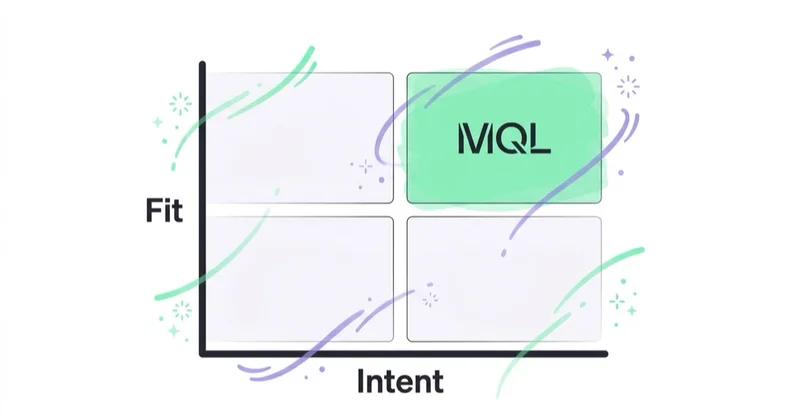
These dimensions do not always belong in one total. A score of 80 can conceal excellent engagement and impossible geography. Hard eligibility rules, fit bands and readiness signals can be clearer than allowing points to cancel one another.
Qualification frameworks support conversations
Sales frameworks such as BANT, CHAMP and MEDDICC can prompt consistent discovery, but they serve different deal types and should not be copied into a marketing score mechanically.
- BANT explores budget, authority, need and timeline. It can organise a relatively direct qualification conversation, but rigid use may reject buyers before those details are known.
- CHAMP begins with challenges before authority, money and prioritisation.
- MEDDICC or MEDDPICC examines areas such as metrics, the economic buyer, decision criteria and process, pain, champion, competition and procurement. It is designed for complex opportunity qualification rather than simple top-of-funnel scoring.
Use a framework only if its questions improve decisions and can be recorded consistently. A checklist cannot replace attentive discovery.
How to build a rules-based lead scoring model
1. Audit the funnel and data
Map the current path from enquiry to customer. Check stage definitions, missing fields, duplicates, inconsistent rejection reasons and whether timestamps reflect real events. Interview salespeople, but compare their perceptions with recorded outcomes. If outcome data is unreliable, fix the process before building a sophisticated model.
2. Agree definitions and mandatory rules
Bring marketing, sales operations and frontline sales together. Define valid, accepted, rejected, qualified and opportunity stages using observable criteria. Separate true disqualifiers — for example, an unsupported country or ineligible service request — from weak signals that merely affect priority.
3. Select signals with a reason
For every candidate field or behaviour, record:
- why it may predict the chosen outcome;
- where the data comes from and how complete it is;
- how easily it can become stale or be misinterpreted;
- whether collecting and using it is appropriate and lawful;
- what action the score will trigger.
Prefer a small number of understandable signals over a long list of speculative ones.
4. Choose a model structure
Options include:
- rules and gates: a lead must meet defined mandatory conditions;
- points: signals add to or subtract from a score;
- bands or grades: leads are grouped as low, medium or high priority;
- separate fit and engagement scores: prevents activity from masking poor fit;
- predictive scoring: a statistical or machine-learning model estimates an outcome from historical data.
Rules-based scoring is easier to explain and can work with limited data. Predictive scoring can find relationships people miss, but historical bias, concept drift, sparse outcomes and opaque features can make a confident-looking number unreliable.
5. Create action bands, not just one threshold
Define what happens above, below and around the threshold. For example:
| Result | Possible action |
|---|---|
| Mandatory condition fails | Route to an appropriate alternative, nurture or close with a recorded reason |
| High fit and explicit request | Send for prompt human review |
| High fit, low readiness | Continue relevant nurture and monitor stronger signals |
| Uncertain or conflicting evidence | Place in a manual review queue |
| Low fit but valid request | Respond appropriately without forcing it into the target sales pipeline |
The exact rules must reflect service obligations and capacity. A lower-priority score should not become permission to ignore a person who reasonably expects a response.
6. Test in shadow mode
Run the model without changing who sales contacts. Compare its prediction with subsequent acceptance, opportunity and customer outcomes. Review false positives and false negatives, not only the average conversion rate. Check whether the model behaves differently across meaningful segments and whether missing data systematically lowers some groups.
7. Launch with monitoring and version control
Record the model version, owner, rules, thresholds and effective date. Monitor data completeness, lead volumes by band, acceptance, time to action, opportunity rate and downstream value. Recalibrate when there is enough new evidence or when the market, offer, tracking or sales process changes — not automatically because a calendar month ended.
An illustrative scorecard
The table below shows how to document reasoning. It is not a ready-made point model:
| Signal | Dimension | Treatment | What must be validated |
|---|---|---|---|
| Service available in requested location | Eligibility | Mandatory gate | Location data is accurate and the rule reflects current coverage |
| Target use case confirmed | Need | Strong positive evidence | The question is understood consistently |
| Consultation or quote requested | Readiness | High-priority trigger | Requests are genuine, deduplicated and routed correctly |
| Relevant return visit | Engagement | Supporting evidence | Consent and identity resolution are appropriate |
| Email opened | Engagement | Weak or excluded | The signal is unreliable for protected mail users |
| Existing customer support request | Routing | Send to service workflow | Customer matching is accurate |
| No sales outcome recorded | Data quality | Do not treat as a loss | Follow-up and CRM recording are complete |
Point values should follow observed differences in outcomes and operational judgement. Do not copy a score such as "+10 for job title" from another company; the same title can mean different buying authority across markets.
The handoff: define the marketing-sales SLA
An internal service-level agreement makes the handoff explicit. It can cover:
- the stage definitions and required fields;
- who accepts, returns or reassigns a lead;
- response expectations by lead type and business hours;
- the contact policy and escalation path;
- permitted rejection reasons and the evidence required;
- what happens when information is missing or duplicated;
- the review cadence and owners of model changes.
Speed matters when intent is time-sensitive, but a single universal response-time target is unlikely to fit every channel and market. Set achievable expectations based on buyer need, operating hours, routing complexity and team capacity. Measure both time to first meaningful action and the quality of that action.
Rejection reasons should be specific enough to learn from. "Bad lead" provides no direction; "unsupported location," "duplicate open opportunity," "student research" or "no current project after contact" describes a different problem and response.
Feed qualified outcomes back to acquisition
The purpose of qualification is not merely to organise the CRM. It should improve where future demand comes from. Compare campaigns and sources using valid leads, accepted leads, opportunities and value as far down the funnel as data quality permits.
Google Ads supports importing selected offline stages, including qualified and converted leads, so advertisers can connect an ad interaction with later outcomes. Google's current guidance recommends enhanced conversions for leads for new implementations and notes that user-provided data must be handled under applicable consent, policy and legal requirements.
Do not upload every internal status without a measurement plan. Choose conversion actions that reflect meaningful value, deduplicate records, monitor import errors and avoid optimising bidding to a stage with too little or badly delayed data. Platform reporting and CRM reporting may use different attribution logic, so document which view answers which question.
Privacy, fairness and governance
Lead scoring may involve profiling because it uses personal data to evaluate or predict aspects of a person. The legal requirements depend on the jurisdiction, data and effect of the decision. The ICO notes that profiling and solely automated decisions can create risks and require an appropriate lawful basis and safeguards; rules are especially important where an automated decision has a legal or similarly significant effect.
For a responsible implementation:
- collect only signals needed for a defined purpose;
- explain relevant processing in your privacy information;
- control access to scores, model rules and underlying data;
- avoid sensitive data and unjustified proxy variables;
- set retention and correction processes;
- give people a suitable route to human review where the consequence warrants it;
- test for systematic errors or unfair exclusion;
- document who can change and approve the model.
Marketing prioritisation does not usually carry the same impact as credit or employment decisions, but that is not a reason to ignore privacy or fairness. Assess the actual use and seek specialist advice where necessary.
Common mistakes
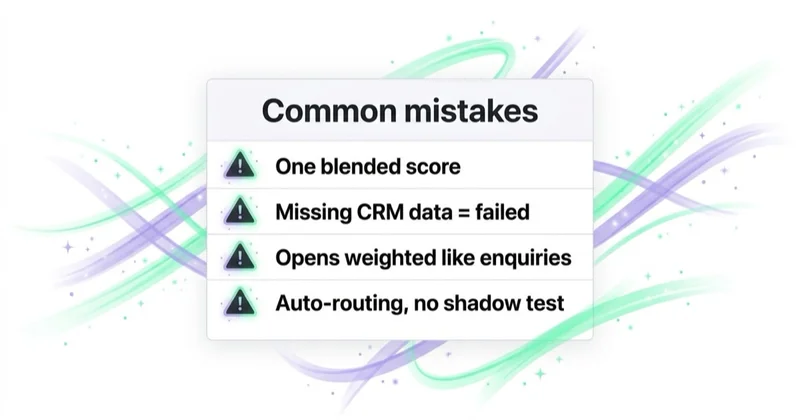
- Using an MQL created by the score as proof that the score predicts MQLs.
- Combining eligibility, fit and engagement into one number that hides why a lead ranked highly.
- Treating missing CRM data as evidence that the lead failed.
- Giving passive activity more weight than an explicit enquiry.
- Allowing points to overcome a genuine eligibility condition.
- Launching automated routing without a shadow test or manual-review path.
- Recalibrating to short-term noise or never revisiting the model after material change.
- Comparing sources on raw lead cost while ignoring acceptance, opportunity and customer value.
Where paid media fits
Paid media can generate an enquiry and capture relevant context, but lead quality is shaped by the offer, form, tracking, qualification and sales response around the campaign. Before selecting an optimisation event, define the stage, confirm that it is recorded consistently and establish how it will be shared with the advertising platform where appropriate.
Space Ads supports lead generation strategy and campaign execution. The scope of CRM, scoring and automation work should be agreed for each engagement rather than assumed from the media brief. Our guide to CRM and marketing automation explains the broader connection.
Common questions
What is the difference between an MQL and an SQL?
An MQL has met the organisation's marketing qualification criteria. An SQL has met the criteria sales uses to begin active pursuit. Some companies add a sales-accepted stage between them; others do not use these labels. The written entry and exit criteria matter more than the acronym.
Does a small company need lead scoring?
It needs a consistent way to qualify and route enquiries, but not necessarily a numerical or automated score. A low-volume team can use a short checklist and manual review. Add automation when volume, complexity or response requirements make it useful.
What is a good MQL score?
There is no portable threshold. A score is meaningful only in relation to a documented model, current data and a defined outcome. Select a threshold by testing the trade-off between volume, precision, sales capacity and the cost of missing a strong lead.
Is BANT outdated?
BANT can still organise a discovery conversation, but rigid early use may exclude viable buyers whose budget, authority or timeline is still forming. Use the framework only where its questions match the sales motion; more complex opportunities may need a richer method.
How often should a lead scoring model be updated?
Monitor it continuously for data or routing failures, but change weights and thresholds when enough outcome evidence exists or a material change affects the model. Preserve version history so you can distinguish a genuine improvement from a temporary shift.
Sources
- Microsoft Learn — Qualify leads with configurable criteria and actions
- Microsoft Learn — Create lead scoring models
- Google Ads Help — About offline conversion imports and enhanced conversions for leads
- Google Ads Help — Offline conversion imports FAQ
- Apple — Mail Privacy Protection
- UK Information Commissioner's Office — Automated decision-making and profiling
Continue learning
Continue reading
How to Choose a Lead Generation Agency (Questions to Ask, Red Flags)
A practical framework for comparing lead generation agencies: scope, measurement, pricing, account ownership, security, contracts and the questions worth asking before you sign.
Appointment Setting vs Lead Generation: What Actually Fills the Calendar
A calendar entry is not a sales outcome. Learn where lead generation ends and appointment setting begins, how to define an accepted meeting, and how to measure the path from booking to opportunity.
Speed to Lead: Why Response Time Decides Who Wins the Deal
Learn how to measure and improve lead response time without sacrificing quality: define the right timestamps, set channel-specific targets, fix routing and coverage, and validate the impact on sales outcomes.