Lead response time is one of the few parts of the acquisition funnel a company can improve without buying more traffic. When a person requests a quote, asks for a call or sends a message, a timely and useful response can preserve the context and intent behind that enquiry.
Speed alone does not decide every deal. Fit, trust, availability, price, expertise and the quality of the conversation still matter. An immediate but irrelevant automated message is not better than a thoughtful response delivered within the timeframe the buyer reasonably expects.
The practical goal is therefore not "respond in five minutes at any cost." It is to match response urgency to the enquiry, remove preventable delays, and measure whether faster meaningful action improves outcomes in your own funnel.
TL;DR
- Define separate timestamps for acknowledgement, first attempt, connection and meaningful response. They answer different questions.
- Set targets by buyer intent, channel, business hours and operational risk; there is no evidence-based universal target for every lead.
- Fix ownership and routing before adding more notifications or automation.
- Use automated acknowledgement to confirm receipt and set expectations, not to impersonate a human conversation.
- Measure the full distribution — median and slower percentiles — plus the percentage handled within the agreed service level.
- Compare response-time bands with connection, qualification, opportunity and customer outcomes, while checking for selection effects.
- Respect contact preferences, time zones, accessibility and applicable rules for calls, email and text messages.
What does speed to lead actually measure?
"Speed to lead" is commonly used for the elapsed time between an enquiry entering a system and a response. That definition is too loose for operational reporting. At minimum, distinguish:
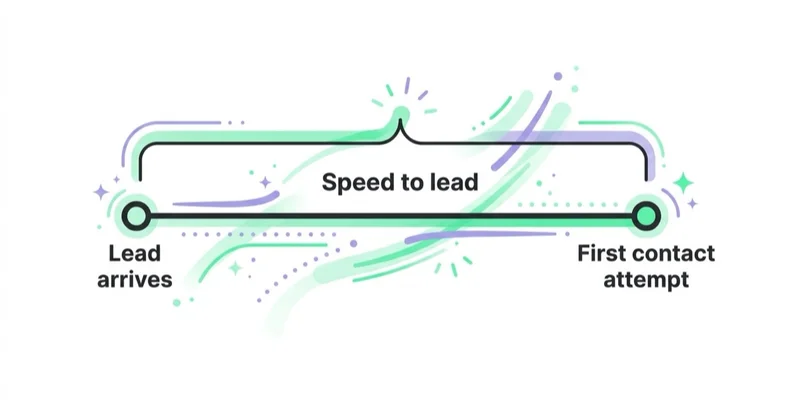
| Event | What it records | What it does not prove |
|---|---|---|
| Lead received | The enquiry reached the agreed system of record | That a person or team could see it |
| Acknowledged | A confirmation or service message was sent | That a human reviewed the request |
| First attempt | A call, reply or other approved contact was attempted | That the prospect received or understood it |
| Connected | Two-way contact occurred | That the need was addressed or qualified |
| Meaningful response | The buyer received a relevant answer or next step | That the deal will progress |
Also define when the timer starts. The platform submission time, webhook receipt, CRM creation and assignment time can differ. Measuring from assignment hides delays in integration and routing; measuring only from the advertising platform can be difficult when systems use different clocks. Choose a source, synchronise time zones and monitor data-transfer failures.
For after-hours enquiries, keep two views if useful: raw elapsed time and service-hours-adjusted time. The raw view reflects the buyer's wait; the adjusted view assesses performance against staffed hours. Reporting only the second can hide a genuine coverage problem.
What the evidence does — and does not — show
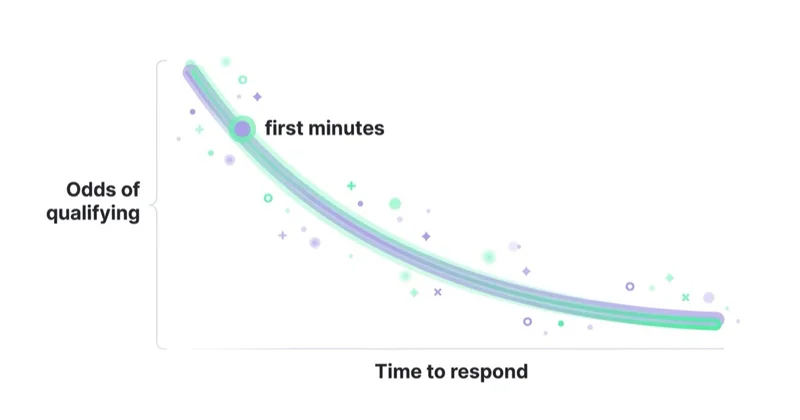
The frequently cited Harvard Business Review article The Short Life of Online Sales Leads was published in 2011. It reported that many companies were not responding to online enquiries quickly enough and associated earlier contact with better qualification outcomes. It remains useful historical evidence that delay deserves attention, but it is not a universal rule for every current channel, market or buying process.
Response time may matter for several plausible reasons:
- the context of an active request is still fresh;
- the prospect may be available on the device or channel they just used;
- urgent or comparison-led buyers may approach more than one provider;
- a prompt response reduces uncertainty and confirms that the request arrived.
However, a simple report can overstate causation. Teams may respond faster to obviously strong leads, during staffed hours or in easy territories. Those same leads may convert better for reasons unrelated to speed. Analyse comparable lead types, channel, time of day, geography and priority before claiming a specific uplift.
Current platform rules can create an additional operational reason to respond. Google says responsiveness is one factor in Local Services Ads ranking, missed calls may affect responsiveness, and estimated messaging response time can appear in an ad when the account meets the relevant conditions.
The defensible conclusion is modest: preventable delay can reduce the chance of a useful conversation, especially for active requests, and companies should find the appropriate target from their service promise and data.
Set response targets by intent and channel
Not every captured contact has asked for immediate sales contact. A person calling now has a different expectation from someone downloading an educational report. Build a response matrix rather than one company-wide number.
| Enquiry type | Buyer expectation to consider | Operational design |
|---|---|---|
| Inbound phone call | A live answer or clear callback route | Queue, overflow, missed-call task and voicemail handling |
| Quote, consultation or demo request | Timely confirmation and a relevant next step | Form validation, priority routing and an accountable owner |
| Chat or messaging | Response within the hours displayed or promised | Staffed availability, queue status and fallback channel |
| Booking request | Confirmation, availability and exception handling | Calendar validation and ownership of failed bookings |
| Content download or newsletter sign-up | Delivery of the requested item; not necessarily a sales call | Accurate service message and consent-aware nurture |
| Existing customer request | Correct service route rather than acquisition follow-up | Customer matching and support escalation |
Define the service level using a combination of buyer urgency, business hours, team capacity, product risk and value. Emergency or safety-related services need processes designed for their actual obligations; a marketing automation workflow is not an emergency-response system.
Why leads still go slow
Delays are often process failures rather than individual effort problems:
- the lead exists in an advertising platform but has not reached the CRM;
- required fields fail validation or duplicate logic blocks the record;
- a shared inbox has no named owner or escalation rule;
- territory and product rules conflict, leaving the lead unassigned;
- notifications are noisy, disabled or sent to someone unavailable;
- business hours, holidays and time zones do not match campaign delivery;
- representatives prioritise existing work because new-lead expectations are unclear;
- the team records calls but not outcomes or timestamps consistently;
- volume exceeds the capacity assumed when the campaign was launched.
Before buying another tool, follow several real enquiries from submission to response. The timestamps and handoffs usually reveal where the waiting time is introduced.
How to improve lead response time
1. Map every intake path
List forms, phone numbers, lead ads, chat, booking tools, partner referrals and manual imports. For each path, identify the system of record, required fields, duplicate rule, owner, fallback and expected action. Test the path with appropriate internal test data rather than assuming the integration works.
2. Make ownership deterministic
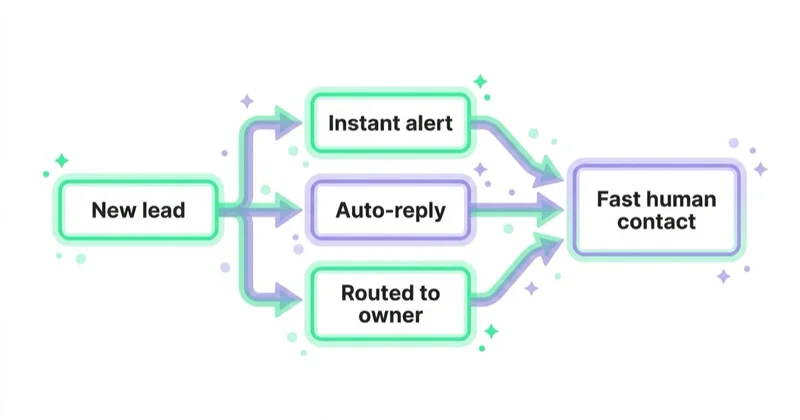
A lead should arrive in a named person's queue or a monitored team queue with explicit acceptance. Routing may use location, language, product, account ownership or capacity. Round-robin distribution is simple but can send urgent or specialist enquiries to the wrong person; rules need to reflect the actual service.
Define what happens when the primary owner is unavailable, does not accept the lead or reaches capacity. An escalation rule is part of routing, not an optional extra.
3. Use notifications selectively
Send actionable alerts to the channel the team actually monitors. Include enough context to choose the next action without exposing unnecessary personal data. Repeated alerts across email, chat and mobile can create alert fatigue and make ownership less clear.
Monitor delivery failures and expiring credentials. A workflow that worked last quarter can silently stop after a form, API or permission change.
4. Separate acknowledgement from human response
An automated message can confirm receipt, repeat the requested service, state opening hours and offer a genuine booking option. It should not pretend that a person has reviewed the enquiry or promise an exact callback the team cannot deliver.
Keep the message useful and restrained. A service acknowledgement should not automatically become a promotional sequence. The rules for marketing by email, SMS and other electronic messages vary by jurisdiction and recipient type. For example, the UK ICO distinguishes service messages from direct marketing and explains when consent or another route is required; the US FTC applies CAN-SPAM requirements to commercial email, including B2B messages. Obtain jurisdiction-specific advice where needed.
5. Build channel-specific response playbooks
Give the owner the information and approved next actions needed to respond well. A playbook can include a concise opening, qualification questions, call-back policy, accessibility options, common routing cases and what must be recorded. It should guide the conversation, not force every buyer through an inflexible script.
6. Plan capacity and coverage
Use lead arrival patterns by hour and day to plan staffing. Decide whether after-hours demand warrants a staffed queue, adjusted campaign schedule, booking option or a clear promise for the next service window. Do not advertise continuous availability if the operation cannot provide it.
During unusual peaks, prioritise explicit requests and tell people when response will take longer. Pausing or limiting acquisition can be better than continuing to buy demand the team cannot handle.
7. Design a respectful follow-up sequence
A missed first attempt is not the end of the lead, but repeated calls and messages can damage trust or breach rules. Set contact frequency, channel, timing, suppression and stop conditions based on the request and applicable law. Honour stated preferences and opt-outs, and use local calling hours.
Record attempts separately from connections. Leaving a voicemail, sending a requested quote and speaking to a prospect are not equivalent events.
8. Create a failure queue
Surface leads with no owner, failed delivery, invalid contact data, missed SLA or contradictory routing. Give someone responsibility for clearing the queue and correcting the root cause. Without this, dashboards may show fast responses for successful records while failed records disappear from the denominator.
A practical marketing-sales SLA
The service-level agreement should be short enough to use and detailed enough to resolve ambiguity. Include:
- which lead sources and stages it covers;
- the exact start and stop timestamps for each metric;
- targets by intent, channel and service window;
- ownership, acceptance and reassignment rules;
- after-hours, holiday and absence handling;
- required response quality and approved channels;
- how attempts, connections, outcomes and rejection reasons are recorded;
- escalation for unassigned or overdue leads;
- privacy, consent and suppression requirements;
- review cadence and authority to change the process.
Avoid a target that rewards superficial activity. If representatives can meet the SLA by sending a generic email and closing the task, the metric will improve while the customer experience may not.
Local Services Ads need specific handling
For Google Local Services Ads, customers may call, message or, where available, book through the ad. Google recommends responding promptly and states that repeatedly failing to answer calls or messages may affect ad ranking. Its help documentation also explains that missed calls may negatively affect responsiveness.
That does not mean every missed call is irrecoverable. Google documents ways to respond to a missed call, and its lead inbox supports calls and messages. Build a callback task, record the result and review opening hours, ad schedules and enabled contact methods. If the team cannot staff messages or calls reliably, adjust availability rather than letting requests accumulate.
Google may display an estimated message response time when an advertiser has sufficient recent message leads. The calculation can depend on specified business hours and weights more recent responses. This platform metric may therefore differ from the CRM metric used for broader operational reporting.
How to measure it
No single average explains response performance. Use a small set of complementary measures:
- median response time: the midpoint and a useful view of the typical lead;
- 75th or 90th percentile: how long slower leads wait;
- percentage within the SLA: operational consistency against the promise;
- unassigned and failed-delivery rate: leads that never entered the normal process;
- acknowledgement, attempt, connection and meaningful-response time: separate stages rather than one blended metric;
- connection and qualification rate by time band: whether faster handling is associated with stronger progression;
- opportunity, customer and value outcomes: whether the effect persists downstream;
- contact complaints and opt-outs: whether faster or more frequent follow-up is harming experience.
Report sample sizes and define exclusions. Separate tests, spam, duplicates and invalid leads using stable rules, not ad hoc removal after seeing performance.
To estimate impact, compare similar cohorts and account for channel, intent, operating hours, territory and priority. A controlled operational change — such as improved routing for one eligible queue — can provide stronger evidence than a simple before-and-after chart, provided it does not unfairly withhold an expected service.
Diagnose before trying to scale
Use a response-time funnel:
- How many enquiries were received?
- How many reached the system of record successfully?
- How many were assigned to an available owner?
- How many were acknowledged, attempted and connected?
- How many received a meaningful next step?
- How many became accepted leads, opportunities and customers?
This makes the constraint visible. More campaign budget will not solve failed routing. More representatives will not solve invalid contact data. More automated messages will not solve an offer that attracts the wrong enquiries.
Where campaign work meets lead operations
A lead-generation campaign should be designed around the organisation that receives demand. Before scaling spend, confirm where enquiries go, how valid leads are identified, who owns response and which downstream events return to measurement.
Space Ads supports lead generation strategy and campaign execution. Routing, CRM, call tracking and automation responsibilities should be defined in the agreed scope for each engagement; they should not be assumed to be included in every campaign service.
Common questions
What is a good speed to lead?
There is no universal number. Set a target by channel, intent, service promise and staffed hours, then validate it against connection and sales outcomes. High-intent requests usually warrant higher priority than passive content engagement, but the response must still be relevant and compliant.
Does an automated reply count as a response?
Count it as acknowledgement, not automatically as human review, a contact attempt or a meaningful response. Report these events separately. The message should identify itself accurately, confirm what happens next and avoid promotional content unless that use is permitted.
How should after-hours leads be handled?
Choose a model the operation can sustain: staffed coverage, a valid self-booking route, adjusted campaign schedules or a clear next-service-window acknowledgement. Measure both the buyer's total wait and performance within staffed hours.
Should every lead receive a phone call?
No. Use the channel and purpose the person selected, their stated preferences and the applicable rules. A call may suit an explicit callback request; it may be intrusive after a simple content download. Qualification and routing should determine the next action.
Is lead quality more important than response speed?
They answer different questions. Quality determines whether and how the enquiry should progress; response time measures how quickly the appropriate action occurs. Optimising either metric in isolation can create poor decisions.
Sources
- Harvard Business Review — The Short Life of Online Sales Leads
- Google Local Services Ads Help — About ad rankings
- Google Local Services Ads Help — Manage leads, response time and jobs
- UK Information Commissioner's Office — Guidance on direct marketing using electronic mail
- US Federal Trade Commission — CAN-SPAM Act compliance guide for business
Continue learning
Continue reading
How to Choose a Lead Generation Agency (Questions to Ask, Red Flags)
A practical framework for comparing lead generation agencies: scope, measurement, pricing, account ownership, security, contracts and the questions worth asking before you sign.
Cost Per Lead (CPL): Benchmarks, What's 'Good', and How to Set Your Target
CPL is easy to calculate and easy to misuse. Learn how to compare valid benchmarks, separate media CPL from fully loaded CPQL, and derive an affordable target from your own unit economics.
Lead Scoring and Qualification: MQL vs SQL Without the Guesswork
A practical guide to MQL, SQL and lead scoring: define auditable stages, choose reliable fit and intent signals, route leads fairly, and improve the model using sales outcomes.