Auto parts ecommerce has a relevance problem that ordinary retail rarely faces. A brake disc can be the correct product for one combination of model year, make, model, engine, body and braking system — and wrong for a vehicle that appears almost identical. Price, stock and advertising cannot compensate for inaccurate compatibility data.
This is why marketing an auto parts store starts upstream of the campaign. The catalogue needs a dependable relationship between parts and vehicles; the website must let a customer identify a vehicle and confirm fitment; product feeds need accurate identifiers and customer-facing titles; and advertising data must eventually reflect cancellations and wrong-fit returns. If one link fails, media can scale orders while the business loses contribution margin.
TL;DR
- Fitment is a data relationship, not a line of copy. Use a maintained application-data source such as TecDoc in many European markets or ACES in North America, supplemented with supplier and internal validation.
- Google's vehicle listings programme is for vehicle inventory, not spare parts. Parts use the standard Merchant Center product specification, which has no universal year–make–model–engine fitment matrix.
- The website resolves compatibility. A persistent garage or vehicle selector, visible fitment confirmation and precise exceptions reduce uncertainty and wrong-fit orders.
- Feeds still matter. Submit stable IDs, correct GTINs or MPNs and brands, accurate titles, landing pages and stock data. Use custom labels for campaign segmentation, not as a customer-facing fitment mechanism.
- Separate intent. A part-number search, a vehicle-plus-part search and a symptom search require different landing experiences.
- Returns belong in acquisition reporting. Track wrong-fit reasons and adjust conversion values where the advertising platform and data latency allow it.
- Optimise for contribution after returns, not gross revenue or ROAS alone.
Why fitment is harder than a normal product variant
A shirt varies by properties of the product itself, such as size or colour. Fitment describes a relationship between two entities: a part and a vehicle configuration. One SKU may fit hundreds of configurations, while two vehicles with the same model name and year can require different parts because of an engine code, axle, production date or optional brake package.
Three failure modes follow, and all cost money:
A false positive. The store says a part fits when it does not. The customer may abandon the page, order and return it, or discover the error during installation when labour and vehicle downtime increase the cost of failure.
A false negative. A compatible part is omitted from the selected vehicle, so the retailer loses a qualified visit or sale without seeing an obvious error in campaign reporting.
An ambiguous match. The store shows a long disclaimer instead of asking for the missing qualifier. Customers either leave or make their own risky interpretation.
Marketing teams should therefore monitor catalogue coverage and compatibility quality alongside sessions and revenue. A technically valid feed can still advertise a commercially unreliable catalogue.
Build a fitment source of truth first
Fitment should not be maintained independently in ad titles, SEO copy and product descriptions. Those are outputs. The source of truth needs structured relationships between the part, vehicle and qualifying notes.
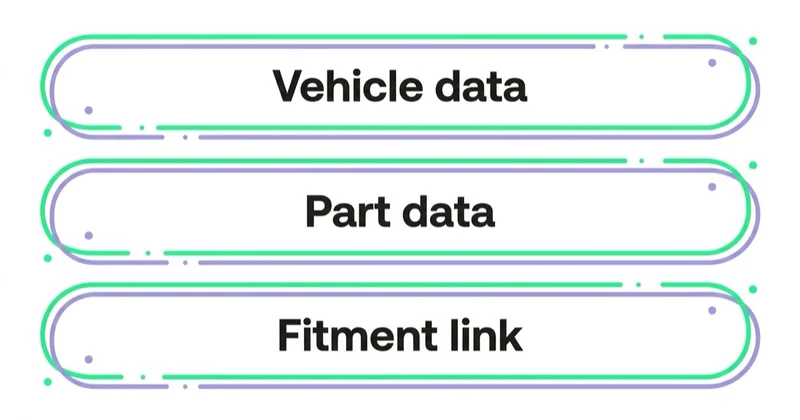
The appropriate standard depends on market and catalogue:
- TecDoc is widely used in the global automotive aftermarket and provides standardised product, vehicle and linkage data.
- ACES (Aftermarket Catalog Exchange Standard) represents vehicle-to-part application data across the Americas, while PIES carries product information. The Auto Care Association released ACES 5.0 and PIES 8.0 in 2026.
- Supplier data and internal validation remain important where coverage is incomplete, local vehicle definitions differ or a manufacturer issues supersessions and exclusions.
A fitment record should preserve more than year, make and model when the category requires it. Engine code, fuel type, power output, body, axle, transmission, chassis range, production date and installation position may decide the match. It should also retain provenance and update time, so the team can investigate whether an error came from a supplier, a mapping rule or an internal edit.
Part identifiers need the same discipline. Store the retailer SKU, manufacturer part number (MPN), brand, valid GTIN where assigned, OEM references and aftermarket cross-references as separate fields. Do not put an internal SKU into the GTIN field or invent an identifier: incorrect identifiers weaken catalogue matching and can lead to Merchant Center issues.
How fitment reaches the customer and the ad platforms
The application database is the foundation, but customers and platforms encounter it through several layers.
Catalogue architecture. Model genuine sellable products as stable SKUs and use the fitment relationship to retrieve them. Do not duplicate the same physical offer into hundreds of pretend variants merely to add vehicle names. Genuine variants need distinct IDs and landing-page states; Google's item_group_id is for variants of the same product, not a substitute for an application table.
Product titles. Lead with information that identifies the item and differentiates the offer: part type, brand, part number and an important specification or narrow vehicle application where it is accurate and useful. Do not force hundreds of fitments into a title or create an unreadable string of keywords. The title on the feed should describe the same product shown on the landing page.
Merchant Center attributes. Submit the standard fields correctly: stable id, title, description, link, images, availability, price, condition and identifiers such as GTIN or brand plus MPN where required. custom_label_0–4 can group offers by margin band, return risk, stock depth, part family or fitment coverage for Performance Max and Shopping reporting. These labels are not displayed to customers and do not encode a complete fitment matrix.
The landing page. Show a clear fitment status near the buying action: confirmed fit, does not fit, or more information required. Display the exact selected vehicle and the qualifiers behind the decision. If a part fits only vehicles produced after a date or with a particular system, the exception must be visible before purchase.
The garage. Save the chosen vehicle with consent and make it easy to switch or remove. Persisting the selection across navigation and return visits removes repeated work, but the interface must never silently apply a stale vehicle to a new order.
The general feed mechanics still apply; our guide to product feeds and their use explains the underlying workflow.
Glossary
- Fitment: the set of vehicles a part is compatible with.
- OEM number: the manufacturer's original part number.
- Cross-reference: the mapping between an OEM number and equivalent aftermarket parts.
- Aftermarket: parts made by companies other than the original manufacturer.
- Garage / vehicle selector: the on-site tool that stores a customer's vehicle and filters the catalogue.
- ACES / PIES: North American standards for exchanging application and product information respectively.
- TecDoc: an automotive aftermarket catalogue standard and data ecosystem for products, vehicles and their linkages.
- Return rate by fitment: the share of orders or units returned because compatibility was wrong or insufficiently described.
Three kinds of buyer, three treatments
| Query type | Who is searching | What they need |
|---|---|---|
| Part number / OEM reference | Has a specific identifier | Confirm the exact part, supersession, equivalence, fitment, stock and delivery |
| Vehicle + part | Knows the vehicle and the component | Fitment confirmation above all |
| Symptom | Knows something is wrong | Diagnosis before a product |
Part-number searches often signal strong product awareness, but they are not automatically safe. A reference can be mistyped, superseded or used to find an equivalent aftermarket product. Landing pages should identify the manufacturer, distinguish OEM and aftermarket references, explain supersessions and still confirm vehicle compatibility. Volumes may be small per number but meaningful across a broad catalogue.
Vehicle-plus-part searches combine product need with a stated vehicle. The destination should preserve that context and answer “does this fit?” without making the customer repeat every selection. Use a category or filtered landing page when several valid products need comparison, and a product page when the query identifies one offer.
Symptom searches describe a noise, warning light or behaviour rather than a known part. Useful content should explain plausible causes, safe checks and when professional diagnosis is necessary. It should not present one part as the guaranteed fix. This is particularly important for braking, steering, restraint and high-voltage systems, where poor advice can create safety risk.
SEO for vehicle and part compatibility
Fitment data can create useful organic landing pages, but generating every possible vehicle–part combination produces millions of thin or duplicate URLs. Indexation needs a deliberate rule.
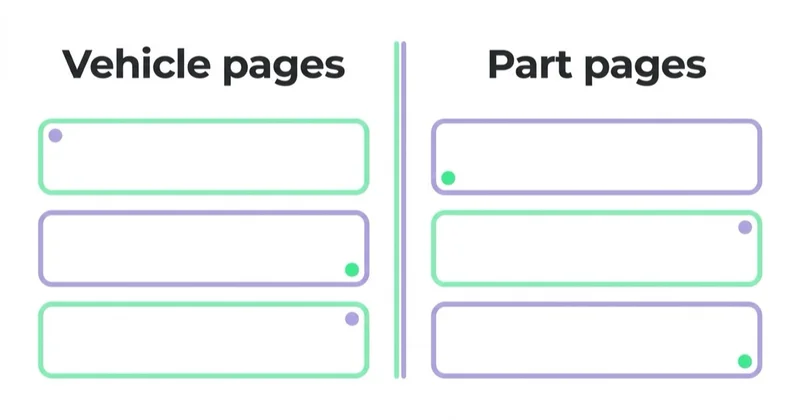
Create an indexable page when it serves a distinct search need and contains meaningful inventory or guidance — for example, brake discs for a specific model generation, with relevant filters, specifications and fitment notes. Keep empty combinations, transient selector states and low-value parameter permutations out of the index. Use consistent canonicals, internal links and sitemaps, and test how search engines crawl faceted navigation.
Product structured data should describe the product and current offer accurately. It does not replace the fitment database. If genuine variants exist, use supported ProductGroup/Product markup consistently with the visible landing page and Merchant Center feed.
Helpful category and product content can answer the questions a fitment row cannot: whether parts are sold as a pair, which axle they serve, what additional hardware is required, how part numbers were superseded and which measurements must be checked. Avoid generic text repeated across every model page.
Returns are a marketing metric
In most ecommerce, returns are an operations concern. Here they belong in the marketing report.
A wrong-fit order can incur outbound and return shipping, payment costs, support time, inspection, repackaging, lost resale value and workshop delay. The exact cost depends on return terms and whether the part can be resold, so calculate it from operational data rather than applying a generic penalty.
That has a direct consequence for optimisation. If the ad platform receives the original order value and never receives the return, value-based bidding continues to learn from revenue the retailer did not keep. Gross ROAS can therefore reward campaigns or products with poor post-purchase economics.
Two practical steps:
Use structured return reasons. Separate confirmed incompatibility from customer selection error, damaged goods, faulty product, installation issue, changed mind and duplicate order. Return codes are evidence, but sampled ticket review is needed because customers and support teams do not always select the true cause.
Connect order IDs to acquisition. Google Ads conversion adjustments can restate the value of a partially returned order or retract a conversion. They require the necessary identifiers and have processing and bidding-readability windows, so the implementation must account for the store's return delay. For slower returns, an expected net value at purchase time may be more useful for bidding, while finance reporting later reconciles actual results.
Use contribution, not an invented “net revenue” metric. At minimum deduct discounts, tax where applicable, product cost, fulfilment, payment fees and expected returns. If shipping revenue and shipping cost behave differently, model both. Our guide to margin-based conversion values covers the broader method.
Diagnose the constraint before changing campaigns
Different symptoms point to different parts of the system:
| Symptom | Likely questions |
|---|---|
| Relevant products receive few impressions | Are identifiers, titles, categories, approvals and campaign inclusion correct? Is demand present? |
| Ads receive clicks but product pages do not convert | Does the page preserve vehicle context, confirm fitment, show delivery and reduce uncertainty? |
| Orders convert but wrong-fit returns are high | Is source data accurate? Are critical qualifiers visible? Does the selector ask enough questions? |
| Revenue is strong but contribution is weak | Are bidding values accounting for margin, fulfilment, discounts and returns? |
| Organic traffic is fragmented across parameter URLs | Is faceted navigation creating duplicate or thin indexable states? |
This diagnostic prevents a bidding change from masking a catalogue or user-experience defect.
How Space Ads approaches auto parts ecommerce
We start by mapping the path of data rather than assuming the advertising account is the only constraint: source catalogue → fitment linkage → selector and landing page → Merchant Center → campaign → order → return or retained contribution. At each transition, we define an owner, freshness threshold and validation check.
Where Space Ads does not control the underlying vehicle database, our role is to specify and test the marketing requirements: stable product IDs, reliable fitment states, feed diagnostics, campaign labels tied to commercial attributes, order-level attribution and return feedback. Claims about performance should follow measured client data; until then, industry practice is treated as a testable implementation standard, not as a guaranteed result.
Structural decisions worth getting right
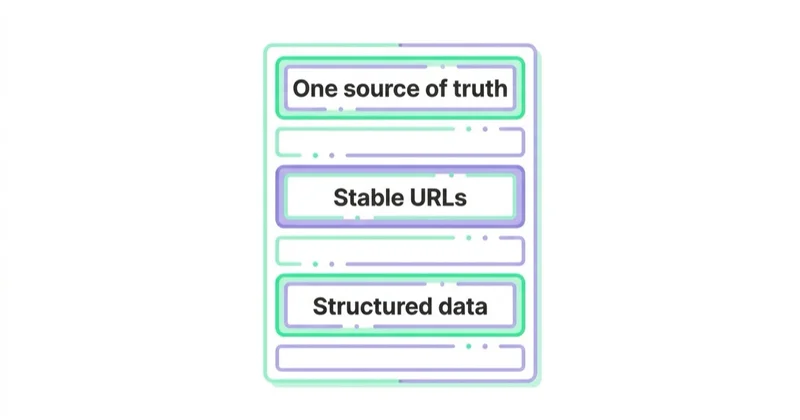
- Choose and document the fitment source of truth. Define how supplier changes, conflicts, supersessions and exceptions are handled.
- Keep product identity separate from vehicle application. Use stable SKUs and valid identifiers; do not create artificial variants for keyword coverage.
- Design a three-state fitment answer: fits, does not fit, or more vehicle information required.
- Persist the selected vehicle responsibly and keep it visible throughout browsing, cart and checkout.
- Create titles for clarity, using part type, brand, identifier and a concise application or specification only where accurate.
- Use custom labels for commercial segmentation, such as margin, stock depth, return risk and range — not as a replacement for fitment.
- Track search terms, selector usage, no-result searches, fitment overrides, cancellations and return reasons.
- Send useful order values and adjustments to ad platforms within their technical windows.
- Control faceted SEO, indexing only pages with distinct demand and meaningful content or inventory.
Instrument the selector as a product feature. Track completion rate, the field where users abandon, zero-result combinations, manual fitment questions and how often customers change the saved vehicle before purchase. These signals show where the catalogue or interface fails before return data arrives.
Where this differs from dealership marketing
The two are frequently conflated and are separate businesses with separate infrastructure.
Dealerships sell vehicles and may be eligible for Google's vehicle listings programme, whose feed includes vehicle inventory fields such as VIN, make, model, trim, year and mileage. Eligibility and availability depend on Google's current programme rules. That distinct use case is covered in our guide to car dealership PPC and vehicle ads.
Parts retailers submit offers through the standard Merchant Center product specification. The vehicle listings feed is not a way to send part-to-vehicle compatibility data. Fitment must be resolved through the retailer's catalogue and customer journey, with selected application details expressed accurately in the product experience.
FAQ
What makes auto parts ecommerce marketing different? Fitment is a many-to-many relationship between parts and vehicle configurations. It often depends on qualifiers beyond year, make and model. Marketing therefore relies on the quality of the application database, selector, product page and post-purchase feedback — not just on ads and bids.
Can Google's product feed express vehicle compatibility?
Not as a universal, dedicated year–make–model–engine matrix. Parts use the standard product specification. Submit accurate identifiers, product information and landing pages, and use custom_label_0–4 for internal campaign grouping. The underlying application database and website must still resolve full compatibility.
Should each vehicle variant be a separate product? Not if the physical sellable item is the same. Keep one stable offer and map its compatible vehicles in the application database. Create separate products or variants only when customers are actually choosing different sellable configurations with their own IDs, landing-page state, availability or price. Artificial duplication increases maintenance and feed risk.
Why do returns matter so much in this category? Because advertising platforms initially see an order, not its final economics. A wrong-fit order may later create shipping, support, inspection and resale costs. Return-reason data and conversion adjustments help the marketing team distinguish retained contribution from revenue that was later lost.
What about symptom-based searches? They represent a research or diagnostic need. Send the visitor to evidence-led guidance that covers several plausible causes, safe checks and the point at which a qualified mechanic is needed. Recommend a part only after the problem and vehicle application are sufficiently identified.
Are OEM part numbers worth bidding on? They can be valuable because the query is specific, but economics and competition vary. Ensure the reference is correct, distinguish OEM from aftermarket equivalents and confirm fitment. Evaluate the aggregate long tail on retained margin rather than assuming every part-number query is profitable.
Key takeaways
- Treat fitment as maintained application data, with documented sources, qualifiers and update rules.
- Use stable product identities and valid GTIN, MPN, brand, OEM and cross-reference fields; do not manufacture variants for keyword coverage.
- Build a persistent vehicle selector and show an explicit fit, no-fit or more-information-required state before purchase.
- Parts use Merchant Center's standard product specification; Google's vehicle listings programme is for vehicle inventory.
- Match part-number, vehicle-plus-part and symptom searches to different landing experiences.
- Connect orders, structured return reasons and commercial value so campaigns optimise towards contribution after returns.
How we build commerce infrastructure, including catalogues and feeds, is on our e-commerce development page.
Sources and further reading
- Product data specification — Google Merchant Center Help
- Custom labels for Shopping and Performance Max — Google Merchant Center Help
- Feed specification — Vehicle listings on Google
- Product variant structured data — Google Search Central
- Conversion adjustments — Google Ads Help
- TecDoc catalogue and ecommerce data — TecAlliance
- ACES 5.0 and PIES 8.0 release — Auto Care Association
- What is a product feed and how to use it
- Car dealership PPC and Google vehicle ads
Continue reading
Local Inventory Ads: The Format Decided by Your Stockroom
Local inventory ads connect nearby demand with products available in physical stores. Learn how to prepare store data, pickup options, landing pages and offline measurement without promising stock the customer cannot buy.
The Shopify Marketing Stack: What to Install and What to Remove
A Shopify marketing stack should connect customer data, storefront experience, merchandising, lifecycle and acquisition without duplicating events or adding unmanaged risk. Use this framework to choose, govern and remove apps safely.

How to Market a Private Label Brand Nobody Has Heard Of
Market an unknown private label by turning a real product advantage into verifiable proof, making the first purchase feel safe and building acquisition around contribution, repeat demand and compliant reviews.