An employer brand is the reputation an organisation has as a place to work. Employer branding is the deliberate work of understanding and shaping that reputation. Recruitment marketing turns the employer proposition into demand and candidate journeys, while vacancy advertising promotes a specific open role.
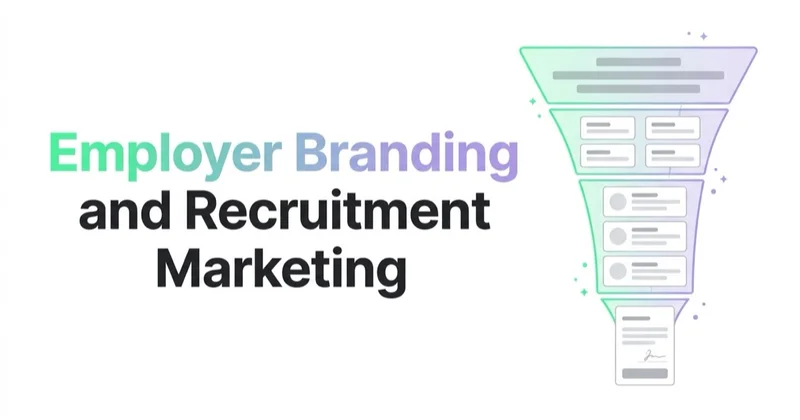
These activities support one hiring system, but they operate on different timescales and should not be judged by the same number. Employer branding cannot be evaluated only by this month's hires; a vacancy campaign that produces hundreds of unsuitable applications is not successful because its cost per form submission is low.
The practical goal is to connect a credible employment experience with the right audience, a clear role, a low-friction process and hiring-stage feedback.
TL;DR
- Employer brand, employer branding, recruitment marketing and vacancy advertising are related but not interchangeable. Define the job of each workstream before assigning spend.
- Build the employer value proposition from employee and candidate evidence. It should describe the real exchange—work, expectations, reward, development and trade-offs—not generic culture claims.
- Employment advertising is subject to platform policies and anti-discrimination law. Google restricts certain targeting for employment ads serving in the US and Canada; Meta requires relevant campaigns to use its Special Ad Category. Check current rules for every target market.
- Clear creative does part of the qualifying: state the role, location, work model, schedule, requirements and pay information that candidates need to decide.
- Audit the full candidate journey on mobile. Campaign optimisation cannot compensate for an unclear job page, unnecessary application steps or a slow response.
- Measure qualified applications, progression, offer acceptance and hires, not application volume alone. Define quality with job-related criteria and monitor for bias.
- Feed deeper recruitment outcomes back into planning—and, where appropriate and lawful, advertising systems—without uploading sensitive or prohibited data.
The terms teams often mix together
| Discipline | Primary purpose | Typical horizon | Useful evidence |
|---|---|---|---|
| Employer brand | The actual perception held by employees, candidates and the labour market | Continuous | Research, reputation, employee and candidate experience |
| Employer branding | Understand, improve and communicate the employment experience and proposition | Months to years | Awareness/consideration in priority talent, application and acceptance trends, retention context |
| Recruitment marketing | Build and convert interest among relevant talent groups | Weeks to months | Qualified candidate pipeline, source progression, cost and speed |
| Vacancy advertising | Generate suitable candidates for a defined open role | Days to weeks | Qualified applications, interviews, accepted offer, cost and time to fill |
The boundaries can overlap. A vacancy advert also shapes employer reputation, and employer-brand content can help an active candidate decide to apply. The table is not an argument for organisational silos; it is a way to prevent one fast metric from distorting every investment.
Budgets do not always need separate bank accounts or campaigns. They do need identifiable objectives, costs, audiences and outcomes. Otherwise, a long-term reputation programme is continually cut for failing to fill this week's role, while vacancy media receives credit for demand created before the advert ran.
Start with the hiring problem
“We need more applicants” is often an incomplete diagnosis. Hiring may be constrained by low awareness, an uncompetitive offer, unclear requirements, a limited qualified population, application friction, slow screening, interview capacity or poor offer acceptance.
Define the problem at role-family and location level:
- How many people need to be hired, by when and where?
- Which skills or credentials are genuinely essential on day one?
- How large and mobile is the relevant labour pool?
- What are candidates choosing instead—including staying with their current employer?
- At which funnel stage does supply fall below the hiring requirement?
- How quickly can recruiters and hiring managers respond?
- Which parts of the offer can the organisation change?
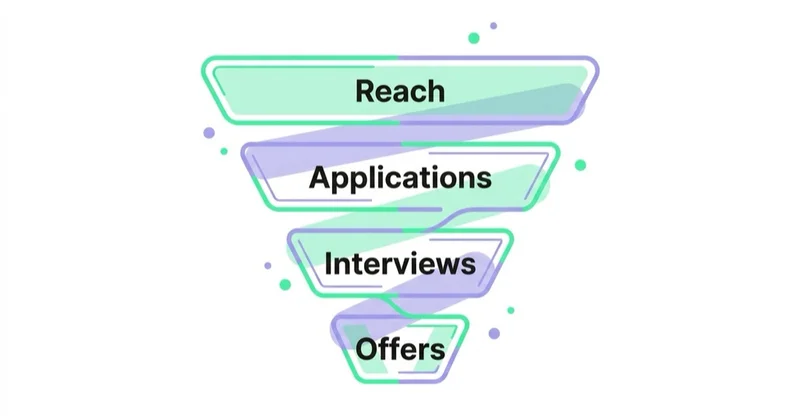
A simple funnel model makes the brief testable. If one hire historically requires two accepted offers, three offers, six final interviews and 30 qualified applications, the team can estimate the required top-of-funnel volume and recruiter capacity. Use real conversion ranges rather than pretending the forecast is exact, and update it as evidence arrives.
Research the employer brand before writing the EVP
Every organisation already has an employer brand; the question is whether the official story matches lived experience. CIPD recommends building a clear picture of what the organisation offers and requires, involving employees, reviewing external perceptions and auditing the candidate journey.
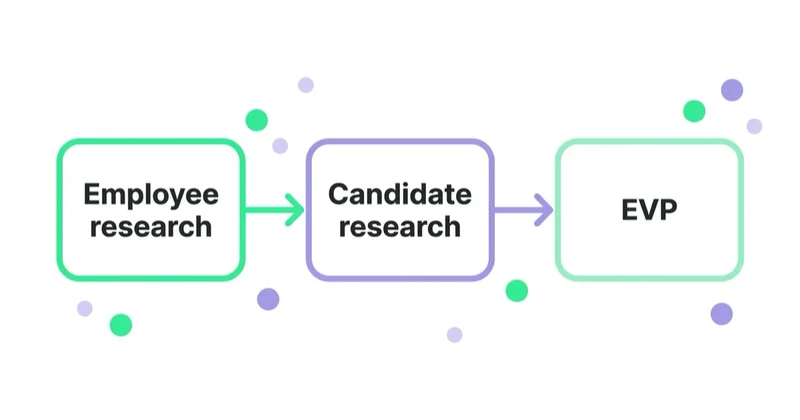
Use several evidence sources:
- interviews or workshops with recent hires, established employees and hiring managers;
- candidate feedback, including people who withdrew or declined an offer;
- exit themes and retention data, interpreted carefully;
- employee surveys and internal mobility patterns;
- reviews and public discussion, checked for recurring themes rather than isolated comments;
- competitor job offers, pay, location and working models;
- application, interview and acceptance data by role family and market.
Research should include both strengths and friction. If employees value autonomy but find priorities change quickly, both may be relevant. Suppressing every trade-off produces a polished campaign that attracts people under false expectations.
Turn evidence into an employer value proposition
An EVP describes the exchange between employer and employee: what people contribute, what they receive and what experience they can reasonably expect. It should be broad enough to unite the organisation but flexible enough to make role-specific choices.
Useful components include:
- the purpose and real scope of the work;
- pay and benefits, explained accurately;
- location, schedule and flexibility;
- team, manager and decision environment;
- learning, progression and evidence of mobility;
- tools, conditions and operational support;
- performance expectations and genuine trade-offs.
Avoid claims such as “dynamic culture”, “industry-leading pay” or “unlimited progression” unless they can be evidenced. Show proof: actual projects, a defined training budget, examples of internal moves, working-pattern details, employee voices and observable policies.
The most useful quality check is consistency. Would an employee recognise the proposition? Will the recruiter, interview, offer and first 90 days confirm it? CIPD explicitly warns that employer brand should reflect actual employee experience rather than restate values as rhetoric.
Build a job proposition, not just an employer slogan
The corporate EVP is not enough to fill a specific role. Candidates need an accurate job proposition.
A strong vacancy page answers:
- What will the person own and what will a normal week involve?
- Which outcomes are expected in the first six or twelve months?
- Who is the manager and how is the team structured?
- Which requirements are essential, and which can be learned?
- Where and when is the work performed?
- What is the recruitment process and expected timeline?
- What pay range and benefits apply?
- What are the demanding or less attractive parts of the role?
Review requirement lists for inherited preferences that are not necessary for performance. Inflated years-of-experience thresholds or generic degree requirements can unnecessarily shrink the pool. Selection criteria should be job-related, consistently applied and agreed before promotion begins.
Creative should help candidates self-select
Employment-ad targeting is more constrained than ordinary product advertising in some markets, and discrimination law applies regardless of what a platform technically permits. Clear messages are therefore strategically important.
Lead with decision-relevant facts: role, location, onsite or hybrid expectations, shift pattern, contract type, pay information and essential credentials. Then communicate a relevant reason to consider the role and support it with evidence.
Different creative can answer different questions without stereotyping the audience:
- “What will I do?”—show the work, tools and outcomes.
- “Who will I work with?”—introduce the team and manager.
- “Can this fit my life?”—state schedule, travel and location plainly.
- “Can I grow?”—show a real learning path or employee example.
- “Is the employer credible?”—use specific policies, facilities and proof.
Avoid implying that a protected characteristic is required or preferred unless specialist legal advice confirms a lawful exception. Do not infer sensitive traits merely because they correlate with candidate profiles.
Employment advertising policies: the operational essentials
Platform policy is not a substitute for legal review, and it changes over time. Confirm the rules in the current policy centre and campaign interface before launch.
Google Ads
Google classifies job opportunities, recruitment sites and related services as employment in its “access to opportunities” policy. For ads serving in the United States and Canada, advertisers cannot target by gender, age, parental status, marital status or ZIP code. City, country and compliant radius targeting remain available; Google currently states that radius targeting must use at least 1 km.
The restriction follows where the ad serves, not simply where the advertiser is based. Google reviews the advert and destination, so neutral ad copy does not necessarily take a careers page outside the policy.
Meta
Meta requires advertisers to choose the applicable Special Ad Category when creating campaigns related to employment. The available targeting controls and enforcement can differ by market and product configuration, so document the category selection and verify the current options in Ads Manager rather than copying an old campaign setup.
Meta's advertising standards also prohibit discriminatory practices. Treat platform controls as a minimum boundary, not permission to use criteria that would be unlawful or unfair in the relevant jurisdiction.
Data and audience governance
Candidate data may reveal or enable inferences about sensitive matters. Establish who may access it, the lawful purpose and retention period, what is sent to media platforms, and how candidates are informed. Never pass CV contents, interview notes or protected-characteristic data in advertising URLs, tags or conversion uploads.
EU pay transparency: what recruitment teams should prepare for
Directive (EU) 2023/970 required EU Member States to transpose pay-transparency rules by 7 June 2026. The Directive requires applicants to receive information about initial pay or its range in a way that supports an informed negotiation, for example in the vacancy notice or before the interview. Employers must not ask candidates about current or previous pay history.

Directives are implemented through national law, so the precise rules, timing, enforcement and additional obligations must be checked in every hiring jurisdiction. This article is not legal advice.
Operationally, multi-market employers should review:
- where and when the pay range appears in the journey;
- whether application forms or recruiter scripts ask about pay history;
- whether job titles and evaluation criteria are gender-neutral and consistent;
- whether published ranges match the approved hiring range;
- how variable pay, benefits, working hours and location affect the comparison;
- how local requirements are maintained when one applicant-tracking template serves several countries.
Publishing an unusably broad range may satisfy neither candidates nor the intended transparency objective. Explain the basis for placement within the range where appropriate.
Choose channels by the labour market and the task
Channel choice should follow role, geography, candidate behaviour, urgency and evidence—not an organisation-wide preference.
Professional, technical and management roles
Professional networks, specialist communities, search, referrals and direct sourcing may all contribute. Candidates often require substantial information before moving, so careers content, employee evidence and a credible hiring manager matter. For scarce roles, reach alone is rarely sufficient; proposition and selection speed can be decisive.
Operations, logistics, retail and hospitality
Local search, social reach, job boards, referrals and community partnerships can generate volume. Mobile application, clear shifts, transport realities and rapid contact are critical. Use permitted location controls and let the job details qualify, rather than making demographic assumptions about likely workers.
Trades, healthcare and regulated roles
The qualified pool may be small and credentials non-negotiable. Specialist sources, professional bodies, search and referrals can be more valuable than broad reach. Verify licensing claims and distinguish credentials required by law from employer preferences.
Early-career and apprenticeship hiring
Education partnerships, careers services, events, search and social content can explain unfamiliar routes into work. The message should address candidates and, where relevant, people who influence the decision—without using inappropriate age targeting.
Employer-brand activity
Careers pages, employee stories, organic social, events, PR and paid reach can build familiarity before a vacancy opens. Choose distribution based on the defined talent group and research question. High engagement with general company content does not automatically mean stronger hiring consideration.
Test source quality through progression, not clicks. A smaller specialist source may deliver a higher proportion of interviewable candidates and a lower total cost per hire than a high-volume network.
Audit the candidate journey end to end
An advert is only one step. Review the journey from first impression to accepted offer on the devices candidates actually use.
Before application
- Is the job title recognisable outside the organisation?
- Are pay, location, schedule and contract details easy to find?
- Does the page distinguish essential from desirable criteria?
- Is the employer claim supported by evidence?
- Is the process and expected timing explained?
During application
- Does the page and form work on mobile and with assistive technology?
- Is account creation necessary before initial submission?
- Are candidates asked to retype information already supplied?
- Is every field needed at this stage and collected for a clear purpose?
- Can reasonable adjustments or an alternative application route be requested?
- Is completion measured by device, role and source?
After application
- Is receipt confirmed and the next step clear?
- How quickly are suitable candidates contacted?
- Are interviews structured around job-related criteria?
- Are rejections and delays communicated respectfully?
- Does the offer match what the advert and interview promised?
Do not assume which form element causes the greatest abandonment. Instrument starts, field errors, completion and response time, then combine the data with usability observation and candidate feedback. Our guide to landing-page conversion mistakes covers the underlying friction principles.
Measure from exposure to employment outcome
A recruitment scorecard should connect marketing signals to hiring quality without pretending that marketing alone controls the result.
| Stage | Useful measures | Main question |
|---|---|---|
| Reach and interest | Relevant reach, job-page visits, repeat engagement | Did the intended labour market encounter and investigate the offer? |
| Application journey | Starts, completion, source, device, time | Did interested people manage to apply? |
| Qualification | Qualified applications and rate, reasons for rejection | Did the offer reach people who meet agreed criteria? |
| Selection | Screening/interview progression, time at stage, withdrawal | Is the process consistent and fast enough? |
| Offer | Offers, acceptance, decline reasons | Did the proposition survive evaluation? |
| Hire | Hires, time and total cost to fill | Did the system produce the required appointments? |
| Post-hire | Early retention and role-specific performance indicators | Did expectations and selection align with the work? |
Define “qualified” before seeing applicants
Qualified-application rate is valuable only if criteria are consistent. Agree essential, job-related requirements with hiring managers, record rejection reasons and audit how different recruiters apply them. Otherwise, campaign optimisation can scale subjective bias rather than quality.
Quality of hire is not a single universal number. Combine role-relevant evidence—such as successful probation, performance against defined expectations, retention and hiring-manager assessment—over an appropriate period. Marketing should not claim sole credit because onboarding, management and the work environment affect post-hire outcomes.
Connect deeper outcomes carefully
Applicant-tracking data can show source-to-hire progression and support offline conversion measurement. Google Ads, for example, allows advertisers to import later outcomes from a lead system. In recruitment, this might mean a privacy-reviewed, appropriately consented and technically compliant “qualified application” event rather than every submitted form.
Before activation:
- confirm the lawful basis, notices and platform terms;
- exclude sensitive or prohibited candidate information;
- establish minimum volumes and reliable event definitions;
- account for long delays between click, application and decision;
- monitor whether optimisation changes the composition or fairness of the pool;
- keep human oversight of employment decisions.
Our guide to offline conversion import and value-based bidding explains the advertising mechanics; recruitment and privacy teams must decide whether and how they are appropriate for the hiring process.
Measuring employer brand without claiming easy causality
Employer brand develops through actual employee and candidate experience as well as communication. Track a balanced set of leading and outcome indicators in priority talent groups:
- prompted and unprompted awareness or consideration research;
- careers-page and employer-content behaviour;
- relevant talent-community growth;
- direct and organic application trends;
- qualified application rate for comparable roles;
- candidate experience and offer-decline reasons;
- acceptance and early retention, with role and market context.
Changes in pay, labour supply, hiring process, role mix or management can move the same outcomes. Use pre/post comparisons cautiously and test specific media activity with holdouts or matched markets when scale allows. Employer-brand measurement should support decisions, not manufacture one neat attribution percentage.
A practical operating plan
Phase 1: diagnose
- Segment hiring demand by role family, market, urgency and volume.
- Map the funnel from relevant reach through hire and identify the weak stage.
- Research employee, candidate and competitor evidence.
- Review policy, legal, accessibility and data requirements by market.
Phase 2: build the proposition and journey
- Define the evidence-based EVP and role propositions.
- Rewrite vacancy pages around candidate decisions and job-related criteria.
- Test the application journey on mobile and assistive technology.
- Agree response standards, interview ownership and feedback fields.
Phase 3: activate and learn
- Assign channel roles and separate employer-brand activity from vacancy outcomes in reporting.
- Create message variants based on candidate questions, not demographic stereotypes.
- Launch in controlled stages that recruitment teams can process.
- Review qualified progression, fairness signals, acceptance and time—not only media cost.
Phase 4: improve the system
- Feed rejection, withdrawal and decline reasons into proposition and targeting decisions.
- Compare sources on cost per qualified progression and hire.
- Use post-hire evidence to check expectation alignment without blaming marketing for every retention outcome.
- Refresh the EVP when employee reality, talent priorities or market conditions change.
Common mistakes
| Avoid | Do instead |
|---|---|
| Treating employer brand as a campaign slogan | Research and improve the actual employment experience |
| Reporting all recruitment activity on cost per application | Separate workstreams and measure qualified progression to hire |
| Writing an EVP from leadership aspirations alone | Use employee, candidate and labour-market evidence |
| Hiding pay, schedule or difficult conditions until interview | Give candidates decision-relevant facts early |
| Copying ordinary audience targeting into employment campaigns | Apply platform policy, law and documented governance by market |
| Assuming the advert is the bottleneck | Instrument the job page, form, recruiter response and selection stages |
| Sending every application as a platform success | Use deeper, reliable and privacy-reviewed outcomes where appropriate |
| Calling recruiter judgement “quality” without a definition | Agree job-related criteria and audit consistency and bias |
| Promising employer-brand ROI from one attribution report | Triangulate research, behaviour, hiring outcomes and experiments |
How Space Ads approaches employer branding and recruitment marketing
We begin with the hiring requirement, candidate evidence and funnel rather than selecting a media platform first. The resulting plan connects the EVP, role proposition, creative, compliant distribution, application journey and hiring-stage feedback.
Media reporting then distinguishes reach and response from qualified progression and hire. We also make dependencies visible: the strongest campaign cannot repair an uncompetitive offer, delayed screening or an employment experience that contradicts the message.
For businesses whose service is recruiting for clients rather than hiring only for themselves, our guide to staffing and recruitment agency marketing covers the separate challenge of generating employer leads and candidate supply.
FAQ
What is the difference between employer branding and recruitment marketing?
Employer branding researches, improves and communicates an organisation's reputation as a place to work. Recruitment marketing applies that proposition to attract and convert relevant candidate groups. Vacancy advertising is the narrower promotion of an open role. The disciplines overlap, but require different objectives and evaluation periods.
What should an employer value proposition include?
It should explain the real exchange between employer and employee: work and expectations, pay and benefits, flexibility, team and management, development, conditions and trade-offs. Claims should be specific, evidenced and consistent with candidate and employee experience.
Can employment ads target a specific candidate profile?
Only within the law and each platform's current policy. For employment ads serving in the US and Canada, Google prohibits targeting by gender, age, parental status, marital status and ZIP code. Meta requires relevant campaigns to use the employment Special Ad Category. Use job-related requirements and clear creative; never use protected characteristics as a shortcut for suitability.
Must employers publish a pay range in the EU?
Directive (EU) 2023/970 requires applicants to receive initial pay or range information in time for an informed negotiation, for example in the vacancy notice or before interview, and prohibits asking about pay history. Member States implement directives through national law, so employers must check the precise rules in each jurisdiction.
Which recruitment marketing metrics matter most?
Use metrics appropriate to the weak stage: relevant reach, application completion, qualified applications, interview progression, offer acceptance, hires, time and total cost to fill. Add post-hire indicators when definitions and observation periods are fair. Application volume alone is insufficient.
Why can a campaign generate many applications but few hires?
The message may be too broad, essential criteria unclear, the source poorly matched, screening inconsistent, the offer uncompetitive or the process too slow. Break down progression and rejection reasons by role and source before increasing media spend.
How long does employer branding take to work?
Reputation usually changes over months or years, while a specific content or media test may produce earlier signals. Track leading indicators in priority talent groups and comparable hiring outcomes, but allow for pay, role mix and labour-market changes when interpreting them.
Should recruitment outcomes be imported into ad platforms?
Deeper outcomes can improve measurement and optimisation, but only when the event is reliable, sufficiently frequent, lawful and compliant with platform terms. Do not upload sensitive candidate data, and monitor for unintended bias. In some contexts, the right decision is to use the data only in internal analysis.
Key takeaways
- Employer brand is a lived reputation; employer branding and recruitment marketing can communicate it but cannot invent it sustainably.
- Define the hiring problem and funnel before buying reach.
- Build the EVP and role proposition from evidence, with clear expectations and trade-offs.
- Apply employment-ad policy, anti-discrimination law, pay-transparency rules and candidate-data governance by market.
- Make the vacancy and application journey explicit, accessible, mobile-friendly and fast.
- Measure qualified progression, acceptance and hire, using predefined job-related criteria.
- Connect marketing and recruitment data carefully, and keep human accountability for hiring decisions.
Learn more about our employer branding and lead generation work.
Sources and further reading
- Employer brand factsheet — CIPD
- Directive (EU) 2023/970 on pay transparency — EUR-Lex
- New EU rules on pay transparency explained — European Commission
- Employment in personalised advertising — Google Ads Policy
- Personalised advertising and restricted targeting — Google Ads Policy
- Create campaigns and select a Special Ad Category — Meta Help Centre
- Discriminatory practices — Meta Advertising Standards
- Set up offline conversions using GCLID — Google Ads
Continue reading

ChatGPT Ad Formats and Character Limits: What Actually Fits
A ChatGPT ad appears below the response and carries six elements, with specific limits: title 3–50 characters, body up to 100. The "24 / 48 character" figures in trade coverage do not match the documentation, so this guide gives the full limits table, shows how to fit a useful message, and covers the image, product ads and end-to-end consistency with the landing page.
OpenAI Ads Manager: How to Set Up Your First ChatGPT Ads Campaign
OpenAI Ads Manager has three campaign levels, but launch also requires advertiser verification, billing, landing-page checks, measurement and deliberate choices for settings that cannot be changed later. This guide covers the setup sequence, budgets, context hints, oCPC, targeting, review and Ads API workflows.

Switching Marketing Agencies Without Losing the Account
A safe agency switch protects client-owned accounts, billing, conversion signals, creative rights and operating knowledge. Use this transition plan to assign responsibility, validate access and change partners without avoidable disruption.