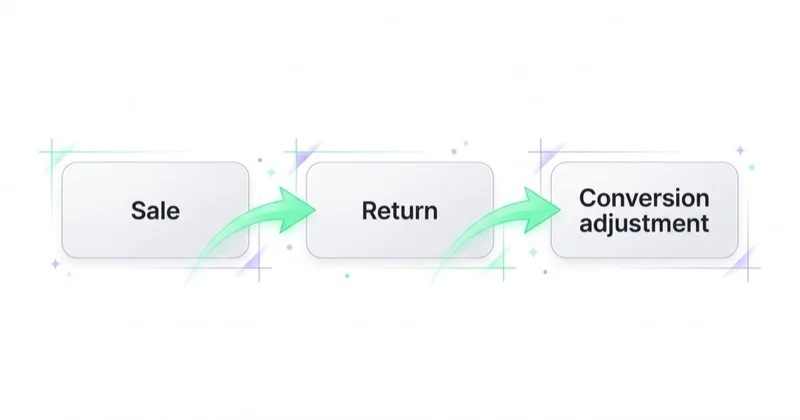
Returns in Google Ads are a measurement issue, not only an operations issue. On the day of purchase, a campaign may record gross order revenue. Days or weeks later, the order can be cancelled, partially refunded or returned. If the ad platform keeps optimising against the original value, Smart Bidding learns from a version of revenue that the business does not keep.
This matters in ecommerce because returns are rarely evenly distributed. They vary by category, size, promotion, product type, market and traffic source. A product can show strong ROAS inside Google Ads while producing weak profit after refunds, discounts, fulfilment and return handling.
TL;DR
- Google Ads can adjust conversions after they have been reported when the value of the order changes.
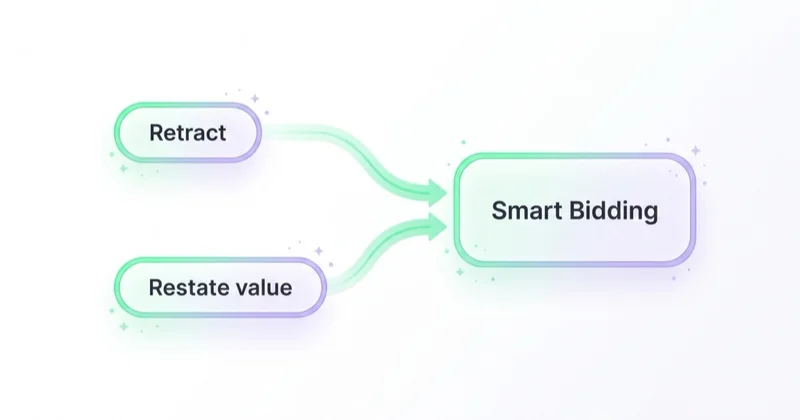
RESTATEchanges the conversion value, for example after a partial refund.RETRACTremoves the conversion, for example after a cancellation or full return.- Conversion adjustments usually need the order ID that was passed with the original conversion.
- Adjustments matter most for value-based bidding strategies such as target ROAS.
- For long return windows, combine adjustments with conservative starting values and product segmentation.
Why returns distort campaign performance
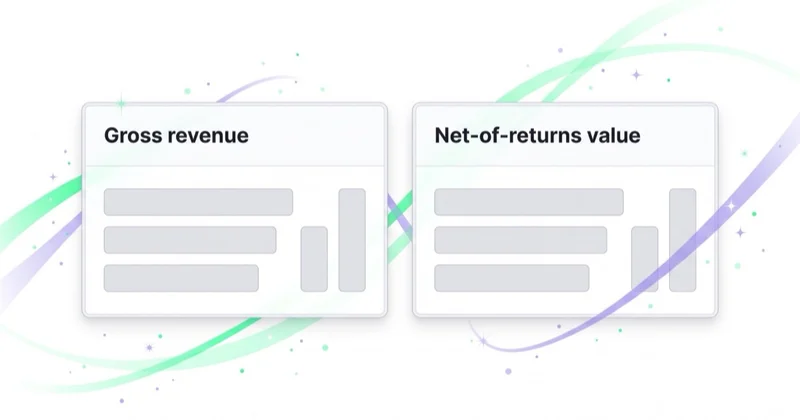
Google Ads optimises based on the data it receives. If an order worth $1,000 is reported as $1,000 and half of it is returned a week later, the original value may remain in Google Ads unless the store sends an adjustment. ROAS is then overstated and bidding decisions are trained on too much value.
The problem becomes larger when returns differ by product segment.
| Product segment | Gross ROAS | Return rate | What the account sees without adjustments |
|---|---|---|---|
| Full-price footwear | 450% | 12% | stable performance |
| Sale dresses | 650% | 45% | apparently the strongest segment |
| Accessories | 350% | 5% | lower ROAS, but more stable value |
Without adjustments, the campaign can shift spend toward the segment that looks best before returns. After orders settle, another segment may have produced stronger net value.
What conversion adjustments are
Conversion adjustments let advertisers update the value or status of a conversion after it has already been reported in Google Ads. Google describes two main adjustment types:
| Adjustment type | What it does | Ecommerce example |
|---|---|---|
RESTATE |
changes conversion value without removing the conversion count | an order was worth $800, one item was returned, final value is $500 |
RETRACT |
removes the conversion and sets value to zero | the order was cancelled or fully refunded |
This is not a manual optimisation lever for rewriting campaign history. It is a data quality process for when the business value of an order changes after purchase.
What needs to be in place first
The critical requirement is a stable order ID. Google Ads uses the order ID, together with the conversion action, to identify the original conversion that needs adjustment. Without order ID, online conversion adjustments become much harder to operate reliably.
Minimum setup:
- purchase tracked as a Google Ads conversion;
- dynamic conversion value;
- currency;
- order ID passed at purchase;
- no duplicated transactions;
- access to return, cancellation and partial refund data;
- a repeatable import process through files, scheduled uploads or API.
In practice, this connects Google Ads with the ecommerce platform, order management system, ERP or returns workflow. The ad tag does not automatically know that an order was returned 14 days later.
When to use RESTATE vs RETRACT
| Situation | Use | Reason |
|---|---|---|
| Customer returned part of the order | RESTATE |
the order still exists but has lower value |
| Customer cancelled the whole order | RETRACT |
the conversion should not remain as a sale |
| One item was refunded | RESTATE |
final order value is lower |
| Payment failed after order creation | RETRACT |
the purchase is not real revenue |
| Order was exchanged for a higher-value item | RESTATE |
final value may be higher if the business treats it that way |
Be careful with full retractions. Google notes that once a conversion is retracted, or restated to zero, later attempts to adjust that same conversion may be ignored. The adjustment logic should be tested before it is automated.
Timing and bidding impact
Adjustments are most useful when they reach Google Ads quickly enough to influence value-based bidding. Google recommends uploading conversion adjustments at least 24 hours after the original conversion to avoid errors. For restating or retracting values, Google notes up to 7 days after first recording for autobidding readability and 54 days overall for conversion adjustments.
This matters when return windows are long. If the store often receives returns after 30 days, late adjustments may still improve reporting, but they may not help bidding as much as the business expects. In that case, combine adjustments with:
- conservative starting conversion values;
- custom labels for high-return products;
- separate targets for high-return categories;
- reporting after the return window closes;
- conversion values closer to margin.
Implementation workflow
- Check the purchase event. It should pass value, currency and order ID.
- Choose the source of return truth. Ecommerce platform, ERP, payment system or returns tool.
- Define the rules. Partial refund =
RESTATE; full refund or cancellation =RETRACT. - Control timing. Do not upload too early before the original conversion is visible.
- Test on a small sample. Confirm that order ID and conversion action name match.
- Monitor adjustment segments. Google Ads can show the effect of adjustments on conversion value and count.
- Compare with store data. Google Ads is not the final order ledger.
The process should be recurring. A quarterly manual import can clean a report, but it will not give Smart Bidding a stable signal.
Impact on Shopping and Performance Max
Shopping and Performance Max often rely on conversion value. If conversion value is overstated by returns, the system can favour products that create high gross revenue and weak net value.
This is especially risky in:
- fashion and footwear;
- size-driven categories;
- heavy promotion categories;
- products bought in multiple variants for trial;
- higher-ticket products with longer consideration;
- categories with frequent cancellations.
For these cases, conversion adjustments should work with custom labels in Google Shopping, especially return_high and return_low segments, and with the guide on margin-based conversion value in Google Ads.
How we approach it at Space Ads
At Space Ads, we start by asking what value Google Ads receives and how far that is from value after returns. We check purchase value, order ID, currency, duplicate transactions, return data sources and category-level return patterns. Only then do we recommend conversion adjustments, segmentation or a different conversion value model.
For ecommerce Google Ads management, we do not judge Shopping and Performance Max only by gross ROAS. We connect ad data with order economics, returns, margin, product feed and catalogue role. This also connects to ecommerce analytics and the Shopify/PMax value model described in Shopify Google Shopping and Performance Max for DTC.
Common mistakes
| Mistake | Result | Better decision |
|---|---|---|
| No order ID at purchase | adjustments are hard to match | make order ID part of conversion tracking |
| Optimising to gross revenue | campaigns favour products weak after returns | adjust values or use conservative starting values |
| Importing adjustments too rarely | bidding learns from stale data | create a recurring import process |
| Retracting instead of partial restating | real remaining value is lost | use RESTATE for partial refunds |
| Judging ROAS before returns close | campaign quality is overstated | report after the return window and segment adjustments |
FAQ
Does every ecommerce store need conversion adjustments?
No. They matter most when returns, cancellations or partial refunds materially change category or campaign performance. If return volume is low, external reporting may be enough.
Do adjustments change historical Google Ads data?
Yes. RESTATE changes conversion value. RETRACT removes the conversion from reported conversion count and value.
Do conversion adjustments help target ROAS?
Yes, especially when they arrive quickly enough. Late adjustments can still improve reporting, but their effect on active bidding may be weaker.
Is GA4 enough for return adjustments?
GA4 can support analysis, but Google Ads needs conversion value signals if bidding strategies are meant to optimise around them. Check where bidding decisions are made.
Is it better to adjust returns or send margin from the start?
Often both. A strong setup can combine conservative starting value, margin-aware value, return adjustments and product segmentation. Adjustments alone do not solve margin differences between products.
Key takeaway
Returns change the real value of ecommerce campaigns after the purchase. If Google Ads only receives gross revenue, Shopping and Performance Max can optimise toward products that look strong before refunds but weak after them. Order ID, conversion adjustments, product labels and margin-aware value bring the ad system closer to business reality.
If ROAS looks good but profit after returns is weak, our Google Ads team can connect conversion tracking, adjustment imports and product-level profitability.
Sources and further reading
Continue reading
Margin-Based Conversion Value in Google Ads: When Ecommerce Should Use It
If Google Ads receives gross revenue as conversion value, value-based bidding optimises toward gross revenue. For ecommerce stores with different product margins, a value closer to gross margin or contribution margin can give Shopping and Performance Max a better signal.

Performance Max Campaigns: What to Know and How to Create Them
Performance Max is a goal-based Google Ads campaign type powered by Google AI, but its results depend on inputs: conversion quality, values, assets, feeds, landing pages and business rules. This guide explains when to use PMax, how to structure ecommerce and lead generation campaigns, and how to measure performance beyond one blended ROAS number.

Google PLA / Shopping Campaigns in Google Ads: What to Know
Google PLA, now usually called Shopping ads, use Merchant Center product data to show product images, titles, prices and store details. Learn how feed quality, PMax, Standard Shopping and profitability measurement work.