Google Ad Grants gives eligible nonprofits up to $10,000 USD per month in in-kind Google Search advertising. It can help a nonprofit attract donors, volunteers, service users, event attendees, petition supporters, members and resource seekers without paying media cost for those Search clicks.
It is not the same as a normal paid Google Ads account with a free coupon. Ad Grants is a rule-bound Search program. It uses text ads on Google Search, has nonprofit eligibility requirements, requires a high-quality website, enforces account quality rules and expects meaningful conversion tracking. A grant account that is treated like "free traffic" usually becomes thin, broad and non-compliant.
The practical goal is to build a focused Search account that connects people with the nonprofit's mission at the moment they are already looking for help, information or a way to support the cause.
TL;DR
- Google Ad Grants provides up to $10,000 USD per month in Search advertising for qualifying nonprofits. The grant does not roll over if unused.
- It is Search-first. Google states that Ad Grants ads are text-based ads on Google.com search results pages, and that standard paid Google Ads can extend reach into formats such as remarketing, image and video.
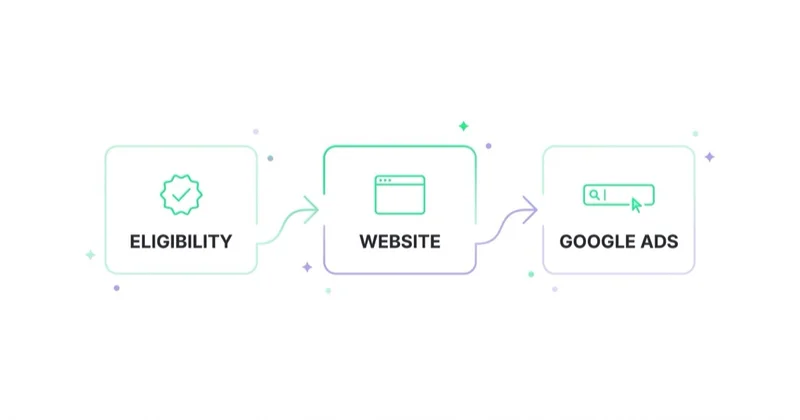
- Eligibility starts before Google Ads. The nonprofit needs valid nonprofit status, Google for Nonprofits verification and a website that meets Google's Ad Grants website policy.
- The website can block approval. Thin content, unclear mission, broken donation flows, poor navigation, slow mobile experience or missing HTTPS can cause rejection or suspension.
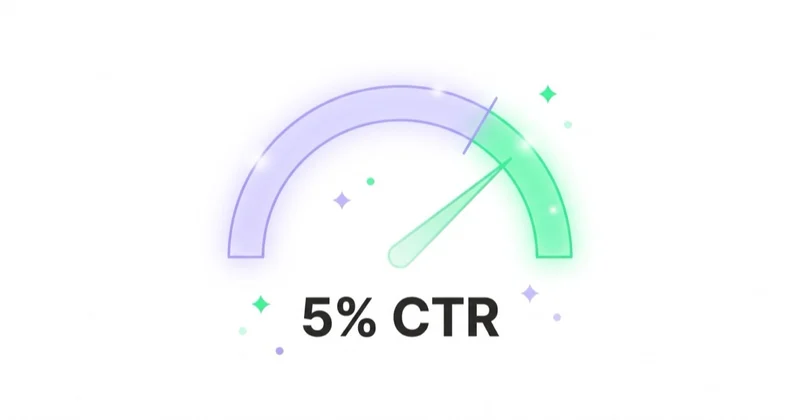
- The 5% CTR rule matters. Ad Grants accounts using Google Ads must maintain a 5% click-through rate each month; failing for two consecutive months can lead to deactivation.
- Compliance is broader than CTR. Single-word keywords, overly generic terms, Quality Score 1-2 keywords, weak conversion tracking and missing sitelinks can all create problems.
- Conversion tracking should be mission-based. Donations, volunteer sign-ups, membership registrations, calls, resource requests and content engagement can be meaningful; homepage visits and weak duration goals should not be treated as primary success.
- Ad Grants often works best beside a paid account. The grant captures evergreen Search demand; paid Google Ads can support time-sensitive campaigns, wider reach and formats outside the grant.
What is Google Ad Grants?
Google Ad Grants is a Google for Nonprofits program that provides qualifying nonprofits with Search ad credit. Google describes it as up to $10,000 USD per month of in-kind search advertising for qualifying nonprofits. The ads appear on Google Search results pages and are text-based.
That creates a useful but narrow channel:
- people search for a cause, service, resource, event or way to donate;
- the nonprofit shows a relevant Search ad;
- the visitor lands on a page that answers the query;
- the page guides the visitor to a meaningful action.
The grant is strongest when search intent already exists. It is weaker for broad awareness, visual storytelling, video campaigns, cold fundraising audiences and social proof. Those often need SEO, email, PR, social, YouTube, Meta or a standard paid Google Ads account.
Who is eligible?
Eligibility depends on country-specific nonprofit requirements, but the core path is consistent:
- The organization must be a nonprofit charitable organization in good standing.
- It must meet the Google for Nonprofits eligibility requirements in its country.
- It must not fall into excluded organization types, such as governmental entities, hospitals or healthcare organizations, or schools and universities, which Google points to separate programs for.
- It must be verified through Google for Nonprofits.
- It must activate Google Ad Grants after verification.
- It must maintain a website that meets Ad Grants policy.
This is why Ad Grants setup should not start inside Google Ads. It starts with eligibility, verification, website readiness and mission clarity.
Website requirements: the approval bottleneck
Google's Ad Grants website policy expects a high-quality, functional website that accurately reflects the nonprofit's mission. The site should provide real value to visitors, be easy to navigate, load quickly, work on mobile and use HTTPS.
The most common website problems are practical:
- thin pages with little original mission content;
- vague or hidden mission statement;
- unclear programs, services or beneficiaries;
- broken links, broken donation buttons or 404 pages;
- excessive reliance on PDF files instead of HTML pages;
- poor mobile usability;
- slow pages caused by heavy images or scripts;
- missing HTTPS or mixed-content issues;
- donation pages that are insecure or unclear;
- commercial content that distracts from the nonprofit mission.
Before applying, the site should clearly answer:
- what the organization does;
- who it serves;
- where it operates;
- how impact is created;
- how people can donate, volunteer, get help, attend or contact the team;
- why the organization is trustworthy.
This work also improves conversion rate after the grant is active. A weak website can get the account rejected and, if approved, waste the traffic.
Core compliance rules
Ad Grants compliance is not a one-time checklist. It is ongoing account management.
| Area | Requirement | Practical meaning |
|---|---|---|
| CTR | Maintain at least 5% CTR each month in Google Ads accounts | keep keywords relevant, pause low-CTR terms, use negatives |
| Keywords | No single-word keywords except allowed exceptions | avoid broad, vague targeting like "donate" or "children" alone |
| Generic terms | No overly generic keywords without clear intent | queries should connect to the mission and landing page |
| Quality Score | Pause or remove keywords with Quality Score 1 or 2 | relevance and landing page experience matter |
| Conversion tracking | Use valid, meaningful conversion tracking where required | measure mission outcomes, not vanity visits |
| Structure | Use specific geo-targeting and at least two sitelink assets | campaigns should show in useful locations and link to useful pages |
| Bidding | Many accounts must use conversion-based Smart Bidding | tracking quality becomes essential |
| Engagement | Respond to required program surveys and account notifications | ignored compliance notices can create account risk |
The safest approach is to design campaigns around these rules from the start. Retroactive cleanup is usually more painful.
The 5% CTR rule
The 5% CTR rule is the constraint that most shapes account strategy. Google says Ad Grants accounts using Google Ads must maintain a 5% click-through rate each month to remain eligible, and that failing for two consecutive months can result in account deactivation.
This pushes the account toward:
- specific multi-word keywords;
- strong ad-to-keyword relevance;
- focused landing pages;
- clear geographic targeting;
- negative keyword lists;
- pausing high-impression, low-CTR terms;
- avoiding broad awareness keywords inside Search.
For example, "volunteer with dogs in Queens" is far stronger than "dog". "Donate to food bank in Austin" is stronger than "charity". The query should carry intent and match a page built for that intent.
Conversion tracking for nonprofits
Google's account management policy emphasizes meaningful conversions. For nonprofits, meaningful conversions can include:
- donations;
- volunteer sign-ups;
- event registrations;
- membership registrations;
- email sign-ups;
- petition signatures;
- calls to the organization;
- information requests;
- resource downloads;
- ticket sales;
- quizzes completed where they matter to the mission;
- engagement with important content.
Not every website interaction should be a primary conversion. Homepage visits, very short time-on-site goals or generic page views can inflate conversion volume and teach bidding the wrong pattern. A better setup separates:
- primary conversions that reflect mission value;
- secondary conversions used for diagnostics;
- micro-conversions that help understand the journey but do not drive bidding.
For definitions, see micro and macro conversions.
Smart Bidding and the grant budget
Ad Grants accounts need conversion-based thinking. Google's account management policy says accounts created on or after April 22, 2019 must use conversion-based Smart Bidding for all campaigns unless using Smart campaigns, and lists strategies such as Maximize conversions, Maximize conversion values, Target CPA and Target ROAS.
This changes the old habit of chasing as many free clicks as possible. The grant budget is not the objective. The objective is meaningful action.
Practical implications:
- conversion tracking should be implemented before scaling;
- conversion names should be clear and mission-based;
- very weak conversions should not be primary goals;
- campaigns need enough relevant traffic to learn;
- landing pages should match queries closely;
- budget should be reviewed by mission outcome, not spend utilization.
There is no requirement to spend the full $10,000 each month. Unused funds do not roll over, but forcing spend into weak keywords can hurt CTR and account quality.
Campaign structure that actually works
A useful Ad Grants structure starts from nonprofit intent clusters.
Examples:
| Nonprofit type | Campaign themes | Conversion goal |
|---|---|---|
| Animal shelter | adopt a dog, foster cats, volunteer locally, donate pet supplies | adoption enquiry, volunteer form, donation |
| Food bank | food assistance near me, donate food, volunteer food bank, pantry hours | call, visit info, volunteer sign-up, donation |
| Education nonprofit | free course, scholarship support, mentor program, local workshops | registration, application, email sign-up |
| Museum or cultural nonprofit | exhibitions, memberships, school visits, donations | ticket, membership, donation, group enquiry |
| Crisis or support nonprofit | local help, helpline, resource guide, appointment request | call, resource download, contact form |
| Environmental nonprofit | local cleanup, conservation donation, volunteer event | event registration, donation, petition |
The ad group should stay tight. A campaign about volunteering should not mix donor terms, education resources and general mission awareness. Each campaign or ad group should send visitors to the most relevant page.
Landing pages for Ad Grants
Ad Grants traffic is still Search traffic. The landing page has to answer the searcher's intent quickly.
Useful landing page elements:
- direct answer to the query;
- clear nonprofit mission and credibility;
- local context where relevant;
- one primary call to action;
- secondary path for people not ready to convert;
- fast mobile experience;
- accessible design;
- secure donation or registration flow;
- proof of impact without vague exaggeration;
- FAQ that answers common objections;
- tracking that fires only after meaningful actions.
For CRO context, see conversion rate optimization and landing pages.
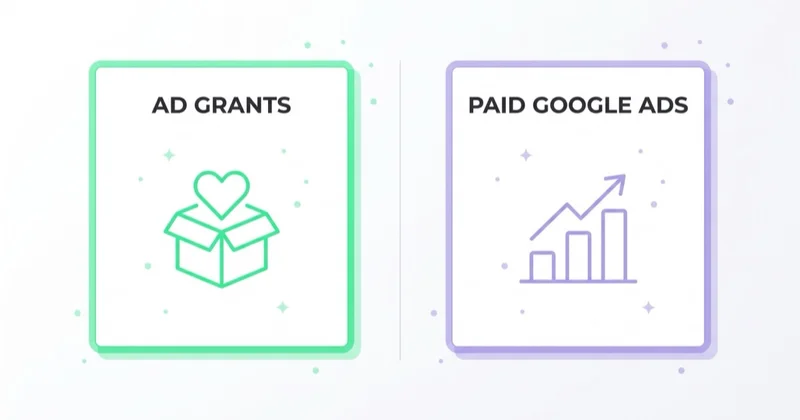
Ad Grants vs paid Google Ads
Google's FAQ says nonprofits can have both an Ad Grants account and a standard paid Google Ads account. A paid account can extend impact and access additional features such as remarketing, image ads and video ads. It also says grant ads are in a separate auction after paid ads.
That means the two accounts should have different roles.
| Need | Better fit |
|---|---|
| Evergreen high-intent Search | Ad Grants |
| Brand protection and donor searches | Ad Grants plus paid where needed |
| Year-end fundraising urgency | Paid Google Ads and email/social support |
| Video storytelling | YouTube or paid campaigns |
| Remarketing | Paid Google Ads or other channels |
| Display reach | Paid Google Ads |
| Event push with strict dates | Paid campaigns plus grant support |
The grant can reduce paid Search dependency, but it should not be expected to replace all acquisition channels.
How Space Ads approaches Ad Grants
Across the 25+ accounts audited daily and roughly 14M monthly data points analyzed through Space Ads OS, the best grant accounts behave like disciplined Search accounts with extra compliance rules. The weak accounts usually fail by chasing free clicks, using broad keywords, sending traffic to thin pages or measuring soft conversions that do not represent mission value.
An Ad Grants audit checks:
- eligibility and website policy risk;
- CTR, Quality Score and generic keyword issues;
- single-word keywords and policy exceptions;
- geo-targeting;
- campaign and ad group structure;
- sitelink and asset coverage;
- conversion tracking quality;
- Smart Bidding setup;
- search term waste;
- landing page relevance;
- whether paid Google Ads should support the grant.
A marketing audit can show whether a nonprofit is compliant, underusing the grant or wasting impressions on low-intent searches. The Search mechanics connect with Google Ads management, but Ad Grants need their own compliance layer.
Common mistakes
| Mistake | Why it hurts | Better approach |
|---|---|---|
| Treating Ad Grants as free traffic | Broad traffic lowers relevance and CTR | Build mission-intent Search campaigns |
| Applying before fixing the website | Thin or broken sites fail review | Improve content, HTTPS, navigation and donation flow first |
| Using generic keywords | Low CTR and weak conversion quality | Use specific multi-word queries |
| Tracking homepage visits as success | Bidding learns low-value behavior | Track donations, volunteer forms, calls and real actions |
| Ignoring low Quality Score keywords | Creates policy risk | Pause or fix Quality Score 1-2 keywords |
| Trying to spend the whole grant | Forces budget into weak intent | Spend only where mission outcomes justify it |
| Expecting the grant to replace paid media | Search-only constraints limit reach | Use paid media for video, display, remarketing and urgent pushes |
FAQ
What is Google Ad Grants?
Google Ad Grants is a program that gives eligible nonprofits up to $10,000 USD per month in in-kind Google Search advertising. The ads are text-based and appear on Google Search results pages.
Who is eligible for Google Ad Grants?
Eligible organizations must be nonprofit charitable organizations in good standing, meet country-specific Google for Nonprofits requirements, be verified through Google for Nonprofits and maintain a qualifying website. Government entities, hospitals or healthcare organizations, and schools or universities are generally not eligible through this route.
What is the 5% CTR rule?
Ad Grants accounts using Google Ads must maintain a 5% click-through rate each month. Failing to meet the requirement for two consecutive months can result in temporary deactivation. Tight keywords, relevant ads, negative keywords and geo-targeting help protect CTR.
What conversions should a nonprofit track?
Good conversions include donations, volunteer sign-ups, event registrations, membership registrations, email sign-ups, petition signatures, calls, information requests and meaningful resource downloads. Generic page views and homepage visits should usually stay out of primary conversion goals.
Can Google Ad Grants replace paid Google Ads?
No. It can cover evergreen Search demand, but paid Google Ads can support remarketing, image ads, video ads, urgent campaigns and wider reach. Google says standard accounts can be used alongside Ad Grants accounts.
Does a nonprofit have to spend the full $10,000 every month?
No. Google says there is no spend requirement and unused funds do not roll over. Spending less is better than forcing budget into irrelevant keywords that weaken CTR and conversion quality.
In short
Google Ad Grants is one of the strongest nonprofit Search opportunities, but only when it is treated as a compliance-aware acquisition channel. Eligibility, website quality, CTR, keyword relevance, conversion tracking and landing page quality decide whether the account survives and whether it creates mission value. The grant is not free traffic. It is a focused Search system for matching people with a cause they are already trying to find.
Sources and further reading
- Google Ad Grants - Program FAQ and requirements
- Google for Nonprofits - Eligibility
- Google for Nonprofits Help - Website policy
- Google for Nonprofits Help - Account management policy
- Google for Nonprofits Help - Ad Grants Policy Compliance Guide
- Google for Nonprofits Help - Ad Grants CTR requirements
Continue learning
Continue reading

Gemini Ad Formats: When the Ad Is Generated, Not Written
Google is testing and announcing Gemini-powered ad experiences across AI Mode and Search. Learn what each format does, what remains uncertain and how to prepare data, content and measurement.

Google Ads Experiments: Testing That Produces a Decision
A useful Google Ads experiment starts with a decision, an effect worth detecting and enough statistical power. Learn how to choose the test, split, metric and interpretation.

Google Ads Account Suspended: Why It Happens and What to Do
A Google Ads suspension requires evidence, not panic. Learn how suspension differs from a hold or pause, what the strike system covers and how to diagnose and appeal safely.