Choosing a performance marketing agency is not a beauty contest for pitch decks. It is a decision about who will influence your acquisition budget, measurement system, customer data and growth priorities.
The right agency is not necessarily the one with the highest claimed ROAS, the largest team or the lowest fee. It is the one whose capabilities, operating model and commercial incentives fit the problem you need to solve—and whose work you can evaluate against agreed business outcomes.
This guide gives you a structured selection process: define the assignment, assess the people who will deliver it, test the agency's thinking, verify the evidence, protect your accounts and write a workable contract.
TL;DR
- Define the business problem, scope, budget, decision criteria and internal responsibilities before contacting agencies.
- Meet the people who would actually work on the account. A senior pitch team is not evidence of day-to-day delivery capacity.
- Ask how the agency connects platform data with contribution, new-customer acquisition, payback and incrementality. MER alone is not enough.
- Keep core ad, analytics and commerce assets under your organisation's control. Give the agency role-based access instead of shared credentials.
- Compare the total commercial model: fee, included capacity, production, tools, media rebates, incentives and out-of-scope rates.
- Put the scope, governance, data use, intellectual property, change control, termination and handover into the contract.
- Use a paid discovery, audit or pilot only when it answers a specific uncertainty. Do not confuse free speculative work with proof of long-term delivery quality.
Start with the assignment, not the agency list
The World Federation of Advertisers and European Association of Communications Agencies recommend defining pitch objectives, required capabilities and selection criteria before the process begins. This matters because agencies can only answer the brief they receive. If stakeholders disagree about the goal, no pitch will resolve that disagreement reliably.
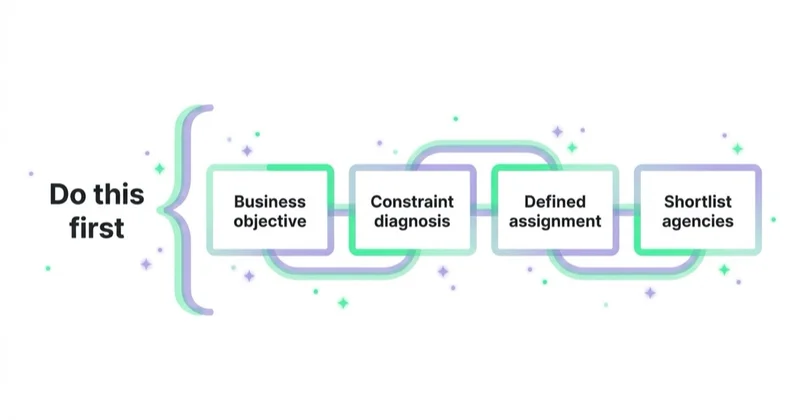
Write a concise selection brief that covers:
- the business model, markets, products and customer groups;
- the commercial problem and why the review is happening now;
- current channel mix, indicative spend and material constraints;
- the outcome required over a defined period;
- what is and is not in scope;
- current measurement limitations and data availability;
- responsibilities that remain in-house;
- required integrations with creative, development, sales or merchandising;
- expected working rhythm, languages, markets and time zones;
- budget range, preferred fee structure and target start date;
- decision process and evaluation criteria.
Separate the business outcome from the agency deliverables. “Acquire profitable new customers” is an outcome. Campaign builds, feed optimisation, creative testing, reporting and quarterly planning are deliverables that may contribute to it.
Also identify the dependencies the agency cannot own. Pricing, stock, website conversion, sales follow-up, product margin and fulfilment can determine paid-media performance. Accountability works only when responsibilities and decision rights are explicit on both sides.
What should a performance marketing agency do?
A performance marketing agency may plan and operate paid acquisition across Google, Meta, TikTok, Microsoft, retail media or other channels. Depending on the agreed scope, its work can include:
- channel and budget planning;
- campaign architecture, bidding and optimisation;
- product-feed and catalogue management;
- audience and first-party data activation;
- measurement design and conversion-quality checks;
- creative strategy, briefing, production and testing;
- landing-page or conversion-rate recommendations;
- forecasting, experimentation and reporting;
- coordination with brand, ecommerce, sales and analytics teams.
No agency needs to provide all of these services. The important point is to match the scope to the actual need and verify where responsibility changes hands. If the agency recommends creative but does not produce it, who makes the assets and how quickly? If it optimises for qualified leads, who defines qualification and returns the sales outcome to the platforms?
For the wider definition and boundaries of the discipline, see what performance marketing is.
Build a scorecard before the meetings
A scorecard prevents the decision from being dominated by the most charismatic presentation. Weight the categories to match your assignment. An ecommerce scale-up, a regulated lead-generation company and an international retailer should not use the same priorities.
An example—not a universal template—is:
| Area | Example weight | What to assess |
|---|---|---|
| Commercial understanding | 20% | Diagnosis, margin logic, customer and category understanding |
| Proposed team and capacity | 20% | Relevant expertise, availability, senior oversight and continuity |
| Measurement and experimentation | 20% | Data quality, attribution limits, incrementality and decision rules |
| Strategy and delivery model | 15% | Prioritisation, workflows, creative process and collaboration |
| Relevant evidence | 10% | Comparable work, context, references and honest limitations |
| Commercials and contract | 10% | Total cost, incentives, scope clarity and exit terms |
| Governance and risk | 5% | Security, privacy, conflicts, subcontractors and business continuity |
Agree what a strong, acceptable and weak answer looks like before scoring. Require the same core information from each shortlisted agency. Otherwise one may be judged on strategic thinking and another on an attractive price with no meaningful comparison.
Questions that reveal how an agency thinks
1. How do you understand our problem?
Ask the agency to state the business problem, key assumptions and missing information in its own words. A credible answer distinguishes symptoms from causes. Rising CAC, for example, could reflect auction pressure, weaker conversion, a changed customer mix, declining repeat value or an attribution change.
Good questions include:
- What would you need to validate before recommending a channel plan?
- Which constraints are most likely to limit the result?
- What would you not change in the first month, and why?
- Which part of the outcome depends on our internal team?
A confident agency can say “we do not know yet” and explain how it will find out.
2. Who will actually work on the account?
Meet the proposed delivery team, not only the founders or pitch specialists. Ask for named roles, approximate capacity and the expected involvement of each person. Clarify:
- who owns strategy and budget decisions;
- who makes daily changes;
- who leads creative, feeds, measurement and reporting;
- who covers holidays or staff changes;
- who has final quality-control responsibility;
- how escalation works;
- which tasks are performed by subcontractors or another group office.
Direct access to relevant specialists is valuable, but a capable account lead is not inherently a red flag. In a complex programme, that person can coordinate several disciplines and protect decision quality. The test is whether communication reaches the right expert quickly and whether ownership is clear.
3. How will you measure success?
Platform-reported ROAS is useful for operating a platform, but it is not a complete business result. Different platforms can claim overlapping conversions, attribution windows differ, and neither revenue nor MER shows product margin or whether the sale would have happened without the ad.
Ask the agency to propose a measurement hierarchy such as:
- Commercial outcomes: contribution, gross profit, qualified pipeline or another decision-relevant value;
- Customer economics: new-customer CAC, payback, repeat contribution and customer mix;
- Blended indicators: total revenue or contribution relative to total marketing investment;
- Incrementality: controlled tests, holdouts or appropriate quasi-experimental analysis;
- Platform diagnostics: attributed conversions, ROAS, CPA, reach, frequency and auction signals.
MER—total revenue divided by marketing spend—can be a useful blended indicator. It is not automatically “the honest number”: it includes demand created elsewhere, can move with seasonality and ignores margin unless adapted. Ask how the agency will reconcile platform, analytics, backend and finance data, and which source settles each decision.
Google's own documentation distinguishes attribution reporting from lift studies. Its Conversion Lift products use exposed and control groups to estimate conversions caused by advertising. Not every account is eligible for every study, so a good answer includes feasible alternatives and acknowledges uncertainty rather than promising perfect attribution.
4. How do you decide what to test?
Look for a prioritisation method, clear hypotheses and pre-agreed decision rules. Ask for an example experiment plan containing:
- the business question;
- control and treatment;
- primary metric and guardrails;
- minimum detectable effect or feasibility check;
- audience assignment and contamination risks;
- test duration and conversion lag;
- what action follows each possible result.
“We test constantly” is not a measurement plan. Many simultaneous changes can make learning impossible. Equally, not every optimisation requires a formal experiment; the agency should know the difference between routine hygiene, platform testing and causal measurement.
5. How does creative enter the performance system?
On visual and social channels, campaign operations alone cannot compensate indefinitely for weak or exhausted creative. Establish who owns insight generation, concepts, production, approvals and iteration.
Ask how the agency will:
- turn customer and performance signals into briefs;
- balance brand consistency with testable variation;
- plan the volume and format of assets;
- identify fatigue without relying on one metric;
- preserve learnings across campaigns;
- handle usage rights for talent, music, stock and generated content.
If creative production is outside the fee, price and resource it separately before comparing proposals.
How to evaluate case studies and references
A case study is evidence only when you understand the context. Ask:
- What was the baseline, period and market condition?
- Which work did the agency perform itself?
- Did spend, price, distribution or promotional intensity change?
- Is the result gross or net of cancellations and returns?
- Does “new customer” have a stable definition?
- Is the number platform-attributed, analytics-based, backend-reconciled or incremental?
- Were brand search and existing demand separated from expansion activity?
- What did not work, and what changed as a result?
Do not demand confidential client data. Instead, ask for definitions, methodology and a reference call where permission exists. On the call, explore reliability, judgement, communication, team continuity, financial transparency and how the agency behaved when performance deteriorated.
Relevant evidence does not have to come from an identical competitor. Similar sales cycles, margin structures, market complexity or data constraints may matter more than the same category logo.
Accounts, data and access: structure them for continuity
Core business assets should normally sit in accounts controlled by your legal entity, with at least two appropriate internal administrators. This includes ad accounts, GA4, Google Tag Manager, Merchant Center, pixels or datasets, product feeds, consent tools, dashboards and creative repositories.
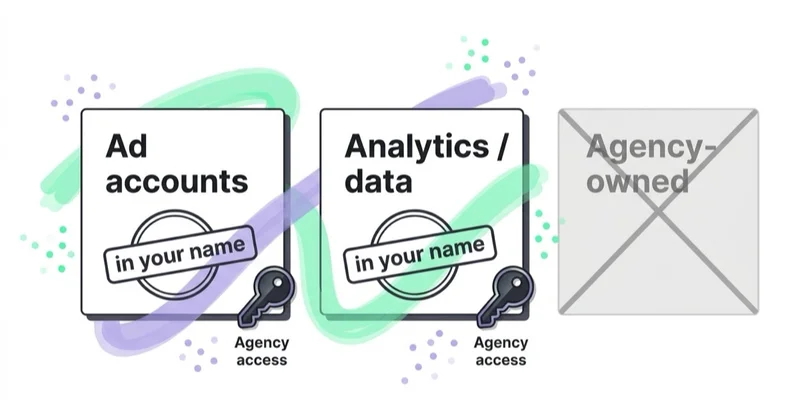
Give the agency named or group-based, role-appropriate access. Do not share personal passwords or make the agency the only administrator.
Google's documented account model illustrates why this matters. A client Google Ads account can be unlinked from a manager account without losing its campaign history. However, unlinking can disrupt manager-owned remarketing lists, cross-account conversion tracking and—in some billing arrangements—ad serving. Therefore the pre-contract and exit checklist should cover:
- who controls the client account and billing profile;
- which tags, conversions, audiences and automated rules are account-owned;
- which resources are shared from an agency manager account;
- how dependencies will be replaced before unlinking;
- who holds administrator rights in GA4 and related tools;
- how access will be reviewed and revoked;
- what will be exported or documented at handover.
Google Analytics supports permissions at account and property level, and Google describes an Analytics account as data owned by a single legal entity. Use least-privilege access where practical and review it periodically.
For a deeper operational checklist, see who owns Google Ads, Meta and GA4 when an agency relationship ends.
Compare fees without comparing the wrong thing
An agency fee can be a fixed retainer, percentage of spend, project price, hourly or capacity model, performance-related component, or a combination. None is automatically best. Evaluate how the model influences behaviour and what the quoted price actually includes.
Ask every agency to disclose:
- base fee and billing frequency;
- included channels, markets, meetings and deliverables;
- named or estimated capacity by role where appropriate;
- creative, feed, tracking, dashboard and tool costs;
- media minimums, percentage tiers, floors and caps;
- setup, travel and out-of-scope rates;
- treatment of platform credits, rebates or other benefits;
- performance-fee formula, baseline, exclusions and data source;
- notice period and transition cost.
A percentage-of-spend fee can be easy to scale but rewards spend growth unless incentives and governance counterbalance it. A fixed retainer gives predictability but requires a clear capacity and scope. A performance component may align incentives only if the agency can materially influence the outcome and the baseline cannot be gamed.
Keep agency compensation visible separately from media investment. For a fuller comparison, read retainer vs project vs performance-based agency billing.
What the contract and SOW should cover
The statement of work should be concrete enough for a third party to determine whether a task is included. Cover:
- channels, markets, accounts and deliverables;
- budget authority and approval thresholds;
- meeting and reporting cadence;
- service levels where response time is genuinely material;
- client inputs and deadlines;
- measurement definitions and source systems;
- creative volume, revisions and usage rights;
- data protection, security and breach notification;
- use of subcontractors and AI systems;
- confidentiality and conflict management;
- ownership and licence terms for campaigns, code, feeds and dashboards;
- change-request and out-of-scope pricing;
- fee, expenses, taxes and payment terms;
- contract length, notice, termination and handover obligations.
Add a simple RACI or decision-rights table for recurring work. It should show who is responsible, accountable, consulted and informed for budget changes, campaign launches, claims approval, tracking releases, creative sign-off and incident response.
Review the final agreement with appropriate legal, privacy and procurement specialists. This article is a commercial selection framework, not legal advice.
Audit, paid discovery or pilot: when do they help?
A smaller paid engagement can reduce a specific uncertainty. For example:
- an audit tests diagnostic depth and reveals measurement debt;
- paid discovery aligns economics, scope and roadmap;
- a pilot tests collaboration or a bounded channel opportunity;
- a transition project documents ownership and removes dependencies.
Define the question, deliverable, access, duration and success criterion in advance. A short pilot cannot prove a long-term growth rate if the sales cycle or learning period is longer than the test.
Avoid using a pitch to collect extensive free strategy or production. WFA/EACA guidance emphasises fair, consistent processes and respect for intellectual property; it also warns against free trial work. The best evidence usually combines relevant prior work, a structured working session, references and—where needed—a properly scoped paid assignment.
Red flags that justify closer scrutiny
| Signal | Why it matters | What to ask next |
|---|---|---|
| Guaranteed ROAS or sales with no conditions | Auctions, demand, pricing and execution dependencies are not controlled by one party | What assumptions, baseline and remedy define the guarantee? |
| Pitch team differs from delivery team | Presentation quality may not represent daily capability | Meet the named team and confirm capacity in writing |
| Reporting stops at platform metrics | Business value, overlap and margin remain unknown | Show the reconciliation and measurement hierarchy |
| Opaque bundled media and fee | You cannot see agency compensation or actual media cost | Request itemised economics and audit rights |
| Agency is the only administrator | Exit and incident recovery become fragile | Add internal admins and document dependencies |
| Shared passwords are requested | Weak security and accountability | Use individual, role-based platform access |
| No clear scope or change process | Cost and expectations will drift | Define deliverables, exclusions and out-of-scope approval |
| Conflicts or subcontractors are not disclosed | Confidentiality and resource allocation may be affected | Ask how separation, access and quality are managed |
| Every problem has the same channel answer | Diagnosis may be shaped by what the agency sells | Ask what evidence would change the recommendation |
| Exit terms are vague | Data, campaigns and tracking may be disrupted | Agree a handover checklist before signing |
A red flag is a prompt to verify, not always an automatic rejection. Context matters. What should not change is the requirement for a clear, testable answer.
A practical selection sequence
- Align internally. Define the problem, scope, budget, decision team and constraints.
- Create the scorecard. Weight capabilities before meeting agencies.
- Build a focused longlist. Check relevant capability, scale, geography and conflicts.
- Issue the same core brief. Give candidates equal access to material information.
- Hold chemistry and diagnostic meetings. Involve the prospective delivery team.
- Assess a bounded assignment. Use the same question and scoring logic for each finalist.
- Verify evidence. Examine methodology, references, team capacity and commercials.
- Resolve contract fundamentals early. Do not leave data, IP, fees or handover until after the decision.
- Select on total fit. Record the rationale and material risks, not only the final score.
- Plan onboarding and transition. Confirm access, baselines, priorities and communication before launch.
How Space Ads approaches agency selection criteria
The standards we recommend are also the standards by which a performance partner should be evaluated: a clear business objective, transparent scope, access to the people responsible for the work, client-controlled assets, explicit measurement definitions and decisions tied to commercial outcomes.
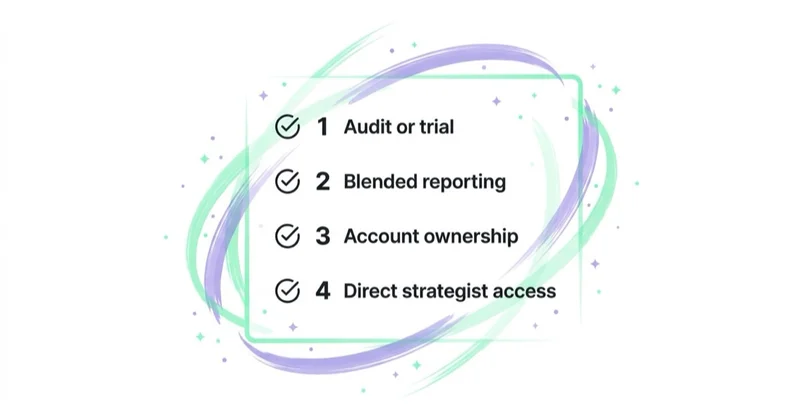
Our preferred starting point is to establish what the data can support, where platform attribution is useful and where blended or incremental evidence is needed. We then connect channel execution with creative, conversion and business economics rather than treating a platform dashboard as the final result.
An independent marketing audit can be useful when the immediate question is diagnostic. Ongoing performance marketing is appropriate when the scope, responsibilities and measurement framework are ready for continuous execution.
FAQ
How do I choose a performance marketing agency?
Define the assignment and scorecard first. Then assess the proposed delivery team, commercial understanding, measurement plan, relevant evidence, operating model, fees, account structure, security and exit terms. Choose the agency that best fits the problem and can explain how its work will be evaluated—not the one with the largest unsupported performance claim.
What should I ask in a performance marketing agency pitch?
Ask the agency to diagnose the problem, name its assumptions, introduce the actual team, explain its first priorities and show how it will reconcile platform data with business outcomes. Also ask about creative responsibilities, experimentation, capacity, conflicts, subcontractors, fees, account access and handover.
Should I choose an agency based on ROAS?
Not on a headline ROAS alone. Establish its source, attribution window, customer definition, margin basis, return treatment, spend scope and incrementality. Platform ROAS can guide optimisation; it does not by itself show total or causal business impact. Use a hierarchy that includes contribution and customer economics.
Who should own the advertising and analytics accounts?
The client organisation should normally control its core business accounts and retain internal administrator access. The agency should receive role-based access required for its work. Document any manager-owned tags, audiences, billing or conversion tracking because these dependencies can affect continuity at exit.
Is direct strategist access essential?
You need reliable access to the people who own important decisions and specialist work. That does not require every message to bypass an account lead. Evaluate whether the communication model is fast, accountable and appropriate to the programme's complexity, and meet the real delivery team before appointment.
Should an agency guarantee performance?
Treat an unconditional guarantee with caution. An agency cannot control demand, competition, inventory, pricing, website performance or every auction. If a commercial guarantee is offered, examine the baseline, definitions, exclusions, dependencies, time horizon and remedy. A credible partner can make firm commitments about process, transparency and deliverables without pretending uncertainty does not exist.
Is an audit or trial necessary before signing?
No. Use a paid audit, discovery or pilot when it resolves a specific uncertainty that references and working sessions cannot. Scope it fairly and define what can be learned within the available time. Free speculative work is not reliable proof of the team or operating model you will receive later.
How should I compare agency fees?
Compare total expected cost and incentives, not the base fee alone. Include production, tools, setup, travel, percentage tiers, performance components and out-of-scope work. Confirm the capacity and deliverables included, how media benefits are handled and what the transition will cost.
Key takeaways
- A good selection starts with an agreed business problem and scorecard.
- Assess the real delivery team, not only the pitch team or agency brand.
- Use platform data, blended indicators, customer economics and incrementality for different decisions.
- Protect continuity with client-controlled accounts, role-based access and a documented exit plan.
- Compare the full fee model and put scope, governance and handover into the contract.
- Use paid diagnostic work only when it answers a defined question.
Sources and further reading
- World Federation of Advertisers and EACA — Guidelines on client-agency relations and best practice in the pitch process
- Google Ads Help — What happens when a client account is unlinked from a manager account
- Google Analytics Help — Google Analytics account structure and access and data-restriction management
- Google Ads Help — About the Google Ads Experiment Center
Continue learning
Continue reading

How to Get More From Your Existing Ad Budget (Improve Marketing Efficiency)
Improve the return from an existing ad budget by validating measurement, protecting profitable demand, testing allocation, improving the offer and conversion path, and tracking marginal business value.
What Good Marketing Agency Reporting Looks Like (and the Red Flags)
A useful agency report gives client and agency a shared, auditable view of goals, spend, outcomes, uncertainty and next decisions. This guide provides a practical structure, metric definitions and constructive red flags.
Why Is My ROAS Dropping? The Usual Suspects, in Order
A ROAS decline can come from reporting, media cost, traffic mix, conversion, order value or a changed business context. Use this diagnostic sequence to protect downside, compare mature data and isolate the real driver.