Performance-based marketing links some or all compensation to a defined outcome. In a pay-per-lead (PPL) arrangement, payment is triggered when a lead meets agreed billable criteria.
That sounds simple until the parties ask what “lead” means. A submitted form, verified contact, qualified opportunity, attended appointment and closed customer have different values, delays and dependencies. The further the payment event moves down the funnel, the more commercial risk the supplier accepts—but the more the result depends on the client's sales process, capacity, pricing and CRM discipline.
Pay per lead does not transfer all risk to an agency or lead supplier. It reallocates a defined part of acquisition risk and prices that uncertainty into the contract. A workable model needs clear economics, an auditable lead definition, a feedback loop and shared compliance controls.
TL;DR
- Separate the fee model from media funding. “Pay per lead” can mean a supplier-funded lead price, a client-funded media programme with a performance fee, or a hybrid.
- Define the billable event precisely: stage, geography, customer profile, intent, consent, duplicates, existing customers, exclusivity and rejection reasons.
- Calculate the maximum sustainable CPL from lead-to-sale probability and contribution—not from a competitor quote or desired volume.
- Use a unique lead ID and CRM stages to connect enquiries with qualification, appointments, opportunities and sales.
- Raw CPL is not enough. Track accepted-lead rate, cost per qualified lead, appointment-held rate, CAC, contribution, contact rate and response time.
- The buyer usually controls material dependencies such as offer, capacity and sales follow-up, although the supplier's scope may include qualification or appointment setting. Responsibilities and compliance ownership must be documented.
- Buying personal data requires due diligence. Verify how leads were generated, what people were told, which parties may contact them and whether the source can be audited.
- A hybrid fee may fit when both parties influence the outcome or when volumes and conversion rates are too uncertain for a defensible all-in unit price.
What does performance-based marketing mean?
“Performance based” describes compensation, not a specific channel or campaign method. Common arrangements include:
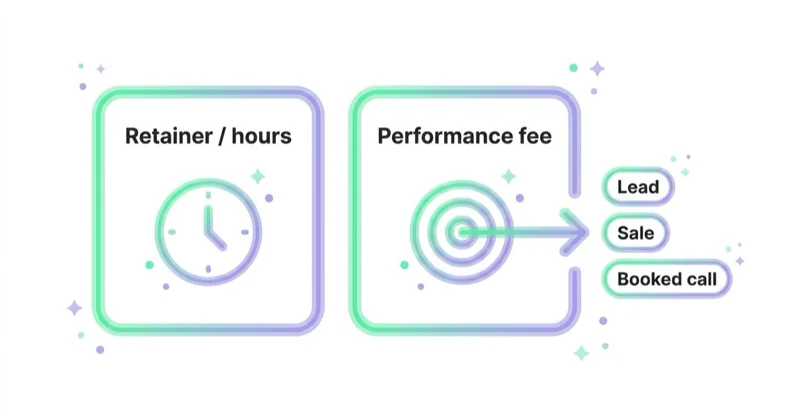
| Model | Who usually funds media? | What triggers variable payment? | Core trade-off |
|---|---|---|---|
| Supplier-funded pay per lead | Supplier | Accepted lead delivered to the buyer | Simple unit price, but source and quality require strong control |
| Client-funded media + PPL agency fee | Client | Agreed lead stage | Client bears media risk; agency compensation varies with output |
| Base fee + performance bonus | Usually client | Target above a baseline or quality threshold | Shares fixed capacity and outcome risk |
| Pay per appointment or opportunity | Contract-specific | Booked, held or sales-accepted event | Later-stage signal, but more client dependencies and longer delay |
| Pay per sale / revenue share | Contract-specific | Completed sale or recognised revenue | Close alignment, high attribution and reconciliation complexity |
The contract must state whether the quoted CPL includes media, creative, landing pages, technology and sales qualification. A £100 “all-in lead” is not comparable with a £100 agency fee plus £200 in client-funded media.
The parties should also specify who owns or licenses the ad accounts, landing pages, creative, source files, domains, tracking and first-party data, and what will be handed over at exit. A performance price should not conceal structural lock-in.
Define the lead funnel before choosing the payment event
Use stages that reflect the actual sales process. For example:
- Inquiry: a person submits a form, calls or starts a relevant conversation.
- Validated lead: contact data is real, reachable and not obviously fraudulent.
- Marketing-qualified lead (MQL): meets agreed profile and intent criteria.
- Sales-accepted lead (SAL): sales confirms that the lead should be worked.
- Sales-qualified lead (SQL): discovery confirms a credible need and fit.
- Appointment booked: a meeting is scheduled.
- Appointment held: the prospect attends and the meeting meets minimum conditions.
- Opportunity: the CRM records a qualified commercial process.
- Converted lead/customer: the agreed sale, contract or revenue event occurs.
Not every business uses every stage. Use a small number of stable definitions that sales can apply consistently.
The payment event should be:
- objectively verifiable;
- material enough to indicate value;
- frequent enough to invoice, report and operate the programme;
- reported within a workable delay;
- sufficiently influenced by the supplier;
- difficult for either party to manipulate.
Paying for a closed sale can appear aligned, but it may be poorly matched when the supplier cannot control sales response, pricing or capacity. Paying for a raw form is fast and easy to verify, but it can reward low-intent volume. A qualified or accepted lead can be a practical middle stage when the definition is consistent and the buyer applies it reliably.
What should a billable-lead definition contain?
“A qualified lead” is not a complete definition. The schedule should answer:
Customer and need
- target country, region or service area;
- B2B company size, sector or role where relevant;
- consumer or business eligibility requirements;
- requested product, service or use case;
- minimum evidence of genuine intent;
- language or serviceability criteria.
Contact validity
- required name and contact fields;
- valid email and telephone rules;
- whether a verified call or two-way response is required;
- treatment of bots, tests, spam and abusive submissions;
- treatment of incomplete, false or disconnected details.
Customer status and duplication
- lookback period for duplicate leads;
- whether existing customers are excluded;
- rules for previous opportunities, lost deals and reactivation;
- household, company, email and phone matching logic;
- which supplier receives credit if several sources submit the same person;
- whether the lead is exclusive, shared or resold.
Consent and provenance
- exact source, landing page and message;
- privacy notice and consent evidence where required;
- parties named or described as recipients;
- permitted channels and purpose of contact;
- timestamp, IP or other audit evidence where lawful;
- use of affiliates, publishers, call centres or data brokers.
Timing
- delivery timestamp and working hours;
- maximum age of a lead;
- service-level expectation for client contact;
- qualification and rejection deadline;
- conversion and attribution window.
Attach examples of accepted and rejected leads. For subjective criteria, define who makes the final decision and how a sample can be audited.
Build a fair rejection and credit process
A rejection mechanism protects quality, but it can also become a way for the buyer to avoid payment. Use objective reason codes such as:
- duplicate inside the agreed window;
- outside service geography;
- invalid or fabricated contact information;
- excluded existing customer;
- wrong product or customer profile;
- no consent or unverifiable source where required;
- bot, test or demonstrable fraud.
“Sales did not close it” is not automatically a valid lead rejection. Neither is “the prospect did not answer” unless reachability forms part of the billable definition and the client followed the agreed contact process.
Set:
- a rejection window measured from delivery;
- evidence required for each reason;
- automatic acceptance after the window;
- credit or replacement mechanics;
- a process for disputed cases;
- periodic sampling of both accepted and rejected leads;
- caps on unresolved volume before campaigns pause.
Review rejection rate by reason, source and sales representative. A sudden increase can indicate source deterioration, CRM inconsistency or a capacity problem at the buyer—not just “bad leads”.
Calculate a sustainable CPL from unit economics
The economic ceiling comes from the expected value of an accepted lead.
Expected contribution per accepted lead = probability of sale × contribution per acquired customer − incremental sales and servicing cost per lead
For multiple outcomes, calculate the probability-weighted contribution across them. Use contribution after product, fulfilment, payment, returns and other variable costs—not headline revenue.
The break-even acquisition amount is not the target CPL. The business needs a margin of safety for uncertainty, fixed cost, delayed cash and profit. If the PPL price excludes media or internal costs, subtract those separately.
Example
Suppose 100 accepted leads produce:
- 15 customers;
- $800 contribution per customer before lead acquisition and incremental sales handling;
- $2,000 total incremental sales-handling cost for the 100 leads.
Customer contribution is $12,000. After sales-handling cost, $10,000 remains, or $100 per accepted lead, before the PPL fee, media, technology, fixed overhead and desired profit.
If the supplier's $70 CPL is all-inclusive, the cohort leaves $3,000 before fixed costs and tax. If $70 is only the agency fee and the client also spends $50 per accepted lead on media, the cohort loses money at this contribution level.
Now stress-test:
- lead-to-sale rate falls from 15% to 10%;
- contribution differs by product or customer segment;
- refunds or cancellations occur after invoicing;
- sales response slows during high volume;
- leads are shared with competitors;
- payment is delayed until a later funnel event.
Price by cohort and outcome maturity rather than one unusually strong month.
Measurement: connect campaigns to downstream quality
Every lead should receive a stable internal ID at creation and retain it through the CRM. Avoid putting personal information into campaign names, URLs or human-readable identifiers. Store, where lawful and necessary:
- source, campaign and creative metadata;
- click identifiers and landing-page version;
- form or call timestamp;
- consent and privacy-notice version;
- lead stage and stage-change time;
- rejection reason;
- appointment, opportunity and sale outcome;
- value, product and cancellation or refund status.
Report a funnel, not one CPL:
| Metric | What it reveals |
|---|---|
| Raw lead CPL | Cost of initial enquiry volume |
| Validation and acceptance rate | Contact and rule-based quality |
| Cost per accepted/qualified lead | Acquisition after quality filtering |
| Contact rate and response time | Whether the handling process affected the chance to connect |
| Appointment-booked and held rate | Intent plus scheduling quality |
| Opportunity rate and pipeline value | Commercial relevance in longer sales cycles |
| Customer acquisition cost | Cost through the agreed sale event |
| Contribution per lead/customer | Economic outcome after variable costs |
| Rejection, duplicate and fraud rate | Source and process integrity |
Google Ads supports qualified lead and converted lead offline goals. Enhanced conversions for leads can use hashed first-party data together with click identifiers to improve matching between a website lead and a later CRM outcome. This can give reporting and bidding a deeper signal than the initial form submission.
Check the integration path before relying on it. Google says that from June 15, 2026, offline-conversion and enhanced-conversions-for-leads uploads are being migrated to the Data Manager API, while Google Ads API uploads are blocked for developer tokens that do not retain legacy access. Teams using an existing API, CRM connector or custom upload should review diagnostics and confirm that events still arrive after the change.
Implementation still requires an appropriate legal basis, consent where required, suitable notice, accurate identifiers, data minimisation and compliance with Google's customer-data terms. Hashing data does not anonymise the source record or remove privacy obligations.
Attribution and deduplication rules
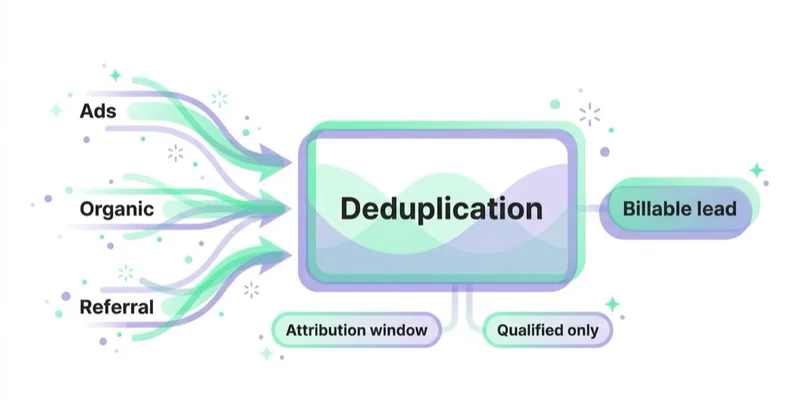
Decide which results trigger commercial payment separately from which data optimises an ad platform.
The contract should define:
- source of truth for lead stage and value;
- unique-ID and matching hierarchy;
- treatment of direct, organic and existing-demand interactions;
- first-touch, last-touch or another commercial credit rule;
- click and conversion windows;
- view-through credit, if any;
- duplicates across vendors and owned channels;
- offline, call and CRM event reconciliation;
- cancellations, chargebacks and late stage reversals;
- time zone, currency and invoice cut-off.
No attribution model observes the full counterfactual. For high-volume programmes, consider holdouts or geo tests to estimate incremental demand. See last-click vs data-driven attribution for the distinction between assigned credit and causality.
Client responsibilities are part of lead quality
The buyer influences downstream conversion through:
- response time and number of appropriate contact attempts;
- staff capacity, training and coverage hours;
- offer, price and availability;
- qualification consistency;
- CRM discipline and prompt status updates;
- customer experience and sales conduct;
- market-level licensing and eligibility;
- feedback supplied to the acquisition system.
Set a client service level, not only a supplier delivery level. If the buyer promises contact within 15 minutes but routinely waits two days, appointment and sale rates cannot be used fairly to judge source quality.
Where calls are recorded or messages analysed, comply with notice, consent, employment and telecommunications rules applicable in each jurisdiction.
Compliance and personal-data safeguards
A lead is a person or organisation expressing some form of interest; it is also a data record. In consumer lead generation, it may contain sensitive financial, health or eligibility information.
The US Federal Trade Commission's 2025 MediaAlpha settlement and related business guidance illustrate the risk. The FTC alleged that consumers looking for health insurance were misled into sharing personal information that was sold to telemarketers. Its guidance says lead generators must not misrepresent identity, affiliations, data use or what consumers will receive, and warns against knowingly assisting or deliberately ignoring a partner's unlawful telemarketing conduct.
UK ICO guidance says organisations buying or renting information for direct marketing remain responsible for their own compliance and should not simply accept a supplier's assurance. Proportionate checks include who compiled the information, its source and age, the notice people saw, the recipients and purposes they agreed to, consent evidence where relied on, suppression checks and the handling of objections. Requirements vary by market, recipient type and contact channel.
Before launch:
- map who is controller, joint controller, processor or independent recipient as applicable;
- approve ads, landing pages, scripts and claims;
- name permitted publishers and subcontractors;
- prohibit unapproved resale or onward sharing;
- verify consent and suppression processes;
- set retention, deletion and security rules;
- audit a sample from ad impression to lead delivery;
- document complaint, breach and regulator-response procedures;
- obtain specialist legal advice for the target market and vertical.
Highly regulated areas such as finance, health, education, insurance and legal services require additional review. A contract warranty is not a substitute for operational due diligence.
When pay per lead is a good fit
PPL has a stronger case when:
- the billable event can be defined objectively;
- lead volume is sufficient to estimate quality;
- CRM stages and outcomes are updated promptly;
- sales capacity and response are stable;
- contribution supports both acquisition and supplier risk;
- fraud and duplication can be detected;
- data collection and contact can be performed lawfully;
- the supplier materially influences the payment event.
It can work in long-cycle B2B when payment occurs at a well-defined intermediate stage and later outcomes are still shared for optimisation. A long sales cycle does not automatically rule it out; it changes cash flow, feedback speed and the fairest event.
When a hybrid or another fee model may fit better
Consider a base fee plus a performance component when:
- the supplier must reserve specialist capacity regardless of volume;
- the client controls material conversion dependencies;
- historic conversion data is sparse or unstable;
- seasonality makes monthly volume highly variable;
- creative, analytics and strategy create value beyond immediate leads;
- market testing is required before a reliable unit price exists.
A retainer may fit continuous multidisciplinary work. A project fee may fit setup, audit or tracking implementation. Revenue share may fit when sales, refunds, contribution and attribution can be reconciled with low dispute risk. The models are compared in retainer vs project vs performance agency billing.
Contract checklist
Include at least:
- billable event and worked examples;
- price, included cost and taxes;
- media funding, account ownership and budget authority;
- geography, volume cap, pacing and minimum commitments;
- exclusivity and duplicate hierarchy;
- lead delivery fields and timestamp;
- client-contact SLA and CRM feedback SLA;
- rejection reasons, window, evidence and dispute process;
- attribution, conversion window and source of truth;
- invoicing, late outcomes, refunds and clawbacks;
- approved sources, publishers and subcontractors;
- privacy, security, data retention and deletion;
- claims approval and regulatory responsibilities;
- intellectual property and asset ownership;
- fraud monitoring and audit rights;
- termination, lead delivery stop and handover.
Review the agreement with legal, privacy and finance specialists. This guide is a commercial framework, not legal advice.
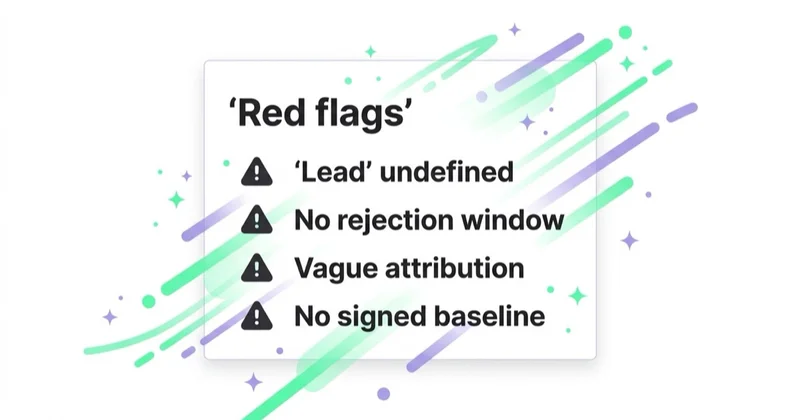
Red flags
| Signal | Why it matters |
|---|---|
| “Qualified lead” has no written definition | Invoicing becomes subjective |
| The supplier will not disclose source types | Deception, reselling and quality cannot be assessed |
| The buyer can reject leads for any reason | The supplier carries unpriceable collection risk |
| No stable CRM stages or IDs | Quality and duplicates cannot be reconciled |
| Media and fees are bundled but opaque | True acquisition economics are unknown |
| The programme optimises only to form fills | Cheap volume can displace genuine prospects |
| Sales outcomes are withheld | Acquisition cannot learn from quality |
| Consent is assumed because data is hashed | Privacy and contact requirements remain |
| Unlimited volume is promised immediately | Capacity, fraud or source quality may fail |
| The agency or vendor owns every account and asset | Exit creates avoidable dependency |
How a Space Ads engagement can be evaluated
Where a performance component is considered, the evaluation can start with business economics and data rather than a headline price. A practical sequence is:
- map the lead and sales funnel;
- select an auditable event within the parties' influence;
- calculate contribution and a sustainable acquisition range;
- define quality, duplicates, consent and rejection rules;
- connect campaign identifiers with CRM outcomes;
- agree client and supplier service levels;
- pilot within volume and budget caps;
- review quality after the relevant sales window;
- move to pure performance, hybrid or another structure based on evidence.
A marketing audit can assess whether the tracking and economics support such a model. If the parties proceed, the agreement should define the fee, media funding, source system, responsibilities and handover. Ongoing performance marketing can then use permitted downstream outcomes where the data is sufficiently timely and reliable.
FAQ
What is pay-per-lead marketing?
Pay per lead is a commercial model in which a supplier or agency is paid when a lead meets agreed billable criteria. The price may include media and delivery or may be an agency fee on top of client-funded spend. The contract must state which version applies.
What counts as a qualified lead?
Only the written agreement can answer that. A useful definition covers customer profile, need, geography, contact validity, intent, consent, duplicates, existing customers, exclusivity and timing. It also defines objective rejection reasons and evidence.
How do I calculate the maximum CPL?
Multiply the probability that an accepted lead becomes a customer by contribution per acquired customer, then subtract incremental sales and servicing cost per lead. This gives a break-even amount before fixed costs and desired profit. Subtract media or agency fees separately if they are not included in the quoted CPL.
Who pays the advertising budget in pay per lead?
Either party can. In supplier-funded PPL, the vendor normally absorbs acquisition cost and sells accepted leads at an all-in unit price. In an agency performance-fee model, the client may fund media and pay an additional amount per lead. Clarify this before comparing offers.
How can a business reduce junk leads?
Define objective acceptance rules, validate contact details, use fraud controls, inspect source and creative, cap volume, import qualified and converted outcomes from the CRM, and feed rejection reasons back quickly. Also check sales response: slow or inconsistent follow-up can make valid leads appear weak.
Should the agency be paid for booked or held appointments?
An attended appointment is a later-stage event than a booking, but it depends more on reminders, scheduling, prospect behaviour and client availability. Choose an event both parties can influence and define reschedules, cancellations, minimum duration and qualification.
Is pay per lead better than a retainer?
Neither is universally better. PPL may fit a repeatable, measurable funnel with prompt quality data. A retainer may fit ongoing capacity and work whose value is not captured by one event. A hybrid can distribute fixed delivery cost and variable outcome risk when both parties control important dependencies.
Does pay per lead transfer all risk to the agency?
No. It transfers or shares risk around the defined payment event. The client still carries product, pricing, sales, capacity, compliance and customer-value risk. The supplier may price uncertainty through the unit rate, caps, minimums or a base fee.
Can purchased leads be contacted freely?
No. Contact rules depend on jurisdiction, channel, data source, what the person was told and the applicable lawful basis or consent. Buyers should verify provenance, permitted recipients, purpose, suppression and evidence before using the data. Seek specialist advice.
Key takeaways
- Pay per lead is a compensation mechanism, not one standard service package.
- Define the funnel and billable event before setting the price.
- Price from expected contribution and include every separate acquisition cost.
- Measure accepted, qualified and converted outcomes through the CRM.
- Document obligations for sales response, feedback, consent and data quality.
- Consider a hybrid when fixed delivery capacity and outcome uncertainty need separate treatment.
Need to determine whether pay per lead fits the economics and data? Explore the Space Ads lead generation service. The commercial model, campaign scope, media funding, measurement and CRM responsibilities are defined for each engagement.
Sources and further reading
- Google Ads Help — About qualified leads and converted leads
- Google Ads Help — Enhanced conversions for leads and offline conversion imports
- Google Ads Help — Updates to enhanced conversions settings and Data Manager API migration
- UK Information Commissioner's Office — Direct marketing: collecting, sharing and generating leads
- US Federal Trade Commission — Compliance lessons for lead collectors, sellers and buyers
Continue learning
Continue reading
How to Choose a Lead Generation Agency (Questions to Ask, Red Flags)
A practical framework for comparing lead generation agencies: scope, measurement, pricing, account ownership, security, contracts and the questions worth asking before you sign.
Cost Per Lead (CPL): Benchmarks, What's 'Good', and How to Set Your Target
CPL is easy to calculate and easy to misuse. Learn how to compare valid benchmarks, separate media CPL from fully loaded CPQL, and derive an affordable target from your own unit economics.
Speed to Lead: Why Response Time Decides Who Wins the Deal
Learn how to measure and improve lead response time without sacrificing quality: define the right timestamps, set channel-specific targets, fix routing and coverage, and validate the impact on sales outcomes.