Pinterest Ads are paid placements across Pinterest's search, home and related feeds. People can search, browse and save visual ideas, so campaign planning can combine keyword intent with interest, audience and catalogue signals. Pinterest is worth testing when visual inspiration is part of a considered purchase—home, fashion, beauty, weddings, food or travel are common examples. It is less obvious for urgent needs, price-only commodities or narrow professional buying groups, but channel fit should be tested rather than declared from a category label.
TL;DR
- Pinterest combines discovery, feeds and search. Keyword, interest, audience and catalogue strategies can therefore coexist.
- Keyword targeting can matter. Search campaigns should be analysed by actual query and downstream value, not by an assumed level of intent.
- Organic and paid distribution are different. An organic Pin may resurface after publication, while paid delivery depends on campaign settings, auction conditions and budget.
- Best fit is visual and considered — home, decor, fashion, beauty, weddings, food, DIY, travel — where people plan before buying.
- Fit needs proof. Urgent needs, price-only commodities and narrow B2B audiences often have clearer channels elsewhere, but exceptions exist.
- Measure beyond platform attribution. Click- and view-attributed conversions describe Pinterest's model; they do not prove that the ad caused the outcome.
- Shopping needs a clean catalogue. Feed quality drives dynamic and shopping ad performance the same way it does on Google.
Why Pinterest is a different kind of platform
Most paid social optimises for attention inside an entertainment feed. People open the app to pass time, and ads interrupt that. Search engines sit at the other end: people arrive with a specific, often urgent query and want an answer now. Pinterest sits in between, and that middle position is the whole point.
Pinterest supports planning behaviours such as saving ideas to boards and returning to them later. That makes it possible to reach a person before a final product or supplier is chosen. It does not mean every user is commercially receptive or that ads are less intrusive than on another platform. Confirm the hypothesis through saves, qualified site behaviour, conversion quality and—where scale allows—incrementality testing.
Two practical options follow. First, search and keyword targeting let advertisers respond to explicit queries alongside feed discovery. Second, Pins can be saved and resurfaced, which gives organic creative a different lifecycle from a chronological post. Do not assume paid results will compound without spend, and separate organic Pin performance from auction-driven campaign delivery.
When Pinterest Ads make sense — and when they don't
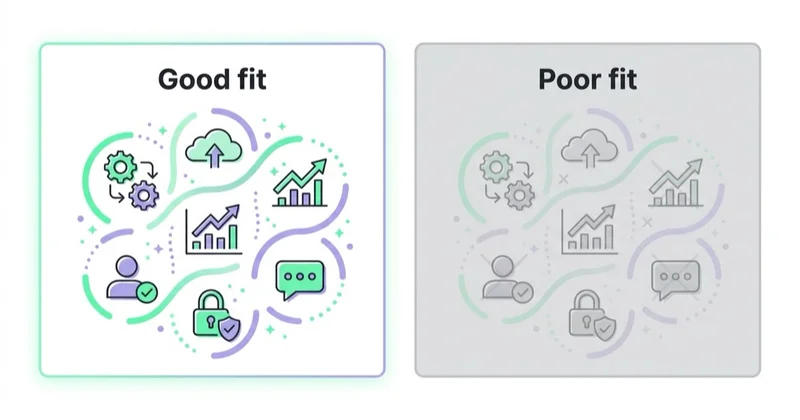
Pinterest rewards a specific shape of product and buyer.
| Signal | Pinterest is a strong fit | Pinterest is a weak fit |
|---|---|---|
| Category | Visual — home, fashion, beauty, food, weddings, DIY, travel | Abstract, non-visual, or B2B |
| Buying mode | Planned, considered, inspiration-led | Urgent need or emergency purchase |
| Differentiation | Design, aesthetics, lifestyle | Pure price on a commodity |
| Time horizon | Weeks or months of consideration | Same-day conversion required |
| Creative | You can produce strong lifestyle imagery | Only plain product shots |
| Audience | Consumer, discovery-oriented | Narrow professional buying group |
The clearest anti-pattern is choosing an attribution window or success metric before understanding the buying cycle. A planned purchase may need a longer observation period than an urgent service, but a longer window also gives the platform more opportunities to claim conversions it did not cause. Compare Pinterest with other channels on incremental value and contribution, not headline CPM or same-day ROAS. For narrow B2B buying groups, LinkedIn Ads for reaching decision-makers may offer more direct professional targeting, subject to its own economics.
Ad formats and the job each one does
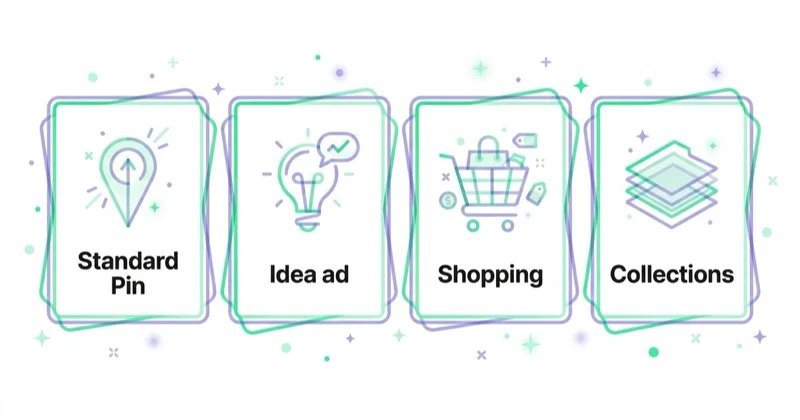
Pinterest's formats map onto the discovery-to-purchase journey.
| Format | Primary job | Notes |
|---|---|---|
| Standard (image) Pin | Discovery, saves, traffic | Test lifestyle context against clear product-led variants |
| Video Pin | Demonstrate, tell a story | Strong for how-to and transformation |
| Idea / multi-page ad | Educate, inspire, build saves | Sequential ideas and steps |
| Carousel | Show a range or multiple angles | Useful for collections |
| Collections | Hero image plus shoppable products | Bridges inspiration and catalogue |
| Shopping ads | Sell from the product feed | Dynamic; feed quality drives results |
| Showcase / Premiere Spotlight | Brand reach at scale | Higher-budget awareness plays |
A useful creative hypothesis is that context helps people imagine the outcome. A sofa in a room, an outfit worn in a setting or a finished recipe can answer a different question from a clean product image. Test both: product-only assets may be more useful when price, detail or exact SKU identification matters. Measure downstream behaviour, not saves alone.
Targeting: keywords, interests and audiences
Because Pinterest is partly a search engine, its targeting blends search and social logic.
- Keywords — target terms people search and related browsing contexts. They are a logical starting test when query intent is clear, not a guaranteed most-efficient option.
- Interests — broad topical categories (home decor, women's fashion, wedding planning) for reach.
- Audiences — your first-party data: customer lists, visitor retargeting via the Pinterest tag, and engagement audiences (people who interacted with your Pins).
- Actalike audiences — Pinterest's lookalike equivalent, built from a seed audience.
- Demographics and expanded targeting — refine or, with expanded targeting, let Pinterest widen delivery when you want scale.
Glossary you need first
- Pin — a saved image or video; the core unit of content and the shelf-life advantage.
- Board — a themed collection of Pins where users organise plans and intent.
- Pinterest tag — the site tag that enables conversion tracking and retargeting audiences.
- Conversions API — a server-to-server connection that can complement or replace some browser event delivery; it still requires lawful data collection, correct matching and validation.
- Actalike audience — Pinterest's lookalike audience, expanded from a seed.
- Catalogue — the product feed that powers shopping and dynamic ads.
Shopping campaigns need a clean catalogue
For retailers, catalogue sales and shopping formats depend on product data, as do catalogue campaigns on other platforms. Accurate titles, prices, availability, destination links, images and product grouping reduce disapprovals and mismatches. Feed quality is one constraint among several—the offer, creative, site and auction still matter. The same operational principle appears in Performance Max vs standard Shopping for ecommerce.
Dynamic retargeting can show an eligible visitor products related to previous site activity. Use it only with the required consent and exclusions, control frequency, and compare it with prospecting because retargeting often receives credit for demand created elsewhere. Pair the Pinterest Tag and Conversions API carefully, using matching event IDs to prevent duplicates.
Measurement: planning horizons and attribution windows
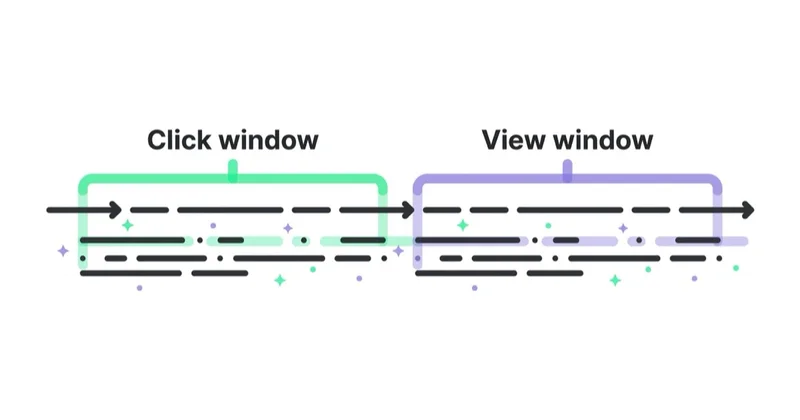
Last-click attribution can omit an earlier Pinterest interaction. The reverse problem also exists: a long view-through window can credit Pinterest for a purchase that would have happened anyway. Attribution is a rule for allocating credit, not a causal estimate.
A defensible measurement setup:
- Install the Pinterest tag and define real conversions (add to cart, checkout, lead), not just page views.
- Connect the Conversions API for durable, server-side measurement alongside the browser tag.
- Report click-through and view-through conversions separately. State the window and whether Pinterest includes modelled conversions.
- Choose an observation period from the buying cycle, but do not equate a longer attribution window with more truth.
- For larger budgets, test incrementally. A holdout answers "did Pinterest create incremental sales?" better than attribution settings — the logic in incrementality testing.
Creative that works on Pinterest
- Show the outcome in context — the styled room, the worn outfit, the finished project — not the product in isolation.
- Design for a vertical, mobile canvas — tall images occupy more screen and earn more attention.
- Add a light text overlay to frame the idea, since Pinterest is scanned visually.
- Lead with inspiration, close with shopping — inspire discovery with lifestyle Pins, then retarget with shoppable formats.
- Refresh seasonally — Pinterest planning is seasonal (holidays, weddings, back-to-school), so align creative with when people plan, which is earlier than when they buy.
Performance+, conversion signals, and deduplication
Performance+ automates more bidding and targeting than a manual setup. Pinterest currently recommends accurate Tag and/or Conversions API tracking, a daily budget of at least five times the cost-per-result goal and at least 10 ads per ad group. These are platform recommendations, not independent performance guarantees; test them against the account's economics and creative capacity.
When the Tag and Conversions API send the same event, both integrations need the same event_id so Pinterest can deduplicate them. Server events should arrive as close to real time as possible; Pinterest specifies less than one hour. Otherwise, reporting can double-count outcomes or optimization can react to a delayed signal.
Pinterest also uses modelled conversions where observed signals are incomplete and discloses that they can appear across reporting surfaces and attribution windows. Never add platform totals from Pinterest, Google and Meta as though they represented distinct orders. Reconcile them with the commerce backend or CRM, document click- and view-through windows, and keep settings stable when comparing periods. Use holdouts or geographic experiments when the decision and scale justify them.
How Space Ads approaches Pinterest Ads
Our Pinterest assessment starts with a testable fit hypothesis: does visual planning materially influence this category, can the company produce suitable creative, is the reachable audience large enough, and can downstream value be measured? We do not assume Pinterest is an upper-funnel success merely because last-click reporting is weak.
If the hypothesis is credible, we validate the Pinterest Tag and Conversions API with deduplication, test keyword and interest routes, and add catalogue or retargeting activity only when the data and consent setup support it. Reporting separates platform attribution from backend orders and experimental evidence. That is the operating core of performance marketing; the full channel approach lives on the Pinterest Ads service page.
An illustrative first 90 days
This sequence is a planning example, not a promise that every account will reach each stage in 90 days. Low conversion volume, catalogue issues or an inconclusive fit test may justify extending or stopping the programme.
| Phase | Work | Output |
|---|---|---|
| Days 1–15 | Confirm category fit; install Pinterest tag + Conversions API; clean the catalogue | A measurable foundation and a go/no-go on fit |
| Days 16–45 | Launch keyword + interest discovery campaigns with lifestyle creative | First saves, traffic and audience signal |
| Days 46–75 | Add shopping and dynamic retargeting from the catalogue | Capture layer converting the audience built above |
| Days 76–90 | Build eligible actalike tests only if the seed is suitable; design an incrementality test where feasible | A decision to scale, revise or stop based on evidence |
Stop doing / Do instead
| Stop doing | Do instead |
|---|---|
| Judging Pinterest only on same-day ROAS | Use backend outcomes, explicit attribution windows and incremental tests where feasible |
| Running plain packshots | Use lifestyle imagery that shows the outcome in context |
| Ignoring keyword targeting | Treat Pinterest partly as search and target keywords |
| Neglecting the product feed | Keep the catalogue clean — it powers shopping and dynamic ads |
| Assuming category fit from a generic list | Test whether visual planning influences this audience and purchase |
| Relying on the browser tag alone | Add the Conversions API for durable measurement |
FAQ
What are Pinterest Ads?
Pinterest Ads are paid Pins shown across Pinterest's search, home and related feeds. Advertisers can target by keyword, interest, audience and demographics, and run formats from standard image Pins to video, collections and catalogue-driven shopping ads. Pinterest suits visual, considered consumer categories.
How is Pinterest different from Meta or Google Ads?
Pinterest combines search, visual feeds, saves, boards and catalogue experiences. Unlike Google Search, not every impression follows an explicit query; unlike Meta, keyword targeting is available. The commercial role depends on campaign placement, targeting and buyer behaviour rather than a universal funnel position.
What products work best on Pinterest Ads?
Home, decor, fashion, beauty, weddings, food, DIY and travel are logical test categories because visual planning can influence the purchase. That is not a performance guarantee. Evaluate audience availability, creative capacity, margin, buying cycle and incremental outcomes. Some visual B2B or non-retail use cases may also work.
Does keyword targeting matter on Pinterest?
It can. Keyword targeting lets campaigns respond to Pinterest searches and related contexts, making it useful when query intent is identifiable. Compare it with interest, audience and automated targeting in a controlled structure; efficiency varies by account.
How should I measure Pinterest Ads?
Validate the Pinterest Tag and Conversions API, deduplicate shared events, and reconcile platform reporting with backend orders or CRM outcomes. Separate click- and view-through attribution, document modelled conversions and windows, and use a controlled lift or geographic test when scale permits.
Are Pinterest Ads cheaper than Meta?
There is no reliable platform-wide answer. Auction cost, conversion quality, creative production and incremental sales vary by market and account. Compare both channels on contribution and incremental outcome under a fair test, not headline CPM.
Key takeaways
- Pinterest Ads reach buyers in a planning, discovery mindset, blending search intent with visual social browsing.
- Pinterest combines visual feeds, saves and keyword targeting, but paid delivery remains auction- and budget-dependent.
- Visual, considered categories are logical tests; urgent, commodity and narrow B2B cases need stronger evidence.
- Separate attribution from incrementality and reconcile platform claims with backend outcomes.
- Lifestyle creative and a clean catalogue drive results; retargeting converts the audience discovery builds.
Sources and further reading
- Pinterest Business — Ad formats
- Pinterest Business Help — Targeting options
- Pinterest Business Help — Conversions API, real-time delivery, and deduplication
- Pinterest Business Help — Performance+ budget and creative guidance
- Pinterest Business Help — Modeled conversions in reporting
Continue learning
Continue reading
LinkedIn Ads for B2B: Reaching Decision-Makers Who Never Click a Google Ad
LinkedIn Ads combines professional attributes, company lists and engagement signals to reach B2B buying groups. Learn when the channel fits, how to avoid obsolete audience advice, connect qualified CRM outcomes, and separate platform attribution from incremental pipeline evidence.
Social Media Advertising Tools That Run Campaigns (Not Just Schedule Posts)
A scheduler will not tell a team where the next budget increase should go. This guide defines the paid-social stack around spend governance, creative evidence, pacing, approvals and AI-assisted changes, then shows when it belongs beside native platform panels.
Static vs Video Ads: Which Converts, and When to Use Each
Static and video ads can both sell. The useful question is which format communicates a specific idea in a specific placement at an acceptable total cost. This guide shows how to choose and test them fairly.