Marketing attribution assigns conversion credit to observable interactions. Last-click attribution gives the eligible final interaction all the credit. Data-driven attribution (DDA) uses a product-specific algorithm and available journey data to distribute fractional credit across eligible interactions.
Neither model tells you with certainty what would have happened without the advertising. Attribution explains how a defined system allocates observed outcomes; incrementality asks what the marketing caused. Those are related but different questions.
This distinction is essential in 2026 because “data-driven attribution” does not mean the same dataset in every product. Google Ads attribution operates within supported Google ad interactions, while GA4 can allocate event-scoped credit across eligible paid and organic channels. The model, identity, lookback window, conversion definition and reporting scope all affect the result.
TL;DR
- Last click is transparent: the final eligible interaction receives 100% credit. Its simplicity is also its limitation.
- DDA distributes credit using observed data and platform methodology. It is not the same as a randomised incrementality test.
- Google Ads no longer supports first-click, linear, time-decay or position-based models. Supported choices are data-driven and last click for relevant conversion actions.
- In GA4,
First user,Sessionand event-scoped traffic dimensions answer different questions. Changing the reporting attribution model affects event-scoped reporting, not user- or session-scoped dimensions. - Platform reports can disagree without either being technically broken because they use different identities, eligible interactions, windows and conversion rules.
- Use backend or CRM outcomes as the commercial record, attribution for operational allocation, experiments for causal questions and MMM for broader budget planning where appropriate.
- MER is a useful blended ratio, not ground truth. It also moves with price, promotions, product availability, seasonality and demand created outside measured media.
What is marketing attribution?
Attribution is a set of rules or an algorithm that distributes credit for an observed outcome—such as a purchase, qualified lead or subscription—among eligible marketing interactions.
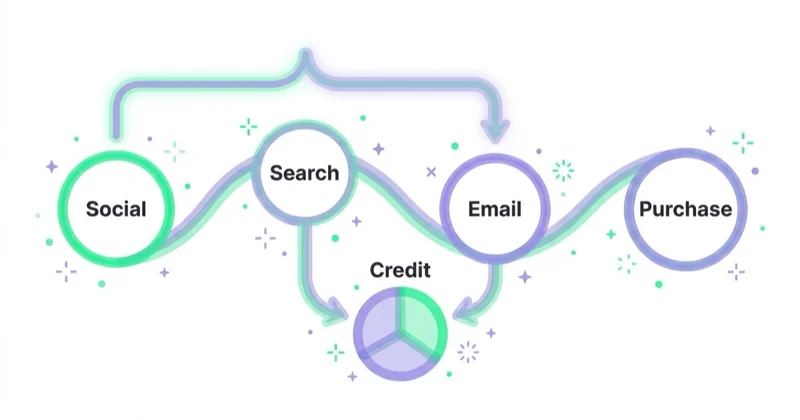
Consider this simplified path:
- a customer sees a video ad;
- later clicks a non-brand search ad;
- returns through an email;
- searches for the brand;
- purchases directly.
The reported answer depends on the system. Did it observe impressions or only clicks? Is email eligible? How is “direct” treated? Are the sessions connected to the same user? Is the purchase inside the lookback window? Is the report scoped to the first user, session or conversion event?
Attribution does not recover interactions the system never observed. It can also include modelled key events where the product supports them. The output is therefore conditional on the available data and product rules—not a complete reconstruction of the customer's mind or every influence on demand.
Last-click attribution explained
Last click assigns 100% of conversion credit to the last eligible clicked interaction before the conversion. A non-direct last-click implementation may ignore a later direct visit and retain the most recent known campaign source; the exact behaviour depends on the product and report.
Advantages
- the allocation rule is easy to explain;
- a conversion is not split into fractions across several interactions;
- reporting and reconciliation can be simpler;
- it provides a stable reference model for comparison.
Limitations
- every earlier eligible interaction receives zero credit;
- channels often used late in a journey will receive more credit by construction;
- the result is sensitive to the definition of “eligible” and the lookback window;
- it does not establish that the final click caused the conversion;
- it can encourage budget decisions focused on demand capture alone.
It is reasonable to suspect that brand search, affiliate coupon traffic or retargeting may capture existing intent in some businesses. But last click itself does not prove over-crediting. A causal test is needed to estimate how many conversions would have occurred without that activity.
Data-driven attribution explained
DDA distributes credit based on patterns in the data available to the product for a particular conversion or key event. It can assign fractional credit to several eligible interactions rather than using a fixed first-, last- or position-based formula.
Advantages
- it can represent more than one interaction in a conversion path;
- the allocation adapts to observed data instead of applying the same fixed split to every journey;
- in Google Ads, the chosen attribution model affects relevant conversion columns and conversion-based bidding;
- model-comparison reports can reveal where allocation changes relative to last click.
Limitations
- the result depends on what the platform can observe and identify;
- each product defines eligible channels and interactions differently;
- model logic and weights are not fully inspectable by the advertiser;
- consent, browser restrictions, cross-device behaviour and offline gaps affect the input;
- modelled attribution is not a randomised counterfactual;
- credit can be precise to decimals without being causally certain.
Do not repeat a universal claim that DDA always requires a specific volume. Eligibility varies by product and conversion type. Google Ads states that some conversion-action types require 3,000 ad interactions and 300 conversions in 30 days to become eligible, with lower ongoing thresholds; this is not a general GA4 rule and can change. Check the status and current documentation in the product you use.
Which attribution models are currently available in Google?
Historical explainers often list six models: last click, first click, linear, time decay, position based and data driven. That list is useful for understanding attribution logic, but it is no longer an accurate list of live Google options.
Google states that first click, linear, time decay and position based are no longer supported in Google Ads. Conversion actions using the deprecated models were moved to DDA, with last click remaining available. GA4 also removed these four rule-based reporting models in November 2023.
| Model | Concept | Current Google status |
|---|---|---|
| Last click | All credit to the final eligible clicked interaction | Available in Google Ads and relevant GA4 settings |
| Data driven | Fractional credit based on observed data and product methodology | Default for most supported Google Ads conversion actions and GA4 event-scoped attribution |
| First click | All credit to the first eligible interaction | Historical concept; no longer supported as a Google attribution model |
| Linear | Equal credit across eligible interactions | Historical concept; no longer supported by Google |
| Time decay | More credit to interactions closer to conversion | Historical concept; no longer supported by Google |
| Position based | Fixed emphasis on first and last interactions | Historical concept; no longer supported by Google |
Other analytics, adtech or internal systems may still implement rule-based models. Always state the product and configuration instead of saying only “we use last click” or “we use DDA”.
Google Ads DDA and GA4 DDA are not interchangeable
Google Ads
The attribution model is configured for a conversion action. It determines how credit is allocated among eligible Google ad interactions and affects the Conversions and All conversions columns. Because automated bidding can optimise using the Conversions column, a model change can influence bidding—not merely reporting.
Google Ads DDA considers supported interactions across Google inventory described in the product documentation. It is not a cross-channel verdict covering every email, affiliate, organic search or competitor platform touch.
Google Analytics 4
GA4 reporting can allocate event-scoped credit across eligible paid and organic channels. The reporting attribution setting applies to key-event metrics used with event-scoped traffic dimensions. GA4 uses paid-and-organic DDA by default, while available settings and channel eligibility determine which interactions can receive credit.
GA4 may also include modelled key events where direct observation is unavailable because of privacy or technical limitations. Google notes that attributed data can be updated after the key event while modelling is processed. Recent periods may therefore move.
If a GA4 key event is used to create a Google Ads conversion, confirm which attribution and window settings govern the resulting Ads conversion. Interface labels and cross-channel conversion behaviour continue to evolve; document the actual configuration rather than relying on an old implementation guide.
Why GA4 reports can show different answers
GA4 organises acquisition data into three scopes.
First-user scope
Dimensions such as First user source describe how the user was first acquired. The assigned value persists as that recognised user returns. Use this scope for questions about initial acquisition, not for deciding which channel received credit for a later purchase.
Session scope
Dimensions such as Session source describe the source associated with a session. Google states that user- and session-scoped traffic dimensions use paid-and-organic last-click rules and are not affected by changes to the reporting attribution model.
Event scope
Unprefixed traffic dimensions used with key-event metrics can reflect the selected reporting attribution model. With DDA, a purchase may contribute fractional credit to multiple channels.
This means Session source revenue and event-scoped attributed purchase revenue can differ while both follow their documented scope. Combining a session-scoped dimension with an event-scoped interpretation is a common source of false discrepancy investigations.
The lookback window changes who can receive credit
A lookback window defines how far before a key event an interaction remains eligible. A 30-day window excludes an otherwise valid interaction from 31 days earlier; a longer window may add more early touches.
In GA4, attribution settings include windows for acquisition events and other key events. Google's documented defaults are 30 days for first_visit and first_open, and 90 days for other key events, with configurable alternatives. Settings for conversions shared with Google Ads can depend on the chosen channel configuration, so verify both products.
Choose a window that reflects the decision cycle and data limitations. A longer window is not automatically more accurate. It can add distant, weakly related interactions and increase identity loss across devices. A short window can exclude genuine consideration for high-value purchases.
Record the window beside every reported attribution model. Without it, the model name is incomplete.
Why platform conversion totals do not add up
Google Ads, Meta, TikTok, an affiliate platform and GA4 can all report credit for the same sale. This is not necessarily a tag duplication problem. Each system sees a different subset of the journey and applies its own:
- click and view eligibility;
- attribution model;
- lookback window;
- user and cross-device identity;
- time zone and currency;
- conversion timestamp convention;
- consent and modelling logic;
- deduplication rules;
- definition of purchase, lead or qualified outcome.
Never add platform-attributed conversions and call the total unique sales. Reconcile them to an order, subscription or CRM system that has stable transaction identifiers.
Even the commercial system needs definitions. Decide whether revenue is gross or net of tax, shipping, cancellations and returns. For leads, define qualification, duplicates and the time allowed for sales disposition.
Attribution is not incrementality
Attribution allocates observed credit. Incrementality estimates the outcomes caused by an intervention compared with what would have happened without it.
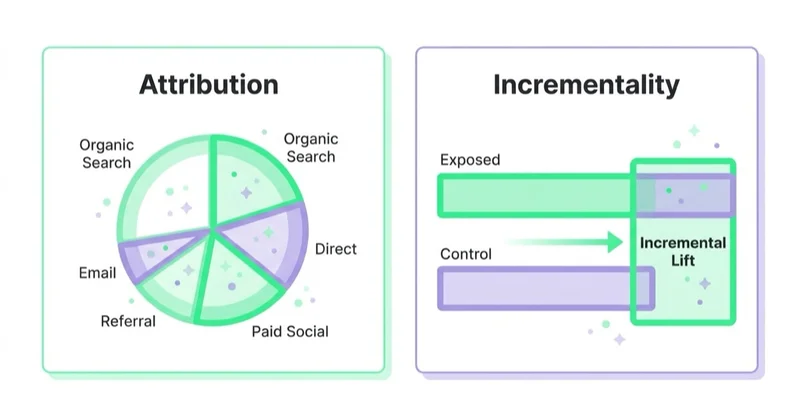
A retargeting campaign may receive substantial attributed credit because ads occur shortly before purchase. A holdout test may show that many of those customers would have bought anyway. Conversely, an awareness campaign may create demand that later appears as direct or organic traffic.
Use controlled methods where the decision justifies them:
- user-level conversion lift where eligible;
- geo experiments with comparable treatment and control regions;
- campaign or audience holdouts;
- platform experiments for specific tactical changes;
- well-designed quasi-experiments when randomisation is not feasible.
Plan power, contamination, conversion lag and decision rules before the test. An inconclusive result is not proof of zero effect.
Where marketing mix modelling fits
Marketing mix modelling (MMM) estimates relationships between aggregated business outcomes and marketing inputs over time, while controlling for relevant non-marketing factors. It can include offline and online channels without requiring user-level path data.
MMM is more suitable for broader budget allocation and response-curve questions than daily keyword decisions. It also has assumptions, data requirements and uncertainty; it is not a replacement for experiments or a clean commercial dataset.
Google's open-source Meridian project is one current MMM framework. Its documentation supports calibration with experiment results and modelling of organic demand controls. That illustrates the correct relationship: MMM and experiments can strengthen each other rather than compete for the title of “single source of truth”.
MER is useful—but it is not truth either
MER is commonly defined as total revenue divided by total marketing spend. It avoids adding overlapping platform claims and provides a blended commercial indicator.
However, MER can improve because prices rose, stock returned, a promotion launched, retail distribution expanded, organic demand increased or marketing spend fell. It also ignores product margin, returns and customer mix unless the numerator is adapted.
Use a metric aligned with the economics, such as contribution after variable costs relative to marketing investment, alongside new-customer CAC, payback and cohort value. Then control for the business factors that moved during the period. See MER vs ROAS for the board-level distinction.
A practical marketing measurement stack
| Layer | Primary job | Typical use |
|---|---|---|
| Commerce, CRM or finance record | Define orders, revenue, margin, customers and qualified outcomes | Commercial performance and reconciliation |
| Analytics and event collection | Capture onsite/app behaviour and campaign metadata | Journey analysis and diagnostics |
| Platform attribution | Allocate credit within the platform's observable system | Bidding and campaign optimisation |
| Cross-channel attribution | Describe eligible paths across measured channels | Reporting and journey allocation |
| Experiments | Estimate causal lift for a defined intervention | Material budget and strategy decisions |
| MMM | Estimate aggregate channel contribution and response | Portfolio planning and scenario analysis |
The layers should reconcile conceptually, but they should not be forced to produce identical numbers. Each answers a different question at a different level.
How to choose between last click and DDA
Use the decision context rather than a universal hierarchy.
In Google Ads
- confirm the conversion action is correct, deduplicated and economically meaningful;
- check current DDA eligibility and supported interactions;
- compare DDA and last click in the model-comparison report;
- understand how a switch affects conversion columns and automated bidding;
- avoid changing the model, targets and campaign structure simultaneously;
- annotate the change and allow for conversion lag before evaluation.
DDA is generally the platform default and can use more of the observed ad path. Last click may remain useful as a transparent benchmark or in specific operational circumstances. Neither choice establishes cross-channel incrementality.
In GA4
- decide whether the question is first-user acquisition, session acquisition or key-event attribution;
- use dimensions with the correct scope;
- verify the reporting model, channels eligible for credit and lookback window;
- inspect key-event paths and model comparison;
- account for modelled data, recent-period updates and reporting identity;
- reconcile purchases and values with the backend.
Changing GA4's reporting attribution model applies to historical and future event-scoped reporting, while user and session scopes remain unaffected. That differs from how Google Ads conversion-action changes affect forward reporting and bidding. Do not treat the products as one switch.
Data-quality checklist before debating the model
Attribution sophistication cannot repair a broken conversion definition. Verify:
- one stable transaction or lead identifier for deduplication;
- correct value, currency, tax, shipping and refund treatment;
- cross-domain tracking for payment and booking flows;
- exclusion of unwanted referrals and internal traffic where appropriate;
- consistent UTM governance and click-ID preservation;
- consent implementation and documented modelling effects;
- correct primary and secondary conversion configuration;
- offline conversion import and sales-stage mapping where needed;
- time zones and reporting dates across systems;
- channel grouping definitions and version changes;
- bot, test and internal transactions;
- conversion lag and return window.
A clean last-click report is more useful than an elaborate model trained on duplicated purchases or unqualified leads.
How Space Ads approaches attribution
We start by naming the decision. Platform bidding, channel reporting, executive planning and causal budget validation require different evidence.
The working sequence is:
- define the commercial outcome and system of record;
- validate collection, identity, value and deduplication;
- document platform and GA4 models, scopes and windows;
- reconcile differences instead of summing claims;
- use attribution for the operational decision it can support;
- add experiments or MMM when the budget question requires causal or portfolio evidence;
- report uncertainty and known blind spots.
This is part of a broader web analytics system. A marketing audit can identify whether configuration, scope or interpretation—not campaign performance—is causing the apparent discrepancy. For the executive layer, see marketing attribution for executives.
Common mistakes
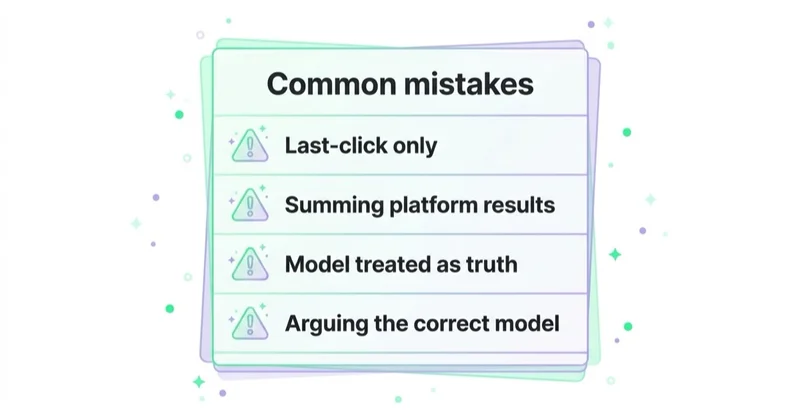
| Mistake | Better approach |
|---|---|
| Presenting deprecated Google models as current choices | Check the current product-specific options |
| Calling DDA causal | Treat it as modelled credit; use lift tests for causal questions |
Comparing First user, Session and event-scoped metrics as equivalents |
Match dimension scope to the question |
| Adding platform conversions | Reconcile unique outcomes to a backend or CRM record |
| Reporting a model without its lookback window | Document model, scope, eligible channels and window |
| Treating MER as ground truth | Add margin, customer mix and contextual business drivers |
| Changing attribution and judging performance immediately | Account for bidding effects, lag and reporting restatement |
| Debating models before validating events | Fix conversion definitions and data quality first |
FAQ
What is the difference between last-click and data-driven attribution?
Last click gives the final eligible clicked interaction 100% of the credit. DDA uses observed data and product-specific methodology to distribute fractional credit across eligible interactions. DDA can represent more of the measured path, but neither model by itself proves which interaction caused the conversion.
Which attribution model is best?
There is no model that is best for every decision. In Google Ads, DDA is the default for most supported conversion actions and directly informs relevant bidding data. Last click is a transparent comparator. For causal budget decisions, use experiments; for broad portfolio planning, consider MMM. Start with the question and dataset.
Is data-driven attribution the same in Google Ads and GA4?
No. Google Ads allocates credit among supported Google ad interactions for a conversion action. GA4 event-scoped attribution can allocate credit across eligible paid and organic channels. They also differ in settings, identities, windows, modelling and downstream use.
Are first-click, linear and time-decay models still available in GA4?
No. Google removed first click, linear, time decay and position based from GA4 in November 2023. Google Ads also no longer supports them. They remain useful historical concepts and may exist in other tools, but they should not be presented as current Google choices.
Why does Session source disagree with GA4 attribution reports?
Session source is session scoped and follows GA4's session-attribution rules. Event-scoped key-event reports can use the selected reporting attribution model, such as DDA. The dimensions answer different questions, so different channel values can be correct.
Why do Google Ads and GA4 report different conversion numbers?
They can use different attribution logic, eligible interactions, identities, lookback windows, timestamps and modelling. Google Ads may also count conversions configured directly in Ads that are not identical to GA4 key events. Reconcile the exact conversion action and settings before diagnosing a tracking fault.
Does last click overvalue brand search and retargeting?
It gives the final eligible click all credit, so channels frequently appearing late receive more attributed value by construction. Whether that value exceeds their causal impact is an incrementality question. Use a suitable holdout or geo test rather than treating attribution position as proof.
Is MER better than attribution?
MER answers a different question. It is a blended revenue-to-spend ratio that avoids summing platform claims, but it cannot isolate channel causality and is affected by price, promotions, distribution, seasonality and organic demand. Use it with contribution, customer economics and appropriate tests.
What happens when I change an attribution model?
In Google Ads, the conversion-action model affects relevant reporting columns and automated bidding; standard reporting changes going forward, with comparison columns available for analysis. In GA4, changing the reporting model restates historical and future event-scoped reports, while user- and session-scoped dimensions are unaffected. Annotate the change and avoid naïve before/after comparisons.
Key takeaways
- Attribution assigns credit within an observable system; it does not establish causality.
- Last click is simple and final-touch weighted; DDA distributes fractional credit using available data.
- Current Google model choices differ from historical six-model explainers.
- Product, scope, eligible channels and lookback window are part of the model definition.
- Use commercial records, attribution, experiments and MMM as complementary layers.
- Fix conversion data before optimising the credit-allocation method.
Sources and further reading
- Google Ads Help — About attribution models
- Google Ads Help — Data-driven attribution eligibility and switching
- Google Analytics Help — Select attribution settings
- Google Analytics Help — Scopes of traffic-source dimensions
- Google Analytics Help — About modelled key events
- Google for Developers — Meridian marketing mix modelling
Continue learning
Continue reading

Marketing Attribution for Executives: Why Your Dashboards Disagree
Marketing attribution assigns conversion credit to touchpoints; it does not prove which channel caused the outcome. This guide shows executives how to use last-click, data-driven attribution, incrementality, and MMM for different decisions.

Website Marketing: How to Actually Drive Revenue From Your Site
A website creates commercial value when it helps the right people complete the right task and gives the business reliable feedback. This guide connects audience journeys, acquisition, experience, measurement and experimentation.

Lead Generation for Online Courses and Education Providers
Education lead generation must connect an honest promise with learner fit, enrolment and course starts—not just form volume. Learn how to design the journey, evidence claims and measure each intake.