Website marketing coordinates how people discover a site, understand an offer, complete a useful task and continue the relationship. Revenue may be the final outcome, but a site can also create value by qualifying demand, answering questions, supporting customers, building trust, recruiting or reducing service cost.
Treat the site as an operating product rather than a finished brochure. Its content, acquisition, user experience, technical quality and measurement need owners and regular improvement. A redesign is one possible intervention—not the starting diagnosis.
TL;DR
- Define the site's jobs. Purchase, enquiry, research, support and recruitment need different journeys and success measures.
- Build a channel portfolio. Paid, organic search, email, social, referral, affiliate, partner, marketplace and offline activity can all create visits or demand.
- Design for tasks, not traffic alone. Content, navigation, accessibility, speed, trust and forms should help an intended user progress.
- Measure decisions, not everything. Use a concise event and KPI plan connected to confirmed business outcomes.
- Treat attribution as an estimate. Consent, devices, missing tags and model choices limit what analytics can prove.
- Test before rebuilding. Diagnose the constraint and validate risky assumptions before committing to a full redesign.
- Keep improving after launch. Search visibility, content, offers, browsers, devices and customer expectations change.
Stop treating the website as a brochure
The brochure problem is not visual design; it is the absence of product management. Pages are launched without an owner, a defined audience task, a content review date or evidence about whether people can use them. Marketing sends traffic, sales receives leads, product changes the offer and analytics reports sessions—yet no one owns the journey end to end.
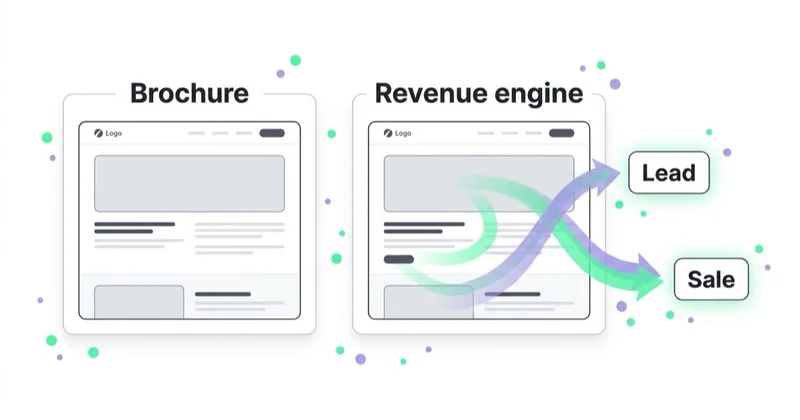
Start with the site's jobs:
- What must a first-time visitor understand?
- Which tasks should a buyer, existing customer, candidate or partner complete?
- What evidence reduces risk at each decision?
- Which outcomes create business value, and which are only diagnostic steps?
- Who owns the content, technical health and follow-up after a form or purchase?
This gives every important page a purpose. A service page may qualify an enquiry; a comparison page may support research; documentation may reduce support contacts; a product page may create a purchase or store visit.
Build an acquisition portfolio
Website visits may come from paid search and social, organic search, organic social, email, affiliates, partners, referrals, marketplaces, public relations, links in documents, QR codes and direct navigation. Channel groups are reporting conventions, not the only ways demand exists.
Choose channels from the audience journey and economics:
- Capture existing demand with search, listings, marketplaces or partners where people already compare options.
- Create and educate demand with content, social, video, events, PR and relevant paid reach.
- Continue a permissioned relationship through email, messaging or account experiences.
- Enable return and referral with memorable brand assets, useful resources, customer service and partner links.
Paid traffic is not merely "rented"—the learning, creative and customers can have continuing value—while organic search is not owned. Rankings and search features can change, and useful content requires maintenance. Email is not automatically owned either: consent, deliverability and platform access matter.
In analytics, direct does not equal "brand traffic." Google Analytics says (direct) / (none) represents traffic without a clear referral source; missing campaign tags, redirects, documents and blockers can contribute. Use consistent auto-tagging or UTMs where appropriate and audit classification before drawing a brand conclusion. Related trade-offs are covered in PPC vs SEO and Google Ads vs SEO.
Help people complete the next useful task
A visit without an immediate purchase is not automatically worthless. A person may compare a complex product, return later on another device, read support documentation or recommend the page. The problem is traffic with no defined audience value or business hypothesis.
Evaluate the journey in layers:
- Relevance: does the landing page fulfil the promise of the ad, search result or link?
- Comprehension: can the intended user understand the offer, audience, price basis and next step?
- Evidence: are claims supported by specifications, reviews, credentials, policies or case evidence appropriate to the decision?
- Usability: can the task be completed on real mobile and desktop devices without avoidable errors?
- Accessibility: can people with disabilities perceive, navigate and operate the experience? W3C recommends integrating accessibility into planning, implementation and ongoing monitoring.
- Performance and security: use HTTPS, avoid intrusive interstitials and assess real-user loading, responsiveness and visual stability. Core Web Vitals are useful indicators, not a guarantee of rankings or revenue.
- Continuity: does checkout, CRM, booking or customer service continue the promise made on the page?
Conversion-rate arithmetic assumes traffic quality and order value remain constant; real changes can alter both. Track guardrails such as qualified-lead rate, average order value, returns, cancellations and support burden alongside the conversion rate. See conversion rate optimisation and landing-page design.
Glossary
- Website marketing — coordinated acquisition, content, experience and measurement around a website's defined jobs.
- Conversion — completion of a defined valuable action; value and quality should be specified.
- Traffic source / medium — analytics dimensions describing where a visit was referred from and by what method.
- Direct traffic — visits for which analytics has no clear referral source; not a synonym for brand demand.
- Key event — an analytics event marked as important; it should map to a real business decision.
- Incrementality — outcomes caused by an intervention beyond what would otherwise have occurred.
Measurement ties it together
Measurement reduces uncertainty; it does not make attribution perfectly clear. Consent choices, blocked scripts, cross-device behaviour, offline sales, missing campaign parameters and model selection create gaps. Google Analytics also uses different scopes for first-user, session and event traffic dimensions, so superficially similar reports can answer different questions.
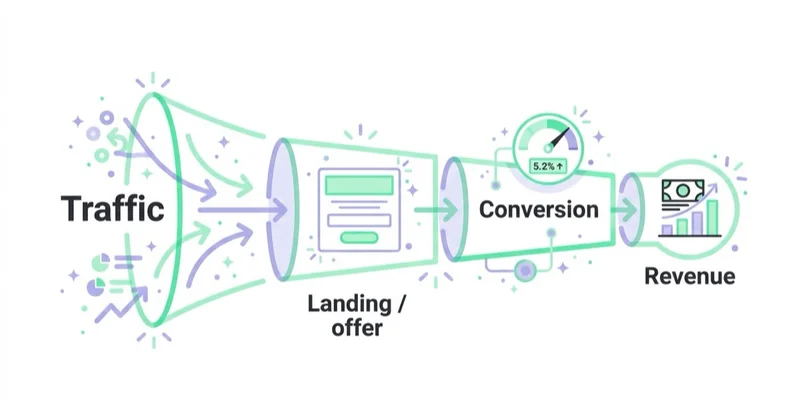
Use a compact measurement plan:
- Define the commercial outcome and its source of truth: commerce platform, CRM, finance or another operational system.
- Map the few website events that indicate meaningful progress.
- Specify event names, values, currencies, statuses and exclusions; test duplicates and failure paths.
- Use campaign naming and tags consistently without placing personal data in URLs.
- Implement consent and privacy controls appropriate to the market.
- Reconcile analytics with operational totals and document expected differences.
- Use experiments or phased releases for causal questions rather than treating attribution as proof.
Funnels show where observed users leave; they do not explain why. Combine quantitative data with user research, support and sales feedback, accessibility testing and session-level diagnostics used lawfully. The measurement discipline is covered in web analytics.
Match the mix to the goal
Website marketing is not one formula. The priorities shift with the site's job:
- Ecommerce: accurate product and inventory data, discovery, product pages, checkout, returns and contribution by customer cohort.
- Lead generation / services: relevant demand, clear qualification, accessible forms, response time and progression to accepted lead, proposal and sale.
- Content / media: discoverability, content usefulness, engaged return visits, subscriber quality, advertising or subscription economics.
- B2B / considered purchase: research journeys, stakeholder evidence, appropriate calls to action and CRM progression through pipeline.
- Support or account sites: task completion, deflection only when service quality holds, accessibility, security and satisfaction.
The common thread is that all three legs still matter; only the emphasis changes. A plan that copies an ecommerce traffic mix onto a B2B lead-gen site (or vice versa) misweights the effort.
How Space Ads approaches website marketing
We begin with a journey-and-evidence audit: business outcomes, priority audiences, acquisition sources, page purpose, content truth, accessibility, technical experience, analytics and downstream operations. Findings are ranked by user harm, commercial impact, confidence and implementation effort.
Small reversible changes are tested where possible. A redesign is recommended when the information architecture, technology, accessibility debt, brand system or operating model prevents incremental improvement—not simply because the current site looks dated. The future measurement plan and content ownership are defined before the new experience is built. This work connects performance marketing, landing pages and web analytics.
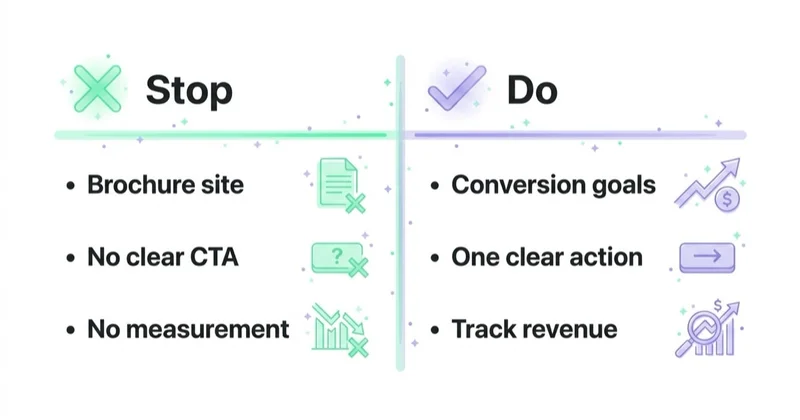
Stop doing / Do instead
| Stop doing | Do instead |
|---|---|
| Publishing pages without an owner or job | Assign audience task, evidence, KPI and review date |
| Calling direct traffic "brand" | Audit tags and lost referral information before interpreting it |
| Treating SEO as owned, free traffic | Maintain content and account for platform dependence and cost |
| Optimising a form-fill count | Connect the journey to qualified outcomes and contribution |
| Chasing perfect tool scores | Use field data and user evidence to prioritise material problems |
| Starting with a visual redesign | Diagnose journeys, architecture, accessibility, technology and measurement first |
Common mistakes
Common mistakes include measuring only form submissions, using analytics categories as if they were ground truth, changing the site without a baseline and adding scripts that harm performance or privacy. Teams also optimise the marketing page while ignoring checkout, CRM response, booking availability or returns—the later step where value is actually lost.
FAQ
What is website marketing?
Website marketing coordinates acquisition, content, user experience and measurement so priority audiences can complete useful tasks and the business can improve the journey. Revenue is often the final objective, but support, recruitment, research and trust can also create measurable value.
How do I get more traffic to my website?
Identify where the intended audience discovers, compares and returns to solutions. Options include paid and organic search, paid and organic social, email, affiliates, partners, referrals, marketplaces, PR and offline activity. Choose by audience evidence, economics and measurement feasibility; use consistent campaign tagging.
Why does my website get traffic but no sales?
Possible causes include irrelevant acquisition, a mismatch between message and page, weak evidence, unclear total cost, technical errors, inaccessible controls, unavailable stock or slow follow-up. Segment by source, device, page and intended task, then combine funnel data with user and operational evidence. Do not assume the page is the only cause.
Is SEO or paid advertising better for website traffic?
Neither is universally better. Paid can test and capture demand quickly; SEO can support discoverability over longer periods. Both require investment and depend on external platforms. Decide from query opportunity, competition, time horizon, unit economics and the value of the content to users.
How do I measure website marketing results?
Define a source of truth for sales or qualified leads, implement a small event plan, use consistent campaign tagging, respect consent and reconcile analytics with operational data. Treat attribution as a model. Use controlled experiments where feasible to determine whether a change caused an outcome.
Do I need a new website to improve results?
Maybe. A redesign is justified when information architecture, accessibility, technology, brand coherence or maintainability blocks priority journeys. If the problem is a specific page, offer, tracking issue or follow-up process, a focused change may be faster and safer. Establish a baseline and success criteria before deciding.
Key takeaways
- Give every important page an audience task, evidence requirement, owner and review date.
- Build the channel portfolio from customer behaviour and economics, not a three-channel slogan.
- Include content, accessibility, performance, trust and downstream operations in conversion work.
- Reconcile analytics with business systems and state attribution limits.
- Diagnose and test the constraint before commissioning a full redesign.
Sources and further reading
- Google Search Central — SEO Starter Guide
- Google Analytics Help — Traffic-source dimensions and campaign tagging
- Google Analytics Help — Understanding direct / none traffic
- W3C Web Accessibility Initiative — Planning and managing web accessibility
- Google Search Central — Page experience and Core Web Vitals limitations
Continue learning
Continue reading
Marketing Attribution Models: Last-Click vs Data-Driven
Last-click and data-driven attribution distribute credit differently; neither proves causal impact. Learn what Google Ads and GA4 currently support, why reports disagree and how attribution fits with experiments and MMM.

Lead Generation for Online Courses and Education Providers
Education lead generation must connect an honest promise with learner fit, enrolment and course starts—not just form volume. Learn how to design the journey, evidence claims and measure each intake.

The Welcome Email Series That Converts New Subscribers
A welcome series should deliver the signup promise, establish expectations and help an eligible subscriber take the next useful step. Learn how to design, sequence, govern and measure it without relying on a universal template.