When demand weakens, an immediate percentage cut to every marketing line can protect cash but also remove the activity that generates future demand. The opposite slogan — “never cut marketing in a downturn” — is equally unsafe for a business with limited runway, falling contribution or no evidence that its spend is working. The disciplined response is to model cash, margin and demand under several scenarios, then remove low-value costs, protect capabilities and profitable demand generation, and release additional budget only where current evidence supports the risk.
TL;DR
- Start with the constraint. Runway, contribution margin, debt covenants, inventory and sales capacity determine how much risk the business can carry.
- Avoid an undifferentiated percentage cut. Classify spend by its purpose, evidence, time horizon and reversibility.
- Cut duplicated tools, low-quality demand, work without distribution and activity whose economics remain below the stop threshold.
- Protect measurement, customer communication, brand availability and acquisition that produces acceptable incremental contribution and payback.
- Scale only after checking live evidence. Competitor activity or media costs may fall, stay flat or rise; verify auction, reach and conversion data rather than assuming a bargain.
- Use base, downside and investment scenarios with release conditions and stop rules.
- Preserve a learning budget. Pausing every experiment can leave the business with no tested growth options when conditions improve.
Why an across-the-board cut is a blunt instrument
Marketing is an easy cut because the saving appears immediately, while the possible cost — weaker demand, fewer qualified opportunities or lower mental availability — arrives later and is difficult to isolate. Research synthesised by the IPA supports the case for balancing long-term brand building with short-term activation, but it does not turn continued spending into a guaranteed return for every company or recession. Category demand, creative quality, distribution, financial resilience and the starting strength of the brand still matter.
Share of voice is one useful planning lens: if competitors reduce their presence while a brand maintains effective coverage, its relative visibility can increase. But category-level share of voice is not the same as Google Ads impression share, and neither measure proves incremental revenue. Google defines Search impression share as impressions received divided by estimated eligible impressions; eligibility itself changes with targeting, approval, quality and other auction factors. Use it as a competitive visibility signal, not as a substitute for contribution or causal measurement.
The problem with a blanket cut is therefore not that it always destroys share. It is that it ignores the different jobs marketing expenditure performs and can remove profitable demand, future availability and measurement capability at the same rate as genuine waste.

The surgical response: cut, protect, double down
A downturn is a forcing function to do what should happen anyway — reallocate from waste to what works. Three moves at once:
| Move | What it applies to | Why |
|---|---|---|
| Cut or renegotiate | Duplicated tools, unused retainers, low-quality demand, production with no distribution, spend beyond an agreed stop rule | Improve cash without treating every marketing line alike |
| Protect | Reliable measurement, customer communication, distinctive brand assets and acquisition with acceptable incremental contribution | Preserve the ability to generate and evaluate demand |
| Test or scale | Audiences and channels where current marginal economics improve and the business can fulfil demand | Capture an opportunity without assuming it exists |
The discipline is knowing which spend is which. Blended CAC and platform ROAS are not enough: review contribution after variable costs, new-customer quality, payback, cash timing and incremental evidence where available. Also consider what happens if the spend stops. A campaign can look inefficient in last-click reporting yet create demand captured later by another channel; a profitable-looking campaign can simply harvest demand that already existed.
What to cut
The first cuts should be the spend that was not working, or not proven to, in good times:
- Duplicated or unused capability — overlapping software, dormant licences and services without an accountable use case.
- Low-quality demand — activity that generates leads or orders below the agreed qualification, margin or payback threshold.
- Production without distribution — content and creative output that has no audience, reuse plan or measurement purpose.
- Experiments with no decision value — tests that cannot reach a useful sample, isolate a change or affect a subsequent decision. Preserve a smaller learning portfolio rather than eliminating testing.
Before stopping a material activity, estimate the cash saved, the revenue and learning at risk, the time needed to restart and the dependencies that would be lost. This prevents an apparently reversible media cut from quietly removing creative capacity, clean data or a hard-won audience.
What to protect
Some spend defends the business and must survive the cut, even though its return is slower or less visible:
- Measurement and commercial data — conversion tracking, CRM stages, margin inputs and cohort reporting needed to distinguish savings from demand destruction.
- Customer communication and service — retention is valuable when the underlying cohort is profitable and the intervention genuinely changes renewal or repeat purchase.
- Distinctive brand assets and availability — the consistent cues and coverage that help buyers recognise and consider the company, scaled to the firm's financial position.
- Profitable acquisition at the margin — spend that continues to produce acceptable incremental contribution and payback, not merely a strong historical average.
Brand activity is often exposed because its return is less immediate. Protecting some continuity may be sensible, but the amount should reflect cash constraints, category purchase cycles and the evidence available. “Protect brand” is a portfolio decision, not permission to exempt every awareness campaign from scrutiny.
What to double down on
A downturn may create opportunity, but the opportunity must be observed rather than assumed. Check:
- Auction and reach data — CPC, CPM, impression share, auction overlap and marginal conversion volume over a comparable period.
- Demand quality — conversion rate, qualified-opportunity rate, returns, cancellations and cohort value, not only cheaper clicks.
- Unit economics — contribution after fulfilment, media, discounts, creative and service costs.
- Operational capacity — inventory, sales coverage, onboarding and customer service available to fulfil the extra demand.
- Cash timing — how much working capital is needed before the expected contribution arrives.
If these measures improve and the company has sufficient runway, release budget in controlled tranches. Compare the next tranche with the base case and stop when marginal payback, customer quality or cash exposure crosses the agreed limit. The relevant economics are explained in CAC and payback, but a lower media price only helps if conversion quality and contribution hold.
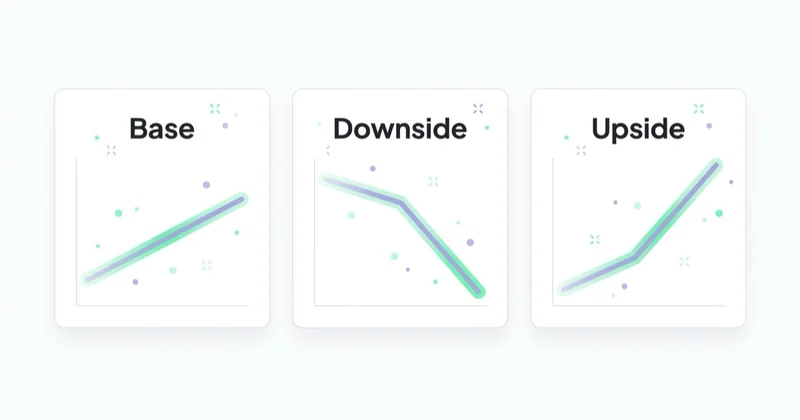
Run three scenarios instead of one fixed budget
A downturn plan needs a base, defensive, and investment scenario. Each specifies more than spend: it includes the release condition, expected payback, cash impact, and stop threshold.
- Base maintains activities with acceptable current economics and a deliberate level of brand and customer availability.
- Defensive removes low-information tests, consolidates redundant tools, and protects the highest-quality demand.
- Investment releases budget where reach becomes cheaper, competitors retreat, and the company has margin and capacity to absorb demand.
Decisions should use cohorts and marginal return. A channel can deteriorate in last-click reporting while still creating new demand. Conversely, strong historical ROAS does not justify expansion when the next spend tranche has slower payback or worse customer quality.
Cost removal should begin where capability is preserved: duplicate software, production with no distribution plan, unmeasured campaigns, and work with no decision owner. Cutting measurement infrastructure, the website, CRM hygiene, or operator capability removes the ability to distinguish savings from demand destruction.
Glossary
- Share of voice — a brand's measured advertising presence relative to a defined competitive set, channel and period.
- Excess share of voice — a planning concept in which advertising share of voice exceeds market share; it is associated with growth in some research, not a guarantee of it.
- Surgical reallocation — cutting waste while protecting and scaling what works, versus an even slash.
- Brand spend — investment in long-term demand and salience, versus short-term activation.
- Proven acquisition — activity with repeatable evidence of acceptable incremental contribution, customer quality and payback within the relevant range of spend.
- Countercyclical investment — increasing spend when competitors cut, to gain share cheaply.
How Space Ads approaches a downturn
When budgets tighten, the first step should be to translate the financial constraint into scenarios rather than apply one percentage to every line. That means agreeing the required cash saving, minimum runway, contribution threshold and decisions that would release or withdraw budget.
We then review each material line by purpose, marginal economics, evidence quality, reversibility and time horizon. Low-value costs can be removed, essential measurement and profitable demand protected, and potential opportunities tested in stages. The goal may be growth, share defence or controlled contraction depending on the company's position. That reallocation discipline is central to performance marketing and the budget question. A fractional CMO can own the cross-functional trade-offs with finance, sales and operations.
Stop doing / Do instead
| Stop doing | Do instead |
|---|---|
| Cutting marketing across the board | Cut, protect and scale surgically at once |
| Cutting brand first because its return is slow | Set a deliberate continuity level based on cash, category and purchase cycle |
| Judging acquisition by historical average ROAS | Review marginal contribution, customer quality and cash payback |
| Slashing to a smaller number | Reallocate to a more efficient budget |
| Assuming competitors' retreat made media cheap | Verify auction, reach, demand-quality and conversion data |
| Flying blind on what to cut | Use scenarios, contribution, payback and incremental evidence |
FAQ
Should you cut marketing during a recession?
It depends on cash, margin, demand and the quality of the current programme. Avoid applying the same cut to every activity. Model several scenarios, remove low-value costs, protect measurement and profitable demand generation, and release additional budget only when current marginal economics and operational capacity support it.
Why do across-the-board marketing cuts lose market share?
Because they ignore purpose and evidence. The same percentage reduction can remove duplicated software, profitable acquisition, customer communication and long-term brand activity without considering their different effects or restart costs. A portfolio review gives finance a clearer view of both immediate savings and demand at risk.
What marketing should you cut in a downturn?
Start with duplicated tools, unused licences, production without distribution, low-quality demand and work with no decision owner. Review experiments individually: close those that cannot produce useful evidence, but preserve a focused learning budget. Estimate restart costs and lost capability before stopping material activity.
What marketing should you protect in a downturn?
Protect reliable measurement, profitable customer relationships, distinctive brand assets and acquisition that still meets contribution and payback thresholds at the margin. The appropriate level is company-specific; no marketing line should be protected solely because of its label.
Is a recession a good time to increase marketing spend?
Potentially, and only selectively. First verify that media or reach has become more attractive, customer quality still holds, the next spend tranche meets contribution and payback limits, and the business can fulfil demand. Release budget in stages with a stop rule rather than treating a recession itself as a buying signal.
What is share of voice and why does it matter in a downturn?
Share of voice estimates a brand's advertising presence relative to a defined competitive set, channel and period. If competitors reduce activity, a maintained budget may buy more relative visibility, but the relationship is not automatic and does not establish incremental sales. Distinguish category share of voice from platform-specific measures such as Google Ads impression share.
Key takeaways
- A downturn changes the planning assumptions; it does not prescribe one universal spending direction.
- Translate the financial constraint into base, downside and investment scenarios with release conditions and stop rules.
- Remove genuine waste while protecting measurement, valuable customer relationships and acquisition that still works at the margin.
- Verify whether media, demand quality and competitive visibility actually improved before scaling.
- Judge each decision by incremental contribution, payback, cash timing, reversibility and operational capacity.
Sources
- IPA / Les Binet & Peter Field — The Long and the Short of It
- Ehrenberg-Bass Institute — How brands grow and share of voice
- Google Ads Help — About impression share
- Google Ads Help — Use auction insights to compare performance
Continue learning
- What % of revenue should you spend on marketing?
- Customer acquisition cost benchmarks by industry
- How to increase revenue: the growth levers a CEO can pull
- Incrementality testing: geo experiments across Meta and Google
- Performance marketing as disciplined reallocation
- Fractional CMO: making the cut-protect-scale calls
Continue reading
What % of Revenue Should You Spend on Marketing? Benchmarks by Stage and Industry
Marketing spend as a percentage of revenue is useful for comparison, but it cannot determine the right budget for one company. This guide combines current benchmarks with a model based on CAC, gross margin, payback, growth targets, and operating capacity.

Lead Generation for Online Courses and Education Providers
Education lead generation must connect an honest promise with learner fit, enrolment and course starts—not just form volume. Learn how to design the journey, evidence claims and measure each intake.
How to Choose a Performance Marketing Agency
Choose a performance marketing agency with a defined brief, evidence-based scorecard and clear commercial safeguards. This guide covers team evaluation, measurement, account access, fees, contracts and handover.