Performance marketing is an operating approach in which marketing investment is tied to defined, measurable outcomes and improved continuously with data and experiments. Those outcomes may be purchases, qualified leads, booked appointments, subscriptions, app actions or another event with real business value.

It is most visible in paid digital media because platforms such as Google Ads, Meta Ads, TikTok Ads and LinkedIn Ads can optimise delivery against conversion signals. But performance marketing is not simply another name for paid advertising. Buying media does not make a programme performance-led if tracking is unreliable, the conversion has little commercial value or decisions are based only on what an ad platform claims.
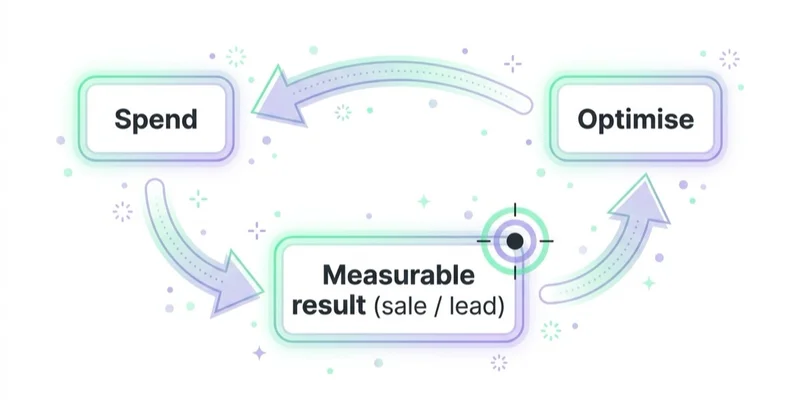
The discipline is better understood as a loop:
Define the outcome → measure the journey → invest → test → learn → reallocate → verify business impact
That distinction matters. A campaign can report an excellent ROAS while acquiring customers who would have purchased anyway, producing low-margin orders or claiming conversions also credited elsewhere. Good performance marketing connects platform optimisation with analytics, customer data, unit economics and, where feasible, incrementality.
TL;DR
- Performance marketing links investment to a measurable outcome and uses evidence to improve the result.
- It is commonly delivered through paid search, Shopping, paid social, video, display, retail media, affiliates and app acquisition.
- Performance marketing is not the same as performance-based pricing. An agency may be paid a retainer while operating a rigorous performance programme.
- Platform ROAS and CPA help steer campaigns, but they do not prove incremental profit.
- A practical measurement stack combines platform data, analytics or CRM data, business finance data and controlled experiments where possible.
- Growth marketing has a wider customer-lifecycle remit; brand marketing develops memory, preference and demand. The boundaries overlap.
- Brand activity can be measured, and performance activity can have long-term effects. The difference is primarily role and operating model, not “measurable versus unmeasurable”.
- The correct objective is not the cheapest conversion. It is sustainable, incremental business value within operational and financial constraints.
What is performance marketing?
Performance marketing is marketing managed against a pre-agreed result. The team defines what success means, implements the signals required to observe it, allocates budget, runs tests and changes the programme based on measured outcomes.
Historically, the term was closely associated with response-based and partner models in which payment followed an action. The IAB's industry definition broadened the category beyond one channel or payment method and included activities such as search, email and cost-per-acquisition programmes. In current practice, the term most often describes accountable paid acquisition and conversion activity.
Three features distinguish a mature programme.
1. The outcome is explicit
“Generate traffic” is rarely sufficient. A more useful objective is:
- profitable new-customer orders;
- sales-qualified opportunities accepted by the sales team;
- completed applications that pass an eligibility check;
- subscriptions that remain active beyond a defined period;
- app users who complete an activation event.
The conversion should be close enough to business value to guide the system. If bidding uses an easy micro-conversion, the platform may become very efficient at finding people who perform that action without becoming customers.
2. Investment can be changed
The team can adjust budget, bids, audience, query coverage, creative, offer, landing journey or conversion signal. Measurement without an operating decision is reporting, not performance management.
3. Results are tested, not merely credited
Attribution assigns credit under a model. It does not establish what would have happened without the marketing. Incrementality testing uses a control or comparison condition to estimate causal lift. Google, for example, distinguishes attribution reports from lift studies and describes conversion lift as a way to measure the additional conversions caused by advertising.
Not every business has the volume or platform eligibility for a lift study. Even then, teams can improve decision quality with clean geo tests, matched-market tests, holdouts, time-based tests with appropriate controls and careful triangulation across multiple data sources.
Performance marketing is not performance-based marketing
These terms are related but not interchangeable.
- Performance marketing describes how marketing is planned, measured and optimised.
- Performance-based marketing or remuneration describes how a publisher, partner or agency is paid—for example per lead, sale or another agreed result.
A fixed-fee agency can run performance marketing. An affiliate paid per sale uses performance-based compensation. A pay-per-lead agreement can still fail if the lead definition, validation and commercial incentives are weak.
If you are evaluating outcome-linked remuneration, see performance-based marketing and pay per lead.
Performance marketing channels
The channel list is not defined by whether a metric exists. Almost every marketing activity produces some data. The practical question is whether investment and delivery can be managed against a meaningful outcome.
| Channel | Typical role | Useful optimisation signal | Important limitation |
|---|---|---|---|
| Paid Search | Capture active demand | Qualified lead, purchase or value | Brand demand and last-click credit can overstate incrementality |
| Shopping / Performance Max | Acquire ecommerce demand across Google inventory | Conversion value, margin-adjusted value or new-customer value | Aggregated reporting can hide inventory and product differences |
| Paid social | Create and capture demand with creative distribution | Purchase, qualified lead, subscription or downstream event | View-through and cross-device attribution need careful interpretation |
| Video and display | Reach, consideration, retargeting and response | Lift, qualified visit or conversion depending on the job | Click-only evaluation can undervalue or distort the channel |
| Retail media | Reach shoppers near product discovery and purchase | Incremental sales, new-to-brand customer or contribution | Retailer attribution and organic sales overlap require scrutiny |
| Affiliate and partnerships | Acquire through publishers, creators and partners | Validated sale, lead or customer | Cannibalisation, voucher interception and partner quality matter |
| App acquisition | Install, activate and monetise app users | Activated user, subscription or predicted value | Privacy frameworks and delayed value complicate measurement |
| Lifecycle media | Reactivate or expand known customers | Incremental repeat order, retention or value | Email and SMS costs are not usually comparable with auction media |
SEO, content, email and conversion optimisation can contribute to the same commercial system. Whether a company labels them “performance marketing” varies. The label matters less than giving each activity an appropriate objective, owner and evaluation method.
How performance, growth and brand marketing differ
These are operating concepts, not mutually exclusive departments.
| Dimension | Performance marketing | Growth marketing | Brand marketing |
|---|---|---|---|
| Primary role | Acquire or convert measurable demand efficiently | Improve growth across acquisition, activation, retention, revenue and referral | Build mental availability, preference, meaning and future demand |
| Typical scope | Media, creative, landing journey, conversion signal and budget allocation | Marketing plus lifecycle, product, pricing and experimentation | Positioning, distinctive assets, communications, reach and experience |
| Common decisions | Where to invest the next unit of budget and which intervention improves the outcome | Which constraint or loop limits sustainable growth | Which audience, idea and memory structures the brand should build |
| Common evidence | CPA, value, contribution, attribution, experiments and marginal returns | Funnel cohorts, activation, retention, LTV and experiment results | Reach, attention, awareness, consideration, search, share and sales impact |
| Typical horizon | Immediate optimisation plus longer-term customer value | Short experiments and compounding lifecycle effects | Current response plus long-term demand and pricing power |
Performance marketing versus growth marketing
Growth marketing usually has a wider remit. It may change onboarding, referral mechanics, lifecycle messaging, packaging or product experience—not only acquisition media. Performance marketing is one possible acquisition and conversion capability within that system.
It is still too rigid to say that all performance marketing is a subset of growth marketing. Organisational definitions differ, and some businesses use “growth” as a name for their paid acquisition team. Before comparing roles or agencies, define the decisions each team owns.
Performance marketing versus brand marketing
Performance and brand marketing often use the same platforms, formats and audiences. A video campaign can build memory and generate conversions; a Search campaign can both capture existing demand and affect future consideration.
The strongest distinction is the primary job and evaluation framework. Performance activity is usually managed close to an observable action and frequent budget decision. Brand activity is designed to influence future choice across a wider audience and requires measures suited to that role, such as reach, awareness, preference, search lift, brand lift, econometric analysis or controlled tests.
Brand is not “unmeasurable”, and performance is not automatically causal. Both require an appropriate measurement design.
The performance marketing measurement stack
One dashboard should not be asked to answer every question.
Layer 1: platform operations
Platform reports help answer tactical questions:
- which campaigns, ads or audiences are receiving delivery;
- which conversion signals guide bidding;
- how spend, reach, clicks, conversions and attributed value change;
- where budget or learning constraints appear.
These reports are useful for daily optimisation. Their conversion windows, attribution logic and modelled data must be documented.
Layer 2: analytics, CRM and backend outcomes
This layer checks what happened after the ad interaction:
- valid landing sessions;
- consent and tracking coverage;
- qualified versus rejected leads;
- orders after cancellations and returns;
- new versus existing customers;
- gross profit or contribution;
- subscription activation, retention and churn.
Meta's official Conversions API guidance, for example, describes server-side business data as complementary to the pixel for measurement and optimisation. Sending more events is not the goal by itself; accurate event design, lawful data use, deduplication and quality are.
Layer 3: blended business performance
Business-level measures show whether total investment and total outcomes move together. They may include:
- total revenue and new-customer revenue;
- total marketing investment;
- contribution after variable costs;
- new-customer acquisition cost;
- cash payback period;
- marketing efficiency ratio;
- cohort retention and lifetime value.
This layer reduces dependence on any one platform's credit, but it is not automatically causal. Revenue can change because of price, promotion, distribution, seasonality, product availability, brand demand or economic conditions.
Layer 4: incrementality and modelling
Experiments estimate what the media caused. Marketing mix models can estimate channel contribution while accounting for time-based factors when data and methodology are suitable. Attribution describes conversion paths and allocates credit. These approaches answer different questions and work best as complementary evidence.
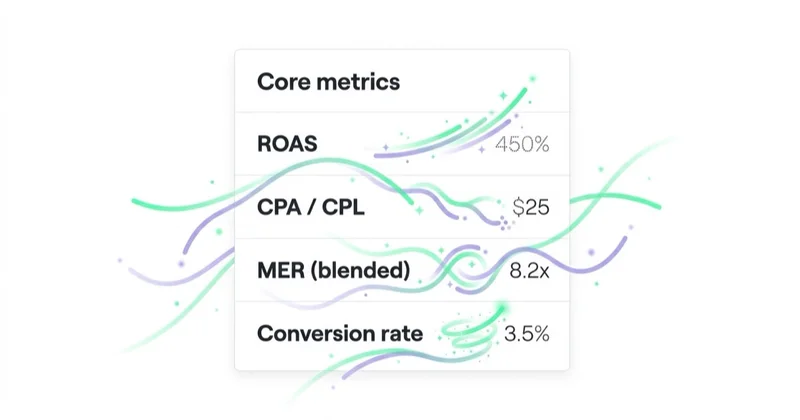
Core performance marketing metrics
CPA and CPL
CPA = media cost ÷ acquired customers or conversions
CPL = media cost ÷ valid leads
Always specify what the denominator contains. A form submission, marketing-qualified lead, sales-accepted opportunity and new customer are different outcomes. Also specify whether cost includes media only or the wider cost of creative, technology, people and fees.
ROAS
ROAS = attributed revenue ÷ ad spend
ROAS is useful for platform and campaign steering when revenue values are accurate and definitions are consistent. It is not profit: it ignores cost of goods, fulfilment, payment fees, discounts, returns and usually operational marketing costs.
MER
MER = business revenue ÷ total marketing investment
Some teams use ad spend rather than total marketing investment in the denominator. Document the definition before comparing reports. MER provides a blended efficiency view, but calling it “un-gameable” or causal would be wrong. It can improve because prices rose, organic demand increased or low-margin marketing was cut—even if the remaining media did not create additional demand.
Contribution after marketing
A practical ecommerce view can be built as:
Net revenue after discounts and returns − product cost − variable fulfilment and payment costs − marketing cost
The exact finance definition belongs to the business. The purpose is to prevent revenue efficiency from hiding margin destruction.
LTV, CAC and payback
Lifetime value and customer acquisition cost matter when repeat purchase or subscription revenue is material. Use observed cohorts and conservative forecasts. A high theoretical LTV does not solve a cash-flow problem if acquisition payback is too slow.
Marginal efficiency
Average ROAS answers what the current total achieved. Marginal ROAS or marginal contribution asks what the next unit of spend is expected to add. Budget decisions should increasingly use the marginal question because channels typically become less efficient as reach expands.
A worked decision example
Assume an ecommerce campaign reports:
- $50,000 ad spend;
- $250,000 platform-attributed revenue;
- 5.0 platform ROAS;
- $190,000 analytics revenue from sessions assigned to that channel;
- $150,000 net revenue after cancellations and returns;
- $55,000 contribution before marketing;
- 60% existing customers.
The platform result is not necessarily wrong. It answers according to that platform's identity, attribution window and model. But it is insufficient for the investment decision.
The next questions are:
- How much value came from new customers?
- What gross margin and repeat value do those customers produce?
- How much credit is also claimed by other channels?
- What happens to sales when eligible users or markets are held out?
- Does the next $10,000 of spend create positive incremental contribution?
Performance management begins where the screenshot ends.
How to build a performance marketing programme
1. Translate the business objective into a decision metric
Define the desired customer, action, time window and economic guardrail. “Increase leads” becomes “generate sales-accepted opportunities from target-market companies within a maximum cost based on observed close rate and contribution”.
2. Map the measurement chain
Document:
media exposure → click or visit → consented measurement → conversion
→ CRM/order validation → customer value → finance result
Name the system of record for each stage. Reconcile platform, analytics, CRM and finance data instead of forcing them to match exactly.
3. Protect signal quality
- define primary and secondary conversion actions;
- remove duplicate and test events;
- pass qualified or value-adjusted outcomes back where appropriate;
- monitor attribution and conversion windows;
- validate tags, server events and offline imports;
- document consent and privacy requirements;
- track changes to the measurement setup.
Automated bidding optimises the signal it receives, not the intention in a strategy document.
4. Build the channel and creative hypothesis
State who the campaign is for, what problem or demand state it addresses, why the offer is credible, which channel can reach that context and what the landing journey must prove. A media plan without a message and conversion hypothesis is only a spend allocation.
5. Set a testing and decision cadence
Separate:
- daily operational checks for broken delivery or tracking;
- weekly decisions on budget, search terms, creative and funnel issues;
- monthly commercial review using validated outcomes and contribution;
- periodic incrementality, marginality or modelling studies.
Account for conversion delay. A lead-generation campaign should not be judged on final sales before enough leads have had time to mature.
6. Scale against constraints
Scaling may be limited by demand, creative supply, audience reach, conversion rate, margin, stock, sales capacity, cash or measurement. More budget is only one intervention.
When performance marketing is a good fit
It is especially useful when a business has:
- a clear and valuable conversion;
- enough demand or a credible way to create it;
- reliable fulfilment or sales capacity;
- sufficient margin or customer value;
- a functioning site, app or lead process;
- consented, testable measurement;
- enough budget and time to learn;
- a willingness to change the offer, creative or journey—not only bids.
It is a weaker immediate fit when the product has no validated demand, the sales cycle cannot be connected to acquisition, every order destroys contribution, stock is unreliable or stakeholders expect guaranteed results from a tiny sample. Those constraints can be addressed, but media buying alone will not remove them.
How Space Ads approaches performance marketing
Space Ads treats performance marketing as a business measurement and optimisation system, not a collection of platform dashboards.
The working sequence is:
- define the qualified outcome and financial boundary;
- audit tracking from media interaction to CRM, order or subscription;
- separate new and existing customer value where the data permits;
- align campaigns, feeds, creative and landing pages with customer intent;
- optimise platforms using the best available conversion signal;
- reconcile attributed results with blended commercial performance;
- test material decisions and look for incremental, marginal value;
- scale only while the operational and economic system can support it.
A marketing audit helps locate the constraint before more budget is committed. Ongoing performance marketing then turns that diagnosis into a measured operating cadence.
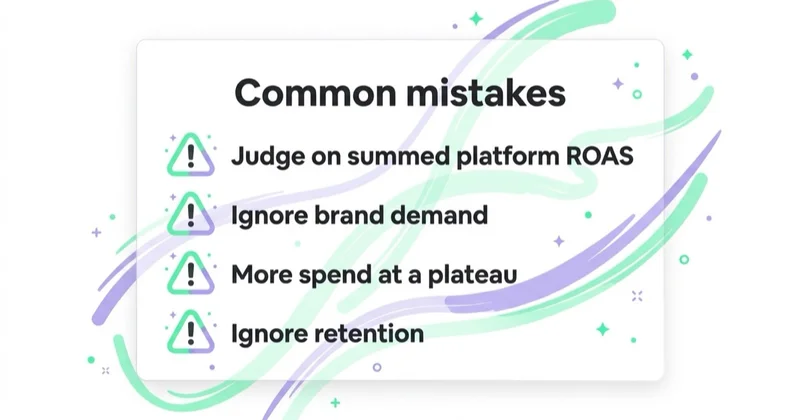
Common mistakes
| Mistake | Better approach |
|---|---|
| Calling all paid advertising performance marketing | Require a valuable outcome, reliable signal and decision loop |
| Treating platform attribution as causation | Use attribution for steering and experiments for causal questions |
| Optimising an easy lead or event | Feed back qualified, revenue-bearing outcomes |
| Calling ROAS profit | Include margin, returns, variable costs and wider marketing cost |
| Calling MER infallible | Control for business mix, seasonality and non-media factors |
| Combining new and existing customers | Report acquisition and retention value separately where possible |
| Scaling on average efficiency alone | Estimate the value of the next unit of spend |
| Pitting brand against performance | Define the role and measurement method for each |
| Changing many variables at once | Use explicit hypotheses and clean experiments where feasible |
| Ignoring sales or fulfilment capacity | Treat downstream operations as part of performance |
FAQ
What is performance marketing in simple terms?
Performance marketing connects marketing investment to a defined result and improves that result through measurement and testing. It commonly focuses on sales, qualified leads, subscriptions or app actions rather than exposure alone.
Is performance marketing the same as digital marketing?
No. Digital marketing includes any marketing delivered through digital channels, including activity designed primarily for communication, community or brand building. Performance marketing is an operating approach focused on measurable outcomes and optimisation. Much of it is digital, but the categories are not identical.
Is performance marketing only paid media?
Paid media is its most common application because spend and delivery can be adjusted quickly. Affiliate partnerships, lifecycle activity and conversion optimisation may also operate on performance principles. A channel being measurable does not automatically place it in the performance team.
Is performance marketing the same as affiliate marketing?
No. Affiliate marketing is one performance channel in which partners often receive commission for validated actions. Performance marketing also covers paid search, Shopping, paid social, app acquisition, retail media and other measurable acquisition activity.
What is the difference between performance marketing and growth marketing?
Performance marketing usually manages measurable acquisition and conversion. Growth marketing typically works across the wider customer lifecycle, including activation, retention, monetisation and referral, and may change product or pricing. Company definitions vary, so scope and decision rights should be agreed explicitly.
What is the difference between performance and brand marketing?
Performance marketing is generally managed close to a measurable action and frequent investment decision. Brand marketing primarily builds memory, preference and future demand across a wider audience. They overlap in channels and effects, and both can be measured. Neither should be evaluated with the other's narrow KPI set.
Which performance marketing metrics matter most?
Use a hierarchy: qualified business outcome and contribution first; blended acquisition cost, payback and customer value next; channel CPA or ROAS for allocation; clicks, CTR and CPM for diagnosis. The exact hierarchy depends on the business model.
Is ROAS enough to evaluate performance marketing?
No. ROAS is attributed revenue divided by ad spend. It does not establish incrementality or account for margin, returns, operating cost and customer quality. Use it for campaign steering alongside validated backend outcomes, contribution and causal evidence where possible.
What budget do I need for performance marketing?
There is no universal minimum. The required budget depends on auction costs, conversion rate, sales cycle, target difference, channel and the amount of data needed for a decision. A useful plan works backwards from expected acquisition cost, conversion volume and learning period rather than choosing an arbitrary daily amount.
How quickly does performance marketing work?
Some channels can generate traffic or conversions quickly, but reliable evaluation takes longer. Tracking validation, platform learning, conversion delay, lead maturation, repeat purchase and statistical uncertainty all affect the timeline. Set decision dates before launch and avoid promising guaranteed results by a fixed day.
Can performance marketing build a brand?
Yes. Performance media exposes people to messages and experiences that can influence memory and preference. However, an optimisation system focused only on immediate conversions may under-deliver reach, consistency and distinctive brand building. Use creative and measurement suited to both intended roles.
Key takeaways
- Performance marketing is a measurable operating discipline, not a media-platform label.
- Define a qualified outcome before selecting channels or automation.
- Separate attribution, blended reporting and incrementality; they answer different questions.
- Read CPA and ROAS with margin, customer quality, payback and contribution.
- Performance, growth and brand marketing should operate as connected capabilities with distinct jobs.
- Sustainable scale comes from the next profitable, incremental customer—not the highest dashboard ROAS.
Sources and further reading
- IAB — Defining the next generation of performance marketing
- Google Ads Help — About attribution reports
- Google Ads Help — About the Experiment Center and lift studies
- Google Ads Help — About conversion lift
- Meta Business Help Center — About Conversions API
- Think with Google — Modern Measurement Playbook
Continue learning
Continue reading

Why Is My ROAS Dropping? The Usual Suspects, in Order
A ROAS decline can come from reporting, media cost, traffic mix, conversion, order value or a changed business context. Use this diagnostic sequence to protect downside, compare mature data and isolate the real driver.
How to Choose a Performance Marketing Agency
Choose a performance marketing agency with a defined brief, evidence-based scorecard and clear commercial safeguards. This guide covers team evaluation, measurement, account access, fees, contracts and handover.

How to Get More From Your Existing Ad Budget (Improve Marketing Efficiency)
Improve the return from an existing ad budget by validating measurement, protecting profitable demand, testing allocation, improving the offer and conversion path, and tracking marginal business value.