A PPC landing page is the destination reached after a paid-ad click. It may be a dedicated campaign page, a product or service page, a category page or, when appropriate, the homepage. Its job is to continue the promise made in the ad and help the visitor complete the next useful action.
Clicks without recorded conversions do not prove that the page is at fault. The campaign may attract the wrong query or placement, the event may be broken, the page may fail, or the lead may be lost after submission. Diagnose the complete path—traffic, promise, destination, action and downstream result—before deciding where to intervene.
TL;DR
- Validate tracking and the destination first. Test the click, consent state, page, form, thank-you event and CRM hand-off.
- Inspect traffic quality. Search terms, placements, geography, devices and ad promise can explain a conversion gap before the page does.
- Preserve message continuity. The page should deliver the same offer, conditions and next step—not necessarily repeat the ad word for word.
- Use Quality Score diagnostically. The reported 1–10 score is not an auction input and should not be treated as a KPI.
- Group by meaningful intent, not an arbitrary page count. Several ads can share a page when the page genuinely serves their decision need.
- Test the actual device mix. Use field performance data and representative devices, not only a desktop preview.
- Measure qualified outcomes. A higher form completion rate can still produce worse customers or lower margin.
Four places the click-to-conversion gap can begin
Treat the journey as four connected layers:
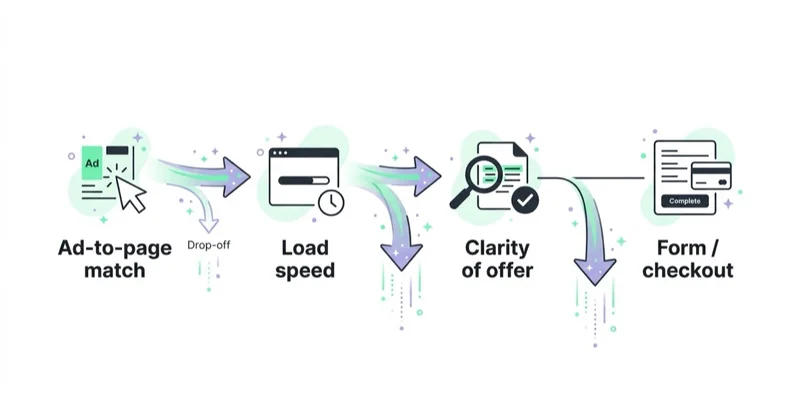
- Traffic: Did the query, placement, geography, device and audience fit the offer?
- Promise: Did the ad describe the service, price, eligibility and next step accurately, or did it win a curiosity click?
- Destination: Did the correct page load, remain usable and provide what the ad promised?
- Outcome: Was the action recorded, delivered to the next system and qualified correctly?
A strong click-through rate does not validate the traffic by itself. An ad can earn clicks through a vague promise, an irrelevant placement or a misleading offer. Likewise, a weak recorded conversion rate can come from consent-mode behaviour, duplicate or missing tags, cross-domain issues, a broken phone event or a CRM import failure.
Once traffic and measurement are credible, page work can increase the value of future clicks. A move from 2% to 3% is mathematically 50% more recorded conversions at the same click count, but only if traffic quality and other conditions remain comparable and the change is real rather than sampling noise. A broader account diagnosis is covered in why your Google Ads aren't converting.
Message match: preserve the promise
Message match is continuity between what produced the click and what the destination delivers. A person who searched for an emergency plumber, clicked an ad that promised same-day availability and landed on a generic company page cannot easily confirm that the promise applies. Google recommends that landing pages match the ad, keywords and advertised call to action.
The fix is to make the page's headline and opening restate the promise of the thing that was clicked:
- For Search, answer the underlying query and preserve advertised prices, availability, geography and conditions.
- For paid social, continue the product, use case and offer shown in the creative rather than introducing a different proposition.
- For materially different promises, use a destination or page state that can fulfil each one. Do not create variants merely to swap a keyword into the headline.
The page does not need exact keyword repetition. Google explicitly notes that the word-for-word phrase does not have to appear on the landing page. Clarity, usefulness and consistency matter more than mechanical insertion.
How the landing page relates to Google Ads quality
Google's reported Quality Score is a 1–10 diagnostic at keyword level. Its components are expected click-through rate, ad relevance and landing-page experience. Google states that Quality Score itself is not an input in the ad auction and should not be treated as a KPI.
Auction-time Ad Rank does consider ad and landing-page quality alongside the bid, thresholds, competition, search context and expected impact of assets. Improving a genuinely poor destination can therefore support both user outcomes and auction-time quality, but it does not guarantee a higher reported score or a lower CPC. CPC changes with the auction. Optimise the page for relevance and successful task completion, then use Quality Score components as diagnostic evidence.
Glossary
- PPC landing page — a page built for one paid campaign's intent, the destination of its clicks.
- Message match — continuity between the ad/keyword clicked and the landing page, especially the headline.
- Quality Score — Google's 1–10 diagnostic for expected CTR, ad relevance and landing-page experience; it is not an auction input.
- Landing-page experience — a Google Ads quality assessment of how relevant and useful the destination is to people who click.
- Ad Rank — auction-time values that determine eligibility and position using bid, auction-time quality, thresholds, context, competition and assets.
- Conversion rate — the share of clicks that complete the page's goal.
- Intent cluster — a group of queries or audiences that can be served by the same offer and decision path.
Diagnostic patterns to investigate
| Cause | Symptom | Fix |
|---|---|---|
| Irrelevant traffic | Weak engagement and outcomes from specific terms, placements or geographies | Correct targeting, exclusions, bidding or ad promise |
| Tracking or hand-off failure | Real actions appear in the site or CRM but not in the ad account | Validate tags, consent, cross-domain flow and imports |
| Promise mismatch | The advertised offer, product or condition is difficult to find | Align the offer and surface the relevant information early |
| Technical or mobile failure | Device/browser segment drops sharply or cannot complete | Reproduce and fix the affected journey |
| Form failure or effort | Starts without valid completions; repeated errors | Fix labels, validation, persistence and unnecessary fields |
| Missing decision information | Users seek pricing, eligibility, delivery or credentials elsewhere | Add accurate information or a clear route to it |
| Downstream quality problem | Forms rise but qualified leads, margin or sales do not | Improve offer, qualification, routing and optimisation signal |
These symptoms are clues, not causes. Bounce rate can be distorted by measurement design; long dwell time can mean useful reading or confusion. Reproduce the path, segment the data and review real search terms or placements before choosing a fix.
One intent per page
Use one page for an intent cluster when the visitors need the same offer, evidence and next step. Split destinations when intent changes the service, eligibility, price, location, product or action. Modern ad groups and responsive ads do not require a page for every keyword or creative variation, and account structure alone does not improve Google Ads quality.
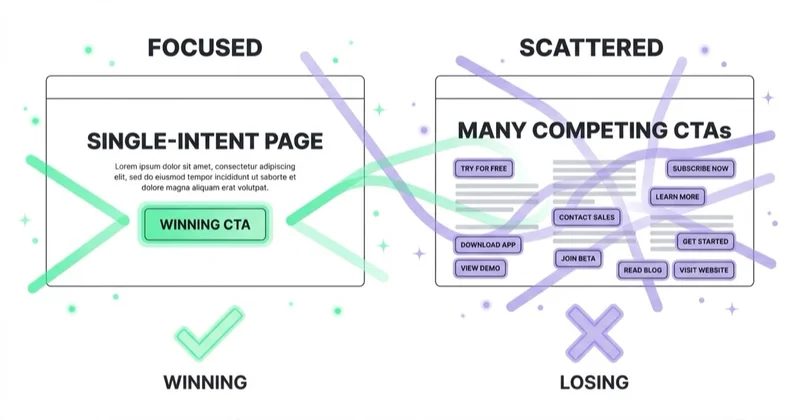
A dedicated page is useful when it can provide a more relevant and complete journey. A product ad may correctly land on a product page; a branded query may be well served by the homepage; a broad category query may need comparison and navigation. Removing all navigation can harm a considered purchase if visitors need credentials, pricing or supporting information. Choose the destination by task, then test it.
Speed, mobile and the form
Three practical fixes close most of the remaining gap.
- Performance. Use real-user data and lab diagnostics to find slow loading, poor responsiveness or layout shift. Core Web Vitals are useful thresholds, not a conversion guarantee.
- Mobile use. Test the actual traffic mix on representative devices. Check navigation, touch targets, input types, sticky elements, consent interfaces and zoom behaviour.
- Forms. Ask only for data needed at this stage. Provide visible associated labels, clear required states and useful errors, preserve entries after validation, and make success unambiguous. A multi-step form can organise complexity but does not remove the total effort.
For the page structure and proof placement that sit alongside these fixes, see high-converting landing page design; for the form as its own surface, see conversion rate optimization.
How Space Ads approaches PPC landing pages
We audit the paid journey as one system. For each material campaign, we map query or audience intent, ad promise, final and expanded URL, page action, analytics event, CRM stage and commercial outcome. We then test the path across relevant devices and consent states before changing copy or targeting.
Priorities follow affected spend, severity, confidence and downstream value. A broken form or wrong destination comes before headline refinement. A controlled experiment is useful when traffic and conversions can support the decision; low-volume pages may require a larger evidence-led revision and cautious monitoring. Quality Score can flag relevance problems, but business outcomes decide success. That work sits inside our landing pages, Google Ads and performance marketing practice, measured through analytics that ties clicks to revenue.
A fix-it sequence when clicks aren't converting
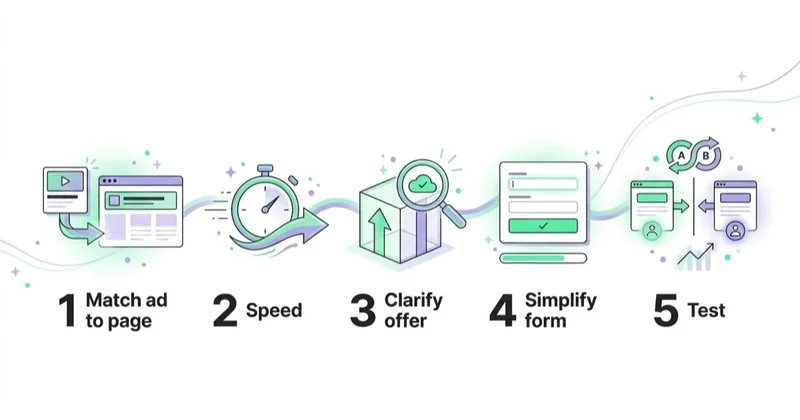
- Reproduce the journey. Open the real ad destination and complete the action on representative devices.
- Validate measurement. Check consent, events, deduplication, phone or cross-domain tracking and CRM receipt.
- Inspect traffic. Review search terms, placements, geography, devices and the promise made in each ad.
- Check continuity. Confirm that product, offer, conditions, location and next step remain consistent.
- Find technical friction. Use field performance data, browser/device breakdowns and form errors.
- Check decision support. Add the pricing, proof, eligibility or process information the task requires.
- Prioritise and test. Define the hypothesis, primary business metric, guardrails, sample needs and decision rule.
Stop doing / Do instead
| Stop doing | Do instead |
|---|---|
| Assuming every homepage is wrong | Choose the page that best completes the visitor's task |
| Treating healthy CTR as proof of traffic quality | Inspect terms, placements, promise and downstream outcomes |
| Building a page for every keyword | Group by meaningful intent and decision path |
| Treating the page as separate from the media | Manage the page and the campaign as one system |
| Checking only a desktop preview | Test representative devices and real-user performance |
| Optimising only form completion | Track qualification, sales, cancellations and margin |
| Chasing the 1–10 Quality Score | Use it diagnostically and optimise for user and business outcomes |
Common mistakes
Common errors include a final URL that redirects to the wrong locale, tracking that fires before success, ad text that omits important conditions, mobile overlays that hide the CTA, and a form that drops attribution or never reaches the CRM. Another is changing targeting, creative and page simultaneously, making the result impossible to interpret. Diagnose the layer before prescribing the fix.
FAQ
Why do my PPC ads get clicks but no conversions?
The cause may be irrelevant traffic, a click-driven ad promise, broken measurement, a poor page experience, form failure or weak sales follow-up. Validate tracking and the CRM hand-off, review actual search terms or placements, and reproduce the page journey by device. CTR alone cannot identify the cause.
What is a PPC landing page?
A PPC landing page is simply the destination of paid traffic. It should fulfil the ad's promise and support the visitor's next task. It can be a dedicated page, product page, category page, service page or homepage; the best choice depends on intent and the information needed for the decision.
Does the landing page affect Google Ads Quality Score?
Landing-page experience is one of the three components in the reported Quality Score diagnostic. Quality Score itself is not used in the auction. Auction-time Ad Rank does consider ad and landing-page quality among several factors. A better page can support performance, but it does not guarantee a particular score, position or CPC.
Should each ad group have its own landing page?
Not automatically. Several ad groups can use the same destination when they share the same offer, conditions, evidence and next step. Create another page when intent materially changes the task or information needed. Avoid thin duplicates and dynamic headline swaps that do not change the underlying experience.
How do I improve PPC landing page conversion rate?
First validate traffic and tracking. Then preserve the advertised offer, fix device-specific failures, make forms accessible and remove unnecessary requests. Add accurate decision information and proof where needed. Test a defined hypothesis when sample size permits, and judge qualified or profitable outcomes rather than raw completion alone.
Is it better to send ads to the homepage or a landing page?
Use the page that best satisfies the visitor's intent. A dedicated page helps when the campaign has a specific offer or journey. A homepage can be appropriate for branded or broad company intent, and product or category pages often fit ecommerce ads. Compare relevance, task completion and downstream value rather than applying a universal rule.
Key takeaways
- Diagnose traffic, promise, destination, tracking and downstream handling as one paid journey.
- Continue the advertised offer and conditions; exact keyword repetition is unnecessary.
- Use Quality Score as a diagnostic, not a KPI or direct auction input.
- Choose destinations by meaningful intent rather than creating one page per ad group.
- Test real devices, accessible forms and qualified business outcomes—not page aesthetics alone.
Sources and further reading
- Google Ads Help — Quality Score and how it's calculated
- Google Ads Help — Ad Rank definition
- Google Ads Help — Optimise ads and landing pages
- web.dev — Core Web Vitals (LCP, INP, CLS)
- W3C Web Accessibility Initiative — Forms tutorial
Continue learning
Continue reading
Landing Page Mistakes That Kill Conversions (and How to Fix Them)
Landing pages often underperform because the promise, path to action or measurement is unclear. This guide shows how to diagnose message mismatch, mobile friction, forms, proof and tracking without relying on universal CRO rules.
High-Converting Landing Page Design: The Patterns That Actually Work
A strong landing page makes the offer, evidence and next step easy to understand for a specific audience. Learn how to design, measure and test message match, forms, proof, accessibility and performance.
Ecommerce Conversion Rate Benchmarks by Industry (and How to Read Them)
Published ecommerce conversion benchmarks often combine different formulas, stores, countries, devices, and traffic mixes. Learn how to qualify an industry comparison, reconcile Shopify and GA4, and build a decision-ready internal baseline.