PPC management software is the tooling agencies and in-house teams use to run pay-per-click advertising — paid search, shopping, and increasingly social — across multiple accounts without managing each one by hand. In 2026 the category has narrowed in purpose: now that Google and Microsoft automate most of the bidding, PPC software earns its keep less on bid tweaks and more on cross-account consistency, auditing at scale, reporting, and the new layer of AI workspaces that read accounts and propose changes. For an agency, the real product is leverage — the same standard applied across every client without the headcount growing in lockstep with the account count.
TL;DR
- PPC management software is about scale, not single-account depth. One account is fine by hand; twenty isn't. The software exists to enforce one standard across many.
- The bidding job mostly moved to the platforms. Smart Bidding and its equivalents run the auction. PPC software's durable value shifted to auditing, alerting, reporting and structure.
- Agencies buy it for three things: consistency across accounts, reporting without the manual export ritual, and an audit trail of who changed what and why.
- "PPC" is broader than Google. It spans Microsoft Advertising, Shopping, and auction-based paid media generally — though search is still the centre of gravity.
- The new category is the AI workspace. Instead of configuring rules, you ask for an audit and approve changes, across accounts, with guardrails.
- White-label and client access matter for agencies. Reporting clients can open, and changes you can defend, are part of the product, not extras.
- Safety scales with account count. A rule or an AI action applied across twenty accounts at once multiplies both the upside and the blast radius — limits and logs are non-negotiable.
This post goes deep on the PPC-software angle for agencies. For the full map of ad management categories it sits within, see the pillar guide to ad management software in 2026; for the reporting layer specifically, see marketing reporting in 2026.
A quick glossary
- PPC — pay-per-click; auction-based paid advertising, billed on clicks (or impressions/conversions) across search and other platforms.
- Bid management — adjusting how much you pay per auction; largely automated by platform Smart Bidding now, with third-party tools adding cross-account logic.
- Account audit — a structured review of an account against best practice, surfacing wasted spend, gaps and risks. See how to audit a Google Ads account.
- White-label — software an agency uses under its own brand, so clients see the agency, not the vendor.
- MCC / manager account — Google's structure for managing many client accounts under one login; the backbone of agency PPC.
- Audit log — a recorded trail of every change made, with the reason, for accountability across a portfolio.
What PPC management software actually does for an agency
The honest version: it removes the parts of the job that don't scale.
Running one account well is a craft problem — judgement, creative, structure. Running twenty is an operations problem. The same five-minute check, done twenty times every morning, is an hour and a half before any thinking happens. The same client report, rebuilt by hand on Friday, multiplied across the roster, is a part-time job. The same negative-keyword hygiene, applied inconsistently because someone was busy, is wasted spend nobody noticed.
PPC management software targets exactly those: it runs the checks across every account at once, flags the exceptions, assembles the reports, and enforces the rules you'd apply by hand if you had the time. The platforms now handle the bidding; the software handles the operational discipline around it.
A clarifying question when evaluating any PPC tool for an agency: does it make one account better, or does it make twenty accounts consistent? The first is nice; the second is what you're actually buying.
What changed: bidding moved to the platforms
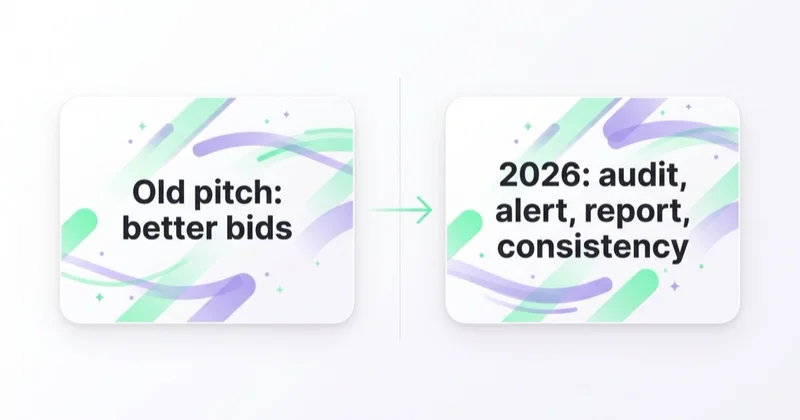
For years, the pitch for PPC software was better bids — rules and algorithms that beat manual bidding. That era is largely over. Smart Bidding, Performance Max and their equivalents now run the auction with signals no third-party tool can match, because the platforms see the full context.
That doesn't make PPC software redundant — it relocates its value. The durable jobs in 2026 are:
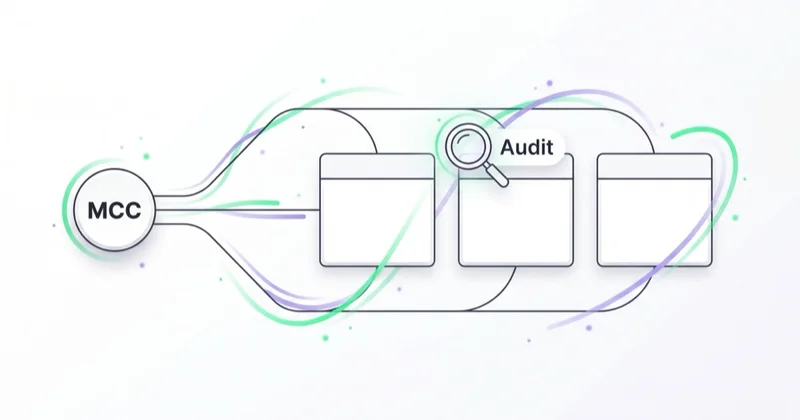
- Auditing at scale — surfacing wasted spend, structural gaps, tracking breaks and policy risks across every account, continuously.
- Alerting — catching the account that broke overnight before the client does.
- Reporting — reconciled, client-ready, without the manual export.
- Structure and hygiene — negatives, naming, feed quality, and enforcing the same standard everywhere.
- Feeding business context to automated bidding — the bidding is automated, but what it optimizes toward (and the value signals it learns from) is still your job.
| The old PPC-software pitch | What earns its keep in 2026 |
|---|---|
| Beat manual bidding with rules | Audit and enforce standards across many accounts |
| Bid adjustments by schedule/device | Feed clean value signals to platform Smart Bidding |
| One-account optimization | Cross-account consistency and alerting |
| Static monthly reports | Reconciled, on-demand client reporting |
What to look for in PPC software as an agency
- Multi-account by design. It should treat the portfolio as the unit, not a single account with a switcher bolted on.
- Reconciled reporting. Numbers should tie to business outcomes via GA4, not just re-display platform-reported figures. (More in the reporting guide.)
- Audit depth. Does it actually find wasted spend and structural issues, or just chart what already happened?
- Change control. If it can act on accounts, it needs per-account limits, previews and a complete audit log.
- White-label and client access. Reports under your brand; a view clients can open without a vendor logo in the way.
- Time-to-value. A tool that takes a quarter to configure costs more than its license in onboarding time.
By agency size
| Agency profile | Primary need | Watch out for |
|---|---|---|
| Boutique (1–10 accounts) | Reporting + audit automation | Enterprise suites you'll underuse |
| Growing (10–30 accounts) | Consistency + alerting across the roster | Tools that don't scale past a switcher |
| Established (30+ accounts) | Governance, audit log, white-label at scale | Anything without per-account limits |
What we see running PPC at scale
Across the 25+ client accounts we audit daily, the pattern is consistent and a little unglamorous: the wins that compound aren't clever bid hacks, they're hygiene applied without exception. The accounts that drift are almost never the ones with a bad strategy — they're the ones where a tracking tag broke quietly, a feed started dropping products, or a negative-keyword list went stale because the week got busy. At one or two accounts you catch those by hand. Across a portfolio you catch them only if something is checking every account, every day, and flagging the exception. That's the real argument for PPC software at an agency: it's not smarter than a good specialist, it's tireless across twenty accounts in a way a person can't be.
It's also why we lean on automated bidding rather than fighting it. The platforms run the auction better than a rules engine can; the leverage is in giving them clean signals and catching the breaks fast — not in re-litigating bids the algorithm already owns.
A 30-day plan to roll out PPC software across an agency
- Week 1 — connect read-only and audit. Link the MCC, pull every account in read-only, and run a full audit. The first output is a prioritized list of what's already broken — useful on day one, no risk.
- Week 2 — standardize reporting. Move one client's report into the tool, reconcile it against GA4, and confirm it matches reality before rolling out to the roster.
- Week 3 — turn on alerting. Enable anomaly alerts across all accounts. Tune the thresholds so the team gets the breaks, not noise.
- Week 4 — controlled changes. If the tool can act, enable it on one or two accounts with hard limits, review every preview, and check the audit log. Widen only once the team trusts it.
Stop doing / do instead
| Stop doing | Do instead |
|---|---|
| Buying PPC software for better bids | Buy it for audit, alerting, consistency and reporting |
| Fighting Smart Bidding with manual rules | Feed it clean value signals; catch breaks fast |
| Checking accounts ad hoc when there's time | Automate daily checks; act on the exceptions |
| Rebuilding client reports by hand each week | Reconciled, templated reports under your brand |
| Applying changes across accounts without limits | Per-account caps, previews and an audit log |
| Treating twenty accounts as twenty solo jobs | Operate the portfolio against one standard |
Where Space Ads OS fits
Space Ads OS is the system we run our own agency on, so the agency problems are the ones it was built around. For PPC specifically, that means the daily audit runs across every account at once and surfaces the breaks — the stale negatives, the tracking gaps, the feed drops — rather than waiting for someone to open each panel. Reporting comes out reconciled and client-ready from chat instead of a Friday export marathon. And because it's a chat-and-agent workspace, a specialist can ask for an audit, get findings across the roster, and apply a fix with the guardrails — per-account limits, a preview, a logged reason — doing the quiet work.
The point isn't to replace the specialist's judgement; it's to give one specialist the reach of several by handling the operational discipline that doesn't scale by hand. If your agency is at the size where consistency and reporting overhead are capping how many accounts you can run well, it's worth a look.
FAQ
What is PPC management software?
PPC management software is tooling that helps run pay-per-click advertising — paid search, shopping and related auction-based media — usually across multiple accounts. It connects to platforms like Google Ads and Microsoft Advertising through their APIs and helps with auditing, alerting, reporting, structure and (in newer tools) proposing and applying changes. Its main value for agencies is applying one standard consistently across many client accounts.
Do agencies still need PPC software now that bidding is automated?
Yes, but for different reasons than before. The platforms now run the bidding through Smart Bidding and similar systems, so the value of third-party software has shifted away from bid adjustments toward auditing accounts at scale, alerting on problems, reconciled reporting, and enforcing consistency across a portfolio — the operational work that doesn't scale by hand.
What's the best PPC software for a small agency?
The best fit for a small agency is usually a tool that prioritizes audit and reporting automation without the configuration overhead of an enterprise suite. The deciding question isn't brand or feature count — it's whether the tool reconciles reporting against business numbers and reduces the manual work per account, rather than just charting what already happened.
Is PPC software the same as Google Ads?
No. Google Ads is one PPC platform with its own native panel. PPC management software sits on top of platforms like Google Ads and Microsoft Advertising, connecting through their APIs to manage several accounts or platforms together. The native panel is free and deep on one account; the software's value is cross-account scale and consistency.
Can PPC software manage multiple client accounts safely?
It can, if it has the right controls. Anything that applies changes across many accounts at once multiplies both the benefit and the risk, so per-account limits, a preview of each change, and a complete audit log are essential. Read-only auditing and reporting carry no such risk; change capability is where the guardrails matter.
What should agencies look for in white-label PPC reporting?
Look for reports clients can open under your brand, reconciled against business numbers rather than re-displaying platform-reported figures, on a cadence clients actually read. The reporting should reduce the manual assembly time per client to near-zero, leaving only the commentary — that's where the agency's value shows.
In short
- PPC management software is about running many accounts to one standard, not making a single account marginally better.
- The bidding job moved to the platforms; the software's durable value is auditing, alerting, reporting and consistency at scale.
- Agencies should evaluate on multi-account design, reconciled reporting, audit depth, change controls and white-label.
- The new category is the AI workspace — audit and act across accounts through chat, with guardrails.
- Safety scales with account count: limits, previews and logs are non-negotiable once software can act.
- The leverage is operational discipline applied tirelessly across the portfolio — that's what one specialist can't do by hand.
Sources and further reading
- Google Ads Help — About Smart Bidding
- Google Ads Help — About manager accounts (MCC)
- Microsoft Advertising — Help and training
- Space Ads — Ad management software in 2026
- Space Ads — Marketing reporting in 2026
Continue learning
Continue reading
Google Local Services Ads: The Pay-Per-Lead Channel for Local Businesses
A current guide to Google Local Services Ads and pay-per-lead Performance Max: eligibility, Google Verified, screening, billing, ranking, lead credits, migration and measurement beyond raw leads.
Google Ads Benchmarks by Industry (CTR, CPC, Conversion Rate)
Google Ads benchmarks can provide context, but only when the campaign type, market, conversion action, attribution and time period match. Learn how to make a valid comparison and turn it into a useful decision.
Google Ads Change History: How to See What Your Agency Actually Changed
Google Ads Change history shows many account edits, their timing and the user or tool responsible. Learn what the log can verify, what it cannot, and how to review agency decisions without rewarding busywork.