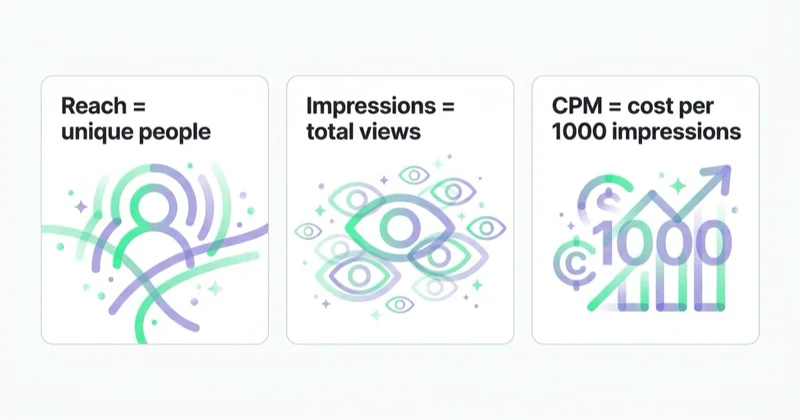
Reach, impressions and CPM describe different parts of media delivery. Reach estimates how many distinct people, users or accounts were exposed within a platform's reporting scope. Impressions count delivery events, including repeated delivery to the same person or device. CPM expresses media cost per thousand impressions.
None of these metrics proves that someone paid attention, remembered the message or changed behaviour. Definitions and estimation methods vary by platform, format and reporting window, so compare like with like. Use delivery metrics to understand what was bought, then use outcome measurement to learn what the exposure achieved.
TL;DR
- Reach is estimated and scoped. It may deduplicate across some devices or account identities, but it is not a census of attentive human viewers.
- Impressions are delivery counts. The same person can generate several, and the platform definition may be "entered the screen" rather than "was noticed."
- CPM = spend ÷ impressions × 1,000. It is a reported efficiency metric and, in some products, a buying or bidding basis.
- Average frequency = impressions ÷ reach. It does not show whether most people saw one ad while a small group saw it many times.
- Viewability is a minimum opportunity to see, not attention. Use viewable impressions or attention measures only when the inventory and methodology support them.
- Choose optimisation from the job, but verify the charging model. A platform can optimise for conversions while the underlying auction still prices impressions.
- Measure awareness with lift where feasible. Reach is an input; ad recall, awareness, search or conversion lift are outcomes.
The definitions, precisely
Because these terms are used loosely, the differences matter. Here they are side by side.
| Metric | What it counts | Answers the question |
|---|---|---|
| Reach | Estimated unique users, people or accounts exposed within a defined scope | How broadly did delivery spread? |
| Impressions | Counted ad-delivery events, including repeats | How much delivery did the platform record? |
| Average frequency | Impressions ÷ reach | How concentrated was delivery on average? |
| CPM | Spend ÷ impressions × 1,000 | What was the average cost of recorded delivery? |
| CPC | Cost per click | What does a visit cost? |
| CPA / ROAS | Cost per action / return on ad spend | What does a result cost, or return? |
The relationship between the first three is useful but simplified. A campaign with 100,000 impressions and estimated reach of 25,000 has an average frequency of four. That does not mean every person received exactly four impressions. Where available, inspect frequency distribution—such as the share reached 1+, 2+, 3+ or 10+ times—and the reporting window. Reach from two platforms cannot normally be added without cross-media deduplication.
Reach vs impressions: why the gap matters
Frequency describes repetition, not whether the message landed. One high-attention exposure may be meaningful; several low-viewability impressions may not be. Repetition can support recall, but excessive concentration may waste budget or contribute to fatigue. The effect depends on creative, placement, campaign length, audience, category and prior familiarity.
There is no universal target. Define the reporting window, watch average and distribution together, and compare response or lift by exposure where the platform supports it. Frequency caps also have technical limits: Google notes that caps can apply to signed-in users or, when signed out, devices or cookies depending on campaign type. A cap is therefore not always a perfect person-level limit.
What CPM actually is
CPM stands for cost per mille, or cost per thousand impressions. As a reported metric, it is calculated as spend divided by impressions and multiplied by 1,000. It can also describe a buying or bidding model, but these are not the same thing. A campaign optimised to clicks or conversions can still report an effective CPM, and some social auctions charge advertisers based on impressions even when the interface optimises toward a different event.
A £2 CPM is not automatically better than a £10 CPM. The difference may reflect audience scarcity, geography, season, placement, format, competition, viewability or predicted response. Ask what inventory and audience the impressions represent, whether the ads had an opportunity to be seen, and what incremental outcome followed.
A viewable impression meets a specified pixel-and-time threshold. The Media Rating Council's baseline is generally at least 50% of pixels in view for one continuous second for display and two continuous seconds for video, with additional measurement requirements. This establishes an opportunity to see, not proof of attention or completion. vCPM uses viewable impressions as its denominator or bidding basis, while eCPM normalises spend to a thousand impressions for comparison. Check the exact platform definition before comparing them.
Glossary
- Reach — estimated unique exposure within a platform, identity model and date range.
- Impressions — counted instances of ad delivery, repeats included.
- Average frequency — impressions divided by estimated reach; not a person-level distribution.
- CPM (cost per mille) — spend per 1,000 impressions; also used to describe some buying models.
- vCPM — cost per thousand viewable impressions, meeting the viewability standard.
- eCPM — effective CPM; a calculated cost-per-thousand used to compare campaigns bought on other models.
- CPC — cost per click; the price of a visit.
- CPA / ROAS — cost per action / return on ad spend; the price or return of an outcome.
When to buy on CPM, CPC or CPA
The metric you optimise toward should match the job of the campaign. Buying on the wrong one is how a good campaign gets judged a failure.
| Goal | Buy / optimise on | Why |
|---|---|---|
| Broad exposure | Reach or frequency optimisation; CPM as an efficiency diagnostic | Spread delivery across the intended population |
| Attention or video consumption | Viewable impression, completed-view or attention-oriented optimisation where valid | Go beyond a basic served impression |
| Qualified visits | Landing-page view or click optimisation, with downstream quality checks | Generate usable sessions rather than impressions alone |
| Leads or sales | Conversion or value optimisation when the event is reliable and sufficiently frequent | Align delivery with a business action or value signal |
Buying model, optimisation event, charging model and reporting metric are separate choices. CPC bidding does not guarantee qualified visits, and a CPA target does not mean the advertiser literally pays only when a sale happens. Confirm how the platform bills and optimises, then select primary success metrics independently.
An awareness campaign should not be judged only by CTR, but reach is still a delivery output rather than proof of awareness. Branded search, direct traffic and assisted conversions can be useful monitoring signals, yet other activity can move them at the same time. Where scale and tools permit, use Brand Lift, Search Lift, Conversion Lift or a credible geo experiment to estimate causality. This is why brand and performance should be evaluated together, as discussed in marketing metrics versus vanity metrics.
Are reach, impressions and CPM vanity metrics?
Reach and impressions are not inherently vanity metrics. They are valid delivery diagnostics. They become misleading when presented as evidence of attention, awareness or commercial effect without the required measurement. They can rise while sales or brand measures remain unchanged.
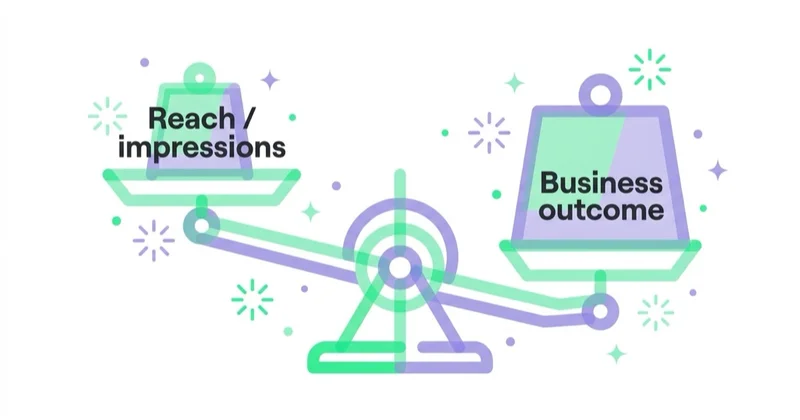
For an awareness plan, on-target reach, frequency distribution and viewability describe whether delivery matched the plan. Brand recall, awareness, consideration, search behaviour or incremental conversion describe effects. Keep these layers separate so a successful delivery report does not masquerade as an effectiveness study.
How different budgets and goals read these metrics
The emphasis shifts with scale and objective.
- Direct response. Use reach, frequency and CPM to explain delivery, while the primary decision uses qualified acquisition, value and incrementality.
- Brand programs. Plan on-target reach and frequency, inspect viewability and creative delivery, then measure brand or behavioural lift where feasible.
- Ecommerce. Read prospecting and brand investment against new-customer economics, margin and experiments; do not infer impact merely from a larger retargeting pool.
- B2B. A high CPM may be rational for a scarce account set, but validate on-target delivery and opportunity creation rather than assuming price signals quality.
How Space Ads approaches reach, impressions and CPM
We document four separate choices for each campaign: business objective, optimisation event, charging or buying basis, and reporting metrics. This prevents a reported CPM from being mistaken for the optimisation goal or a reach target from being presented as proof of brand growth.
The report shows the metric's scope and definition, audience denominator, date range, estimated reach, average and distributed frequency, viewability where applicable, and creative or placement mix. Effect is measured separately through the strongest available design, from platform lift studies to geo experiments. Observational signals are labelled as such. This connection between delivery and business evidence is central to web analytics and performance marketing.
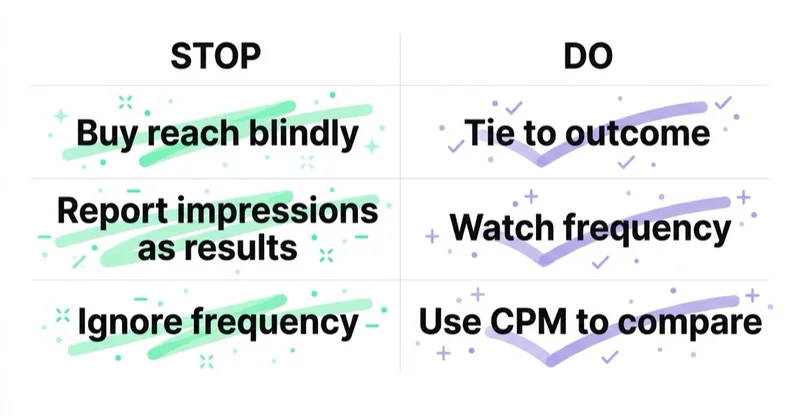
Stop doing / Do instead
| Stop doing | Do instead |
|---|---|
| Calling reach "unique people who watched" | State that it is estimated exposure in a defined platform scope |
| Treating a low CPM as success | Inspect audience, inventory, viewability and incremental outcome |
| Judging awareness only on clicks or last-click ROAS | Use delivery diagnostics plus lift measurement where feasible |
| Reading average frequency as a uniform dose | Review frequency distribution and the reporting window |
| Comparing CPMs with different definitions | Align platform, format, geography, viewability and dates |
| Reporting impressions as awareness | Separate media delivery from attention and brand effect |
Common mistakes
Common errors include adding reach from multiple platforms as though it were deduplicated, comparing CPM across different countries or formats, and calling an impression a view. Teams also infer awareness from delivery or causality from branded-search correlation. Finally, average frequency can look acceptable while a small group receives excessive repetition, which is why distribution matters.
FAQ
What is the difference between reach and impressions?
Reach estimates distinct people, users or accounts exposed within the platform's identity model and reporting window. Impressions count delivery events, including repeats. If a platform deduplicates one person's three impressions correctly, reach may be one and impressions three. Average frequency connects the estimates but does not reveal the person-level distribution.
What does CPM mean?
CPM is cost per thousand impressions: spend divided by impressions, multiplied by 1,000. It can be a reported metric or part of a buying and bidding model. Always distinguish it from vCPM, which uses viewable impressions, and from an optimisation goal such as clicks or conversions.
Is a lower CPM always better?
No. CPM describes the cost of recorded delivery. Audience scarcity, auction competition, geography, format, placement and viewability can all change it. Compare on-target and viewable delivery, then examine lift or downstream value. An expensive CPM is not proof of quality either.
When should I optimise for CPM instead of CPC or CPA?
Use reach or frequency optimisation when the delivery goal is broad or repeated exposure, and viewability-oriented buying when an opportunity to see matters. Use visit or conversion optimisation when those actions are reliable and sufficiently frequent. The billing basis may still differ, so verify both optimisation and charging. Measure awareness with lift rather than CPM alone.
What is a good frequency for an ad campaign?
There is no universal number. Set a hypothesis based on campaign length, creative, audience, format and category, then inspect average and distributed frequency over a defined period. Use lift or response evidence where available. Remember that caps may operate at user, account, cookie or device level rather than perfectly across people.
Are impressions and reach vanity metrics?
They are valid delivery metrics. They become vanity reporting when used to imply attention, awareness or commercial impact without evidence. For a brand campaign, report reach and frequency against the plan, then measure ad recall, awareness, search or conversion lift separately where feasible.
Key takeaways
- Reach is an estimate of unique exposure; impressions count delivery events; neither proves attention.
- CPM is spend per 1,000 impressions and can also describe some buying models.
- Average frequency hides distribution, so review exposure bands and date range where available.
- Viewability is a minimum opportunity to see, not evidence that the ad was noticed.
- Match optimisation to the task and use lift or experiments to estimate awareness and business effects.
Sources and further reading
- Google Ads Help — Measuring unique reach and frequency
- Meta Help Center — Differences between reach and impressions
- Media Rating Council — Viewable ad impression measurement guidelines
- Google Ads Help — About lift studies
Continue learning
Continue reading

Lead Generation for Online Courses and Education Providers
Education lead generation must connect an honest promise with learner fit, enrolment and course starts—not just form volume. Learn how to design the journey, evidence claims and measure each intake.

How to Choose a Performance Marketing Agency
Choose a performance marketing agency with a defined brief, evidence-based scorecard and clear commercial safeguards. This guide covers team evaluation, measurement, account access, fees, contracts and handover.
Website Marketing: How to Actually Drive Revenue From Your Site
A website creates commercial value when it helps the right people complete the right task and gives the business reliable feedback. This guide connects audience journeys, acquisition, experience, measurement and experimentation.