Solar marketing is not a contest to collect the cheapest leads. Residential solar is a high-ticket, consultation-led purchase. A viable enquiry must progress through an appropriate qualification process, a completed appointment, a proposal that makes financial sense and operational stages such as contract, permitting, installation and utility approval.

That means the useful metrics include cost per qualified appointment, set rate, sit rate, proposal rate, contract rate and cost per install. A low cost per lead can hide properties outside the service area, homes with poor installation fit, incentive confusion and people who cannot or do not want to continue. Campaign reporting should learn from later project outcomes, not only form submissions.
TL;DR
- Solar marketing should optimize for installs, not lead volume. Lead cost is only useful when it predicts qualified appointments and projects.
- Qualification should be proportionate. Installation authority, roof condition, shading, utility territory, usage, location and timeline affect viability. Detailed financial or property data should move to an appropriate secure process.
- Google and Meta reveal different signals. Search queries can show explicit research; Meta can introduce educational or consultation offers without a search. Neither channel guarantees readiness or project fit.
- Savings and incentive claims need review. Tax credits, state incentives, utility rules and net metering change, and the customer may still pay utility charges.
- Response handling needs ownership and consent. Track response time, contact rate and appointment outcomes instead of relying on a universal speed rule.
- Measurement needs CRM stages. Import set appointments, sat appointments, proposals, contracts and installs when the data is reliable.
- Solar is a trust sale. Financing, leases, PPAs, roof work, warranties and contractor proof should be clear before the appointment.
Why Solar Marketing Is Different
Solar combines local lead generation, home improvement, financial decision-making and utility-specific qualification. That makes shallow lead generation dangerous.
First, solar is property-dependent. A homeowner may be interested, but the roof may be shaded, too old, poorly oriented, structurally unsuitable or due for replacement. Service area, utility territory and net metering rules can also change the economics.
Second, the offer is financially complex. Customers compare cash purchase, loan, lease and power purchase agreement options. Incentives may depend on ownership, eligibility, installation timing, tax liability, state programs, utility rules and contract structure. Marketing cannot reduce all of that to a simple savings promise.
Third, sales cycles have several drop-off points. A lead can qualify, set an appointment, miss the appointment, sit but decline the proposal, sign but fail financing, or contract but not install. Each stage matters.
Fourth, lead aggregators and shared leads distort benchmarks. A shared lead contacted by multiple companies behaves differently from an exclusive lead generated from a brand-owned funnel and contacted quickly.
Fifth, market conditions move. Utility rates, interest rates, local incentives, net metering rules, dealer fees and consumer sentiment can change lead quality even when campaign structure stays the same.
Qualification: What Makes A Solar Lead Viable?
Solar qualification should happen before media optimizes around a lead.
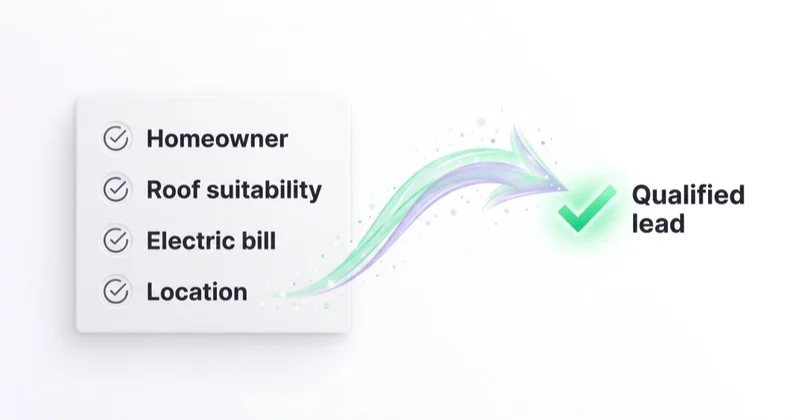
| Qualification Area | Why It Matters |
|---|---|
| homeownership | renters generally cannot approve rooftop installation |
| service area | installer licensing, crews and utility territory matter |
| roof age and condition | old roofs may need replacement before solar |
| shade and orientation | production depends on sunlight and roof geometry |
| electric bill / usage | low usage weakens the savings case |
| utility and rate plan | net metering and fixed charges affect economics |
| purchase structure | cash purchase, loan, lease or PPA changes ownership, cost and qualification |
| financing process | financing-dependent projects can fail later and require separate, compliant review |
| HOA or permitting constraints | some projects need additional approvals |
| timeline | immediate project vs early research affects follow-up |
| ownership plan | moving soon can change purchase logic |
These questions can be distributed across the journey rather than placed in one advertising form. An early form may need only contact details, service area, authority to consider an installation and timeline. Roof photos, full utility bills, credit details, tax information and documents belong in a secure process with a clear purpose, access controls and appropriate consent. The goal is to collect enough information for the next step without teaching advertising platforms that every submission is equally valuable.
Google Search For Solar
Google Search can reveal explicit intent when people compare costs, installers, incentives, financing and home fit. The query still does not prove that the property or purchase structure is viable.
| Search Intent | Example Pattern | Better Landing Page |
|---|---|---|
| installer | solar installers near me, solar company city | local proof, reviews, license info, quote CTA |
| cost / savings | solar panel cost, solar savings estimate | cost drivers, utility context, qualification |
| incentive | solar tax credit, solar incentives state | current incentive caveat, eligibility path |
| financing | solar loan, solar lease, solar PPA | compare options and explain tradeoffs |
| roof / home fit | solar for shaded roof, roof replacement and solar | feasibility and consultation path |
| brand | company name, reviews, complaints | trust reinforcement and direct booking |
Search campaigns should separate installer intent from cost research and incentive research. A homeowner searching "solar installers near me" may be ready for a quote. A homeowner searching "does solar work on a shaded roof" may need education before an appointment. Both can be valuable, but they should not be judged by the same immediate conversion rate.
Negative keywords protect budget:
- DIY, kits, portable panels and RV solar;
- jobs, training, salary and certification;
- wholesale panels and product-only searches;
- commercial terms if only residential is served;
- off-grid terms if not offered;
- locations outside the service area;
- free-only or incentive-misunderstanding queries;
- unrelated science or school project queries.
The broader local lead-gen structure is covered in Google Ads for local businesses, home services and contractors.
Meta Lead Ads For Solar
Meta can introduce a solar offer without waiting for a search query, but lead quality depends on the offer, form and follow-up. Instant forms reduce friction; that can increase submissions while providing less context for qualification.
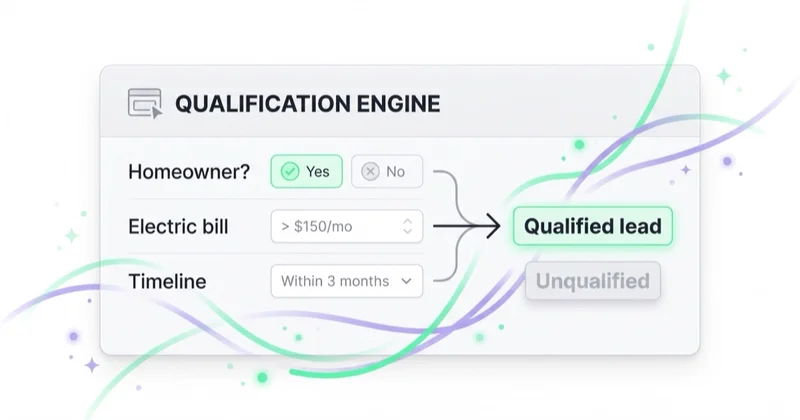
A proportionate early-stage form can ask for:
- confirmation that the person owns the property or is authorised to discuss an installation;
- city, service area or another permitted location field;
- a high-level roof or shade question where useful for routing;
- timeline;
- best callback time;
- consent language, contact-channel choices and a privacy notice aligned with the CRM process.
Creative should avoid implying that the platform knows private financial or home details about the viewer. Useful angles include education, local installation questions, utility-bill planning, roof suitability, how solar quotes work and what to ask before signing. If the ad promotes a loan or another financial product, the advertiser should also review Meta's financial-services rules, the applicable Special Ad Category and local disclosure requirements. Credit score, income, full bill data and financing documents should not be requested in a casual social form.
For the mechanics of instant forms, see Facebook lead ads.
Savings, Incentives And Financing Claims
Solar copy needs claim discipline. The FTC's consumer guidance on solar power emphasizes that homeowners should understand whether they are buying, leasing or signing a power purchase agreement, compare detailed bids and understand financing terms. It also notes that homeowners using solar may still pay utility fixed charges and may still buy some power from the utility depending on production and usage.
Marketing should therefore avoid shortcuts such as:
- implying that every homeowner will eliminate utility bills;
- presenting incentives as universal or permanent;
- treating tax credits as automatic cash rebates;
- hiding lease or PPA ownership implications;
- presenting future utility-rate assumptions as certain;
- using pressure-based deadlines without accurate basis;
- promoting financing without clear terms and eligibility review.
Better solar copy explains:
- what affects system size;
- why roof condition and shade matter;
- how utility rules affect savings;
- differences between purchase, loan, lease and PPA;
- what the consultation will calculate;
- what data is needed for a realistic proposal;
- how warranties and maintenance are handled;
- where incentives must be verified before signing.
For US residential campaigns, a major 2026 correction is essential: the IRS states that the federal Residential Clean Energy Credit applied to qualified property installed from 2022 through December 31, 2025, and is not available for property placed in service after that date. A 2026 campaign should therefore not promote a current federal 30% residential credit for a new installation. State, local, utility or narrowly applicable programs may still exist, but each claim needs the official program source, eligibility conditions, funding status and a clear date. Tax treatment should be reviewed by a qualified adviser rather than promised by a salesperson or lead form.
An incentive register makes this manageable. For every claim, record the program owner, geography, eligible customer and equipment, reservation or installation deadline, funding limit, ownership requirement, source URL, last verification date and person responsible for approval. Pause or replace the copy when any field cannot be confirmed. Do not use a generic "up to" disclaimer to rescue an expired or unavailable benefit.
Landing Pages For Solar Appointments
A solar landing page should qualify and educate. It should not only capture a phone number.
Strong pages usually include:
- local service area;
- homeowner qualification language;
- roof and shade factors;
- explanation of when usage data or a utility bill will be requested and why;
- utility and net metering caveat;
- financing option overview;
- current incentive disclaimer;
- installer proof, licenses and reviews;
- equipment and workmanship warranty overview;
- consultation process;
- what documents to prepare;
- privacy and consent language;
- clear phone and form CTA.
The page should also set expectations for the appointment. Is it a virtual design consultation? A phone qualification call? An in-home visit? Does the homeowner need a utility bill? Will the proposal include purchase, loan, lease or PPA options? Clear expectations can reduce avoidable confusion and missed appointments.
For CRO structure, see what a landing page is and how to build one.
Speed-To-Lead And Appointment Setting
A fresh solar enquiry may be comparing several providers or may simply be exploring the category. A prompt, permission-based response helps set expectations, but there is no universal deadline that turns every lead from good to bad.
But speed alone is not enough. The appointment setter needs a structured path:
| Intake Area | Why It Matters |
|---|---|
| lead source | Search, Meta, LSA, referral and aggregator leads behave differently |
| response time | compare it with contact and appointment outcomes |
| qualification script | supports consistent, proportionate triage |
| appointment type | virtual, phone, in-home or design consult |
| confirmation process | can reduce avoidable no-shows |
| follow-up cadence | provides a defined path for unanswered enquiries and opt-outs |
| document request | move utility bills, the full address and financing data to a secure step when genuinely needed |
| CRM stage discipline | enables true source reporting |
Solar teams should track response time, contact rate, appointment-set rate, appointment-sat rate, proposal rate, contract rate and install rate by channel. Scaling media before ownership, consent, routing and appointment handling are defined can increase volume without improving installs.
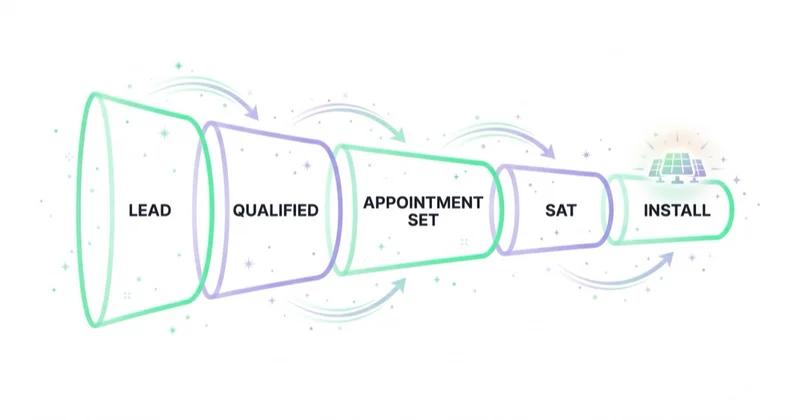
Measurement: From Lead To Install
Solar measurement needs more stages than ordinary lead generation.
| Stage | Meaning | Platform Use |
|---|---|---|
lead |
form, call or lead ad submission | early signal only |
qualified_lead |
homeowner, service area and basic fit confirmed | better optimization signal |
appointment_set |
consultation scheduled | useful bidding signal |
appointment_sat |
homeowner attended consultation | stronger quality signal |
proposal_sent |
design/financial proposal delivered | deep funnel |
contract_signed |
customer signs agreement | late-stage signal |
financing_approved |
financing path clears where applicable | project-quality signal |
permit_or_ntp |
project moves toward installation | operational signal |
install_complete |
system installed | primary outcome |
pto |
permission to operate / utility approval where relevant | final operational milestone |
Google Ads offline conversion imports can connect later CRM outcomes back to the ad interaction where the advertiser has an appropriate legal basis, consent where required and a permitted setup. Useful candidates include qualified appointment, sat appointment, contract signed and install complete, depending on volume, delay and data reliability. Send only the minimum permitted identifiers and event data. Do not upload utility bills, credit decisions, income, tax information, property documents or free-text CRM notes. Call reporting can help capture phone demand, but call outcomes still need a consistent disposition.
When reliable later-stage data exists at usable volume, it can be more informative than a shallow lead event. A campaign with a higher cost per lead may still produce a lower cost per install.
Local Services Ads And Local Trust
Local Services Ads may be worth testing where solar or related contractor categories are eligible in the target market. Availability can vary, so eligibility should be checked in the actual account. If LSA is available, it should be measured by qualified appointments and installs, not lead count.
Google has announced that Local Services Ads will migrate in phases into specialized Performance Max campaigns with pay-per-lead goals. Solar is not listed among the selected US categories in the first phase beginning in August 2026, but Google says broader groups and remaining categories will transition later. Account owners should follow their own migration notice, export historical reports before the assigned date and verify the transferred budget, service area, categories and lead settings rather than applying another vertical's timetable.
Local trust also depends on:
- Google Business Profile quality;
- reviews and review responses;
- service-area accuracy;
- installer licenses and certifications where applicable;
- local project photos;
- roof and electrical experience;
- warranty clarity;
- financing transparency;
- post-install support.
Solar is a home-improvement decision. A homeowner may check the company name, reviews, complaint history and licensing before booking. Ads can create interest, while verifiable local proof can reduce uncertainty.
Content, SEO And AEO
Solar buyers ask detailed questions before they book. Useful content can support both organic visibility and sales follow-up:
- "How to read an electric bill for solar quotes."
- "Solar loan vs lease vs PPA."
- "What roof age means for solar."
- "How shading affects solar production."
- "What happens after a solar contract is signed."
- "What to ask before accepting a solar proposal."
- "How solar warranties work."
- "What net metering means in this state."
- "What documents are needed for a solar consultation."
This content should be local, current and internally linked to appointment pages. It helps search engines and answer systems associate the brand with concrete buyer questions instead of generic solar claims.
How a Space Ads engagement can be structured
A solar acquisition engagement can start with funnel economics and claim control. An audit can map lead sources, proportionate qualification criteria, appointment-set rate, sit rate, proposal rate, contract rate, install rate, cancellation reasons, CRM quality, incentive language and response handling.
The media structure can then follow the funnel. Google Search can address installer, cost, incentive and financing queries. Meta can introduce educational and consultation offers with proportionate forms. Landing pages can explain roof fit, utility context and appointment expectations. Permitted CRM events can show which leads became appointments, proposals, contracts and installs. Platform-policy checks can form part of campaign work, while tax, financing, regulatory and legal approval remains with the installer and its qualified advisers. The exact scope for landing pages, routing, CRM integration and follow-up should be agreed before implementation.
For an existing installer, a marketing audit can show whether the account is buying qualified appointments or only cheap leads. Execution connects Google Ads, Meta Ads, call tracking, landing pages, CRM stages and performance marketing.
30-Day Optimization Plan
- Map the funnel. Lead, contact, qualified lead, set appointment, sat appointment, proposal, contract, install and PTO by source.
- Review claims. Update savings, incentive, financing, lease/PPA and tax-credit language against current sources.
- Define qualification. Homeownership, service area, roof age, shading, usage, utility, financing fit and timeline.
- Fix intake handling. Define ownership, consent-aware confirmation, callback coverage and escalation by source and hour.
- Rebuild Search. Separate installer, cost, incentive, financing, roof-fit, brand and local campaigns.
- Make Meta forms proportionate. Ask only what is needed for routing, then move bills, credit and detailed property data to an appropriate secure step.
- Improve landing pages. Add roof/utility context, financing comparison, incentive caveat, proof and consultation expectations.
- Connect CRM outcomes. Import qualified appointments, sat appointments, contracts and installs where reliable.
- Review by install economics. Compare cost per install, not cost per lead.
- Create buyer education. Publish current local content for incentives, utility rules, roof fit and financing choices.
Common Mistakes
| Mistake | Why It Hurts | Better Approach |
|---|---|---|
| Optimizing to raw leads | cheap leads may not set or install | optimize to appointments and installs |
| Using outdated incentive copy | creates trust and compliance risk | review incentive language regularly |
| Overpromising bill outcomes | utility charges and production vary | explain assumptions and qualification |
| Forms that collect too little or too much | either hide fit or create unnecessary privacy risk | collect only what the next step requires |
| Unowned follow-up | enquiries wait or receive inconsistent contact | define ownership, consent and response standards |
| No sit-rate tracking | appointments may not happen | measure set and sat separately |
| Blending all channels | Search and Meta have different roles | compare by install economics |
| No later outcome feedback | platforms learn from shallow conversions | send permitted, consistently defined outcomes when reliable |
FAQ
What is solar marketing?
Solar marketing is the process of generating qualified homeowner demand for solar consultations, proposals, contracts and installs through channels such as Google Search, Meta lead ads, Local Services Ads where available, local SEO, content, reviews, landing pages and CRM follow-up.
What is the best channel for solar leads?
Google Search can capture explicit installer, cost and incentive queries. Meta can introduce an educational or consultation offer without a search. Either channel can produce exploratory or ready-to-buy enquiries. The better channel is the one that produces qualified appointments and installs at a viable acquisition cost, not the one with the cheapest lead.
Why do cheap solar leads fail?
They often lack qualification. Renters, low-usage homes, shaded roofs, wrong service areas, weak financing fit and early-stage researchers can all submit forms. If the CRM only reports lead volume, the campaign may look efficient while the sales team struggles to set appointments.
How should solar lead forms qualify prospects?
An early form can ask whether the person owns the property or is authorised to discuss installation, the permitted service-area field, high-level roof fit, timeline and preferred contact method. Detailed utility, credit, tax and property information should be collected only when needed, through an appropriate secure process. The exact fields should balance routing value, privacy risk and completion friction.
How should solar ads talk about tax credits and incentives?
Incentive copy should be current, specific and linked to an official source. As of July 2026, the IRS says the US Residential Clean Energy Credit is not available for property placed in service after December 31, 2025. Do not advertise it as a current federal 30% benefit for new 2026 installations. State, local and utility programs need separate verification, and tax questions should be referred to a qualified adviser.
How should solar marketing be measured?
The funnel should track lead, qualified lead, appointment set, appointment sat, proposal sent, contract signed, financing approved, install complete and PTO where relevant. Cost per install and install value are stronger metrics than cost per lead.
Does speed-to-lead matter in solar?
Response handling matters because prospects may compare providers and expect to know what happens next. Track response time against contact and appointment outcomes rather than relying on a universal speed rule. A prompt reply still needs valid consent, clear ownership and proportionate qualification.
In Short
- Solar marketing should optimize for qualified appointments, contracts and installs.
- Qualification needs installation authority, roof, utility, usage, purchase structure and local eligibility signals.
- Search reveals explicit solar queries; Meta can introduce educational and consultation offers without a search.
- Savings, tax credit, lease/PPA and financing claims need current, careful review.
- CRM imports let campaigns learn from installed projects instead of shallow leads.
Need help connecting solar campaigns to qualified appointments, contracts and installs? Explore the Space Ads lead generation service. Campaign, landing-page, tracking and CRM responsibilities are defined for each engagement; tax, financing, regulatory and legal approval remains with the advertiser and its advisers.
Sources
- FTC Consumer Advice - Solar Power for Your Home
- Department of Energy - Homeowner's Guide to Solar
- IRS - Residential Clean Energy Credit
- Google Ads Help - About offline conversion imports
- Google Ads Policy Help - Consumer finance in personalized advertising
- Google Ads Help - About call reporting
- Local Services Help - Getting started with Local Services Ads
- Google Ads Help - Local Services Ads transition to Performance Max campaigns with pay-per-lead goals
Continue Learning
- Google Ads for local businesses, home services and contractors
- Home remodeling marketing: high-ticket leads from Google and Meta
- Roofing company marketing and lead generation
- Facebook lead ads: what they are and how to launch instant forms
- Call tracking for PPC and lead generation
- Negative keywords in Google Ads
- Google Ads · Meta Ads · Performance marketing · Marketing audit
Continue reading
Weight Loss Clinic Marketing: GLP-1 Demand Without Risky Claims
Weight loss clinic marketing in the GLP-1 era has to generate qualified consultations without risky body claims, prescription-drug shortcuts or privacy leakage. This guide covers Meta, Google Search, telehealth funnels, HIPAA-conscious tracking and program LTV.

Wedding Venue Marketing: Tours, Dates and Signed Bookings
Wedding venue marketing should fill the calendar with qualified tours and signed bookings, not just raw inquiries. This guide covers Google Search, Google Business Profile, wedding marketplaces, Instagram, Pinterest, galleries, off-peak dates, CRM follow-up and measuring tour-to-booking value.

Catering Marketing: Google Ads, Meta and Booked Events
Catering marketing works when event catering, corporate accounts and drop-off orders are measured separately. This guide covers Google Search, Meta, marketplaces, food trust, seasonality, quote quality and booked-event value.