Travel marketing has an unusually large gap between the number visible in an advertising account and the value eventually retained by the business. A customer may reserve a £3,000 holiday today, pay only a deposit, amend the booking twice and travel nine months later. Depending on the business model, the company may earn a commission, a service fee or the margin on a package—not the full booking value.
That does not make the initial booking unimportant. It means marketers need to distinguish booking value, cash collected, accounting revenue and contribution. Treating them as interchangeable can make an apparently excellent ROAS conceal weak margins, high cancellation rates or underfilled departures.
This guide explains how a travel agency or tour operator can build acquisition around the economics that actually matter, while still giving advertising platforms a timely signal to optimise against.
TL;DR
- Start by identifying the commercial model: agent, organiser/principal, affiliate or a combination. Each produces value differently.
- Do not bid against gross booking value by default. Use a value connected to commission or expected contribution, then correct it when the booking changes.
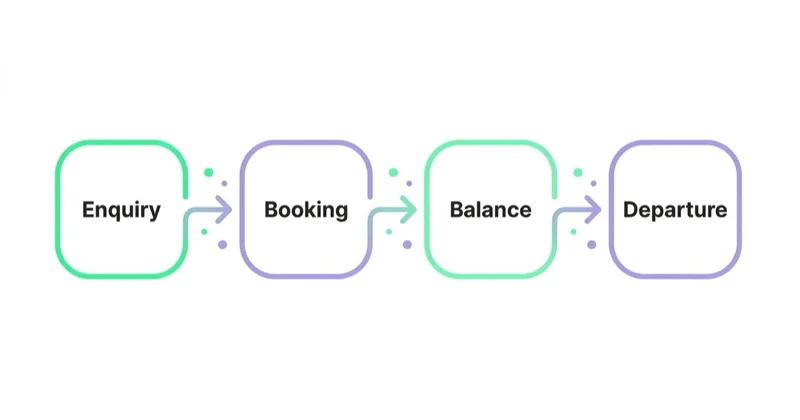
- Measure the entire booking lifecycle: enquiry, quote, deposit, balance paid, departure, completion, cancellation and refund.
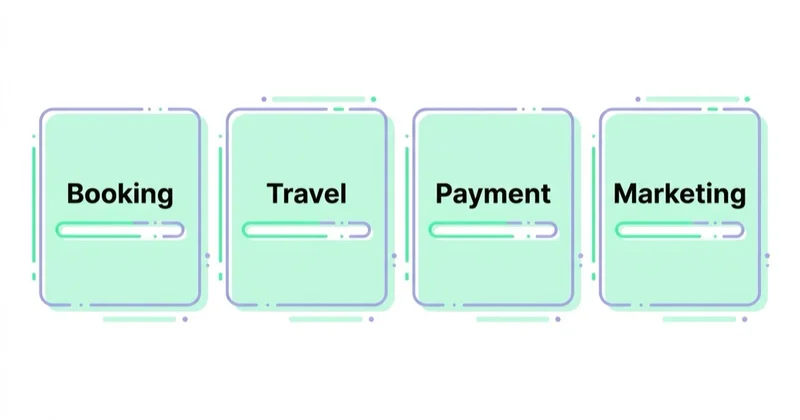
- Plan against at least four calendars: booking demand, travel dates, payment deadlines and available inventory.
- Segment by product economics and decision process. A last-minute city break and a long-haul escorted tour should not share one performance expectation.
- Match ads and landing pages to real search intent, availability and price conditions. Inspiration traffic and booking-ready traffic need different jobs.
- Make trust operational: clearly show who organises and sells the trip, what is included, the applicable protection and the cancellation terms.
Travel agency and tour operator marketing are not the same model
The label “travel business” covers companies with materially different responsibilities and profit structures.
| Model | Typical source of value | What marketing should optimise towards |
|---|---|---|
| Retail travel agent | Commission and/or service fee | Expected net commission or contribution from a completed booking |
| Tour operator or organiser | Margin between the customer price and direct delivery costs | Expected contribution after variable costs and cancellation risk |
| Lead generator or affiliate | Qualified-lead or referral fee | Accepted lead, confirmed referral value or downstream booking value |
| Hybrid business | Different economics by product and channel | Product-level value based on the role played in that transaction |
The distinction is more than terminology. Under IFRS 15, whether a business acts as principal or agent affects how revenue is presented, and the timing of recognition depends on the obligations in the customer contract. Finance should therefore define recognised revenue under the company's accounting policy. Marketing needs a related but separate figure that is useful for acquisition decisions.
For campaign optimisation, that figure is usually expected contribution: what the business expects to retain from the booking after the direct costs that vary with the sale. It is not a substitute for statutory accounts. It is a practical bidding and planning signal agreed with finance.
The four values teams should stop confusing
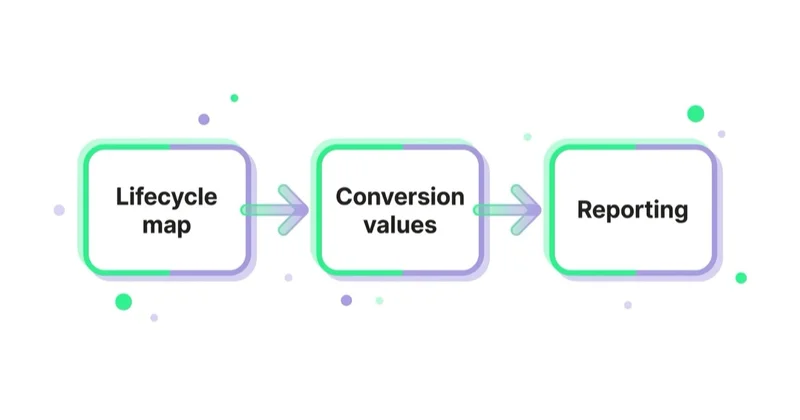
Before changing campaigns, put these fields into one shared data dictionary:
- Booking value — the total customer price attached to the reservation.
- Cash collected — the deposit and subsequent payments received so far.
- Recognised revenue — the accounting value and timing determined by the company's role and obligations.
- Contribution — commission or package margin less the agreed variable costs attributable to the booking.
A large booking can produce little contribution. A smaller specialist itinerary may be far more valuable. If both send gross customer price to an ad platform, value-based bidding receives the wrong hierarchy.
Consider an illustrative £3,000 booking. The agency expects £300 of commission, incurs £60 in payment, sales and servicing costs, and historical data suggests that comparable reservations have a 90% probability of reaching travel without losing the commission. A simplified initial signal could be:
(£300 expected commission − £60 variable cost) × 90% = £216 expected contribution
Real models may also account for retained fees, supplier penalties, amendments, foreign-exchange exposure or add-on revenue. The purpose is not false precision. It is to replace a £3,000 proxy with a value that reflects the business outcome.
Map the booking lifecycle before choosing conversions
Travel journeys rarely end on the confirmation page. A useful measurement design follows the reservation through the systems that know what happened next.
| Stage | What it tells you | Typical use in advertising |
|---|---|---|
| Enquiry or call | The customer has shown interest | Diagnostic or secondary conversion |
| Qualified enquiry | Dates, party, budget and product are plausible | Early optimisation signal for assisted sales |
| Quote or itinerary sent | A sellable option exists | Funnel-quality indicator |
| Deposit paid | A reservation has been created | Primary early signal, valued cautiously |
| Balance paid | Commitment has strengthened | Later quality milestone |
| Travel completed | The core service was delivered | Confirmed commercial outcome |
| Cancellation, amendment or refund | Original count or value is no longer accurate | Retraction or value adjustment where supported |
For online bookings, pass a unique reservation or order ID. For phone and adviser-assisted sales, retain campaign identifiers—with the appropriate consent—from the initial enquiry in the CRM. Google Ads, for example, supports offline conversion imports and enhanced conversions for leads, while conversion adjustments can restate a changed value or retract a cancelled reservation.
The exact implementation varies by platform. The operating principle does not: send a timely estimate, then return the later truth. Do not leave cancelled bookings permanently teaching the bidding system that they were profitable.
There are platform limits on how far back data can be imported or used by automated bidding. Long booking windows make timely milestone design essential; waiting until travel completion may produce a signal too late for optimisation. The early value must therefore be stable enough to bid on, while final outcomes remain available for reporting and model calibration.
Build a value model that survives cancellations
A useful starting formula is:
Expected contribution = expected commission or gross margin − direct variable costs − expected cancellation and servicing cost
Estimate it at the most granular level that has enough historical volume to be reliable. Useful dimensions may include:
- product and destination;
- departure month and booking window;
- sales channel and payment plan;
- party type and lead source;
- flexible versus restrictive cancellation terms;
- new versus returning customer.
Avoid building a separate rate for every tiny segment. Sparse data creates unstable values and invites overfitting. Start with broad, economically distinct groups, review the difference between expected and confirmed contribution by booking cohort, and split a group only when evidence supports it.
Also prevent data leakage. A probability model should use information available at the moment the signal is sent, not an outcome that became known later. And do not let the advertising system's own targeting decision become a circular input into the value assigned to its conversion.
For a deeper implementation framework, see margin-based conversion value in Google Ads.
Booking windows change evaluation—not just attribution settings
A short break booked next week and a once-in-a-lifetime itinerary researched for a year are different acquisition problems. Segmenting them improves budgets, creative, landing pages and reporting.
However, a longer booking window does not automatically mean selecting the longest attribution window available in every platform. Attribution settings have platform-specific limits and answer only part of the question.
Use three complementary views:
- Platform attribution for day-to-day optimisation, configured within the platform's capabilities and based on observed conversion lag.
- CRM journey data to connect the original enquiry, later interactions and confirmed booking.
- Incrementality and cohort analysis to understand whether media created additional demand rather than merely claiming credit for it.
Report booking cohorts by the date the reservation was made, and travel cohorts by departure or completion date. If booking windows move from one year to the next, comparing only departures can misdiagnose a timing shift as a performance change. The limitations of common models are explained in our guide to marketing attribution.
Travel businesses operate on four calendars
Seasonality is not one curve.
- Booking calendar: when customers research and reserve.
- Travel calendar: when the trip departs and the service is delivered.
- Payment and cancellation calendar: when balances fall due and cancellation economics change.
- Inventory calendar: which dated departures, flight allocations or rooms still need demand.
Media budgets should respond to the booking calendar, but campaign priorities also need live commercial context. A sold-out departure should stop receiving acquisition spend. A departure with spare capacity may deserve more support only when the incremental booking still creates acceptable contribution. “Underfilled” is not automatically “profitable to advertise”: remaining inventory, supplier commitments, discounting and servicing capacity all matter.
Where possible, connect availability, price and margin data to campaign feeds or automation. Put safeguards around stale data, zero inventory, expired departures and sudden price changes. The unit being marketed is often not a generic destination but a specific product, departure, room basis and origin combination.
Search strategy: build around jobs, not one keyword hierarchy
Travel searches sit across several jobs:
- Inspiration: “where to go in October” or “family holiday ideas”.
- Evaluation: destination, itinerary, operator and review research.
- Product discovery: duration, dates, board basis, departure airport and traveller type.
- Booking: a specific package, cruise, tour or operator with commercial modifiers.
- Support: baggage, changes, check-in, cancellations and existing-booking queries.
Search results differ by market and query, so classify intent by inspecting the actual results, landing-page fit and downstream behaviour—not by relying on a universal keyword list. Product-level demand often produces a clearer path to a booking, but inspiration can create valuable new demand when supported by useful editorial content, remarketing and a measurement horizon long enough to observe its effect.
Brand campaigns also require evidence rather than a blanket rule. Measure whether paid brand activity adds bookings, protects specific high-risk queries or mainly captures customers who would have clicked an organic result. Segment operator brand, travel-agent brand and product names where their economics differ.
Negative keywords and landing-page routing matter heavily. Existing-customer support traffic should not be judged as acquisition, and an ad for a specific departure should not land on a generic destination guide.
What a booking-ready landing page must answer
Travel is a high-consideration, high-trust purchase. A persuasive page reduces uncertainty without hiding material conditions.
Show clearly:
- the itinerary, dates, duration and departure point;
- what the price includes and excludes;
- whether the displayed price is per person, per room or for the whole party;
- the basis of any “from” price and current availability;
- deposit, balance, amendment and cancellation terms;
- who is organising and who is retailing the package;
- applicable financial protection and how to verify it;
- accessibility information and how to request assistance;
- independent evidence such as relevant, verifiable customer reviews;
- a clear route to advice for complex bookings.
Do not use an ATOL logo or protection statement more broadly than the protection actually applies. The UK Civil Aviation Authority states that businesses selling flight-inclusive packages or Flight-Only arrangements to UK consumers generally need to be an airline, an ATOL holder or fall within an exemption. The requirement can also apply to businesses based outside the UK when they advertise and sell to UK consumers.
Trust signals work best when they are specific and verifiable. Memberships, licences, protection and review claims should link to evidence or provide a reference customers can check.
Regulatory change UK travel marketers should prepare for
At the time of publication, UK package travel businesses operate under the Package Travel and Linked Travel Arrangements Regulations 2018. The Package Travel and Linked Travel Arrangements (Amendment) Regulations 2026 have been made, but their substantive changes take effect on 6 April 2027 and generally do not apply retrospectively to earlier contracts.
Among other changes, the 2026 instrument revises parts of the package definition, removes the linked travel arrangement category and introduces supplier refund and redress provisions. Businesses should review product construction, customer information, terms and marketing claims with qualified legal advisers before the commencement date. This article provides a marketing framework, not legal or accounting advice.
A practical campaign structure
Account structure should expose meaningful economic differences without fragmenting data unnecessarily. A workable hierarchy is:
- Separate markets, languages and materially different regulatory propositions.
- Separate online bookings from adviser- or call-assisted journeys.
- Group products by booking window, contribution profile and inventory logic.
- Separate inspiration, product discovery, high-intent and brand demand where each has a distinct role.
- Use product- or departure-level feeds when price and availability change frequently.
- keep acquisition, remarketing and existing-customer activity measurable as different jobs.
Creative should mirror that structure. Inspiration ads sell the relevance of a destination or experience. Product ads need accurate dates, origin, inclusions, price conditions and availability. Adviser-led journeys need a reason to enquire and a credible expectation of what happens after the form or call.
The operating framework we use at Space Ads
When approaching travel acquisition, we start with the commercial and data model before scaling media:
- Define the transaction: identify whether the business acts as agent, organiser or referrer for each product family.
- Agree the value: document booking value, commission or margin, variable costs and cancellation treatment with finance.
- Trace the data: map identifiers from ad click or lead through CRM, reservation, payment and final status.
- Audit demand and inventory: align search intent, creative and landing pages with sellable departures and current commercial priorities.
- Design experiments: separate changes to targeting, value signals and landing pages so their effects can be interpreted.
- Scale on confirmed quality: review expected versus realised contribution by cohort, not just platform ROAS.
This is an industry-practice framework and should be adapted to the operator's systems, contracts and markets. It prevents media activity from outrunning the evidence available to manage it.
Metrics that reveal whether travel marketing is working
Use a scorecard that connects marketing, sales, operations and finance:
- qualified enquiry rate and cost;
- quote-to-book and enquiry-to-book rate;
- deposit-to-balance-paid and deposit-to-travel rate;
- cancellation, amendment and refund rate;
- expected versus confirmed contribution per booking;
- contribution after media spend;
- conversion lag and booking window by product;
- available capacity or departure fill, where commercially relevant;
- call response time and adviser capacity;
- repeat booking and referral contribution.
Platform ROAS remains useful only when its numerator is defined. Label dashboards explicitly: gross booking value ROAS, commission ROAS and contribution ROAS are not interchangeable.
FAQ
What conversion value should a travel agency send to ad platforms?
Use a value tied to expected net commission or contribution rather than gross customer price, provided the estimate is consistent and documented. Update or retract it when a cancellation, refund or material amendment changes the outcome and the platform supports adjustments.
Is a customer deposit recognised revenue?
Not necessarily, and there is no universal answer for every travel business. Recognition depends on the contract, performance obligations and whether the company acts as principal or agent. Finance should set the accounting treatment. Marketing should separately define the value used for bidding.
How should a tour operator measure long booking journeys?
Capture campaign identifiers at the first eligible interaction, preserve them in the CRM and reservation system, and import meaningful downstream milestones promptly. Combine platform attribution with booking-cohort analysis and incrementality testing rather than relying on one attribution window.
Should travel advertisers bid on destination keywords?
Only when the query, search results and landing page support a clear job. Broad inspiration terms can build demand, but they should have separate budgets and success criteria from booking-ready product searches. Judge them on assisted and incremental value, not immediate last-click bookings alone.
How should cancellations be handled in campaign reporting?
Keep cancellation status linked to the original booking ID. Restate the conversion value or retract the conversion where the platform and timing allow, and always include cancellations in the business-side cohort report. Also compare expected and actual cancellation rates so the early value model improves.
What is the difference between travel agency and hotel marketing?
Hotels primarily market their own dated room inventory. Agencies and operators may combine services, earn commissions or package margins, and carry different consumer-protection and supplier relationships. Read our guide to hotel and hospitality marketing for the hotel-specific model.
Key takeaways
- A booking, collected cash, accounting revenue and contribution are four different measures.
- Campaigns should optimise towards expected business value and learn from final booking outcomes.
- Booking windows require CRM continuity and cohort analysis, not merely a longer attribution setting.
- Search intent, landing pages and creative must match real product detail, availability and buyer readiness.
- Trust and regulatory claims need to be precise, verifiable and appropriate to the product sold.
- Inventory expires. Acquisition should follow both demand and the contribution available on each dated departure.
If your acquisition system needs to connect media decisions with CRM and commercial outcomes, see how Space Ads approaches performance marketing.
Sources and further reading
- Package Travel and Linked Travel Arrangements Regulations 2018: guidance for businesses — GOV.UK
- Package Travel and Linked Travel Arrangements (Amendment) Regulations 2026 — UK legislation
- Do I need an ATOL? — UK Civil Aviation Authority
- IFRS 15 Revenue from Contracts with Customers — IFRS Foundation
- How to adjust conversions — Google Ads Help
- Configure enhanced conversions for leads — Google Ads Help
- Margin-based conversion value in Google Ads
- Marketing attribution models
Continue reading

Language School Marketing: Two Businesses, One Building
Language schools often combine consumer enrolment and corporate training. Market them as separate buying journeys, then connect campaigns to attendance, enrolment, group contribution and continuation.
Driving School Marketing: Selling Instructor Hours, Not Courses
A practical system for growing a driving school around real instructor capacity: local demand, transparent lesson offers, compliant proof, responsive booking and completed-pupil value.
Bike Shop Marketing: The Workshop Pays the Rent
A practical marketing system for bike retailers and workshops: model capacity and contribution, capture local service demand, promote in-stock bikes, and turn first visits into lasting customer relationships.