Online selling is the process of selling products, services, subscriptions, bookings, digital goods or leads through digital channels. It can happen through an owned ecommerce store, marketplace, social commerce platform, app, landing page, booking system, course platform, sales call funnel or B2B enquiry flow. It is broader than ecommerce because not every online sale uses a classic shopping cart.
Online selling works when the whole system is aligned: offer, traffic, trust, product or service information, payment, fulfilment, customer support, analytics and retention. A website alone does not create sales. Demand, conversion and operations do.
TL;DR
- Online selling is broader than ecommerce. It includes physical products, services, digital products, subscriptions, bookings, lead generation and marketplaces.
- The main channels are owned stores, marketplaces, social commerce, landing pages, apps and sales-led funnels.
- The core system includes traffic, offer, trust, conversion, payment, fulfilment, analytics and customer retention.
- Revenue is not enough. Profitability depends on margin, CAC, LTV, refunds, returns, shipping, support and repeat purchases.
- The best channel depends on the business model. A visual product, B2B service and digital course need different sales architecture.
- Analytics should connect marketing activity with commercial outcomes.
- The biggest mistake is treating online selling as a website project instead of a business system.
What online selling means
Online selling means using the internet to generate and complete commercial transactions or qualified buying actions.
It can involve:
- physical products;
- digital products;
- software subscriptions;
- online courses;
- memberships;
- professional services;
- consultations;
- bookings;
- events;
- lead generation;
- quote requests;
- B2B procurement;
- marketplace orders;
- social commerce purchases.
The sale may happen instantly through checkout, later through a sales call, or inside a platform marketplace. The common element is that digital channels create the buying path.
Online selling vs ecommerce
Ecommerce usually refers to selling products through an online store or digital checkout. Online selling is broader.
| Area | Ecommerce | Online selling |
|---|---|---|
| Typical transaction | Product order through cart | Product, service, booking, subscription or lead |
| Main interface | Online store | Store, marketplace, app, social platform, landing page or form |
| Conversion | Purchase | Purchase, booking, enquiry, demo, subscription or quote |
| Examples | Clothing store, electronics store | SaaS demo, marketplace sales, course signup, consultation booking |
Every ecommerce store is part of online selling, but not every online selling system is a classic ecommerce store.
Main online selling channels
Owned online store
An owned store gives control over brand, data, checkout, UX, SEO, analytics and customer relationship.
Best for:
- long-term brand building;
- SEO and content;
- email retention;
- paid media control;
- product storytelling;
- owned analytics;
- higher-margin sales.
Main challenge: traffic must be generated.
For the store launch process, read How to Start an Online Store and What You Need to Know.
Marketplace
Marketplaces provide access to demand and trust, but they reduce control.
Best for:
- demand validation;
- standardised products;
- price comparison categories;
- international testing;
- sellers without mature acquisition channels.
Risks:
- fees;
- competition;
- price pressure;
- limited brand control;
- less customer ownership;
- dependency on marketplace rules.
Social commerce
Social commerce connects discovery, content and purchase inside social platforms.
Best for:
- visual products;
- creator-led brands;
- impulse buying;
- short-form video discovery;
- communities;
- product drops;
- live shopping or social proof.
Examples include TikTok Shop, Facebook Shop and Instagram Shop. For platform-specific context, read TikTok Shop: What It Is and How It Works, What Is Facebook Shop and How to Set It Up? and How to Set Up and Manage an Instagram Shop.
Landing page and lead funnel
Services and B2B products often sell through a lead funnel rather than a cart.
The conversion may be:
- form submission;
- demo booking;
- call booking;
- quote request;
- audit request;
- consultation;
- proposal request.
In this model, online selling is successful only if lead quality and sales follow-up are measured.
Digital products and subscriptions
Digital products include:
- courses;
- templates;
- memberships;
- paid communities;
- ebooks;
- software;
- digital assets;
- content subscriptions.
The key challenge is access management, retention, support and perceived value after purchase.
The online selling system
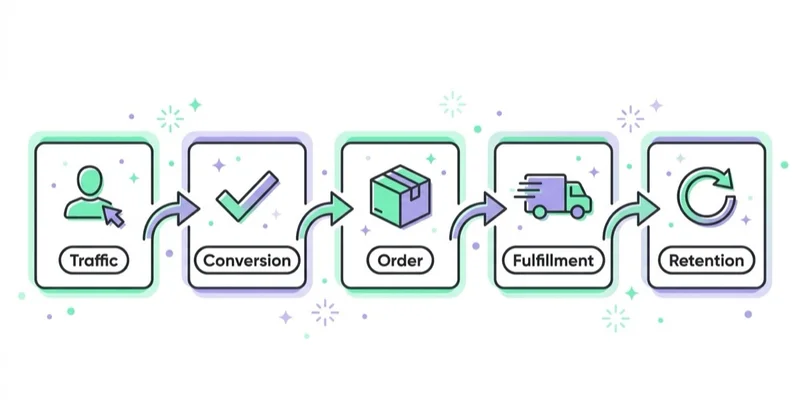
A successful online sales system has eight core parts.
1. Offer
The offer answers:
- What is being sold?
- For whom?
- Why now?
- Why this seller?
- What problem is solved?
- What proof exists?
- What risk is removed?
Without a strong offer, traffic and technology cannot compensate.
2. Traffic
Traffic sources can include:
- SEO;
- Google Ads;
- Shopping and Performance Max;
- Meta Ads;
- TikTok Ads;
- social organic;
- marketplace search;
- email;
- affiliate marketing;
- influencer marketing;
- YouTube;
- content marketing;
- direct traffic;
- referrals;
- PR.
Each channel should have a role. Some create demand, some capture demand, some retain customers.
3. Trust
Users need confidence before buying or submitting contact details.
Trust signals:
- clear company information;
- reviews;
- case studies;
- testimonials;
- secure payment methods;
- visible return policy;
- delivery information;
- contact options;
- product photos;
- certifications;
- transparent pricing;
- realistic claims.
Trust is especially important for new brands, high-ticket products, regulated categories and cross-border sales.
4. Conversion path
The conversion path should make action easy.
For ecommerce:
- product page;
- add to cart;
- cart;
- checkout;
- payment;
- confirmation.
For services:
- landing page;
- value proposition;
- proof;
- form or booking;
- qualification;
- sales follow-up.
For digital products:
- product page;
- checkout;
- account creation;
- access delivery;
- onboarding.
5. Payment
Payment should match user expectations and market norms.
Common options:
- cards;
- digital wallets;
- local payment methods;
- bank transfers;
- buy now, pay later;
- invoices;
- subscriptions;
- payment links.
Payment processing should be tested before launch, including successful payments, failed payments, refunds and mobile checkout.
6. Fulfilment
Fulfilment means delivering what was sold.
For physical products:
- stock;
- packing;
- shipping;
- tracking;
- returns;
- exchanges.
For services:
- scheduling;
- onboarding;
- delivery process;
- scope control;
- reporting.
For digital products:
- instant access;
- account login;
- file delivery;
- licensing;
- support.
Poor fulfilment can destroy repeat sales even when acquisition works.
7. Analytics
Analytics connects activity with outcome.
Track:
- traffic source;
- conversion rate;
- revenue;
- average order value;
- lead quality;
- customer acquisition cost;
- lifetime value;
- margin;
- refunds and returns;
- repeat purchase rate;
- checkout abandonment;
- content or campaign assists.
For ecommerce analytics, read What Is Ecommerce Analytics and Why Is It So Important?.
8. Retention
Online selling becomes stronger when customers return.
Retention channels:
- email;
- SMS;
- remarketing;
- loyalty programme;
- subscriptions;
- replenishment reminders;
- product education;
- customer success;
- community;
- post-purchase support.
Acquiring a customer once is usually more expensive than selling again to a satisfied customer.
Online sales economics
Profitability depends on more than revenue.
Important metrics:
- revenue;
- gross margin;
- contribution margin;
- CAC;
- LTV;
- ROAS;
- conversion rate;
- AOV;
- return rate;
- refund rate;
- shipping cost;
- payment fees;
- support cost;
- repeat purchase rate.
Example:
Two products can both generate GBP 10,000 in revenue. One may have 60 percent margin and low returns. Another may have 20 percent margin and frequent refunds. Treating them equally because revenue is equal is a mistake.
Online selling for services
Service businesses do not always need a full ecommerce store.
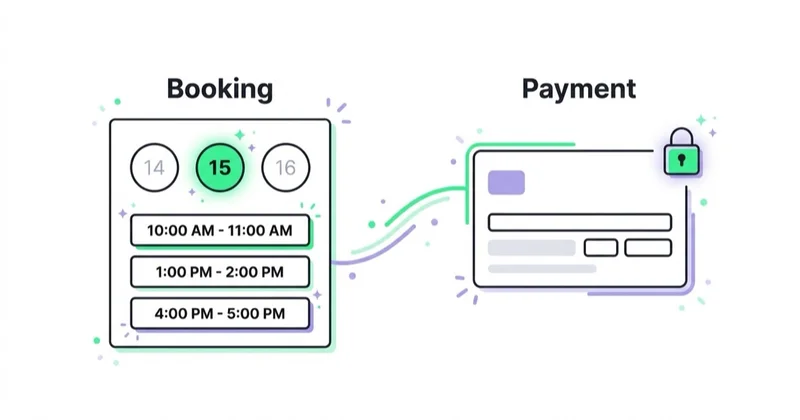
They may need:
- offer page;
- landing page;
- booking system;
- lead form;
- CRM;
- email automation;
- trust proof;
- case studies;
- qualification questions;
- call tracking;
- sales pipeline reporting.
The main metric is not only number of leads. It is qualified opportunities, closed revenue and acquisition cost.
For landing pages, read What Is a Landing Page and How to Build One?.
Online selling for ecommerce
Ecommerce selling needs:
- product data;
- product pages;
- category pages;
- checkout;
- payments;
- shipping;
- returns;
- stock control;
- product feed;
- Merchant Center;
- Shopping or PMax;
- retention;
- analytics.
The store should make product decisions easy. That means clear descriptions, good images, specifications, delivery details and trust signals.
Read How to Write a Product Description That Sells and What It Must Include and What Is Google Merchant Center and How to Manage It?.
Online selling for B2B
B2B online selling often combines digital research with human sales.
Common conversions:
- demo request;
- contact form;
- quote request;
- downloadable guide;
- webinar registration;
- sales call booking;
- product configurator;
- pricing request.
B2B buyers often need more information before converting:
- use cases;
- integrations;
- security;
- pricing logic;
- implementation timeline;
- case studies;
- ROI argument;
- compliance;
- procurement support.
Online selling in B2B should support the buyer's research process, not only collect form submissions.
Online selling and mobile-first behavior
Many users discover, compare and buy on mobile. Even when the final purchase happens on desktop, mobile often shapes the journey.
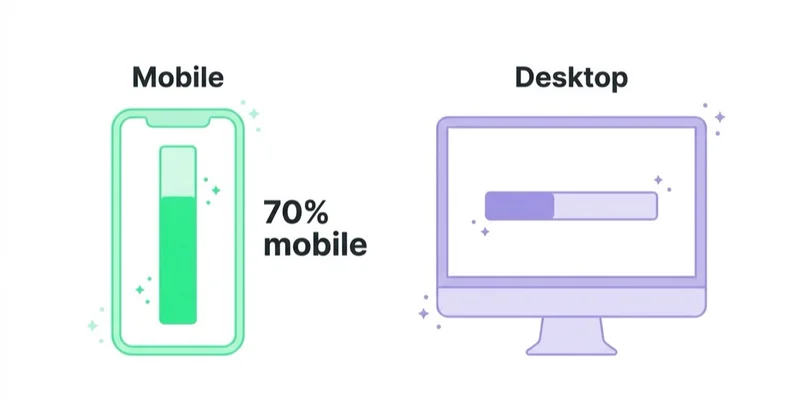
Mobile requirements:
- fast pages;
- readable product information;
- clear buttons;
- simple navigation;
- easy filters;
- short forms;
- wallet payment options;
- visible delivery and returns;
- mobile-friendly checkout.
A store can have strong desktop conversion and still lose growth if mobile UX is weak.
How to grow online sales
Use this sequence:
- Check the offer and margin.
- Fix tracking and analytics.
- Improve product or service pages.
- Remove checkout or form friction.
- Choose acquisition channels based on intent and creative fit.
- Test paid campaigns with clean measurement.
- Build SEO and content assets.
- Add retention through email, remarketing and customer lifecycle.
- Review margin, refunds and customer quality.
- Scale the channels that produce profitable customers.
For conversion work, read What Is Conversion Rate and How to Increase It?.
Common mistakes
| Mistake | Why it hurts | Better approach |
|---|---|---|
| Treating online selling as a website only | No demand or operations plan | Build the full sales system |
| No traffic plan | Store or landing page has no users | Define acquisition channels early |
| No analytics | Decisions become guesses | Track conversions, cost, margin and LTV |
| Revenue-only reporting | Profitability is hidden | Add margin, refunds and CAC |
| Weak product information | Low trust and conversion | Add descriptions, specs, images and FAQs |
| Too much channel dependency | Platform risk grows | Balance owned and external channels |
| Ignoring retention | Acquisition cost stays high | Build email, remarketing and repeat purchase flows |
| Hidden delivery or pricing details | Users abandon checkout | Communicate clearly before final step |
How we approach this at Space Ads
At Space Ads, we look at online selling as a commercial system before we choose channels. We map offer, margin, stock or delivery capacity, conversion path, payment friction, fulfilment, analytics and retention, then decide where paid media, SEO, marketplaces or social commerce can actually add profitable demand. For ecommerce, we connect campaign decisions with feed quality, product pages, availability, delivery, returns and contribution margin. For services and B2B, we connect forms and booking flows with CRM status, qualification, sales follow-up and closed revenue. This prevents a common mistake: scaling traffic before the business knows which sales are worth acquiring again.
FAQ
What is online selling?
Online selling is selling products, services, subscriptions, bookings, digital goods or leads through internet-based channels such as websites, marketplaces, social platforms, apps or landing pages.
Is online selling the same as ecommerce?
No. Ecommerce is usually product selling through an online store. Online selling is broader and includes services, B2B leads, subscriptions, digital products, social commerce and marketplaces.
Does online selling require a website?
Not always. Sales can happen through marketplaces, social platforms, booking systems or landing pages. However, an owned website usually gives more control over brand, data, SEO and analytics.
What is the most important part of online selling?
There is no single part. Offer, traffic, trust, conversion, payment, fulfilment and analytics must work together. A weakness in one area can limit the whole system.
Which channel is best for online sales?
It depends on the business model. Search works well for existing demand. Social and creator channels work well for visual discovery. Marketplaces work well when users already search there. Email and remarketing support retention.
How should online sales be measured?
Measure revenue, conversion rate, AOV, CAC, LTV, margin, refund rate, repeat purchase rate and channel-level profitability. Do not rely only on order count.
Is online selling cheaper than offline selling?
Not automatically. Online selling can reduce some physical overheads, but it adds costs for technology, ads, content, logistics, payment fees, customer support and returns.
What is the biggest mistake in online selling?
The biggest mistake is launching without a plan for profitable traffic and retention. A website or marketplace listing does not guarantee demand.
Conclusion
Online selling is an ecosystem, not a single tool. The storefront, marketplace listing, landing page or social shop is only the visible part. Behind it are offer, traffic, trust, payment, fulfilment, analytics and customer retention.
The strongest online sales systems are built around profitability, not only revenue. They measure margin, acquisition cost, customer value and repeat purchase potential. That is what turns digital sales from random orders into a scalable business model.
Sources and further reading
- Shopify Help Center: General checklist for starting a new Shopify store
- Stripe: How to accept online payments
- Google Analytics Help: Ecommerce purchases report
- Google Analytics Help: About ecommerce metrics
- Google Merchant Center Help: Product data specification
- Google Search Central: Product structured data
Continue learning
- How to Start an Online Store and What You Need to Know
- What Is Ecommerce Analytics and Why Is It So Important?
- How to Write a Product Description That Sells and What It Must Include
- What Is Google Merchant Center and How to Manage It?
- What Is a Landing Page and How to Build One?
- What Is Conversion Rate and How to Increase It?
Continue reading
What Is Q-Commerce and Why Is It Growing?
Q-commerce is quick commerce: fast local fulfilment built on nearby inventory, dense demand, mobile UX and last-mile economics that actually work.
What Is M-Commerce and How to Use It in Your Business?
M-commerce is the full commercial journey shaped by mobile behavior: mobile pages, apps, payments, checkout, social traffic, lead forms and interrupted multi-session decisions. This guide explains how to improve speed, UX, measurement and paid-media landing paths so mobile traffic can create real revenue or qualified demand.
How to Start an Online Store and What You Need to Know
Starting an online store takes more than a platform. Learn how to plan offer, products, payments, shipping, legal pages, analytics, Merchant Center and traffic.