Remarketing is a strategy for reaching people who have already interacted with a brand, website, app, product, content, ad, email list or customer database. It can run through Google Ads, Meta Ads, email, YouTube, display, Search, push notifications and other channels. Good remarketing is not "following people around the internet." It is using previous intent to show the right next message at the right time.
Remarketing works best when audiences are segmented by intent: a blog reader, pricing page visitor, product viewer, cart abandoner, lead form starter and previous customer should not receive the same message. It also needs consent, frequency control, exclusions and measurement beyond the ad platform dashboard.
TL;DR
- Remarketing means re-engaging people who already had contact with the brand.
- Retargeting is often used as a similar term, especially for ad-based remarketing.
- Remarketing is not one channel. It can use Google Search, Display, YouTube, Performance Max, Meta, email, CRM and more.
- Audience segmentation is the main success factor. Match the message to the user's previous behavior.
- Dynamic remarketing shows products or services related to what a user viewed.
- Consent, privacy, data quality and exclusions are mandatory.
- Frequency control matters. Too much remarketing creates irritation and wasted spend.
Remarketing vs retargeting
The terms are often used interchangeably, but there is a practical distinction.
Remarketing is the broader strategy of re-engaging people after previous contact. It can include ads, email, CRM, push notifications and sales follow-up.
Retargeting usually refers to paid ads shown to previous visitors or users based on tracking signals, audience lists or platform engagement.
In everyday marketing, both terms often mean: "show a relevant follow-up message to someone who already knows the brand."
How remarketing works
Remarketing starts with a signal.
Examples:
- website visit;
- product view;
- add to cart;
- checkout start;
- purchase;
- form start;
- video view;
- social engagement;
- email signup;
- app event;
- CRM list;
- previous lead;
- previous customer.
That signal places the user into an audience segment when requirements are met. A campaign can then show a follow-up message through an eligible channel.
The strongest remarketing campaigns use behavior, recency and business value together.
Remarketing strategy map
Remarketing should be planned as a sequence of next steps.
| Previous behavior | Likely intent | Better next message | Possible channel |
|---|---|---|---|
| Blog or guide read | Early research | related guide, newsletter, checklist | Meta, Google Display, email |
| Pricing page visit | Commercial evaluation | consultation, demo, objection handling | Search, Meta, LinkedIn, email |
| Product view | Product consideration | reviews, comparison, availability | Meta catalog, Google dynamic remarketing |
| Add to cart | High purchase intent | delivery, returns, reminder, limited offer | email, Meta, Google |
| Form start | Lead intent with friction | shorter CTA, alternative contact, trust proof | Search, Meta, email |
| Previous customer | Existing relationship | cross-sell, replenishment, loyalty | email, customer lists, catalog ads |
| Closed-lost lead | Known fit or timing issue | update, new case study, reactivation | CRM, Search, social |
This prevents a common mistake: treating all warm audiences as equally ready to buy. Remarketing is strongest when it answers the reason the user stopped.
Main types of remarketing
| Type | Example | Best use |
|---|---|---|
| Website remarketing | Visitors to a landing page | Re-engage people who explored the site |
| Dynamic remarketing | Product viewers see related products | Ecommerce and catalogue-based offers |
| Search remarketing | RLSA in Google Search | Bid or message differently when warm users search |
| Video remarketing | YouTube or video viewers | Move engaged viewers toward next action |
| Social remarketing | Meta engagers or website visitors | Retarget in feeds, Reels and Stories |
| CRM remarketing | Customer list or lead list | Win-back, upsell, cross-sell |
| Email remarketing | Abandoned cart sequence | Owned-channel follow-up |
| App remarketing | App users who did not complete action | Re-engage users inside app funnels |
The channel matters less than the intent match.
Google Ads remarketing
In Google Ads, remarketing is increasingly described through "your data" and "audience segments." Google's documentation explains that older terms such as audience types and remarketing have been updated toward audience segments and your data.
Google Ads remarketing can include:
- Display remarketing;
- dynamic remarketing;
- YouTube remarketing;
- Search audience segments and RLSA;
- Performance Max audience signals;
- customer lists where eligible;
- app remarketing.
Dynamic remarketing can show previous visitors ads with products or services they viewed. Google Ads supports dynamic remarketing through Display, Performance Max and App campaigns, depending on setup and eligibility.
For Search-specific strategy, read What Are RLSA Campaigns? Remarketing Lists for Search Ads. For dynamic product use cases, read Dynamic Remarketing: What It Is and How It Works.
Meta Ads remarketing
On Meta, remarketing can use Custom Audiences and engagement signals.
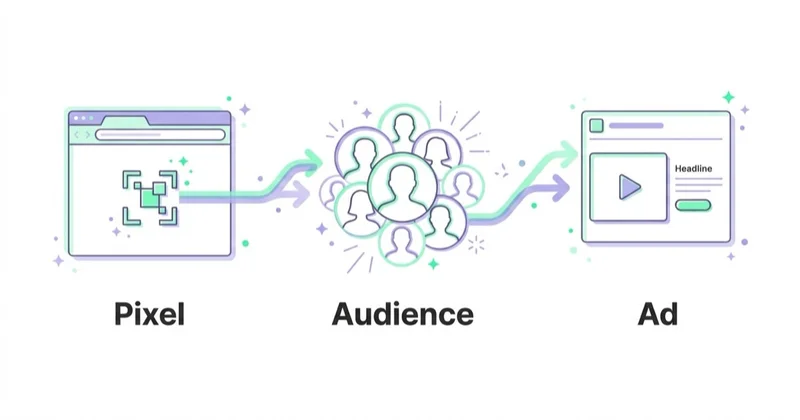
Audience sources may include:
- website visitors through Meta Pixel;
- app events through SDK or app integrations;
- customer lists;
- Facebook Page engagement;
- Instagram engagement;
- video views;
- lead form interactions;
- catalogue events;
- shop activity where available.
Meta's retargeting guidance explains that businesses can create Custom Audiences from a list, pixel data or SDK, and that dynamic ads can show relevant catalogue items to people based on their behavior.
For Meta-specific context, read Facebook Remarketing: How Meta Retargeting Works and Why Use It and Meta Conversions API: Integration and Benefits.
Dynamic remarketing and catalogue ads
Dynamic remarketing uses a product or service feed to personalise ads.
For ecommerce, this may mean:
- a user views a product;
- the product ID is passed through tracking;
- the product exists in the feed;
- the platform can show that product or related products in an ad.
Requirements usually include:
- product catalogue or feed;
- website or app events;
- product identifiers matching feed IDs;
- conversion tracking;
- privacy and consent setup;
- enough audience volume.
Dynamic remarketing is powerful because it connects user intent with inventory. It is also fragile when feed IDs, event IDs, prices or availability are inconsistent.
Remarketing segmentation
Strong segmentation is the difference between helpful remarketing and noise.
Start with these segments:
- all visitors;
- product or service page visitors;
- pricing visitors;
- blog or guide readers;
- add-to-cart users;
- checkout starters;
- form starters;
- leads;
- previous customers;
- high-value customers;
- inactive customers;
- email subscribers;
- video viewers;
- social engagers.
Then add recency:
- 1-3 days;
- 4-7 days;
- 8-14 days;
- 15-30 days;
- 31-90 days;
- older windows for long B2B cycles.
A cart abandoner from yesterday is not the same as a blog reader from 90 days ago.
Exclusions and audience hierarchy
Remarketing needs exclusions as much as inclusions.
Useful exclusion rules:
- exclude recent purchasers from acquisition ads;
- exclude submitted leads from form-start reminders;
- exclude employees and internal traffic where possible;
- exclude existing customers from first-purchase discounts unless intentional;
- exclude low-quality lead sources from scaling audiences;
- exclude users who saw too much frequency without action;
- exclude sensitive or unsupported categories according to platform rules;
- exclude audiences that should receive a different lifecycle message.
Audience hierarchy matters when several lists overlap. A user can be a blog reader, product viewer, cart abandoner and previous customer at the same time. The campaign should decide which state has priority. Usually, more recent and higher-intent behavior should receive the more specific message.
Without hierarchy, the same person can see contradictory ads: a first-order discount after buying, an awareness ad after starting checkout or a generic brand video after requesting a quote.
Message by intent
| Segment | Better message | Poor message |
|---|---|---|
| Blog reader | Related guide, checklist, newsletter or soft offer | Hard discount immediately |
| Product viewer | Product benefits, reviews, comparison | Generic brand ad |
| Cart abandoner | Delivery, returns, urgency, reminder | Introductory awareness ad |
| Pricing visitor | Demo, consultation, objection handling | Basic educational content |
| Previous buyer | Cross-sell, replenishment, loyalty | Same acquisition offer |
| Inactive customer | Win-back, new collection, update | Repeated old product ad |
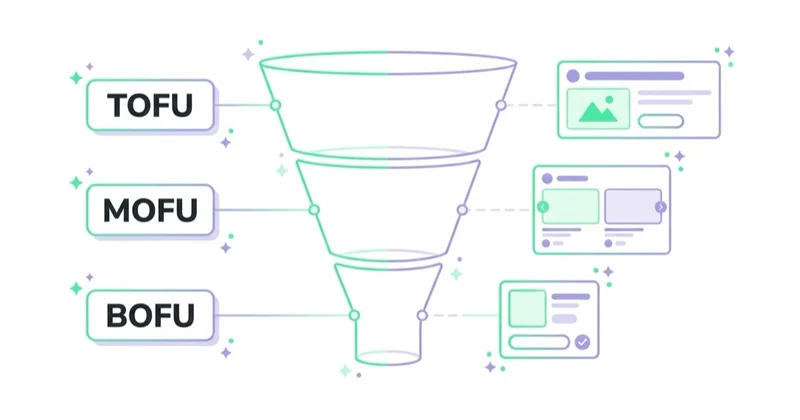
Remarketing should move the user to the next logical step.
Frequency and fatigue
Remarketing can become irritating when the same ad appears too often.
Watch for:
- high frequency;
- falling CTR;
- negative comments;
- rising CPA;
- declining conversion rate;
- repeated views after purchase;
- small audience with high budget;
- no creative rotation.
Fixes:
- shorten audience windows;
- exclude purchasers;
- use frequency caps where available;
- rotate creative;
- separate high-intent from low-intent segments;
- reduce budget;
- change offer or landing page;
- stop remarketing to users who already converted.
Consent and privacy
Remarketing depends on data. Data use must be compliant with applicable law, platform policies and user choices.
Important areas:
- cookie consent;
- privacy policy;
- data retention;
- customer list permissions;
- sensitive categories;
- user opt-out choices;
- Consent Mode;
- platform advertising policies;
- server-side tracking governance.
GTM, pixels and conversion APIs do not remove privacy obligations. They must be configured to respect consent and policy requirements.
For the measurement layer, read What Is Google Tag Manager and How to Use It? and Consent Mode v2: What It Is and How to Implement It.
Remarketing in ecommerce
Ecommerce remarketing is usually built around product intent.
Useful scenarios:
- viewed product, no cart;
- added to cart, no purchase;
- checkout started, no purchase;
- bought product, likely needs accessory;
- bought consumable, likely needs replenishment;
- high-value customer, new collection;
- seasonal category visitor;
- previous sale buyer, new promotion;
- product out of stock, back in stock.
Avoid showing the same product repeatedly after the user already bought it unless the product is replenishable or the goal is accessory cross-sell.
Measurement should include revenue, margin, refund rate, repeat purchase and customer value, not only platform ROAS.
Remarketing in B2B and services
B2B remarketing usually has a longer and more educational role.
Useful sequences:
- article reader -> related guide;
- guide downloader -> webinar;
- webinar attendee -> case study;
- pricing visitor -> consultation;
- form starter -> reminder or alternative CTA;
- lead -> sales follow-up and nurture;
- closed lost lead -> win-back after a defined window.
B2B remarketing should be careful with pressure. The goal is often to support trust and recall, not force an immediate sale.
Multi-channel remarketing sequences
Remarketing is stronger when channels have different roles instead of repeating the same message everywhere.
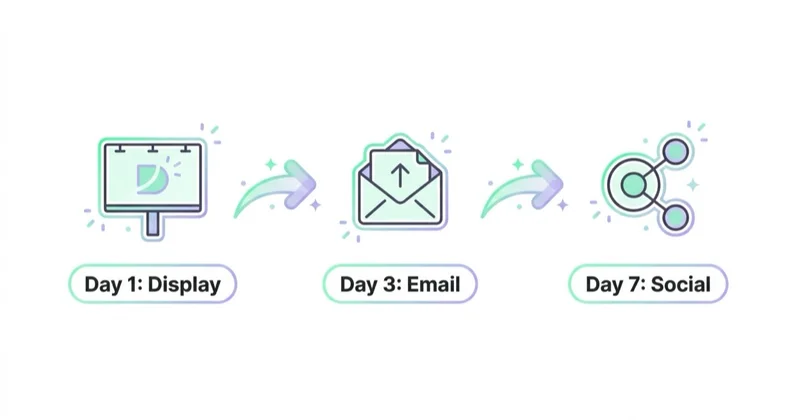
Example ecommerce sequence:
- Product view: dynamic product ad with the viewed item.
- Add to cart: email or ad addressing delivery, returns and urgency.
- No purchase after several days: comparison, review or bundle.
- Purchase: exclusion from acquisition and entry into cross-sell or replenishment flow.
Example B2B sequence:
- Guide reader: related article or downloadable checklist.
- Pricing visitor: case study or consultation CTA.
- Webinar attendee: specialist follow-up or sales-assisted nurture.
- Lead submitted: exclude from generic ads and move to CRM workflow.
- Closed-lost: reactivation only after a reasonable window.
The purpose is not to surround the user with ads. The purpose is to continue the journey in a useful order.
How to measure remarketing
Measure:
- CPA;
- ROAS;
- conversion rate;
- conversion value;
- lead quality;
- revenue after refunds;
- margin;
- new vs returning customer mix;
- frequency;
- audience size;
- overlap between audiences;
- assisted conversions;
- incremental lift where possible;
- CRM outcomes.
Remarketing often looks good in platform dashboards because it targets people already close to purchase. That does not always mean it created the sale. Use holdout tests or incrementality thinking where budgets are meaningful.
Incrementality questions
To avoid over-crediting remarketing, ask:
- Would some users have converted anyway?
- Is the campaign mostly reaching people already returning through brand search or email?
- Does revenue increase when remarketing spend increases?
- Does a holdout group convert at a similar rate?
- Are purchasers being excluded correctly?
- Does the campaign bring back users who would otherwise be lost?
- Does it improve margin or only revenue?
Small accounts may not have enough data for formal incrementality tests, but they can still think in these terms. Remarketing should be judged by added value, not only by attractive ROAS inside a platform that is close to the conversion.
When not to use remarketing
Remarketing is not always appropriate.
Avoid or limit it when:
- consent or policy requirements are unclear;
- the audience is too small and frequency becomes excessive;
- the product is sensitive and ad follow-up could feel intrusive;
- conversion tracking is broken;
- the business cannot exclude purchasers or leads;
- the offer has no useful next-step message;
- the user journey is better handled by email, CRM or sales follow-up;
- the campaign simply repeats the same generic ad.
In these cases, fix data, privacy, segmentation and messaging before spending more.
Setup checklist
Before launching remarketing:
- tracking is implemented correctly;
- consent states are tested;
- audience sources are active;
- product feed matches event IDs if dynamic ads are used;
- key segments are defined by intent;
- audience windows match decision cycles;
- purchasers are excluded where needed;
- frequency is monitored;
- creative matches the segment;
- landing pages match the message;
- CRM or backend outcomes are connected where possible;
- reporting includes margin or lead quality.
Common mistakes
| Mistake | Why it hurts | Better approach |
|---|---|---|
| One audience for everyone | Message is too generic | Segment by behavior and recency |
| No purchaser exclusions | Wasted spend and annoyance | Exclude or cross-sell intentionally |
| Too long audience windows | Low relevance | Match window to decision cycle |
| Too much budget on small lists | High frequency and fatigue | Cap spend and rotate creative |
| Feed and event mismatch | Dynamic ads break | Align product IDs and feed data |
| No consent QA | Compliance and tracking issues | Test consent before launch |
| Only platform ROAS | Overstates impact | Add GA4, CRM and incrementality view |
| No creative rotation | Fatigue | Refresh ads by segment |
| Same offer for all users | Weak relevance | Use next-step messaging |
How we approach this at Space Ads
At Space Ads, we build remarketing around the reason someone stopped, not around one generic "all visitors" audience. We separate product viewers, cart abandoners, pricing visitors, content readers, form starters, customers and closed-lost leads, then decide the next useful message, exclusion and window for each group. In ecommerce, we check catalogue and event ID consistency, availability, margin, returns and customer value so dynamic ads do not optimise only for visible ROAS. In B2B and services, we connect remarketing with CRM status, sales follow-up and lead quality. We also review frequency and incrementality signals, because warm-audience results are easy to over-credit when the same user would have returned through brand search, email or direct traffic.
FAQ
What is remarketing?
Remarketing is re-engaging people who previously interacted with a brand, website, app, product, content, ad or customer database.
Is remarketing the same as retargeting?
They are often used interchangeably. Retargeting usually refers to ad-based follow-up, while remarketing is a broader strategy that can also include email, CRM and lifecycle communication.
Is remarketing legal?
It can be, but it depends on jurisdiction, consent, privacy policy, platform rules and data use. A qualified legal or privacy review may be needed for specific markets.
What is dynamic remarketing?
Dynamic remarketing shows ads tailored to previous behavior, often using a product or service feed so users see items they viewed or related offers.
How long should remarketing run?
It depends on the decision cycle. Cart abandonment may need a short window of days. B2B research may need weeks or months. Old audiences need different messaging.
Should purchasers be excluded?
Usually yes for acquisition campaigns. They can be included only when the goal is cross-sell, upsell, replenishment, loyalty or win-back.
Does remarketing work for services?
Yes. It can re-engage pricing page visitors, case study readers, webinar attendees, form starters and previous leads. Measure lead quality, not only lead volume.
What is the biggest remarketing mistake?
The biggest mistake is using one generic ad for all previous visitors. A blog reader and a cart abandoner need different messages.
Can remarketing overstate performance?
Yes. Remarketing often targets people already close to conversion, so platform ROAS can overstate incremental value. Use exclusions, CRM data, GA4 and holdout thinking where possible.
What should be excluded from remarketing?
Common exclusions include recent purchasers, submitted leads, irrelevant visitors, internal traffic, users with excessive frequency and audiences that should receive a different lifecycle message.
Conclusion
Remarketing is useful because it respects a simple truth: people rarely convert at the first contact. The right follow-up can help them return, compare, trust and complete the next step.
The best remarketing is segmented, consent-aware, frequency-controlled and measured against real business outcomes. It should feel like a relevant reminder, not like surveillance.
Start with intent. Build audiences around behavior. Match the message to the next step. Then measure whether the campaign creates incremental value, not only whether it looks good in the ad platform.
We implement retargeting campaigns within Facebook and Instagram ads, with correct measurement and exclusions.
Sources and further reading
- Google Ads Help: About setting up your data segments
- Google Ads Help: About dynamic remarketing
- Google Ads Help: Set up dynamic remarketing
- Meta for Business: Retargeting
- Meta for Business: Meta Advantage+
- Meta for Business: Advantage+ shopping campaigns
Continue learning
- Facebook Remarketing: How Meta Retargeting Works and Why Use It
- Google Remarketing: What It Is and Why Use It
- Dynamic Remarketing: What It Is and How It Works
- What Are RLSA Campaigns? Remarketing Lists for Search Ads
- Meta Conversions API: Integration and Benefits
- What Is Conversion Rate and How to Increase It?
Continue reading

What Is a Sales Campaign and How to Plan It?
A sales campaign needs a clear offer, conversion goal, tracking, creative, landing page and optimisation plan across Meta, Google and owned channels.

Messenger Ads: What You Need to Know
Messenger Ads can generate valuable conversations, but performance depends on channel fit, response speed, automation, CRM handoff and business outcomes.

Is Video Marketing Worth Using Online?
Video marketing can build awareness, explain offers, support sales and improve retention when every video has a clear brief, channel fit and measurement plan.