An ecommerce consultant is often hired to diagnose a problem, advise on a decision or design a change. An ecommerce agency is often hired to combine several skills and implement or operate a function over time. These are useful tendencies, not fixed definitions: consultants can support implementation, and strong agencies should challenge a weak strategy rather than execute it blindly.

The right choice follows the work. Does the business need to understand a problem, make a decision, deliver a defined project, run a recurring function, build internal capability — or some combination? Scope those stages first, then choose the provider model and commercial terms that make accountability clear.
TL;DR
- Define the work in five stages: diagnose, decide/design, implement, operate and transfer. One provider may cover several, but each needs an owner and acceptance criteria.
- Choose by constraint, not label. A decision gap points towards senior diagnosis; a capacity gap towards delivery; a single specialist gap towards a freelancer or hire; a capability gap towards training and transfer.
- Specify outcomes and evidence. “Improve ecommerce” is not a scope. State the business problem, baseline, deliverables, dependencies, decision rights and how work will be accepted.
- Evaluate the named team. Case relevance, analytical method, implementation depth and availability matter more than the provider's logo or pitch team.
- Compare total engagement cost. Include internal time, tools, media/production, change requests, recruitment, ramp-up and switching — not only a day rate or retainer.
- Protect ownership and access. The client should understand account control, data access, intellectual property, documentation, security, subcontractors and exit support before work begins.
- Plan implementation at the start. A recommendation without capacity and mandate is not yet an outcome; recurring execution without a validated objective is activity, not progress.
- Combined diagnosis and delivery can work. Manage the incentive with a paid, evidence-led diagnosis, separate options and explicit approval gates rather than assuming an automatic conflict.
Start with the five stages of work
Use this sequence to expose what is actually missing:
| Stage | Core question | Typical output |
|---|---|---|
| Diagnose | What is happening, why, and how certain are we? | Evidence, root causes, quantified opportunities and uncertainties |
| Decide / design | What should change, in what order, with which trade-offs? | Target state, prioritised roadmap, business case and decision record |
| Implement | Who will build, configure, migrate or launch it? | Working change, quality checks, release plan and acceptance evidence |
| Operate | Who owns recurring optimisation and delivery? | Ongoing campaigns, merchandising, feed, creative, analytics or CRO work |
| Transfer | What must the client own after or during the engagement? | Documentation, training, account access, operating rhythm and handover |
An engagement can cover one stage or all five. The mistake is leaving a gap between them without naming it. If a consultant recommends a replatform, who owns requirements, procurement, migration, SEO assurance and post-launch operation? If an agency runs paid media, who owns product margin, stock priorities, promotions and site conversion?
Two tests help:
- If a defensible decision arrived tomorrow, could the organisation implement it? If yes, external judgement may be the missing piece. If no, implementation capacity, skills or mandate must be included.
- If extra delivery capacity arrived tomorrow, does the team know what it should do and how success will be judged? If yes, a managed service or specialist may fit. If no, diagnosis and decision must come first.
The answer may be neither consultant nor full agency. A senior hire fits work that is strategic, permanent and central to the company. A specialist freelancer can fill one defined skill. A technology vendor may solve a repeatable technical requirement. A fractional leader can own decisions while agencies or employees deliver. Use the smallest model that covers the actual work and risk.
ISO 20700, the current international guideline for management consultancy services, emphasises effective, transparent delivery based on client needs and outcomes. The UK government's Consultancy Playbook similarly recommends focusing requirements on desired outcomes and the deliverables that produce them, while making knowledge and capability transfer a core requirement. The principles apply well beyond public procurement.
What each actually delivers
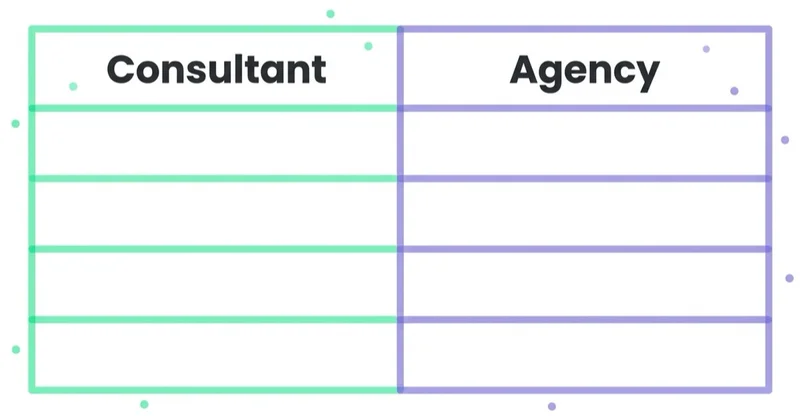
| Dimension | Consultant-led model | Agency-led model |
|---|---|---|
| Common strength | Senior attention on a defined problem or decision | Multi-skill capacity for implementation and recurring delivery |
| Typical shape | Time-bound diagnostic, design, assurance or advisory support | Project team, managed service or recurring operating scope |
| Useful when | Uncertainty, independence or a high-consequence decision is the constraint | Coordination, throughput and sustained specialist work are the constraints |
| Watch for | Advice detached from data, implementation or client reality | Junior delivery, opaque process, activity without commercial diagnosis |
| Possible pricing | Fixed fee, milestone, day/time, advisory retainer | Project fee, retainer, output/unit, media-linked or hybrid |
| Client dependency | Access to evidence, decision-makers and implementation owner | Inputs, approvals, product truth, stock/margin priorities and clear decision rights |
Do not buy the label. Ask which named people will perform each stage, how much of their time is committed, what evidence they need and how responsibility changes after launch.
When a consultant-led model fits
Consulting is a strong fit when the question is bounded, consequential and requires experienced judgement more than recurring throughput.
Platform and replatform decisions. The useful output is not “choose platform X”. It is a requirements model, total-cost and risk comparison, migration implications, gaps, decision rationale and implementation route. Execution can then be procured separately or included with an approval gate. Our ecommerce development page covers the delivery layer.
Commercial diagnosis. Falling contribution can involve product mix, discounts, delivery subsidy, returns, channel cost, repeat behaviour or stock. A consultant should show the reconciliation and uncertainty, not merely produce a list of generic margin levers.
Catalogue, merchandising and operating design. A redesign can define taxonomy, ownership, rules and prioritisation. It still needs implementation, QA and governance as the range changes.
Independent assurance. High-risk migrations, attribution designs, forecasts or agency performance may benefit from an adviser who is not responsible for selling the implementation. Independence matters only if access, method and decision rights make the assurance meaningful.
Temporary leadership or capability design. A fractional CMO can own cross-functional decisions and build an operating model; our guide to when a fractional CMO fits explains when this is different from a narrow ecommerce diagnostic.
A useful recommendation includes evidence, options considered, expected benefit range, effort, dependencies, risk, owner and next decision date. It distinguishes facts from assumptions. Our marketing audit and ecommerce audit guide show how we structure that diagnostic layer.
Where an agency is the right shape
An agency fits when the work needs coordinated specialists, sustained throughput and clear operational ownership.
Examples include continuous campaign and creative operations, feed quality and merchandising, lifecycle programmes, experimentation, analytics implementation, development and multi-market execution. These still need a strategic owner and inputs from the business; an agency cannot invent margin, stock, product truth or customer-service policy.
The buy-versus-hire arithmetic depends on required seniority, utilisation of each skill, management load, speed, continuity and knowledge retention. Agency breadth can be efficient when the business needs fractions of several specialists; an internal team can be better when knowledge and iteration are daily strategic capabilities.
Our guide to what an ecommerce marketing agency does covers typical functions. Paid-media-specific selection is covered in choosing an ecommerce PPC agency.
Glossary
- Day rate — a fee for time, which does not by itself define the deliverable or outcome.
- Retainer — a recurring fee for ongoing delivery capacity, typically monthly.
- Handover — the transfer of a recommendation to whoever will implement it.
- Contribution margin — revenue minus the variable costs of producing and delivering a sale.
- Scope creep — expansion of an engagement beyond its defined boundary without a matching change to terms.
- Diagnostic engagement — a bounded investigation intended to establish causes, options and a decision.
- Acceptance criteria — observable conditions used to confirm that a deliverable is complete and usable.
- Decision rights — who recommends, approves, executes and can stop a change.
Write a scope people can actually use
A clear scope should answer the following in plain language:
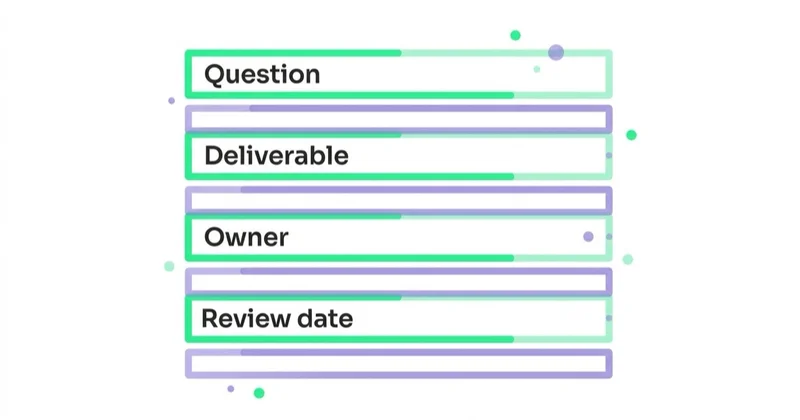
- Why now? State the business problem, baseline and consequence of doing nothing.
- What outcome is sought? Separate the commercial outcome from provider-controlled deliverables.
- What is included and excluded? Name channels, markets, platforms, teams and work types.
- What will be delivered? Make each item testable: a live implementation, decision paper, trained team, campaign set or documented process.
- Who does what? Include client inputs, approvals, access and turnaround times.
- How will the work be accepted? Define quality checks, evidence and who signs off.
- How are changes handled? State how added work is estimated, approved and scheduled.
- What will the client own? Cover accounts, raw data, code, creative source files, documentation and licences.
- How does the engagement end? Specify notice, access transfer, data return/deletion, documentation and support.
The legal agreement and scope of work serve different purposes: the agreement governs the relationship, while the scope describes the specific service, milestones and deliverables. Have qualified counsel review legal terms where the risk warrants it.
Prevent the handover gap
Handover is not a final meeting. It is a planned stream of work.
- Name the client owner and implementation capacity before the diagnosis begins.
- Prioritise recommendations and show dependencies, not just a long audit backlog.
- Pair each recommendation with a decision, owner, first action and due date.
- Transfer accounts and documentation continuously, not only on the final day.
- Train the people who will operate the change and confirm they can perform the process.
- Schedule an implementation review and define what evidence will be checked.
For ongoing agency work, transfer is still relevant. The client should be able to understand what is running, where assets live, how results are calculated and how to transition without losing critical access.
Evaluate providers beyond the pitch
Ask every shortlisted provider to respond to the same evidence-based brief. The IPA/ISBA agency-selection guidance recommends a fair, transparent process suited to how the client will actually work, with clear requirements and evaluation.
Evaluate:
- named delivery team, roles, senior involvement and availability;
- relevant examples and what the provider actually did;
- diagnostic method and evidence requirements;
- ability to connect ecommerce metrics to finance and operations;
- implementation depth, QA and risk management;
- communication rhythm, escalation and decision-making;
- security, privacy, subcontractors and account-access model;
- knowledge-transfer and exit approach;
- conflicts, platform incentives, rebates or partner relationships;
- commercial assumptions and likely change scenarios.
Do not demand large amounts of speculative unpaid work. It encourages theatre, disadvantages smaller specialists and gives the provider too little access for a defensible answer. A paid diagnostic or working session can reveal more than a polished speculative strategy.
Pricing models and incentives
No pricing model guarantees alignment.
Fixed project fee creates budget clarity when deliverables and assumptions are known. It needs a change process and should not reward cutting necessary discovery or QA.
Time/day rate suits uncertain investigation or flexible access to expertise. Use a budget cap, priorities and transparent time reporting where appropriate; hours are an input, not the outcome.
Retainer reserves recurring capacity and operating rhythm. Define included roles, approximate capacity or outputs, response expectations and how unused or additional work is handled.
Performance-linked fees may align incentives only when the metric is attributable, auditable and within the provider's influence. Specify baseline, attribution, margin/returns, caps, exclusions and what happens when external factors change.
Percentage of media spend is simple but can reward spend growth rather than marginal profit. Pair it with governance, service minimums and commercial outcome reviews.
Compare the total cost over the intended period, including setup, tools, production, media, internal team time, taxes, travel, change requests and exit. Do not claim that a consultant is “usually cheaper” or that an agency retainer is automatically better value.
How Space Ads structures the choice
We first classify the requirement across diagnose, decide, implement, operate and transfer. The proposal then names which stages Space Ads owns, which remain with the client or another provider, what evidence is required and where an approval gate sits.
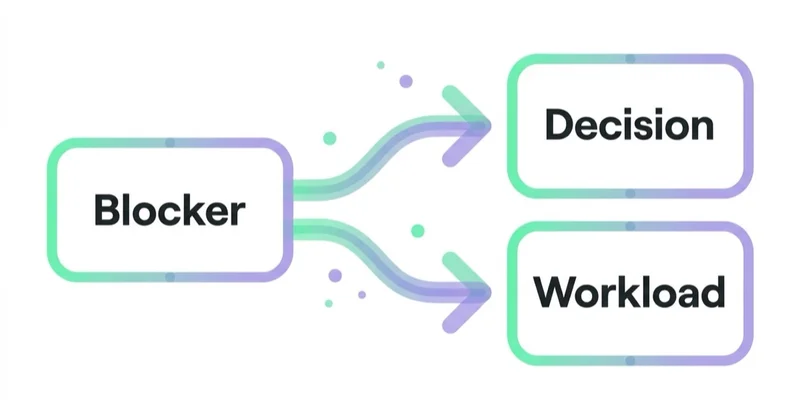
If diagnosis may lead to delivery, we separate the diagnostic output and commercial options so the client can approve, procure elsewhere or stop. Ongoing work is reviewed against the current business constraint rather than renewed merely because the activity continues. Where we lack case-specific evidence, recommendations remain hypotheses with a validation plan rather than claims presented as fact.
Choosing, in order
- Write a one-page problem brief. Include baseline, desired outcome, constraints, decisions due and available evidence.
- Map all five stages. Assign diagnosis, decision, implementation, operation and transfer even if different parties own them.
- Test internal capacity and mandate. Availability on an organisation chart is not the same as protected time and authority.
- Choose the smallest suitable provider model. Consultant, specialist, agency, fractional leader, hire or hybrid.
- Write deliverables and acceptance criteria. Include client dependencies, exclusions and change control.
- Evaluate the named team and method. Use consistent criteria and speak with relevant references where risk justifies it.
- Confirm ownership, security and exit. Do this before granting access.
- Set implementation and commercial reviews. Check both outcomes and whether the scope still addresses the current constraint.
Common mistakes
| Stop doing | Do instead |
|---|---|
| Choosing by provider label | Map diagnose, decide, implement, operate and transfer first |
| Buying a retainer to answer a one-off question | Buy a defined engagement with an end date |
| Accepting an unranked audit backlog | Require evidence, priority, owner, dependencies and next action |
| Assuming combined diagnosis and delivery is conflicted | Use a paid diagnosis, options and approval gate |
| Ending a consulting engagement at a presentation | Plan implementation, transfer and review from the start |
| Assuming an agency owns every outcome | State provider-controlled work and client dependencies clearly |
| Leaving accounts in provider ownership | Agree client control, access and exit transfer before launch |
FAQ
What does an ecommerce consultant actually do? Commonly, a consultant diagnoses a defined ecommerce problem, evaluates options, supports a decision or assures an implementation. The engagement should deliver evidence, trade-offs, recommendation, uncertainty and an actionable route — not just opinions or a deck.
Is a consultant more expensive than an agency? Neither is inherently more expensive. Compare the same scope and period, including team seniority, internal time, tools, production, implementation, change requests and exit. Day rate and monthly retainer are pricing units, not measures of value.
Can the same supplier consult and deliver? Yes. Continuity can reduce handover loss. Manage the incentive by paying for an evidence-led diagnosis, requiring alternatives, separating implementation pricing and using an approval gate that lets the client proceed, procure elsewhere or stop.
When is neither the right answer? An internal hire may fit when the work is permanent, strategically central and sufficient to occupy the role. A specialist may fit a narrow temporary gap, and software may fit a standard repeatable task. Compare ramp time, management, continuity, breadth and knowledge retention.
How do I know a consulting engagement worked? Judge diagnostic quality first by whether the evidence, decision and route were sound and usable; then judge implementation and business results with dependencies and uncertainty documented. A consultant cannot guarantee a commercial metric outside their control, but the work should enable and track the intended change.
What if we cannot tell whether it is a decision or a workload problem? Start with a bounded discovery phase that maps causes, required stages, internal capacity and options. It may be led by an independent consultant or an agency, provided the method, output, fee and next approval decision are clear.
Sources and further reading
- ISO 20700:2017 — Guidelines for management consultancy services
- The Consultancy Playbook — UK Cabinet Office
- Finding an Agency — IPA and ISBA
Key takeaways
- Map diagnosis, decision, implementation, operation and transfer before choosing a provider model.
- Consultants commonly bring bounded senior judgement; agencies commonly bring coordinated delivery capacity, but evaluate the proposed work and named team rather than the label.
- Write outcomes, testable deliverables, dependencies, acceptance criteria, ownership, change control and exit in plain language.
- Plan implementation and knowledge transfer before diagnosis begins; plan strategic review before recurring execution starts.
- Compare total engagement cost and incentives rather than day rates, retainers or performance fees in isolation.
- Combined diagnosis and delivery can work when the diagnostic is evidence-led, separately visible and followed by a genuine approval gate.
Continue reading

ChatGPT Ad Formats and Character Limits: What Actually Fits
A ChatGPT ad appears below the response and carries six elements, with specific limits: title 3–50 characters, body up to 100. The "24 / 48 character" figures in trade coverage do not match the documentation, so this guide gives the full limits table, shows how to fit a useful message, and covers the image, product ads and end-to-end consistency with the landing page.
OpenAI Ads Manager: How to Set Up Your First ChatGPT Ads Campaign
OpenAI Ads Manager has three campaign levels, but launch also requires advertiser verification, billing, landing-page checks, measurement and deliberate choices for settings that cannot be changed later. This guide covers the setup sequence, budgets, context hints, oCPC, targeting, review and Ads API workflows.

Switching Marketing Agencies Without Losing the Account
A safe agency switch protects client-owned accounts, billing, conversion signals, creative rights and operating knowledge. Use this transition plan to assign responsibility, validate access and change partners without avoidable disruption.