An ecommerce PPC agency should connect product data, media execution and store economics. It needs to maintain Merchant Center eligibility, understand how Shopping and Performance Max use the catalogue, pass dependable purchase and cart data, and make budget decisions with margin, stock, returns and customer value in view.
No agency can guarantee profitable growth from campaign settings alone. Demand, price, merchandising, website experience, fulfilment and retention also shape the result. Use this guide to assess whether a partner can diagnose that whole system and state what it can and cannot control.
TL;DR
- Product data is a core operating surface. Ask who owns titles, attributes, IDs, images, price and availability accuracy, diagnostics and approval issues.
- Define the economic value. Revenue, gross profit and contribution after variable costs are different; agree which value is dependable enough for reporting and bidding.
- Measure customer mix carefully. New-versus-returning classifications need first-party data, tested definitions and an “unknown” category where identification is incomplete.
- Use several measurement views. Google attribution, blended efficiency and incrementality answer different questions; none should be treated as causal truth by default.
- Ask about current PMax controls. Brand exclusions, campaign-level negative keywords, listing groups and new-customer goals are tools with trade-offs, not magic switches.
- Include retail operations. Stock, promotions, returns, fulfilment, price competitiveness and seasonality can change the optimal media decision.
- Protect continuity. The advertiser should retain direct administrative access to Google Ads, Merchant Center, Analytics, tags and source feeds.
Why ecommerce PPC is a specialist skill
Ecommerce work adds a catalogue and transaction layer to paid media. The team may need to coordinate Merchant Center, store platform, promotions, product availability, order-level values, cancellations and returns. Search may still be important, and not every retailer should use the same mix of Shopping and Performance Max.
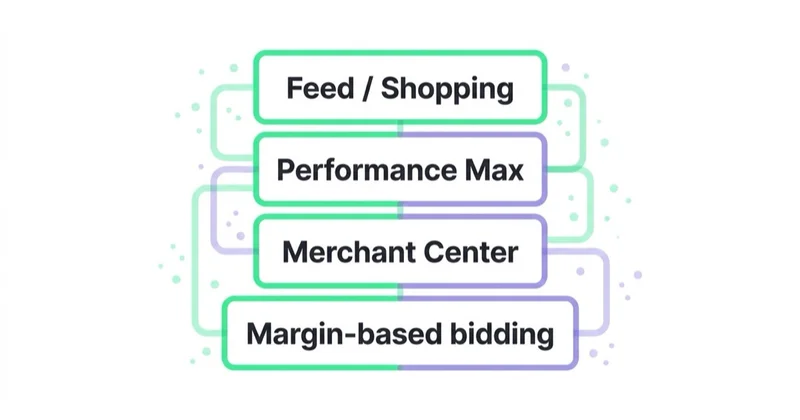
A capable partner should explain the full path from query or audience to product data, ad, product page, checkout and fulfilled order. Ask which team owns each dependency and how discrepancies are escalated. Channel mechanics are covered in Shopify Google Shopping and Performance Max for DTC and Performance Max vs standard Shopping.
Product data: eligibility, relevance and merchandising
Product data helps Google understand the items and determine how ads and free listings behave. Titles, identifiers, categories, attributes, images, price and availability must accurately match the landing page and variant. Strong data improves eligibility and relevance, but it cannot compensate for an uncompetitive offer or poor checkout.
Ask for a product-data responsibility matrix and change process. Good answers cover stable item IDs, feed-source ownership, supplemental data, critical attributes, custom labels, price and availability updates, diagnostics, policy appeals and testing. Titles should describe the actual product and follow Merchant Center rules—not be stuffed with unrelated search terms. See what a product feed is and how to use it.
Margin, not revenue: bid to profit
Revenue-based bidding values two orders with the same revenue equally, even when their economics differ. That can misallocate spend across products with different cost of goods sold, fulfilment, payment, return and discount profiles. Before changing bidding values, agree a calculation the business can maintain and audit.
Google's conversions with cart data can report sold products, revenue and—with COGS in Merchant Center—gross-profit metrics. Gross profit is still not full contribution profit, and incomplete COGS or mismatched item IDs makes the report inaccurate. Ask how the agency tests cart parameters, reconciles orders and handles returns or later adjustments. Margin-based conversion values may be appropriate when the values are reliable and privacy requirements are met.
New vs returning: the hidden profitability question
New-customer acquisition cost is important when acquisition is the strategy, while repeat-customer efficiency matters for retention and inventory decisions. Neither is inherently better. The business needs a definition of “new,” a lookback period, first-party customer data and a way to handle unidentified customers.
Google's new-customer acquisition goal can bid higher for new customers or use a new-customer-only mode, based on detected purchase history and customer lists. Classification and implementation should be audited; “unknown” does not automatically mean new. Brand search captures identifiable demand but may still play a defensive or navigational role. Report it separately and test incrementality where material rather than declaring all brand revenue worthless. This ties to customer acquisition cost and unit economics.
Measurement: reconcile attribution with the P&L
Google Ads reports attributed conversions under its selected settings. Results can overlap with other platforms, include modelled conversions or omit journeys that Google cannot observe. Platform ROAS may overstate or understate causal contribution; the dashboard alone cannot determine the direction.
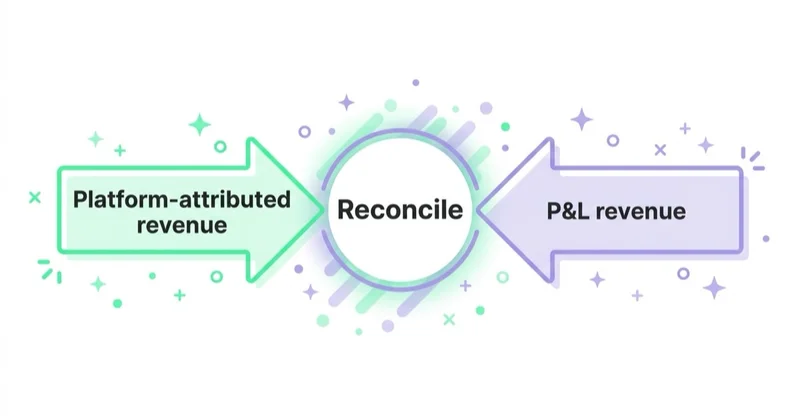
Blended MER connects total revenue with total marketing spend, but price changes, promotions, organic demand, retail channels and repeat customers all affect it. Require a measurement map: Google Ads for delivery and bidding, analytics or warehouse data for cross-channel journeys, order data for margin and returns, customer data for cohort economics, and experiments for incremental impact where feasible. See MER vs ROAS for the whole business.
Glossary
- Product feed — the structured file of products (titles, attributes, prices) Google uses to match Shopping/PMax ads to queries.
- Merchant Center (GMC) — where the feed lives and where disapprovals must be managed.
- Performance Max (PMax) — Google's automated cross-inventory campaign type, feed-driven for ecommerce.
- Value-based bidding — automated bidding toward conversion value; the value can represent revenue or another consistently defined business value.
- New-customer acquisition cost — what it costs to win a first-time buyer, distinct from blended cost.
- Blended efficiency / MER — total revenue divided by defined marketing spend; useful for the whole business but not channel incrementality.
- Custom labels — feed attributes used to segment products (e.g. by margin or bestseller status) for bidding.
PMax: handled, not hoped
Performance Max can serve across Google inventory and combines bidding, targeting and creative automation. Its structure should follow meaningful differences in objective, budget, geography, product economics or business priority—not a desire to create more campaigns. Asset groups organise creative themes; listing groups determine which products are eligible within them.
Ask how the agency will use product selection, brand exclusions, campaign-level negative keywords, search themes, URL expansion, new-customer goals and experiments. Search themes are signals, not keywords or exclusions. Brand exclusions limit relevant inventory and can reduce conversions, so they should follow the measurement objective. The right answer explains trade-offs and reporting, not merely a list of controls.
How Space Ads approaches ecommerce PPC
Our ecommerce PPC process starts with business economics, product and measurement integrity. We audit Merchant Center and the source feed, purchase values and cart data, product-page continuity, campaign structure and customer definitions before setting expansion priorities.
We report Google-attributed performance alongside blended, customer and margin views, with their limitations stated. Brand and non-brand demand, new, returning and unknown customers, and advertised versus sold products are separated where the data supports it. The advertiser retains direct access to Ads, Merchant Center and its data sources. This work lives in performance marketing and Google Ads.
Red flags and green flags
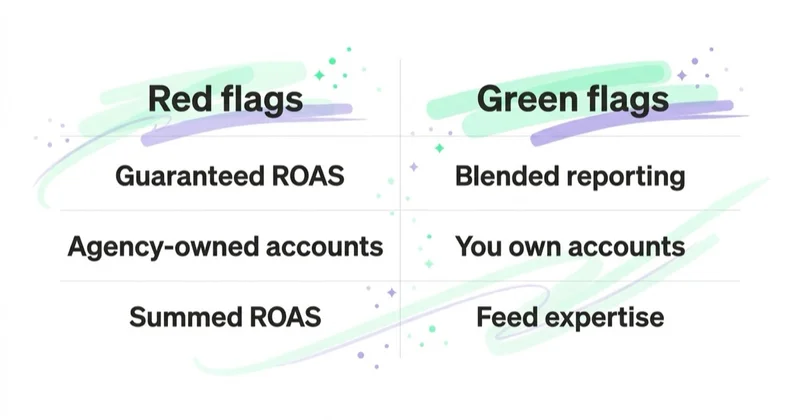
| Red flag | Green flag |
|---|---|
| Treats media as separate from retail operations | Includes feed, stock, promotions, returns and fulfilment |
| Edits product data without governance | Documents source, rules, approvals, tests and rollback |
| Calls revenue ROAS “profit” | Defines COGS, contribution and data limitations explicitly |
| Reports only blended or platform ROAS | Reconciles attribution, store economics and experiments |
| Labels every unidentified buyer “new” | Defines new, returning and unknown with first-party data |
| Lists PMax features without trade-offs | Explains controls, hypotheses and success criteria |
| Keeps access or feed logic inside agency systems | Advertiser retains accounts, sources and documentation |
FAQ
What does an ecommerce PPC agency do differently from a generalist?
It coordinates Merchant Center product data, inventory and promotions with campaign execution and store economics. It can implement and test purchase or cart measurement, distinguish revenue from gross and contribution profit, analyse customer mix, and explain PMax controls. It also knows which constraints sit outside media and how to work with ecommerce, finance and development teams.
Why does the product feed matter so much?
Product data identifies what is sold and shapes eligibility, relevance and presentation across Shopping inventory. Accurate titles, attributes, IDs, images, price and availability help Google and the customer understand the offer. Feed improvements should follow Merchant Center rules and be tested; they work together with bidding, price, product page and market demand rather than replacing them.
How should an ecommerce PPC agency measure success?
Use a hierarchy: fulfilled revenue and contribution economics for the business; new, returning and unknown customer cohorts for growth quality; blended efficiency for the total marketing system; and Google-attributed results for campaign delivery. Add experiments where incremental impact matters. No single metric is enough, and customer classification or return data may arrive later than the ad conversion.
Should the agency bid to ROAS or to profit?
Optimise toward the most reliable value that reflects the business objective. Revenue may be an acceptable starting point when margins are stable. If COGS, cart and contribution data are complete and timely, a more economic value can improve decisions. Test implementation carefully: inaccurate or volatile margin values can make bidding worse, and gross profit does not include every variable cost.
How much does an ecommerce PPC agency cost?
Fees vary by market, catalogue size, number of countries, spend and scope. Compare written deliverables for media, Merchant Center, feed rules or tooling, tracking, creative assets, promotions, reporting and meetings. Model retainers, spend percentages, minimum fees and third-party costs at several budget levels, and define who pays for feed platforms or development.
How do I stop Performance Max from just claiming my brand sales?
Decide first whether you need to isolate brand traffic for budgeting, reporting or an experiment. Performance Max supports brand exclusions for relevant Search and Shopping inventory and campaign-level negative keywords; Google recommends using exclusions only where needed because they restrict reach. Search themes do not block brand. Report brand exposure and customer mix, and use an experiment when the causal question justifies it.
Key takeaways
- Ecommerce PPC links product data, media, store operations and unit economics.
- Product data must be accurate, governed and tested; it is one input to performance, not a substitute for the offer.
- Use the most reliable business value available and distinguish revenue, gross profit and contribution.
- Separate new, returning and unknown customers where first-party data supports the classification.
- Reconcile platform, blended and incremental evidence, and use PMax controls for explicit objectives.
Sources and further reading
- Google Merchant Center Help — Product data specification
- Google Ads Help — About Performance Max campaigns
- Google Ads Help — Value-based bidding
- Google Merchant Center Help — Tips to optimise product data
- Google Ads Help — Conversions with cart data
- Google Ads Help — Performance Max brand suitability and controls
Continue learning
Continue reading

Why Is My ROAS Dropping? The Usual Suspects, in Order
A ROAS decline can come from reporting, media cost, traffic mix, conversion, order value or a changed business context. Use this diagnostic sequence to protect downside, compare mature data and isolate the real driver.
What Is Performance Marketing? (And How It Differs From Growth and Brand)
Performance marketing connects media investment with measurable business outcomes and improves those outcomes through continuous testing. Learn how it works, which channels it covers, how to measure it beyond platform ROAS and how it complements growth and brand marketing.
MER vs ROAS: The Blended Metric Your Board Should Actually Track
MER is a useful whole-business efficiency control; platform ROAS is an attribution-based operating signal. Learn to define both, avoid additive errors and connect them with contribution and incrementality.