There is no single market rate for SEO or AI SEO. The price depends on the site, markets, competition, deliverables and who implements them. Two proposals with the same total may describe fundamentally different work: one may diagnose problems and write recommendations, while another includes development, content production and measurement. A useful comparison therefore starts with what the fee buys, what remains on the client's side and how completion will be verified.

TL;DR
- SEO pricing is a scope question, not a rate question. The same number can buy a diagnosis, an implementation programme, or a report nobody acts on.
- Six blocks sit inside a credible price: audit and diagnosis, technical work, entity and structured data, content, monitoring and reporting, tooling.
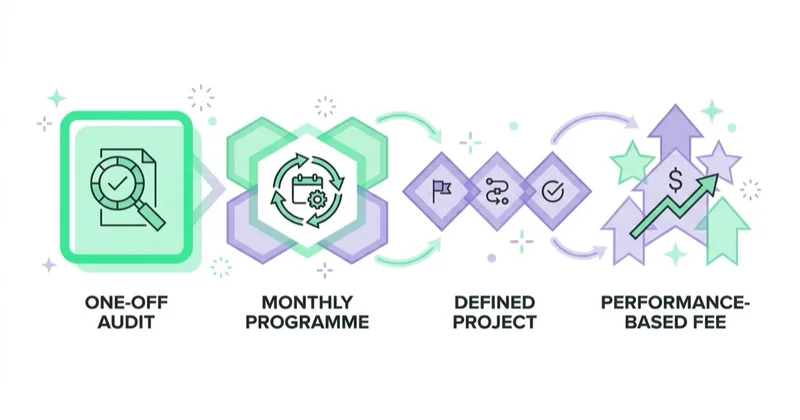
- Four billing models dominate: a one-off audit, a monthly programme against an agreed scope, a defined project, and performance-based fees.
- Performance-based pricing needs unusually precise attribution, because organic demand includes brand searches, existing customers and demand created by other channels.
- No single factor always dominates cost. Technical debt, site size, market count, competition, content depth and implementation capacity interact.
- AI SEO may be integrated with SEO or scoped separately. Google requires no special optimisation for its AI features, but other assistants, cross-platform monitoring and entity/source work can add genuine, non-duplicative effort.
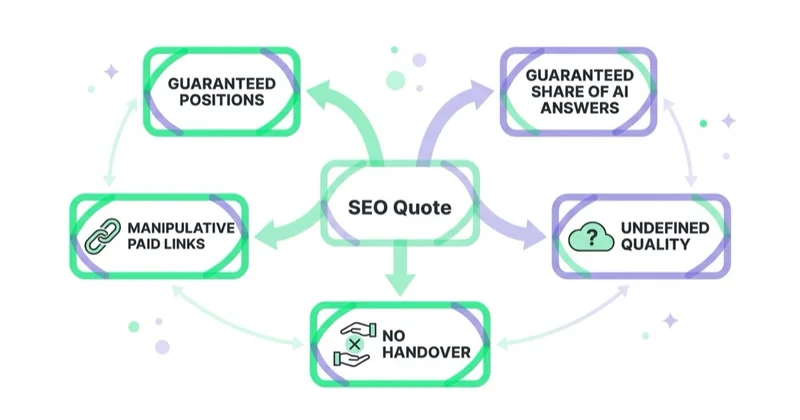
- Real red flags are unverifiable promises and opaque delivery: guaranteed positions or AI-answer share, paid links intended to manipulate rankings, undefined output quality, hidden implementation responsibility and no usable handover.
- Normalise quotes before comparing them — same scope, same implementation responsibility, same reporting, same exit terms.
What a price actually contains
Most arguments about SEO being expensive or cheap are arguments about scope. Before comparing figures, establish which of these six blocks a supplier priced, which they excluded, and which they assumed somebody else would do.
Audit and diagnosis. Establishing what is actually wrong: crawl and indexation state, rendering, internal linking, duplication, intent coverage, structured data and access for relevant crawlers. A free review can be a useful preliminary screen, but it is rarely equivalent to a paid audit with evidence, prioritisation, implementation requirements and a deliverable the client owns. For the expected depth, see what an SEO audit includes.
Technical work. Fixing what the audit found. Quotes diverge most sharply here, because it depends on the platform, on how much of the fix list needs developer time, and on whether the supplier can ship changes or only write tickets.
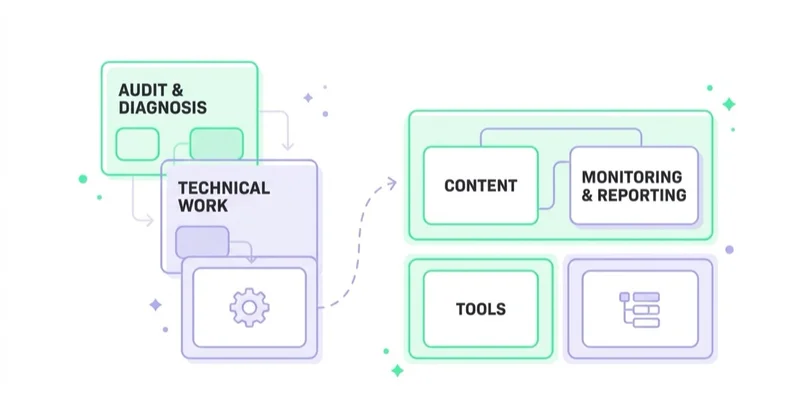
Entity and structured data. Making the business facts machine-readable and consistent — what the company does, which markets it serves, what it can prove — across the site, its schema markup, and the third-party sources assistants already read.
Content. Briefs, production, editing, and keeping published pages accurate. The largest variable is whether the supplier writes or only briefs, and whether subject-matter interviews are included.
Monitoring and reporting. Visibility tracking, Search Console analysis, citation monitoring across AI surfaces, and the analyst time to turn it into a decision. Reporting that only lists positions is worth correspondingly less.
Tooling. Crawlers, visibility trackers, log analysers, AI-visibility monitors. Absorbed into the fee, passed through at cost, or held by the client — all three are defensible, none is the same price.
The four billing models
| Model | How it works | Where it fits | Main risk |
|---|---|---|---|
| One-off audit | Fixed price for a diagnosis, ending in a prioritised plan the client owns | When the constraint is unknown | The plan gets filed and never implemented |
| Monthly programme, agreed scope | Flat fee for a defined set of work: technical, entity and schema, content, monitoring, reporting | Compounding work with a stable scope | Scope creep both ways — silent shrinkage or unbilled expansion |
| Defined project | Fixed scope with a fixed end: a migration, a schema rebuild, a crawler policy, a page cluster | Bounded work with a finish line | Anything found mid-project needs a change order |
| Performance-based or hybrid | Part of the fee tied to agreed outcomes | Cases with a reliable baseline, attribution rules and controllable implementation | Rewards whatever the contract can count, which may differ from incremental value |
The percentage-of-spend model common in paid media has no equivalent here: there is no media budget for the fee to be a percentage of. A flat fee for an agreed scope has the useful property of not rising simply because the business grew.
Why performance-based SEO pricing is riskier than it sounds
Performance pricing looks attractive because part of the fee moves with an outcome. It can work, but only when both sides define the outcome and the agency has enough control over implementation. Without that, the contract creates arguments about attribution rather than better decisions.
Organic traffic is not homogeneous. It contains brand searches from people who already knew the company, navigational searches from existing customers, and support queries from people looking for a login page. A fee tied to organic sessions or revenue pays for all of it, including demand created by a TV campaign, a product launch or a PR cycle the supplier had nothing to do with.
A fee tied only to positions can reward low-value queries or a keyword set chosen for winnability rather than commercial impact. Google is explicit that no one can guarantee a number-one ranking, and its hiring guidance treats such a guarantee as a reason to find a different supplier.
A performance component therefore needs five things agreed in writing before it means anything: a baseline, one source of truth for the data, a rule excluding brand and returning-customer demand, a treatment for delayed outcomes, and a rule for platform-driven changes.
What moves the price up and down
| Factor | Pushes the price down | Pushes the price up |
|---|---|---|
| Technical state | Modern platform, server-rendered, clean index | Client-side rendering, parameterised URLs, unresolved migration |
| Site size | A few hundred URLs, coherent structure | Large catalogues, faceted navigation, thin archives |
| Markets and languages | One market, one language | Several markets, hreflang, localised content and legal pages |
| Competitiveness | Niche category, few competitors publishing | Competitors publishing and building authority continuously |
| Implementation capacity | Developers on a predictable cadence, one decision-maker | No development resource, or a queue behind an unrelated roadmap |
| Content readiness | Internal experts available, existing proof | Everything written from scratch, no source material |
Technical state can change the order and skills required. A site with inaccessible rendered content, uncontrolled faceted URLs or unresolved migration errors may need engineering before additional publishing. That does not make performance metrics the whole technical scope: Google's page experience guidance and Core Web Vitals cover important user-experience signals, while crawlability, indexation, canonicalisation and rendering require their own checks.
The last row is one clients can influence directly. Access to an in-house expert gives the writer original details, caveats and evidence; a brief with no source material is more likely to produce generic content that resembles the existing search results.
Why a universal price range would mislead you
A public range without a common scope mixes different currencies, labour markets, site sizes and delivery models. It may compare an automated crawl with a senior technical audit, briefs with finished content, or recommendations with implemented changes. A very wide range answers nothing; a narrow one creates false precision.
Ask each supplier for three numbers instead:
- Diagnosis and planning: the cost to establish the baseline, constraints, priorities and implementation requirements.
- Minimum viable implementation: the work required to remove the most material blockers and establish reliable measurement.
- Recommended programme: the technical, editorial and authority-building work justified by the opportunity, with optional items shown separately.
This creates a decision the buyer can inspect. If the available budget only covers diagnosis, the business still receives a plan it can implement. If it covers implementation, both sides know which outcomes the scope is expected to influence and which dependencies remain with the client.
Glossary
- Scope — the written list of work a fee covers, including who implements each item.
- Baseline — the measured state of visibility, traffic and conversion before work starts, used later to judge change.
- Entity — the specific organisation, person, product or place a name refers to, represented through facts and relationships rather than keywords alone.
- Handover — the transfer of everything produced during an engagement: audits, content, schema, tracking configuration, platform access.
- Lock-in — any contract term or technical arrangement making departure more expensive than the work justifies.
- Incrementality — the share of a result that would not have happened without the work, as distinct from the result recorded next to it.
When AI SEO is additional scope — and when it is duplicate scope
Google states that AI Overviews and AI Mode require no special optimisation, AI text file or special schema beyond the foundations used for Google Search. That statement applies to Google's Search features. It does not mean that every cross-platform AI visibility programme is free or identical to an existing SEO retainer.
Some work overlaps directly with good SEO: crawlable pages, useful content, accurate structured data, clear internal linking and a site experience that works for users. Charging twice for the same technical fix or article under two labels is duplicate scope. Other work can be genuinely additional:
- Provider-specific access and governance. Documenting separate policies for training crawlers, search crawlers and user-initiated fetchers across the providers in scope, then checking CDN or WAF enforcement and verified logs.
- Entity and source consistency. Auditing how the company, offer, people and evidence are described across controlled profiles and material third-party sources. The effort depends on the number of brands, markets and factual conflicts.
- Cross-platform measurement. Google, Bing and independent assistants expose different data. Building a repeatable prompt sample, citation inventory, referral reporting and server-log view is real setup and analyst work, with limitations that must be reported honestly.
- Content improvement. Existing pages may need direct answers, primary sources, expert evidence, clearer comparison criteria and stronger maintenance — not an “AI version” of the same page, but substantive editorial work that may not exist in the current SEO scope.
The commercial test is simple: map every AI SEO deliverable to an owner, output and acceptance criterion, then check whether it already exists in the SEO scope. Combine overlapping work into one programme. Price separate work separately when it requires additional research, implementation or monitoring. Labels such as GEO, AEO and LLM SEO matter less than whether the statement of work is clear.
Red flags in a quote
| Red flag | What it usually means | What to ask instead |
|---|---|---|
| Guaranteed positions | The supplier will pick winnable keywords and report on those | Which commercial queries matter, and how progress is evidenced |
| Guaranteed share of AI answers | No platform sells this, so it cannot be delivered | How citations get measured, and what the baseline is |
| Paid links intended to influence rankings | The tactic can violate Google's link-spam policy and create site risk | How mentions are earned, which placements are sponsored and how links are qualified |
| Content priced only by volume, with no acceptance standard | Word or article count can replace usefulness as the objective | What research, expert input, editing, evidence and performance review are included |
| No notice period and no handover | Cancellation friction replaces retention, and the work stays with the supplier | What leaving looks like in month four, and what transfers on the last day |
| One monthly number with no statement of work | Delivery can shrink without a visible scope change | Deliverables, responsibilities, assumptions and change process in writing |
The exit row is about ownership rather than price. An engagement that keeps the content, the schema and the tracking configuration on the supplier's side is not cheap — it is a deferred cost that lands the day the relationship ends. Our guide to SEO contracts has the clause-level detail.
How to compare two quotes that are not the same shape
Most SEO quotes are not comparable as written. Normalising them takes about an hour and often reverses which one looks cheaper.
- Map the six cost blocks and mark, per quote, whether each is included, excluded, or assumed to be the client's job.
- Ask who implements. Does the supplier ship the change, or write a ticket for someone else? A quote that only produces tickets needs a development budget added before comparison.
- Ask who writes. Briefs only, or briefs and production — with or without subject-matter interviews?
- Ask who holds the tools. In the fee, passed through at cost, or the client's licences?
- Ask what reporting contains. Positions only, or positions plus indexation, intent coverage, AI citations and a recommendation?
- Ask what transfers on exit, and what the notice period is.
- Only then compare numbers, over the same period — a quarterly project against three months of a retainer, not against one.
The supplier should be able to answer these questions before signature or state which details depend on discovery. Google's hiring guidance recommends asking for previous work, expected results, measurement methods and transparency about changes made to the site; the same standard applies to the fee and scope.
Working out whether the spend can return
A quote is only expensive relative to what it has to produce. The arithmetic below is deliberately simple, and the figures in it are an illustrative calculation, not a benchmark or a rate — the inputs must come from the business's own margin and conversion data.
additional profitable conversions to break even = total programme cost ÷ contribution margin per conversion
If a programme costs X and the business earns Y in contribution margin per incremental order or customer, break-even needs X ÷ Y additional conversions within the evaluation horizon. Then test whether the implied qualified traffic and conversion rate are plausible given measured search demand. For lead generation, use the expected contribution per qualified lead: close rate multiplied by realised contribution per new customer, adjusted for invalid leads and the time it takes revenue to materialise. Do not substitute revenue for margin unless the objective is explicitly revenue rather than return.
Two adjustments make the sum more useful. Time to impact: different work moves on different schedules, and Google notes that crawling alone can take from days to months depending on the page. Build cash-flow scenarios rather than promising that all technical work pays back in weeks or all content in quarters. Existing demand: a calculation that credits every organic conversion may include brand, navigational and returning-customer demand the programme did not create, so report those segments separately where the data supports it.
The output is not a forecast; it is a threshold — the result below which the engagement is not worth running, and exactly the number worth agreeing with a supplier in advance.
How Space Ads approaches SEO and AI SEO pricing
Space Ads structures SEO and AI SEO pricing around the problem and implementation scope. When the constraint is not yet known, the first deliverable can be a diagnosis with evidence, priorities, dependencies and an implementation plan the client can use. Bounded work such as a migration review, structured-data implementation or measurement setup fits a defined project. Ongoing technical, editorial and monitoring work fits a recurring programme only when the monthly responsibilities and decision cadence are explicit.
The proposal should not guarantee positions or a fixed share of AI answers, because the platforms do not offer that control. It should commit to work Space Ads can deliver and the client can verify: a defined scope, named responsibilities, an agreed measurement method, documented changes and a usable handover. The AI SEO service page explains the service area, while the final commercial scope must reflect the client's site, markets, access and implementation model.
The sequencing principle is to remove material access and indexation blockers before scaling content production. Publishing can continue where it serves users, but volume should not be used to avoid a technical constraint that prevents the intended pages from being discovered or understood.
Common mistakes
| Mistake | Why it hurts | What to do instead |
|---|---|---|
| Comparing quotes on the final number | The cheaper quote often excludes implementation | Normalise scope, implementation and exit terms first |
| Treating a preliminary review as a full diagnosis | The review may omit evidence, prioritisation and implementation detail | Confirm the audit depth and the deliverable you will own |
| Buying AI SEO as a separate programme without mapping overlap | Existing SEO deliverables may be billed again under a new label | Map each deliverable to an owner, output and acceptance criterion |
| Accepting a monthly fee without a statement of work | Scope changes become invisible | Document deliverables, responsibilities, assumptions and change control |
| Tying the fee to organic revenue | Brand and returning demand inflate the result | Exclude both, or use a flat scope fee |
| Signing without an exit clause | Leaving costs more than the work is worth | Agree notice, handover and rights before starting |
FAQ
How much does SEO cost?
There is no single rate that answers the question responsibly without a scope. A price reflects the site, markets, objectives, billing model and who implements the findings, so the same figure can buy a one-off diagnosis, an implementation programme or reporting only. Compare proposals by normalising six cost blocks — audit, technical work, entity and structured data, content, monitoring and tooling — and establishing who ships each change.
Is AI SEO more expensive than traditional SEO?
Not automatically. Google states that its AI Overviews and AI Mode need no additional technical requirements or special optimisation beyond Google Search fundamentals. A cross-platform programme can still add provider-specific access governance, entity and source audits, citation and referral measurement, and substantive content improvements. It should cost more only where those are new deliverables, not where an existing SEO task has simply been renamed.
Should an SEO agency charge a percentage of results?
It can, but a performance component needs strict definitions: an agreed baseline, one source of truth, treatment of brand and returning-customer demand, attribution windows, platform-driven changes and the client's implementation obligations. A hybrid model is more defensible when the agency controls only part of the result. Avoid guarantees of specific Google positions; Google explicitly says no one can guarantee a number-one ranking.
What does an SEO audit's price depend on?
It depends on the number and diversity of meaningful URLs, platform and rendering complexity, legacy and parameterised URLs, markets and languages, available data and the depth of analysis. A crawl-and-report exercise costs less than a diagnosis that validates templates, samples rendered output, reconciles Search Console and server evidence, reviews intent and structured data, and ends in implementation-ready priorities.
What are the biggest red flags in an SEO quote?
Warning signs include guaranteed positions or a guaranteed share of AI answers, paid links intended to manipulate rankings, content volume with no research or acceptance standard, unexplained methods, unclear implementation responsibility and no usable handover. Pricing a legitimate content deliverable per article is not itself a red flag; buying ranking links or rewarding word count without quality control is.
How long before SEO spend shows a return?
There is no universal timetable. A deployed fix can be tested immediately on the site, but search engines may need days to months to recrawl and process changes, and commercial impact also depends on demand, competition and conversion. Set checkpoints by workstream: implementation and quality assurance, crawling and indexation, visibility, qualified traffic, then business outcomes. Treat each as evidence, not a promised deadline.
Key takeaways
- SEO and AI SEO have no single market rate; a quote is a scope, a billing model and an assumption about who implements.
- Six cost blocks belong in any credible price: audit, technical work, entity and structured data, content, monitoring, tooling.
- A fixed or recurring fee against a defined scope is predictable; a performance component needs rigorous attribution and implementation rules.
- Technical state, site size, market count, category competitiveness and implementation capacity move the number most.
- AI SEO may add provider governance, source consistency, cross-platform measurement and content work, but duplicated SEO deliverables should not be billed twice.
- Guaranteed positions or AI-answer share, manipulative paid links, undefined output quality and no handover are reasons to challenge or reject a proposal.
Sources and further reading
- Google Search Central — Do you need an SEO? (hiring guidance, questions to ask, and why ranking guarantees are a warning sign)
- Google Search Central — AI features and your website (no additional requirements or special optimisations for AI Overviews and AI Mode)
- Google Search Central — Spam policies for Google web search (link spam, including exchanging money for links)
- Google Search Central — Understanding page experience in Google Search results
- web.dev — Web Vitals (LCP, INP, CLS thresholds)
State as of July 2026 — AI crawler user-agent names and platform behaviour are revised regularly, so check each provider's current documentation (Google, OpenAI, Anthropic, Perplexity) before writing a crawler policy.
Continue learning
Continue reading
Shopify SEO: The Checklist That Matches How the Platform Actually Works
Shopify handles several SEO basics automatically, but rankings still depend on the decisions it cannot make for you. Use this checklist to audit indexation, collections, products, filters, variants, performance and international stores in the right order.
What an ASO Service Should Deliver (and When You Do Not Need One)
ASO should deliver research, store-specific metadata, creative tests and a reusable learning system—not a promised ranking. Here is the scope, evidence and ownership to expect.
App Store Optimization (ASO): How It Works and How It Differs From SEO
ASO improves app discovery and product-page conversion, but Apple and Google use different metadata, behavioural signals and testing tools. Learn what is officially documented, what remains an operating hypothesis, and how to coordinate store work with paid acquisition.