An agency should be evaluated against the job it was hired to do, the decisions within its control and the quality of the working relationship. Commercial outcomes matter, but they are also affected by pricing, product, stock, sales follow-up, seasonality and the market. Activity matters, but a high number of platform changes is not evidence of good judgment.

Build a scorecard before deciding whether the agency is strong, weak or simply working under an unclear scope. Review business impact, measurement quality, strategic decisions, delivery, access, communication and commercial governance together.
TL;DR
- Start from scope and baseline. List agreed outcomes, deliverables, assumptions, client dependencies and the period in which change can reasonably appear.
- Use a measurement hierarchy. Combine business economics, channel delivery, customer quality and experiments; platform and blended metrics have different limits.
- Evaluate decisions, not edit count. Ask what hypothesis was tested, what was learned and why the next action follows.
- Maintain durable access. The advertiser should control or have direct administrative continuity for core accounts, data and billing.
- Score operational quality. Include deadlines, QA, compliance, documentation, incident handling and responsiveness—not only campaign performance.
- Require honest uncertainty. “We do not know yet; here is the test” is stronger than false precision or permanent platform blame.
- Use a second opinion carefully. Define scope, evidence and conflicts of interest, especially when the auditor also sells replacement services.
Judging an agency you have is not choosing one
Most advice about marketing agencies is about choosing one — the questions to ask before you sign, the red flags to screen for, the model to pick. This is different: you already have an agency, you're paying them, and the question is whether the relationship is working. That's a harder, more emotional question, because there's sunk cost, a working relationship, and the fear that switching means disruption. It's also the question that matters most, because an agency that's coasting quietly costs you far more over time than a bad hiring decision caught early.
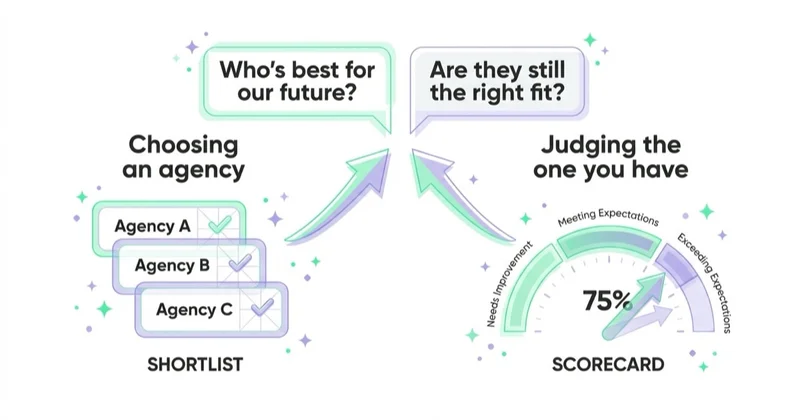
The answer will not be perfectly objective, but it can be evidence-based. Agree weights for outcomes, strategy, execution and relationship quality, then review the same scorecard quarterly. A pleasant account manager is not enough, but collaboration and response quality are legitimate performance inputs because they affect execution.
Signal 1: outcomes tied to a measurement hierarchy
Start with contribution, qualified pipeline, customer acquisition or another agreed business outcome. Then use platform metrics to diagnose delivery and blended metrics to track the total marketing system. Platform attribution can overlap or miss journeys; blended MER can move because of pricing, promotions, organic demand or channel mix. Neither is automatically the “truth.”
Ask whether conversion definitions, attribution windows, refunds, lead quality and conversion delay are visible. Where the decision and scale justify it, an experiment can estimate incremental impact. MER and ROAS remain useful when their scope and limitations are explicit.
Signal 2: transparency and account ownership
The advertiser should retain durable access to core advertising, analytics, commerce, CRM and creative systems. Exact ownership models vary by platform: linked manager accounts and partner access can be legitimate. The practical tests are whether the client can inspect data, change partners, preserve history and continue operating after offboarding.
Review administrators, partner permissions, billing, recovery methods, data-processing roles, source-file rights and export capability. Excessive access can be a security risk, so use role-appropriate permissions rather than granting every stakeholder full admin. See account and data continuity.
Signal 3: verifiable delivery and decision quality
Verify agreed deliverables: experiments, creative, analyses, tracking fixes, feed work, landing pages and decisions. Platform logs such as Google Ads Change history can confirm many account edits, but they do not record research, meetings, website work, CRM changes or the quality of analysis. Google retains Change history for two years and notes that some changes may be absent.
A quiet log can be appropriate for a stable automated campaign; frequent edits can be counterproductive. Ask for the decision record: issue, hypothesis, expected effect, guardrail, owner, review date and conclusion. Repeated reversals before data matures or claimed work that cannot be reconciled with any evidence deserves investigation, not an automatic verdict.
Signal 4: reporting that drives decisions
Good reporting should help a named audience make decisions. It states the objective, data period and caveats; separates fact from interpretation; explains material movements; records decisions and owners; and shows risks or dependencies. Operational metrics remain useful when they diagnose a business outcome.
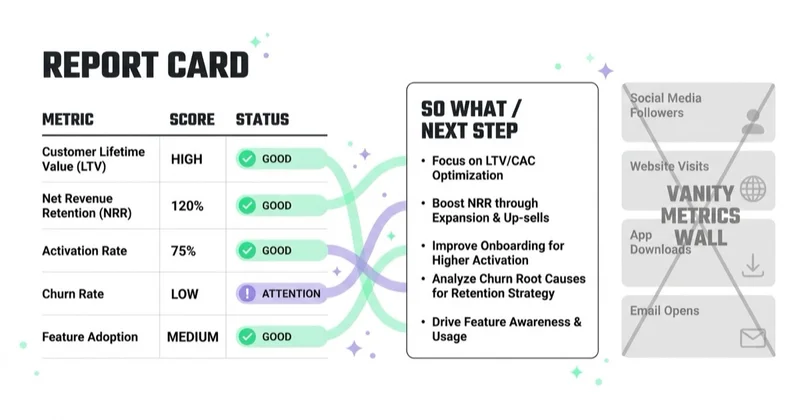
The test: after reading the report, do you know whether marketing is paying, what's being changed, and why? Or just that a lot of numbers moved? Good reporting leaves you able to make a decision; vanity reporting leaves you impressed and none the wiser. What good reporting should contain is covered in what good marketing agency reporting looks like.
Glossary
- Blended efficiency / MER — total revenue divided by defined marketing spend; a portfolio measure that does not isolate channel causality.
- Vanity metrics — impressions, clicks, engagement that rise without necessarily moving revenue.
- Access continuity — the advertiser's ability to inspect, administer and retain core accounts and data through a partner change.
- Change history — the log of what was changed in an account and when; evidence of activity.
- Coasting — an agency riding your budget with little active management.
- Second opinion / audit — an independent review of your accounts and results.
Signal 5: they can explain their reasoning
Ask the agency to distinguish observation, hypothesis and evidence. It should explain why a change was made, what alternative explanations exist and what evidence would cause it to reverse course. Clear communication does not require revealing proprietary personal data or pretending every result has one cause.
Blaming the platform deserves special attention. Platforms do change, and signal loss is real — but a good agency operates within those realities and has a plan; it doesn't use them as a permanent excuse for flat results. "The algorithm turned against us" as a recurring explanation, with no corresponding change in approach, is a coasting tell. A good operator names what they'll do about it.
The red flags, gathered
Put together, the signs an agency is coasting or underperforming:
| Red flag | What good looks like instead |
|---|---|
| One favourable metric without scope or caveats | A hierarchy of business, customer and delivery evidence |
| Advertiser continuity depends on agency logins | Direct access, documented partner roles and offboarding |
| Activity count presented as strategic value | Decisions linked to hypotheses, evidence and outcomes |
| Results cannot be reconciled with sales or finance | Definitions and discrepancies are investigated openly |
| "Trust us, it's working" / jargon | Clear reasoning you can follow |
| Blaming the platform with no plan | Operating within platform realities with a plan |
| A wall of metrics, no "what next" | Reporting that drives a decision |
None of these alone is proof of bad work — but several together, especially resistance to transparency and inability to connect work to revenue, is the pattern of an agency you should question.
Second opinion before switching
Before switching, give the incumbent a written review with specific evidence, questions and a remediation period when risk permits. Immediate action may be necessary for security, legal, billing or material trust failures. Otherwise, a second opinion can test the disputed areas and reduce avoidable transition cost.
An audit is not automatically independent because it is external. Ask who performs it, which systems are reviewed, which evidence standard is used, whether the incumbent can respond and whether the auditor benefits from recommending replacement. A scoped marketing audit can clarify facts and uncertainty; offboarding preparation protects continuity if a change follows.
How Space Ads approaches this
Our reviews use an evidence table: contractual expectation, observed state, business impact, confidence, missing information and recommended validation. We reconcile platform, analytics and commercial data, inspect access and measurement, and separate work quality from constraints outside the agency's control.
Because an audit cannot eliminate all uncertainty, recommendations state assumptions and conflicts explicitly. The aim is not to maximise the number of findings or manufacture a reason to switch; it is to give management a defensible next decision. That is the standard for our marketing audit.
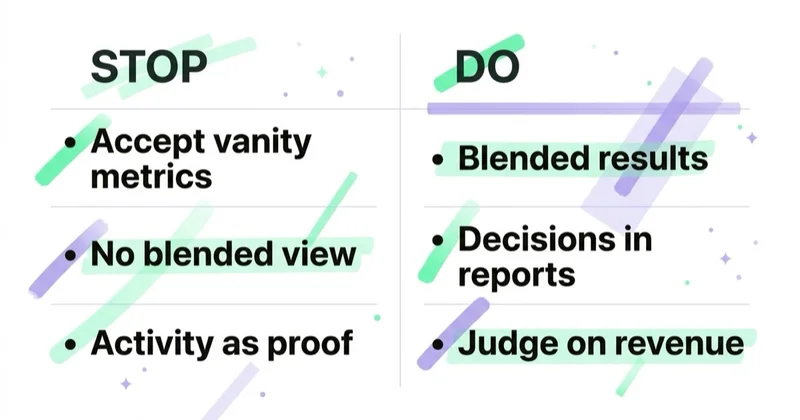
Stop doing / Do instead
| Stop doing | Do instead |
|---|---|
| Judging only on report polish | Use a weighted scorecard tied to scope and business needs |
| Treating platform or blended ROAS as truth | Reconcile attribution, blended, customer and incremental evidence |
| Counting platform changes as productivity | Verify deliverables, decisions, learning and outcomes |
| Relying on agency-only access | Maintain advertiser-side continuity and role-appropriate permissions |
| Accepting "trust us, it's working" | Require reasoning you can follow |
| Switching on a gut feeling | Document evidence, seek a response and scope a conflict-aware review |
Common mistakes
Common errors are changing evaluation criteria after results arrive, ignoring client-side dependencies, mistaking activity for impact and accepting one attribution view as causal proof. Relationship failures also persist when neither side documents decisions, approvals or scope changes. A recurring scorecard and evidence log make remediation or transition more defensible.
FAQ
How do I know if my marketing agency is doing a good job?
Evaluate the agreed scope across seven areas: business outcomes, measurement quality, strategic decisions, delivery and QA, access continuity, communication and commercial governance. Weight them for the engagement. Review evidence and client dependencies, not only outcomes or activity. A strong agency explains uncertainty and turns reporting into documented decisions.
What are the red flags of a bad marketing agency?
Serious warnings include advertiser lockout from core systems, unexplained billing or data access, fabricated or irreconcilable reporting, repeated missed deliverables, unapproved material changes and failure to address privacy or policy issues. Softer concerns—unclear narrative, quiet logs or weak performance—need context, evidence and a remediation discussion before they become a verdict.
How can I verify what my agency is actually doing?
Match contractual deliverables with evidence: briefs, experiments, releases, reports, issue tickets and decision records. In Google Ads, open Campaigns → Change history to inspect many edits from the previous two years, including the associated user or tool. Treat it as a partial execution log, not a timesheet; work outside the platform and some changes are not recorded.
Should I fire my marketing agency or get a second opinion first?
For performance or relationship concerns, document the gap, request the agency's response and set a time-bound remediation plan when appropriate. Use a scoped second opinion if facts remain disputed. Skip the delay when there is material security, legal, financial or integrity risk. Any auditor should disclose if it also wants the replacement engagement.
My agency shows great ROAS but revenue is flat — what's going on?
Possible causes include attribution overlap, a shift toward brand or returning customers, falling organic or offline revenue, lower prices, refunds, stock constraints or different time windows. Platform ROAS may overstate or understate causal value. Reconcile conversion definitions and periods, customer and margin data, blended performance and—where material—an incremental test.
How do I know if it's my agency or the market causing a plateau?
Build competing hypotheses: execution, measurement, offer, capacity, customer mix, competition, seasonality and market demand. Compare them with search demand, auction and platform data, business releases, sales feedback and experiments. An audit can narrow the causes but may not identify one definitive source without a suitable counterfactual. See why growth has plateaued.
Key takeaways
- Evaluate against an agreed, weighted scorecard and the constraints each party controls.
- Reconcile business, platform, customer and incremental evidence; no single metric is ungameable.
- Verify delivery through multiple records, not Change history volume alone.
- Maintain direct access continuity, documented partner permissions and an offboarding plan.
- Use remediation and conflict-aware review before switching, except where material risk requires immediate action.
Sources and further reading
- Google Ads Help — About change history
- Google Ads Help — Google Ads data retention policy
- Google Analytics Help — Attribution and reporting
- 4A's and ANA — Agency compensation and evaluation framework
Continue learning
Continue reading

What Good Marketing Agency Reporting Looks Like (and the Red Flags)
A useful agency report gives client and agency a shared, auditable view of goals, spend, outcomes, uncertainty and next decisions. This guide provides a practical structure, metric definitions and constructive red flags.

Lead Generation for Online Courses and Education Providers
Education lead generation must connect an honest promise with learner fit, enrolment and course starts—not just form volume. Learn how to design the journey, evidence claims and measure each intake.
How to Choose a Performance Marketing Agency
Choose a performance marketing agency with a defined brief, evidence-based scorecard and clear commercial safeguards. This guide covers team evaluation, measurement, account access, fees, contracts and handover.