Promote an app by moving through four readiness gates: the product delivers the promised value, the store page communicates that value, measurement reaches a meaningful post-install outcome, and the acquisition model can support a controlled test. Scale only after acquired cohorts activate, return or monetise in line with the business model.
This is an order of evidence, not a rigid rule that every app must launch one channel at a time. A consumer game, a paid productivity tool and a B2B companion app have different usage cadence, monetisation and channel fit. The launch plan should define what must be true before the next level of spend—not imitate a generic calendar.
TL;DR
- Define the audience, use case, activation event and commercial model before choosing channels.
- Test product stability, onboarding, store compliance, customer support and analytics before a broad launch.
- Build the App Store and Google Play listings early, then improve them with source-level data and controlled tests when enough traffic exists.
- Measure install, activation and a business outcome. Cost per install is a delivery metric, not proof of valuable growth.
- Pre-order or pre-registration can build a launch audience, but neither guarantees activation after download.
- Choose the first channel mix by intent, creative mechanism, platform and measurement—not by a universal ranking.
- Evaluate cohorts after an appropriate conversion and retention window; D1 or D7 alone is not a universal go/no-go metric.
- Scale product, market, creative and channel combinations that meet contribution and payback requirements after returns, refunds and platform fees.
Define what a successful app launch means
“More installs” is not a complete objective. A launch can produce a chart spike and no durable users.
Write a launch scorecard before production:
- target user and use case;
- market, language and device scope;
- activation event showing that the user reached first value;
- relevant engagement or retention cadence;
- monetisation event and value definition;
- acquisition cost ceiling and payback window;
- product capacity, support and incident thresholds;
- evidence required to expand geography, channel or budget.
Choose the right value event
The first downstream event should be close enough to occur at useful volume and strong enough to predict value.
| App type | Possible activation signal | Later business outcome |
|---|---|---|
| Subscription utility | Completes core task and starts trial | Paid renewal or retained subscriber |
| Marketplace | Completes search and contacts/saves supplier | Completed transaction or contribution |
| Game | Finishes tutorial and reaches meaningful session depth | Payer/ad revenue and retained player |
| B2B workflow | Connects account and completes first workflow | Active seat, expansion or retained contract |
| Retail app | Signs in and views/saves relevant product | Purchase, repeat purchase or store visit |
These are examples. An app used monthly should not be judged by the same daily retention pattern as a social game. Use product evidence and store peer-group benchmarks where available, then refine the event as customer value becomes observable.
Gate 1: product and operational readiness
Acquisition magnifies the experience that already exists. Before sending a large audience, validate:
- core journey and value proposition;
- onboarding completion and permission prompts;
- crashes, latency and high-impact bugs;
- account creation, payment, subscription and restore flows;
- deep links and deferred deep links where relevant;
- accessibility and supported devices;
- privacy disclosures, consent and data deletion;
- App Store and Google Play policy requirements;
- support, moderation, fraud and incident response;
- server and fulfilment capacity.
Use beta and soft-launch evidence correctly
Internal, closed or open testing can find technical and usability failures. A limited-country or limited-audience release can also test live onboarding, monetisation and support.
Do not assume beta retention will equal paid acquisition retention. Testers may be more motivated and receive more assistance. Treat pre-launch behaviour as an initial risk signal, then establish separate cohorts for each acquisition source and market.
Decide whether to pre-launch publicly
Apple permits eligible new apps to be offered for pre-order in a country or region before release; the release date is set between two and 180 days ahead under current App Store Connect rules. Google Play pre-registration campaigns currently last up to 90 days and can notify or, for eligible users/devices, automatically install the app at launch.
Use pre-order/pre-registration when there is a real audience-building plan: creator reveal, event, franchise community, publisher list, product waitlist or seasonal moment. A dormant store page without distribution does not create demand.
Track:
- listing visits and pre-orders/pre-registrations;
- cost per registered user where paid media is used;
- release-day download/installation behaviour;
- activation and retention of the pre-launch cohort;
- cancellation or opt-out where reported.
A registration is not a customer. Forecast the drop from interest to download, activation and monetisation.
Gate 2: store listing and message readiness
The store surface must answer four questions quickly:
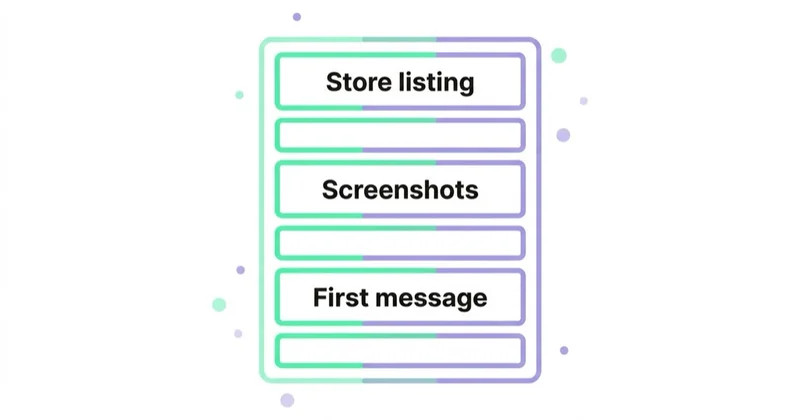
- What does the app help me do?
- Is it meant for someone like me?
- What will the experience look like?
- Why is it safe and worthwhile to install?
Build the icon, name, subtitle/short description, first screenshots, preview/video, full description, privacy information, category and localisation around one coherent promise. Show real product states rather than a sequence of slogans.
The detailed metadata differences are covered in App Store Optimization.
Do not wait for a “perfect” conversion rate
A new listing may not have enough qualified traffic for a reliable baseline. It should be accurate, differentiated, localised and technically ready before spend; optimisation continues after traffic arrives.
Apple's App Store Connect Analytics distinguishes impressions, product-page views and downloads and can segment performance by source and product page. Note its official conversion-rate definition: total downloads and pre-orders divided by unique device impressions. That is not the same as page-view-to-download rate, so label metrics precisely.
Google Play and Apple offer listing variation tools. Apple Product Page Optimization can test icons, screenshots and previews among eligible users. Custom Product Pages can align screenshots, previews and promotional text with particular audiences and campaign links. Google Play custom store listings can target eligible segments such as country or pre-registration state.
Use custom pages to continue a real campaign promise, not to make contradictory claims to different audiences.
Ratings and reviews
Prompt for a rating after a meaningful successful moment, not immediately after first open. Follow store APIs, policies and local review law. Do not gate the request by asking only satisfied users to post publicly or buy positive sentiment.
Review themes also identify product and expectation problems. A listing that promises a different experience from the app can achieve a good initial download rate and poor retention.
Gate 3: measurement readiness
At minimum, measurement should cover:
- first-time install/download where available;
- first open and onboarding steps;
- activation;
- monetisation or another business outcome;
- subscription lifecycle, refunds or ad revenue where relevant;
- source/campaign under permitted attribution frameworks;
- app version, market and relevant device context;
- consent state and diagnostics;
- product quality such as crash-free use.
An event taxonomy must define exact triggers, values, currency, transaction IDs, deduplication, destinations and ownership. Do not call three different actions conversion and expect bidding or analysis to understand their quality.
Product analytics, attribution and finance answer different questions
- Product analytics explains behaviour in the app.
- An MMP or platform attribution system connects eligible acquisition interactions with events.
- Store consoles explain downloads, proceeds and store-specific usage.
- Backend/finance data confirms paid transactions, refunds and contribution.
- Experiments or modelling estimate incrementality where feasible.
The role and limitations of an MMP are explained in how to choose a mobile measurement partner. Apple privacy frameworks are covered in SKAdNetwork and AdAttributionKit.
Plan for delay and different attribution rules
Apple's privacy-preserving AdAttributionKit can produce delayed postbacks with limited detail. Apple documents a minimum 24–48 hour delay for eligible production postbacks. Networks, an MMP and internal analytics may apply different windows and logic.
Google App campaigns also use click, engaged-view, view-through and post-install windows. Google recommends aligning the window with how long the chosen action takes and using conversion-lag reporting. A longer window can include more conversions but may also capture more organic behaviour.
Create a reconciliation note before launch:
- source used for platform optimisation;
- source used for finance and cohort analysis;
- windows and attribution definitions;
- expected reporting delay;
- acceptable discrepancy and escalation owner.
Gate 4: acquisition test design
A useful launch test states:
- audience/market;
- channel and campaign objective;
- message and store-page variant;
- target event;
- expected event rate and delay;
- budget and duration;
- scale, hold and stop criteria;
- confounding product or pricing changes.
Budget from the decision you need to make
Start with the required downstream observations.
expected activations = paid installs × install-to-activation rate
expected customers = activations × activation-to-customer rate
media budget = expected installs × planned cost per install
Illustrative scenario
Assume the team needs about 100 activated users in one market to diagnose onboarding quality. The planning model uses:
- install-to-activation rate: 25%;
- planned CPI range: $3–$5.
The model needs roughly 400 paid installs and $1,200–$2,000 in media. If only 10% of activated users become customers, that produces about ten customers—far too few for a precise customer-acquisition estimate.
These are hypothetical planning inputs, not app benchmarks. They show why a test can answer an activation question without proving lifetime value. Use ranges and state which question the budget can realistically answer.
Platform campaigns also need enough budget and events for their delivery systems. Follow the current in-account guidance and official bid-to-budget recommendations for the chosen objective rather than forcing a low spend across too many markets and campaigns.
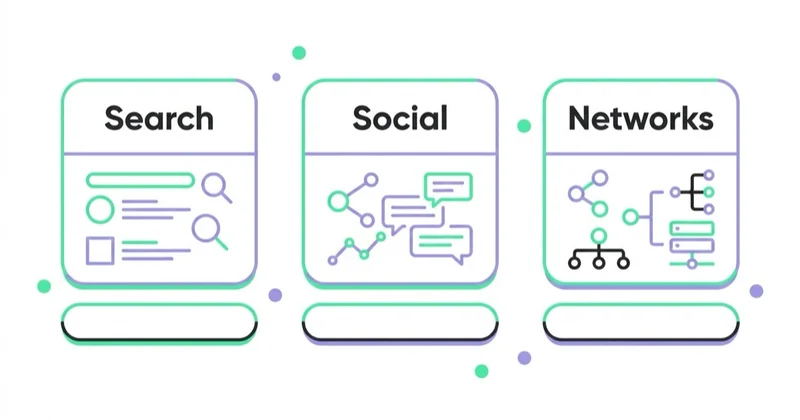
Choose channels by acquisition mechanism
Apple Ads
Apple Ads search-results campaigns reach users while they search the App Store. They can use keywords and connect ad variations to Custom Product Pages. This makes them useful for learning which explicit intents align with the app.
Apple's current recommended search-results structure separates brand, category, competitor and discovery themes. That is a platform starting point, not proof that every new app should fund brand terms first. A brand campaign may mostly capture users already looking for the app; evaluate its incremental role separately from category acquisition.
Apple Ads also includes Today tab, Search tab and product-page placements. Their intent and creative role differ from keyword search results.
See the Apple Ads guide for implementation detail.
Google App campaigns
Google App campaigns can distribute across Google properties including Search, Google Play, YouTube and the Display Network. They are not simply “Android search ads”. Their automation uses the supplied assets, conversion events, bid, budget and other campaign inputs.
Google distinguishes install, engagement and pre-registration objectives. Choose a meaningful target and confirm event volume and conversion settings. Do not launch overlapping App campaigns in the same geography without understanding how they may compete.
Paid social and video
Meta, TikTok and other video/social platforms can explain a use case to people who are not actively searching for an app. They require enough creative breadth to test distinct user problems, demonstrations and proof.
Align the ad, store page and onboarding. If an ad leads with one feature but the screenshots and first session lead with another, each transition loses intent.
Creator, PR and community
Creators and communities are useful when trust, demonstration or cultural context matters. Define disclosure, usage rights, tracking links, embargo, claim boundaries and the post-launch content plan.
PR can create reach and credibility around a real story—original research, category innovation, partnership, expert or launch moment. “A new app exists” is rarely a durable story by itself.
Cross-promotion, partnerships and owned audiences
Existing customers, a web product, partner distribution or an established publisher portfolio can be the most efficient first audience. Segment communications by actual relevance and permission. Measure whether the app adds value or merely moves existing users into another interface.
Multiple channels at launch?
Launching one channel can simplify diagnosis, but it is not a universal requirement. A time-sensitive release may need search, creator, PR and social activity together.
If multiple channels launch simultaneously:
- give each a distinct hypothesis and tracking plan;
- use source-aligned store pages where possible;
- avoid splitting budgets below viable delivery levels;
- annotate overlapping activity;
- do not claim that attribution alone proves channel incrementality;
- use geo, audience or timing tests where feasible.
The problem is not multiple channels; it is multiple channels with no decision design.
Interpret the launch through cohorts
Analyse by install week, source, market, creative/store page and app version. Averages can hide a weak release or low-quality channel.
Acquisition funnel
- store impressions and page views using the store's definitions;
- tap/click to store visit;
- store conversion or download/install rate;
- first open;
- cost per install and cost per activated user.
Product quality
- onboarding completion;
- activation and time to value;
- crash-free users/sessions;
- permission acceptance where relevant;
- support, deletion and refund reasons.
Retention and value
- return rate on the cadence the product promises;
- trial-to-paid and renewal;
- purchase/ad revenue and contribution;
- payer or customer conversion;
- cohort value and payback;
- re-engagement and churn.
D1 and D7 retention are useful for some apps but not universal truth. A tax-filing or travel app may be valuable without daily use. Define “retained” around the intended job and compare like-for-like cohorts.
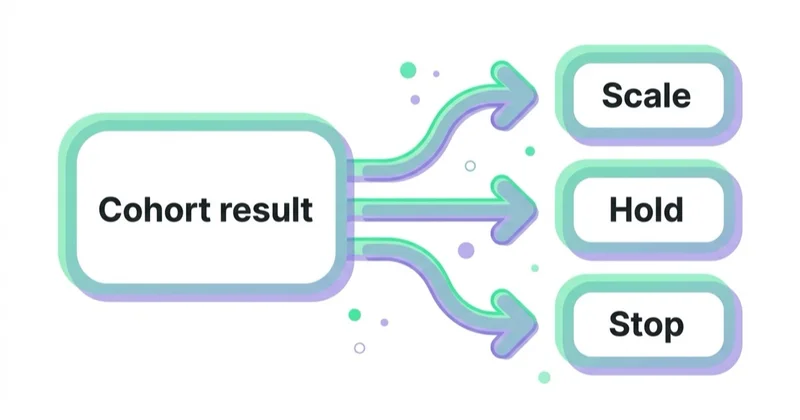
Scale, hold or stop: decision rules
Scale when
- tracking and product quality are stable;
- the acquired segment activates and retains as expected;
- downstream contribution supports the acquisition cost;
- the channel has room to grow without exhausting the audience;
- creative and store-page supply can support expansion;
- operations can handle volume.
Scale one constraint at a time where possible: budget, geography, audience, product or channel. Expect marginal acquisition cost and cohort mix to change.
Hold and diagnose when
- attribution totals diverge unexpectedly;
- the campaign is still inside its conversion delay;
- a new app version changed onboarding or payment;
- store conversion is weak for one source but not others;
- activation is healthy and monetisation is not;
- sample size cannot support the decision.
Stop or reduce spend when
- high-severity product or privacy failures appear;
- the promise attracts users the product does not serve;
- downstream value remains below cost after a fair evaluation window;
- fraud, accidental installs or low-quality placements dominate;
- support, inventory or server capacity is at risk.
Stopping a campaign is not necessarily stopping the launch. It may identify a product, message, measurement or market problem that must be fixed before the next test.
Post-launch growth is not only acquisition
A sustainable plan includes:
- onboarding and time-to-value improvements;
- lifecycle messages tied to useful behaviour;
- referral or collaboration loops with genuine user value;
- ratings and review prompts at appropriate moments;
- subscription, trial and pricing experiments;
- store page localisation and seasonal updates;
- app updates and in-app events;
- churn research and win-back;
- web content and partner distribution;
- creative production based on product evidence.
Retention work and acquisition work share one economic model. A small improvement in activation or renewal can raise the affordable acquisition cost, while poor product fit makes every channel look expensive.
Space Ads app-promotion approach
Space Ads starts with the business and measurement architecture: audience, activation, value event, contribution, attribution limits and cohort window. We then align channel creative, store page and onboarding around the same use case.
Launch tests are scoped to answer a defined question. Reporting separates platform attribution from product and finance outcomes, accounts for conversion delay and shows where the constraint sits—campaign, listing, onboarding, retention or monetisation.
We scale only when the downstream evidence supports it. Where there is insufficient volume or the product cadence requires a longer window, we say what can and cannot yet be concluded.
FAQ
How do I promote a new app?
Validate product and operations, build accurate store listings, instrument activation and value events, then run controlled acquisition against a defined audience and budget. Analyse source-level cohorts and scale only when product behaviour and commercial value support the cost.
Should ASO happen before paid acquisition?
The listing must be credible and ready before paid traffic, but ASO is continuous. A new page may need paid and organic traffic to reveal which messages convert. Use store experiments and source-aligned product pages when there is enough evidence.
Which paid channel should an app launch first?
Choose by the acquisition mechanism. Apple Ads can capture App Store search intent; Google App campaigns automate across several Google properties; paid social/video can create demand through demonstration. Existing audiences or partnerships may be stronger than any cold channel.
Should I launch only one channel?
One channel can simplify learning, but a coordinated multi-channel launch is valid when timing and reach matter. Give every channel a hypothesis, viable budget, aligned store experience and measurement plan. Do not confuse attributed conversions with incremental impact.
How much should an app launch budget be?
Back-solve it from the downstream event and number of observations needed, expected install-to-event rate and planned CPI/CPA range. Add creative, analytics and product work. A budget that buys installs may still be too small to estimate customer value reliably.
What app launch metrics matter most?
Store conversion, first open, activation, relevant retention, product stability, customer/payer conversion, cohort value, acquisition cost and payback. The priority depends on the business model and usage cadence.
Is D7 retention the main go/no-go metric?
Not for every app. Use a retention definition matching the promised frequency of use, together with activation and monetisation. D7 can be useful for frequently used products but misleading for episodic apps.
How long should I wait before judging an app campaign?
Wait until the relevant event window and reporting delay have matured, and account for campaign learning and app changes. Define the evaluation date before launch. Some activation questions resolve quickly; subscription renewal or customer value takes longer.
Key takeaways
- Use readiness gates instead of a universal channel sequence.
- Align product promise, store page, onboarding and campaign creative.
- Measure activation and business value, not only installs.
- Treat pre-registration and pre-order as audience programmes, not vanity totals.
- Choose channels by mechanism and test design; multiple channels are manageable when deliberately structured.
- Judge like-for-like cohorts after the appropriate delay and usage cadence.
- Scale only when contribution, retention, product quality and operational capacity support it.
See how Space Ads approaches performance marketing and app marketing.
Sources and further reading
- Creating your App Store product page — Apple Developer
- App Store Connect Analytics metrics — Apple Developer
- Publish an app for pre-order — Apple Developer
- Build awareness with Google Play pre-registration
- Google Play custom store listings
- Google App campaign best practices
- App campaign conversion windows — Google Ads Help
- Apple Ads search results — Apple Ads Help
Continue reading
ChatGPT Ad Formats and Character Limits: What Actually Fits
A ChatGPT ad appears below the response and carries six elements, with specific limits: title 3–50 characters, body up to 100. The "24 / 48 character" figures in trade coverage do not match the documentation, so this guide gives the full limits table, shows how to fit a useful message, and covers the image, product ads and end-to-end consistency with the landing page.
OpenAI Ads Manager: How to Set Up Your First ChatGPT Ads Campaign
OpenAI Ads Manager has three campaign levels, but launch also requires advertiser verification, billing, landing-page checks, measurement and deliberate choices for settings that cannot be changed later. This guide covers the setup sequence, budgets, context hints, oCPC, targeting, review and Ads API workflows.
Switching Marketing Agencies Without Losing the Account
A safe agency switch protects client-owned accounts, billing, conversion signals, creative rights and operating knowledge. Use this transition plan to assign responsibility, validate access and change partners without avoidable disruption.