An app marketing agency helps a mobile product acquire, activate and retain valuable users across app stores and paid channels. The work can combine store optimisation, acquisition, attribution design, creative testing and lifecycle recommendations, although product and CRM teams often own parts of activation and retention.
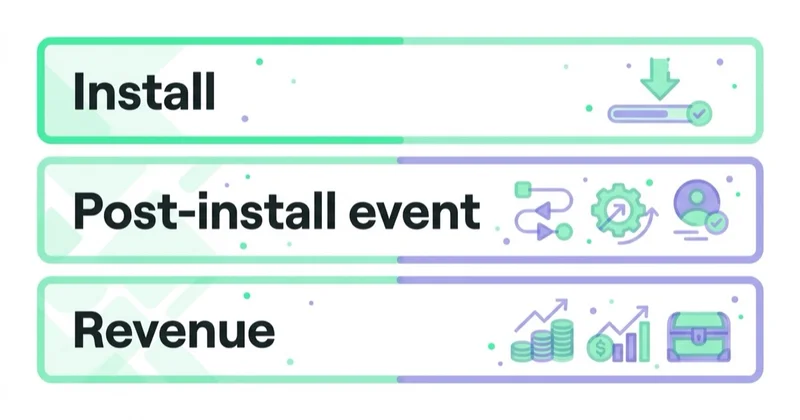
The capability that most clearly separates app specialists from general paid-media teams is measurement design. App campaigns may use native platform measurement, Google Analytics 4, server-to-server integrations or a mobile measurement partner. On iOS, AdAttributionKit and SKAdNetwork protect privacy through delayed postbacks and data granularity that depends partly on crowd anonymity. Commercial value also arrives after the install: activation, trial conversion, purchases, retention and payback may take days or months to mature.
TL;DR
- App marketing spans store optimisation, paid acquisition, attribution and retention — four disciplines, not one.
- The differentiator is measurement competence, because app acquisition combines store, device, privacy and post-install signals that web-only teams may not handle routinely.
- On iOS, privacy-preserving postbacks are delayed and can be less granular, so evaluation windows and evidence limits should be agreed before launch.
- Judge an agency on cohort value, activation and retention, not cost per install alone. Low CPI is useful only when downstream quality remains acceptable.
- ASO and paid affect the same store conversion step. They require one measurement plan so paid growth, organic discovery and product-page improvements are not misread.
- App type changes everything: games, subscription apps, commerce apps and ad-monetised utilities have different economics and different success metrics.
- The generic agency-selection machinery still applies — scorecards, contracts and references — this article covers what is specific to apps.
What the work actually consists of
Four areas, and an agency covering only one of them is a specialist rather than an app marketing agency.
Store presence. Metadata, creative assets, ratings and product-page performance. This is a shared conversion step for many paid and non-paid journeys, so improving it can increase the yield of several channels. Definitions must be kept current: Apple reports product-page conversion from views to downloads or pre-orders, while Google Play shifted its primary store-listing performance metrics toward unique intent clicks in June 2026. The mechanics differ from web SEO in ways that matter — covered in App Store Optimization, and what to expect from the service in what an ASO service should deliver.
Paid acquisition. Apple Ads and Google App campaigns closest to existing intent, then social platforms, in-app networks and creator content as reach broadens.
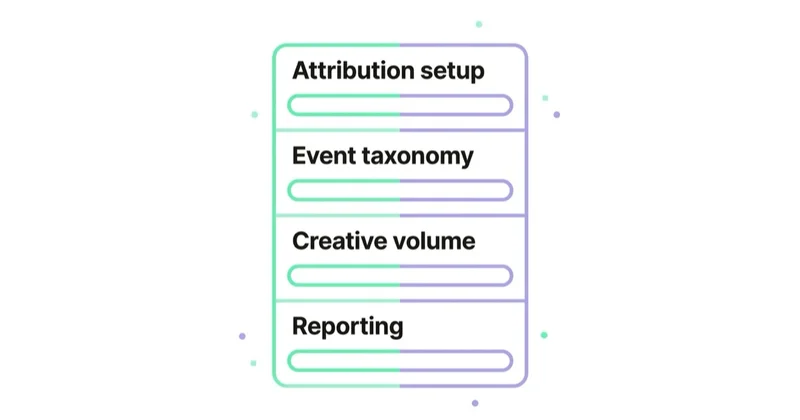
Attribution and measurement. Selecting the appropriate combination of native store data, platform measurement, GA4, server-to-server connections and — when justified — a mobile measurement partner. The agency should map post-install events, values, consent states and reporting limitations before media scales.
Retention. Onboarding, lifecycle messaging, re-engagement. Acquisition without retention increases the number of people who try the product and leave, which costs money and produces nothing.
One provider does not need to execute every layer. The accountability boundary does need to be explicit, because acquisition is judged partly on activation and retention outcomes influenced by the app, pricing, onboarding, CRM and product roadmap. The scope should name who diagnoses, who recommends and who implements each change.
The measurement constraint that shapes everything
This is the point on which app marketing genuinely differs. Web measurement also has consent, modelling and attribution gaps, but app journeys add app-store handoffs, platform-specific identifiers, deep links, first-open logic and operating-system privacy frameworks.
Attribution needs an explicit source of truth. A mobile measurement partner can deduplicate claims and apply attribution rules across networks, but it is not the only measurement route. Google Ads supports GA4, server-to-server and third-party app analytics; Android can also use codeless Google Play measurement for eligible events. The right architecture depends on channels, privacy requirements, data exports, deep links and internal analytics. The selection criteria are in how to choose a mobile measurement partner.
iOS reporting is deliberately constrained. Apple's privacy-preserving attribution frameworks send postbacks after random delays and may limit their granularity to preserve crowd anonymity. AdAttributionKit can send up to three postbacks across conversion windows; the first has a shorter random delay than later postbacks. Not every iOS report is anonymous or delayed in exactly the same way, so an agency should distinguish Apple Ads attribution, consented first-party analytics, MMP reporting and AdAttributionKit rather than calling all of it "SKAN data". The mechanism is explained in SKAdNetwork and AdAttributionKit.
The metric that matters arrives late. Whether an install was worth buying depends on retention and in-app behaviour over days or weeks. Any figure available on day one is a proxy.
Three practical consequences for choosing an agency:
- An agency promising complete, user-level and immediate visibility for every iOS channel should be asked which data source supports that claim and where it stops.
- Evaluation windows must be agreed in advance. Otherwise the first two weeks look alarming, pressure builds, and the campaign is changed before the data that would have justified it arrives.
- Competence with incomplete, modelled and delayed data is a genuine skill. A good answer to "how do you handle iOS attribution gaps" names the data sources, reconciliation method, decision window and limits.
Glossary
- MMP (mobile measurement partner): the third-party platform attributing installs and in-app events across networks.
- Post-install event: an action after install that indicates value — registration, trial, purchase.
- Cohort: users grouped by install date and source, tracked over time.
- D1 / D7 / D30 retention: the share of a cohort that returns or remains active at defined horizons. The exact calculation — classic, rolling or unbounded retention — must be stated.
- Organic uplift: a change in non-paid acquisition associated with paid activity. Association alone does not prove that paid media caused it.
- ROAS by cohort: revenue from a group of users measured against what was spent acquiring them.
- Store listing performance: platform-defined measures of how listing exposure becomes an install-intent action or download. The denominator and outcome differ between App Store Connect and Google Play reports.
Channels, and what each is for
| Channel | Role | What it demands |
|---|---|---|
| Apple Ads | Reach people across App Store ad placements, including search-led intent | Keyword, placement, product-page and incrementality discipline |
| Google App campaigns | Reach across Search, Play, YouTube and Display | Asset variety and clean conversion signal |
| Social platforms | Broaden beyond people already searching | Continuous creative production |
| In-app networks | Scale, particularly for games | Vigilance on placement and traffic quality |
| Creators | Demonstration and credibility | Briefing and rights management |
Two things matter in an agency's answer here. First, the channel sequence should match the app: search-led demand may justify Apple Ads first, while a new game or unfamiliar category may need creative-led social or in-app distribution. Second, the agency should explain how it will estimate incremental acquisition rather than assuming every attributed install is additional to what the store would have delivered.
App type changes the assignment
A consequential mismatch occurs when experience in one app category is assumed to fit a very different one. The channels may look similar while the economics are not.
Games. Monetisation may come from in-app purchases, advertising or both. Creative testing, event design and channel knowledge are often important, but genre, market and monetisation determine the mix. Success should be measured on cohort retention, payer or ad-revenue behaviour and an agreed payback horizon. Format and network specifics are in mobile game advertising.
Subscription apps. Value accrues over billing cycles, so the decisive metrics are trial-to-paid conversion and churn. An agency here needs to think in payback periods rather than install costs, and needs to understand that acquisition scaled before churn is known is a guess. The underlying economics parallel subscription commerce.
Commerce apps. The app is one channel of a business that also sells elsewhere. The risk is buying installs from customers who would have purchased on the website anyway — genuine incremental value has to be demonstrated, not assumed.
Ad-monetised utilities. Viable acquisition cost depends on ad revenue per active user, retention, geography and ad load. Scale can help, but buying low-quality volume can also create fraud and poor engagement. Cost per retained or monetised user is more informative than CPI alone.
Ask directly which of these an agency has run, and for how long. Experience can transfer, but not automatically; the gap often appears when the selected optimisation event does not drive that app's business model.
Questions that reveal app competence
The generic agency questions are worth asking too. These are the ones that separate app specialists from generalists:
- "How do you evaluate iOS campaigns given the reporting constraints?" Look for a description of method, evaluation windows and acknowledged limits — not a claim of full visibility.
- "Which post-install event would you optimise toward for our app, and why that one?" A good answer reasons from the business model. A weak one names installs.
- "How do you separate paid installs from ones the listing would have earned anyway?" Tests whether they think about incrementality at all.
- "How would you set a threshold for pausing or limiting acquisition?" A useful answer derives it from activation, retention, monetisation, payback and data maturity rather than inventing a universal benchmark.
- "Who does ASO, and how does it coordinate with paid?" If the answer separates the two entirely, expect to pay for installs the store was already delivering.
- "How long before results are readable?" An honest answer includes the cohort maturity period. An answer of "a few days" indicates optimising toward install cost.
- "What does your reporting show?" Cohort tables and retention curves indicate one thing; install counts and cost per install indicate another.
Question four is particularly useful because weak activation or retention can make additional acquisition destructive. A credible agency should be willing to recommend a hold, narrower test or product fix when the cohort economics do not support scale.
Judging results
A common failure in app marketing is treating the cheapest install as the end goal. When post-install measurement is missing or immature, CPI is the fastest number available and can become the de facto target. This may shift budget toward sources that generate volume without the activation, retention or value the business needs.
What to hold an agency to instead:
- Cost per retained user, at a retention horizon relevant to the app.
- Cohort value against acquisition cost, within a defined payback period.
- Store listing conversion rate, because it multiplies everything.
- Retention curves by source, which reveal which channels buy real users.
- Incremental acquisition or revenue, estimated through experiments or credible counterfactual analysis where volume and platform controls support it.
Installs and cost per install still belong in reporting — they are operational diagnostics. They should not be the terms on which the engagement is judged.
Commercial models, and what they incentivise
The pricing structures are the same as in any agency relationship, but the incentives land differently on apps:
Percentage of spend can create an incentive to increase media volume. If used, pair it with cohort-quality review points, clear budget authority and a fee structure that does not reward unprofitable scale.
Fixed retainer is neutral on spend and suits work spanning ASO, paid and retention, since it does not push effort toward whichever activity is billable.
Performance-based on installs is risky when install eligibility and post-install quality are absent from the agreement. If used, fraud rules, source quality, activation gates and cohort guardrails should prevent a race toward low-cost volume.
Performance-based on post-install events aligns better but depends on measurement both parties trust — which, given iOS constraints, must be agreed in writing before it can work.
For the general contractual machinery — scope, notice, data ownership, references — the performance marketing agency selection guide covers ground that applies here unchanged.
A selection sequence
- Define the assignment. Growth in installs, improved retention, better monetisation, or a launch. These need different agencies.
- Confirm category experience in your app type, and ask what they learned that did not transfer from others.
- Test measurement competence using the questions above, before discussing channels or budget.
- Check ASO and paid sit under one plan, whoever executes them.
- Agree the metrics and evaluation windows in writing — including the cohort maturity period — before any spend.
- Confirm data and account ownership. MMP account, store console access, campaign accounts and historical data should remain yours.
- Start with a bounded first phase in one channel, sized to produce a readable cohort rather than volume.
- Review at cohort maturity, against the metrics agreed in step five rather than whatever the first report happens to show.
Step five prevents many disputes. Without agreed windows, early iOS postbacks and immature revenue cohorts can generate pressure to change course before the selected success metric is readable. Operational issues can still require immediate action; the rule is not to freeze campaigns, but to distinguish an anomaly from an immature outcome.
The full launch sequence, for teams doing this before an agency is appointed, is in how to promote an app.
How Space Ads approaches an app growth assignment
The professional starting point is a measurement and economics map: store impression or product-page view, download or first open, activation, monetisation, retention and payback. Each event needs an owner, a definition, a data source and a maturity window. This prevents CPI from becoming the goal merely because it appears first.
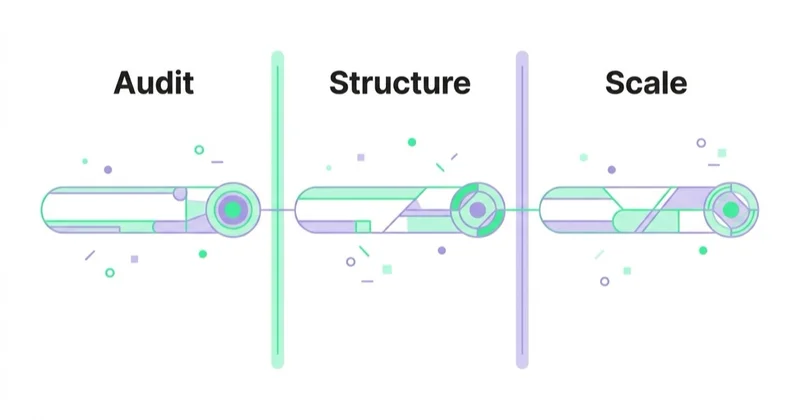
Paid acquisition and store performance are then reviewed under one plan. We establish the baseline for non-paid discovery, store conversion by market or product page, campaign overlap and post-install quality by cohort. App Store product page optimisation and Google Play store-listing experiments can test creative changes, but conclusions should wait for enough data rather than follow a short-term conversion-rate movement.
The result is a decision framework, not a promise of perfect attribution. More spend is justified when the store can convert the additional demand, post-install behaviour supports the target economics and the available evidence is mature enough for the decision. When those conditions are missing, the next action may be an instrumentation, product-page, onboarding or monetisation fix rather than a larger campaign.
FAQ
What does an app marketing agency do? It connects four areas: store presence and optimisation, paid acquisition through Apple Ads, Google App campaigns, social or in-app networks, attribution infrastructure and retention economics. One agency may execute all four or coordinate with product, analytics and lifecycle teams. What matters is explicit scope and accountability for each layer.
How is an app marketing agency different from a PPC agency? Mainly in measurement and operating context. App acquisition involves store handoffs, first opens, deep links, app events, platform-specific privacy frameworks and delayed cohort value. A mobile measurement partner may be part of the architecture, but native platform, GA4 and server-to-server measurement can also contribute.
How should an app marketing agency be judged? On the business event the app needs: activation, retained or paying users, cohort contribution and payback. Store conversion and retention by source help explain the result. Installs and CPI remain useful operating metrics, but low CPI is not a success if downstream quality or incrementality fails.
Should ASO and paid acquisition be handled by the same agency? They should sit under one measurement and testing plan even if different people execute them. Paid media changes the mix of visitors reaching the store, while product-page changes affect the conversion of paid and non-paid traffic. Coordinated reporting helps identify overlap and test incrementality without assuming every paid install replaced an organic one.
How much does app marketing cost? It depends on the app category, the markets and whether ASO, paid and retention are all in scope. More useful than a headline figure is the model: percentage-of-spend biases toward more spend, performance-on-installs optimises toward the misleading metric, and a fixed retainer is neutral across activities that are not equally billable.
How long before an app marketing agency shows results? Store and paid tests can begin collecting signals quickly, but a reliable conclusion depends on traffic, effect size, review timing and cohort maturity. Apple's product-page optimisation reports confidence as evidence accumulates, and tests can remain inconclusive at low volume. Paid value is readable only after the selected activation, retention or payback horizon has matured; iOS privacy-preserving postbacks add their own delay.
What are the warning signs? Reporting built only around installs and CPI; claims of complete iOS visibility without naming the data source; no view on activation or retention; ASO and paid treated as unrelated projects; no method for setting cohort guardrails; and an arrangement where the client lacks administrative access, export rights or continuity for store, measurement and campaign accounts.
Key takeaways
- App marketing spans store presence, paid acquisition, attribution and retention — assess all four.
- Measurement competence is the real differentiator, because app attribution is unlike web attribution.
- Agree metrics and evaluation windows in writing before spend, including cohort maturity.
- Judge on activation, retained or paying users and cohort value; use CPI as a diagnostic rather than the final verdict.
- Keep ASO and paid under one measurement plan so store conversion, media mix and incrementality can be interpreted together.
- App type changes the assignment — games, subscription, commerce and ad-monetised apps differ fundamentally.
- Retain ownership of the measurement platform, store console and campaign accounts.
How we run paid acquisition and its measurement across channels is on our performance marketing page.
Sources and further reading
- About App campaigns — Google Ads Help
- Set up conversion tracking for App campaigns — Google Ads Help
- Ads on the App Store — Apple Ads
- AdAttributionKit postback windows — Apple Developer
- Product Page Optimization analytics — Apple Developer
- Google Play store-listing performance metrics — Play Console Help
- How to promote an app: the launch sequence
- How to choose a mobile measurement partner
- How to choose a performance marketing agency
Continue reading
ChatGPT Ad Formats and Character Limits: What Actually Fits
A ChatGPT ad appears below the response and carries six elements, with specific limits: title 3–50 characters, body up to 100. The "24 / 48 character" figures in trade coverage do not match the documentation, so this guide gives the full limits table, shows how to fit a useful message, and covers the image, product ads and end-to-end consistency with the landing page.
OpenAI Ads Manager: How to Set Up Your First ChatGPT Ads Campaign
OpenAI Ads Manager has three campaign levels, but launch also requires advertiser verification, billing, landing-page checks, measurement and deliberate choices for settings that cannot be changed later. This guide covers the setup sequence, budgets, context hints, oCPC, targeting, review and Ads API workflows.
Switching Marketing Agencies Without Losing the Account
A safe agency switch protects client-owned accounts, billing, conversion signals, creative rights and operating knowledge. Use this transition plan to assign responsibility, validate access and change partners without avoidable disruption.