A lead magnet is a resource or experience offered to a defined audience, often in return for contact information or another permissioned next step. It might be a checklist, benchmark, calculator, template, webinar or product sample. It can support lead capture, but that is not its only possible job: some resources educate existing demand, reveal a use case or help a buyer complete part of an evaluation.
The title's "freebie-seekers" is convenient shorthand, not a useful way to judge people. Someone researching a problem may be early in a legitimate buying process, while a person requesting a demo may still be a poor fit. The real issue is whether the resource attracts the intended audience, delivers the promised value and leads to a proportionate next action.
This guide shows how to design that system without treating the download itself as success.
TL;DR
- Give the resource one primary job: education, self-assessment, planning, evaluation, activation or lead capture.
- Define the audience, problem, promised output and logical next step before choosing a format.
- A lead magnet should create stand-alone value. A long sales brochure hidden behind a form breaks the exchange.
- Specificity can help the right person recognise relevance, but narrow language alone does not prove qualification.
- Collect only data that has a defined purpose. More form fields add friction; they do not manufacture buying intent.
- State what the person will receive and what follow-up to expect. Delivery does not automatically justify unrelated marketing.
- Measure reach, delivery and use alongside accepted leads, opportunities, customers and value, using comparable cohorts and suitable time windows.
What is a lead magnet?
A lead magnet gives a person a clear reason to take a measurable step: submit a form, register, start a tool, request a sample or provide permission for a defined follow-up. Some are gated behind contact details; others are ungated and use a contextual call to action after delivering value.
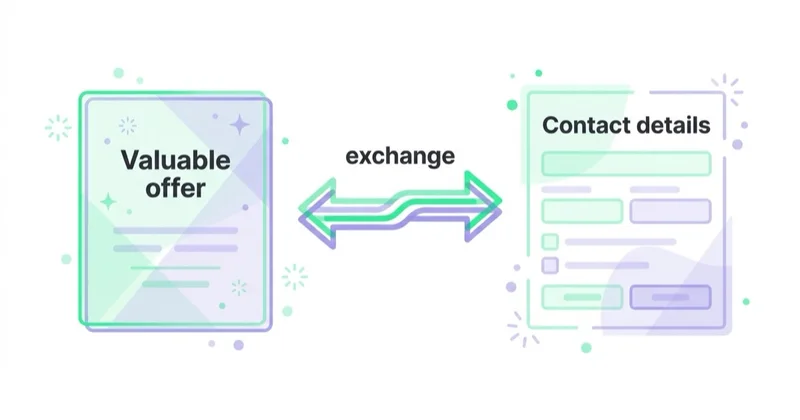
Gating is a strategic choice, not part of the definition. An ungated guide can earn reach, links and trust. A gated calculator may need an email to save a result. A webinar needs registration for attendance logistics. Ask whether collecting data improves the user experience or only improves the campaign's lead count.
It also helps to separate educational resources from direct sales offers:
- a benchmark report or template primarily delivers information or utility;
- a quote, consultation or demo is primarily a request to engage with sales;
- a free trial or sample is a product experience;
- an assessment can sit between categories depending on whether it provides a substantive result.
All can generate leads, but they imply different intent and require different measurement.
Start with the job the resource must do
Complete this one-sentence brief before production:
For [defined audience] dealing with [specific situation], this [resource] helps them [complete a useful task or make a decision] by providing [concrete output], after which the appropriate next step is [action or no immediate action].
That statement forces five useful decisions:
- Audience: who can use the resource, not merely who could click the ad.
- Situation: the moment or problem in which it becomes relevant.
- Utility: the work it helps the person complete.
- Output: what they actually receive, calculate or understand.
- Next step: the natural continuation, if one exists.
If the next step is unrelated to the resource, the sequence will feel like a pretext for collecting contact details.
Choose a format from the buyer's task
There is no universally best format. Choose the smallest format that can deliver the promised result credibly.
| Buyer task | Suitable formats | Evidence of value |
|---|---|---|
| Diagnose a current state | Self-assessment, audit worksheet, diagnostic tool | Clear criteria, result and limitations |
| Plan a project | Checklist, timeline, brief template, requirements matrix | Editable structure and realistic dependencies |
| Estimate an outcome | Calculator, estimator, scenario model | Transparent assumptions and sensitivity ranges |
| Compare options | Decision guide, scorecard, specification sheet | Balanced criteria and disclosed methodology |
| Learn a process | Guide, workshop, course, annotated example | Actionable sequence, examples and sources |
| Benchmark performance | Research report, benchmark tool | Sample, definitions, date and methodology |
| Experience a product | Trial, sample, sandbox, interactive demo | Representative experience and clear restrictions |
A PDF is appropriate when the content benefits from a fixed, downloadable format. It is not the default answer. A web tool may be easier to update and use; a template may produce more value than a long ebook; an email course may suit a staged learning task.
What makes the offer credible and useful
Relevance
Use the audience's real context: decision, constraint, system, role or service type. "A budget scenario model for multi-location retailers" communicates more relevance than "The ultimate growth guide." Avoid artificial specificity that changes only the headline while the content remains generic.
A concrete output
Tell the person what they will have after using the resource: a prioritised checklist, editable brief, estimated range or comparison matrix. "Learn more" is not an output.
Stand-alone value
The resource should fulfil the central promise without requiring a sales call to reveal the answer. It can show when expert help is useful, but withholding the result behind a second conversion damages trust.
Evidence and boundaries
Explain who created the material, which sources or data support it, what assumptions it uses and where it does not apply. For calculators, expose important inputs and avoid presenting an estimate as a quote or guarantee. For benchmarks, state the sample, period and metric definitions.
Proportionate effort
Not every resource must deliver a result in minutes. A procurement template or technical workshop can demand more effort if the outcome justifies it. Set the expectation accurately: reading time, required inputs, session length and any software needed.
Continuity
The next step should follow from the work already completed. A person who used a calculator might save assumptions, request a reviewed scenario or explore the relevant service. Someone who downloaded an introductory guide may need more education rather than an immediate sales call.
Map the resource to the decision stage
Decision stage is not a reliable label on its own, but it helps prevent mismatched calls to action.
| Situation | Resource role | Sensible next step |
|---|---|---|
| Problem is being explored | Explain causes, definitions and decision criteria | Related education or preference-based updates |
| Requirements are being formed | Template, brief or assessment | Save result, compare approaches or request review |
| Options are being compared | Scorecard, case evidence or estimator | Product detail, trial, demonstration or consultation |
| Provider is being selected | Scope checklist, quote inputs or implementation plan | Qualified conversation or proposal request |
| Product is being adopted | Sample, sandbox, checklist or onboarding tool | Activation milestone or appropriate assistance |
A content download is not proof of purchase readiness, and a direct sales request is not proof of fit. Use behaviour as context, then validate the lead against an agreed definition.
How to build the lead magnet step by step
1. Use first-party questions to find the topic
Review sales questions, search terms, site search, customer-support themes, onboarding friction and lost-deal reasons. Look for a recurring task the organisation is genuinely qualified to help with. Validate the language through customer or prospect conversations where possible.
Do not select a topic only because it has high search volume. The resource must connect to an audience the organisation can serve and to an area in which it can demonstrate credible knowledge.
2. Write the promise and exclusions
Define the output, inputs, time required and important limitations. If it is a sample, state the quantity and eligibility. If it is a template, show the file type. If it is a live workshop, provide the date, duration, presenter and whether a recording will be available.
3. Produce the useful core first
Create the calculator logic, template, research or lesson before writing the landing page. Test whether a person can achieve the promised result without additional explanation. Add examples, definitions, sources, version information and accessibility features appropriate to the format.
4. Design the landing experience
The page should answer:
- who the resource is for;
- which problem it addresses;
- exactly what it includes;
- who created it and why their expertise is relevant;
- what information is requested and what happens after submission;
- whether a sales or marketing follow-up will occur;
- how personal data is used.
Show enough substance to support the decision. A vague page should not rely on curiosity to hide a weak asset. A conversion-focused landing page should make the exchange clearer, not more coercive.
5. Design the form from purpose
For each field, write down why it is needed now. Delivery may require an email address; routing may require country; an estimator may require project variables. A phone number is not necessary simply because sales prefers calling.
More questions can help routing or disqualify ineligible requests, but they do not create intent. They also introduce abandonment, inaccurate self-reporting and more personal data to protect. Use optional fields, progressive collection or a later qualification step where appropriate.
Google Ads lead forms require at least one contact field and a privacy-policy link, and support custom or qualifying questions in eligible setups. LinkedIn prohibits requesting sensitive data through Lead Gen Forms and assigns retention periods by lead type. Platform capability is not proof that a field is necessary for your purpose.
6. Deliver immediately and reliably
Use a clear confirmation page and a delivery method that works on mobile and desktop. Test spam filtering, expired links, file permissions, CRM delivery and duplicate submissions. Provide a support route for someone who does not receive the resource.
The confirmation can offer a next step, but do not make the promised asset difficult to find in order to force another action.
7. Create follow-up that matches the permission
Separate delivery or event reminders from promotional follow-up. Explain who will contact the person, through which channel and for what purpose. The legal basis and consent requirements depend on jurisdiction, recipient and message type; a download does not automatically authorise every form of marketing.
Use the resource context in follow-up. Ask whether it helped, provide a relevant example or offer an optional next step. Suppress people who opt out, route active requests appropriately and avoid treating every download as an instruction to call immediately.
Where to promote a lead magnet
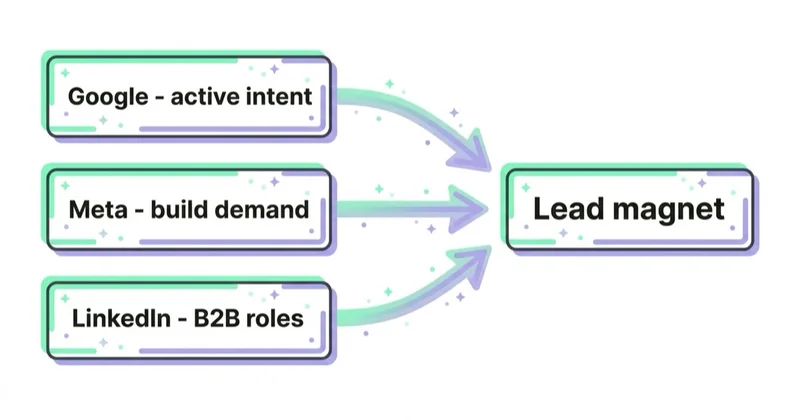
Choose distribution from where the audience encounters the problem and what the format requires:
- Relevant website pages: place the resource beside the problem it helps solve rather than showing it indiscriminately across the site.
- Organic search: publish enough useful, crawlable information to match the search intent; decide whether the full asset needs a gate.
- Google Ads: a website form gives control over context and experience, while eligible Google-hosted lead forms reduce steps and require a privacy-policy link.
- Meta lead ads: instant forms can reduce mobile friction; website forms can provide more detail or support actions such as booking or complex quotes. Meta also supports returning CRM outcomes for eligible conversion-lead optimisation.
- LinkedIn: Lead Gen Forms can use member-provided profile information, which can reduce typing, but the advertiser still needs relevant questions, access controls and timely export or integration.
- Email, communities, partners and events: distribute only where the audience and permissions fit. A partner's reach does not automatically authorise sharing lead data.
The channel does not permanently determine intent. A high-value buyer can discover a report on social media, and a low-fit visitor can submit a Search form. Test the offer and conversion experience within each channel.
Native lead form or landing page?
Native platform forms and website pages offer different trade-offs:
| Consideration | Native form | Website landing page |
|---|---|---|
| Friction | Often lower through pre-filled fields and fewer transitions | Depends on page speed, form and device experience |
| Context | Limited space and layout | More room for evidence, examples and complex explanations |
| Data delivery | Requires platform download, notification, API or integration | Controlled by the site's form and systems |
| Measurement | Platform submission is directly visible | Supports broader on-site behaviour and testing |
| Control | Constrained by platform fields, policies and retention | Greater design control with greater security and maintenance responsibility |
Do not decide from cost per form alone. Compare valid delivery, accepted-lead rate, downstream value and data-handling requirements. Meta explicitly distinguishes retrieval into a CRM from sending later conversion outcomes back through Conversions API; one does not automatically enable the other.
Privacy and data governance
The form is a data-collection interface, not merely a conversion element. Applicable rules vary, but sound practice includes:
- identify the purpose and lawful basis for each use;
- collect information that is adequate, relevant and limited to what is necessary;
- provide clear privacy information at the point of collection;
- distinguish resource delivery from direct marketing choices;
- state relevant retention, sharing and rights information;
- restrict access and remove it when roles change;
- transfer platform leads into the system of record before platform retention expires where appropriate;
- delete data that is no longer needed;
- avoid sensitive information unless a properly assessed process genuinely requires it.
The UK ICO's data-minimisation guidance describes the standard clearly: data should be sufficient for the stated purpose, rationally connected to it and no more than necessary. Its lead-generation guidance also requires transparent information about direct-marketing use and relevant rights. Apply the law for every market in which data is collected.
How to measure a lead magnet
Build a measurement chain rather than declaring downloads either a success or a vanity metric:
| Level | Measures | Interpretation |
|---|---|---|
| Reach | Qualified page views, ad reach, search visibility | Did the intended audience encounter the offer? |
| Conversion | Form starts, completion rate, cost per opt-in | Did the exchange feel relevant and proportionate? |
| Delivery and use | Successful delivery, attendance, tool completion, activation | Did people receive and use the promised value? |
| Fit and response | Valid rate, accepted-lead rate, stated need, replies | Did the resource reach people the business can help? |
| Commercial progression | Meetings, opportunities, purchases, revenue | Did the cohort progress within a suitable time window? |
| Economics | Cost per accepted lead, acquisition cost, contribution, payback | Was the programme economically worthwhile? |
Some formats have meaningful use signals; others do not. Do not install invasive tracking merely to prove that a PDF was read. Use proportionate evidence such as webinar attendance, calculator completion, a saved result, reply or next-step action.
Compare cohorts at the same stage and cost scope. Include production, media, platform, technology and follow-up costs where relevant. Allow for the sales cycle: an early-stage report may influence a later opportunity without receiving full attribution, while last-click reporting may over-credit the final touch.
Test the system, not only the headline
Prioritise tests around important uncertainties:
- Is the problem relevant to the intended audience?
- Does the format deliver enough utility?
- Is gating necessary, and at which point?
- Which fields improve routing enough to justify their cost and data burden?
- Which next step matches the person's stage?
- Can downstream outcomes return to campaign reporting reliably?
Keep offer, audience and measurement definitions stable when testing a page detail. If the resource, targeting, form and follow-up all change at once, the result cannot explain what worked. Use sufficient sample sizes and report uncertainty rather than promoting an early fluctuation as a win.
Common mistakes
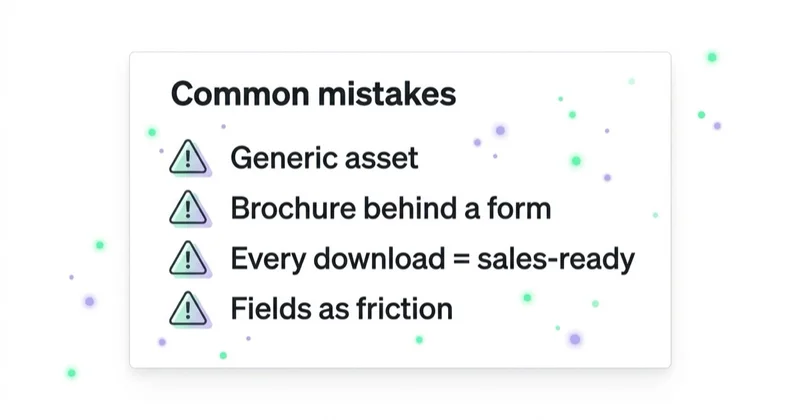
- Creating a generic asset and adding an industry name only to the headline.
- Hiding a sales brochure behind a form and calling it a resource.
- Treating every content interaction as sales-ready intent.
- Using extra fields as friction without a routing or decision purpose.
- Requiring a phone number for a resource delivered by email without explaining why.
- Failing to test delivery, integrations, permissions and mobile use.
- Adding people to unrelated nurture without appropriate transparency or permission.
- Optimising campaigns to submissions when accepted outcomes are available and reliable.
- Ignoring production and follow-up cost when calculating return.
- Keeping an outdated benchmark, legal checklist or template live without version control.
Where Space Ads fits
A lead magnet can support a lead generation programme, but its role depends on the audience, offer and sales process. Space Ads can align campaign strategy with an appropriate conversion path; content production, research, landing-page development, CRM integration and automation should be confirmed in the scope of the individual engagement.
Common questions
What is the best lead magnet format?
There is no universal winner. Choose the smallest format that credibly helps the intended audience complete a relevant task. A template may suit planning, a calculator may suit scenarios and a workshop may suit a process that needs demonstration.
Should a lead magnet be gated?
Only when collecting information serves a clear purpose and the exchange is proportionate. Ungated resources can maximise access and organic reach. Partial or delayed gates can let people assess value first. Registration is reasonable when needed for delivery, attendance or saved results.
How many form fields should it have?
Use the minimum information needed for delivery and the declared next action. Add a field only when it improves routing, eligibility, personalisation or measurement enough to justify friction and data processing. Test the effect on both completion and downstream quality.
Does a content download make someone an MQL?
Not by itself. It is one engagement signal. Combine it with agreed fit, need and readiness criteria, or keep the person in an educational path until stronger evidence appears.
How can lead magnet quality be measured?
Assess whether the asset delivers its promised utility, reaches the intended audience and contributes to an appropriate next step. Depending on the goal, use delivery, attendance, completion, accepted leads, opportunities, customers and economic value — not downloads in isolation.
Sources
- Google Ads Help — Create lead form assets
- Google Ads Help — Lead form requirements
- Meta for Business — Lead ads with instant and website forms
- LinkedIn Marketing Solutions Help — Data collection and retention for Lead Gen Forms
- UK Information Commissioner's Office — Collect information and generate leads
- UK Information Commissioner's Office — Data minimisation
Continue learning
- Facebook lead ads: what they are and how to launch instant forms
- Lead form ads without the junk leads: Facebook, Instagram, LinkedIn
- High-converting landing page design best practices
- Lead nurturing: convert more leads without increasing ad budget
- B2B lead generation: a predictable pipeline from paid media and SEO
Continue reading
How to Choose a Lead Generation Agency (Questions to Ask, Red Flags)
A practical framework for comparing lead generation agencies: scope, measurement, pricing, account ownership, security, contracts and the questions worth asking before you sign.
Cost Per Lead (CPL): Benchmarks, What's 'Good', and How to Set Your Target
CPL is easy to calculate and easy to misuse. Learn how to compare valid benchmarks, separate media CPL from fully loaded CPQL, and derive an affordable target from your own unit economics.
Speed to Lead: Why Response Time Decides Who Wins the Deal
Learn how to measure and improve lead response time without sacrificing quality: define the right timestamps, set channel-specific targets, fix routing and coverage, and validate the impact on sales outcomes.