
Marketing due diligence examines whether the commercial growth case is supported by reproducible evidence. The questions depend on the transaction thesis, but they commonly cover market demand, customer and revenue concentration, cohort economics, retention, acquisition capacity, brand and channel dependencies, data quality, contracts, compliance and the people required to operate the system. The findings inform forecasts, integration plans, risk allocation and potentially valuation or deal terms; they do not produce one universal “quality of growth” score.

This is an operating guide, not investment, accounting or legal advice. Transaction scope and materiality should be agreed with the buyer's advisers and the relevant specialists.
TL;DR
- Start with the deal thesis. A buyer seeking international expansion asks different marketing questions from one underwriting operational efficiency.
- Reproduce the core claims. CAC, payback, retention, pipeline and cohort value need definitions, source data, assumptions and a reconciliation to finance.
- Treat concentration as an exposure to model. A dominant channel is not automatically bad; quantify what happens if cost, access, reach or conversion changes.
- Paid and organic are not synonyms for fragile and durable. Test incremental demand, contribution, customer quality and dependencies in both.
- Separate averages from marginal economics. Historical blended ROAS does not show what the next unit of budget can produce.
- Prepare a controlled data room. Use an index, data dictionary, version history, access rules and a log of limitations and manual adjustments.
- Disclose issues with a remediation plan. Findings can affect forecasts, covenants, indemnities, earn-outs, integration priorities or price depending on materiality.
Why marketing due diligence moves valuations
Transaction valuation reflects expected cash flows, risk and the specific deal structure. Marketing diligence contributes by testing assumptions that sit behind the forecast: addressable demand, acquisition cost, conversion, capacity, retention, pricing and the investment required to sustain growth. It is one workstream alongside financial, commercial, legal, tax, technology and operational diligence.
A buyer will typically challenge both the base case and the upside case. How much recent growth came from price, volume, acquisitions, promotions or channel mix? Do new cohorts retain and contribute like earlier cohorts? Is the sales pipeline independently defined and stage history preserved? What happens if media costs rise, a platform changes access, a distributor leaves or a key operator departs? The objective is to quantify those sensitivities, not to classify the company with a slogan.
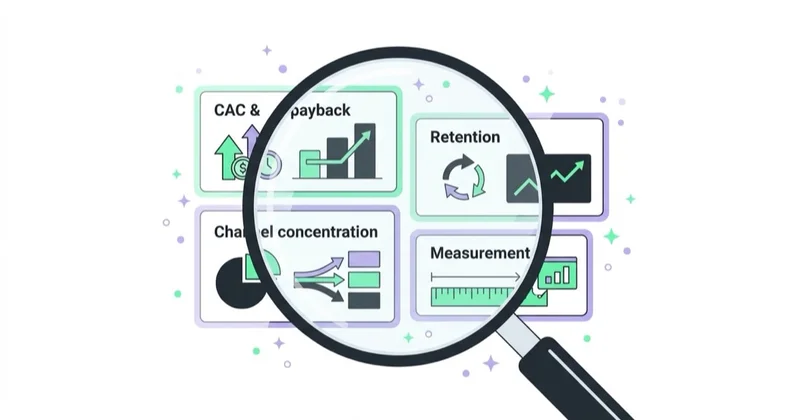
For management, preparation reduces avoidable uncertainty. A clearly defined limitation with an owner and remediation plan is easier to assess than a headline metric that changes during diligence. Early preparation also gives the team time to correct permissions, preserve source data, reconcile definitions and distinguish a real commercial issue from a reporting defect.
What buyers actually check
| Area | What they look for | Red flag |
|---|---|---|
| Unit economics | Cohort contribution, acquisition cost, payback and sensitivity by segment | Blended averages, omitted costs or value projected before it is observed |
| Customer and channel concentration | Exposure, switching costs, mitigations and contractual dependencies | One dependency can impair a material share of forecast cash flow |
| Demand composition | Incremental role and economics of paid, organic, partner, referral and sales-led demand | Channel labels used as proof of causality or durability |
| Retention and expansion | Cohort definitions, churn, repeat, returns, downgrades and expansion | Changing denominators or recent cohorts treated as mature |
| Brand and market | Awareness, consideration, search demand, pricing and competitive evidence | Brand claims based on traffic or attributed conversions alone |
| Measurement and controls | Source lineage, access, definition history, reconciliation and quality checks | Metrics cannot be regenerated from source systems |
| Team and operating model | Responsibilities, capacity, incentives, agencies, vendors and transition risk | Undocumented knowledge or critical access held by one person |
The materiality of each line depends on the transaction. A concentrated channel can be acceptable if its economics, contract, access and contingency plan are strong. A broad channel mix can still destroy value if none of the channels is incremental or profitable. The diligence report should state the evidence, limitation, sensitivity and mitigation rather than assign automatic rewards or penalties.
CAC, payback and the efficiency trend
Acquisition efficiency should be analysed by customer cohort, product, geography and channel where sample size permits. Define the numerator and denominator before showing the trend: which sales and marketing costs are included, how new customers are identified, how refunds and incentives are treated, and whether payback uses revenue, gross profit or contribution. Do not compare cohorts using different cost scopes or maturity windows.
The trajectory matters, but a fixed number of quarters is not universally appropriate. Normalise for seasonality, product launches, channel mix, price changes, sales-cycle length and cohort maturity. Show both reported and restated series when definitions changed, with a bridge explaining the effect. The CAC and payback discipline is valuable because it makes assumptions visible, not because one benchmark proves scalability.
Channel concentration and platform risk
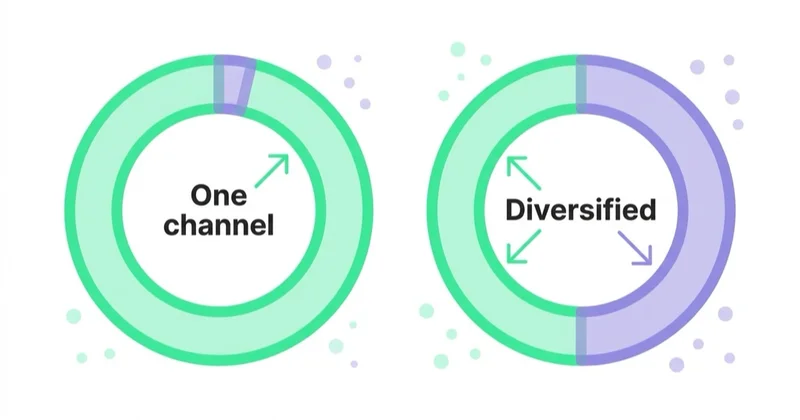
Concentration analysis starts with a denominator and period: share of new customers, contribution, pipeline or revenue by channel, partner, geography and customer segment. Then model plausible shocks — loss of access, higher media costs, reduced ranking, contract termination or lower conversion — and the time and investment required to replace the affected volume.
Avoid the “owned versus rented growth” shortcut. Organic traffic depends on search platforms, content, technical maintenance and historic investment; paid acquisition can be predictable, profitable and difficult for competitors to replicate. Analyse contribution, incrementality, customer quality, platform or partner dependency, and recovery time across all routes to market. If spend has changed historically, use those periods cautiously as evidence; otherwise use experiments or scenario ranges rather than claim to know what happens when paid media stops.
Retention, brand and measurement
Retention determines how acquisition turns into future cash flow, but definitions vary. Subscription businesses should reconcile logo and revenue retention, downgrades, expansion and reactivation. Ecommerce businesses should show repeat purchase, returns and contribution by acquisition cohort. Marketplaces may need buyer and seller retention. Recent cohorts should not be projected as mature without an explicit model and sensitivity.
Brand evidence may include research, pricing, direct and branded demand, repeat behaviour and controlled tests, but none is sufficient alone. Underpinning the analysis is measurement reliability. The SEC's guidance for public-company KPIs is a useful discipline even outside public reporting: define how a metric is calculated, explain material assumptions and changes, and maintain appropriate disclosure controls. The limits of attribution and a reconcilable reporting picture should be explicit.
Glossary
- Marketing due diligence — a buyer's assessment of a target's growth engine before acquisition.
- Channel concentration — the share of a defined commercial outcome dependent on a channel, platform or partner.
- Demand composition — the contribution of paid, organic, partner, referral and sales-led routes, including overlap and dependencies.
- CAC-by-cohort — acquisition cost tracked by customer cohort over time, showing the efficiency trend.
- Quality of growth — a transaction-specific assessment of the sources, economics, recurrence, risk and cash-flow implications of growth.
- Key-person dependency — growth reliant on an individual who may leave after the deal.
How to prepare (and protect valuation)
For a founder heading toward a raise or exit, marketing due diligence is not something to face cold — problems found by the buyer become price reductions, while the same facts disclosed and managed upfront protect the valuation. Preparation means:
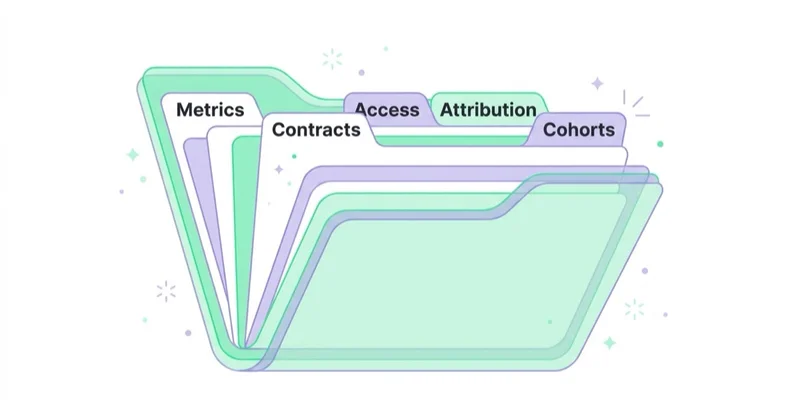
- Freeze metric definitions and restate changes so historical trends can be reproduced.
- Reconcile marketing outputs to CRM, product and finance, including timing and known exclusions.
- Model concentration and marginal economics instead of forcing diversification shortly before a process.
- Prepare retention and contribution cohorts at the level relevant to the business model.
- Inventory accounts, contracts, data roles and key-person dependencies, then test access and transition steps.
- Document limitations and remediation rather than hiding gaps or creating precision the data cannot support.
Do not manufacture short-term improvements for the process. Cutting necessary brand activity, changing qualification rules or shifting costs out of the CAC definition may improve a headline while weakening the underlying case. Consistency, a transparent bridge and defensible assumptions are more useful than an artificially smooth chart.
Build a reproducible marketing data room
The data room should let authorised reviewers reproduce the main claims. Include monthly spend by channel, CRM or product exports, cohort revenue and contribution, new-versus-existing customer logic, CAC definitions, retention, sales-stage history, attribution settings, experiment results and a reconciliation to finance. Provide a data dictionary, extraction date, version, owner and note every manual adjustment.
Access and control need their own register: ad accounts, analytics, domains, tag management, CRM, creative source files, consent records and critical vendors. List administrators, payment relationships, contracts, renewal dates, data-processing roles, sub-processors and offboarding rights. Apply least-privilege access, staged disclosure and retention rules; a data room is not permission to upload unnecessary personal data or unrestricted credentials.
Prepare a growth bridge that separates price, volume, acquisition, retention, expansion, FX, acquisitions and one-off effects where relevant. Tie each component to source evidence and state whether it is observed, estimated or management judgement. The UK government's investment-readiness guidance similarly recommends a clearly indexed, current data room spanning financial, legal, commercial, regulatory and technical materials.
How Space Ads approaches marketing due diligence
Our role in a transaction-readiness project is to make the commercial claims testable. We define the questions and materiality with management and advisers, reconstruct metric history from source systems, reconcile marketing to CRM and finance, and document where the available evidence stops.
The output is a versioned evidence pack: definitions, cohort economics, demand composition, concentration sensitivities, experiments, access and vendor registers, limitations and remediation owners. We do not replace financial, commercial, legal or tax diligence. We make the marketing workstream reproducible and connected to the operating plan. That is consistent with disciplined performance marketing; a fractional CMO can own internal readiness, while web analytics supports the source lineage and controls.
Stop doing / Do instead
| Stop doing | Do instead |
|---|---|
| Calling a channel concentrated without a denominator | Quantify exposure, sensitivity, replacement time and mitigation |
| Comparing CAC with changing cost scopes | Freeze the definition and restate or bridge changes |
| Labelling paid as fragile and organic as durable | Test contribution, incrementality and dependencies in both |
| Showing immature cohorts as completed value | Separate observed results from projections and sensitivities |
| Uploading dashboards without source lineage | Provide definitions, extracts, reconciliation and adjustment logs |
| Waiting for the request list | Build a controlled, indexed and versioned evidence pack early |
FAQ
What is marketing due diligence?
Marketing due diligence tests the commercial assumptions behind a transaction. Depending on the deal thesis, it can examine market demand, customer and channel concentration, cohort economics, retention, pricing, acquisition capacity, brand, contracts, compliance, team dependencies and the reliability of data supporting the forecast.
What do buyers check in marketing due diligence?
Buyers prioritise issues material to their investment case. Common checks include definitions and trends in CAC and payback, marginal economics, customer and channel concentration, retention cohorts, demand composition, pricing, pipeline quality, data and account controls, contracts, compliance and the team's ability to operate after the transaction.
Why does marketing due diligence affect valuation?
Because marketing assumptions influence forecast cash flows, investment requirements and risk. Findings can change the forecast, integration plan, conditions, representations, indemnities, earn-out structure or price, but the outcome depends on materiality, evidence, competition for the asset and the wider deal.
What are the red flags in marketing due diligence?
Examples include metrics that cannot be regenerated, changing cohort definitions, omitted acquisition costs, immature value projections, unexplained differences between CRM and finance, undocumented administrator access, material channel or customer exposure with no contingency, and forecasts that rely on attribution rather than incremental evidence.
How do you prepare for marketing due diligence?
Start early. Freeze definitions, preserve source extracts, reconcile commercial data to finance, prepare mature cohort views, quantify concentration and sensitivities, inventory access and contracts, document manual adjustments and assign remediation owners. Use a controlled data room and disclose limitations instead of inventing precision.
Is marketing due diligence only for large deals?
No. The scope should be proportionate to the company, transaction and investment thesis, but smaller acquisitions and growth investments can still depend heavily on customer economics, pipeline and platform access. A concise, reproducible evidence pack is useful even when there is no large formal diligence team.
Key takeaways
- Marketing due diligence tests the commercial assumptions relevant to a specific transaction thesis.
- Core claims should be reproducible from defined source data and reconciled to CRM, product and finance.
- Concentration, paid media and organic demand are exposures to analyse, not automatic evidence of weak or strong growth.
- Separate observed cohort results from forecasts, attribution from incrementality and historical averages from marginal economics.
- A controlled data room, transparent limitations and owned remediation reduce avoidable uncertainty.
Sources
- US Securities and Exchange Commission — Guidance on key performance indicators and metrics
- IFRS Foundation — Management Commentary supporting material
- GOV.UK — Data room essentials and documents checklist
Continue learning
- Customer acquisition cost benchmarks by industry
- Marketing attribution for executives
- The marketing dashboard growth teams should track across ads, SEO and sales
- Incrementality testing: geo experiments across Meta and Google
- Web analytics that produces reconcilable numbers
- Fractional CMO: building a growth story that survives diligence
Continue reading

Lead Generation for Online Courses and Education Providers
Education lead generation must connect an honest promise with learner fit, enrolment and course starts—not just form volume. Learn how to design the journey, evidence claims and measure each intake.

How to Choose a Performance Marketing Agency
Choose a performance marketing agency with a defined brief, evidence-based scorecard and clear commercial safeguards. This guide covers team evaluation, measurement, account access, fees, contracts and handover.

Website Marketing: How to Actually Drive Revenue From Your Site
A website creates commercial value when it helps the right people complete the right task and gives the business reliable feedback. This guide connects audience journeys, acquisition, experience, measurement and experimentation.


































