“Mobile game advertising” describes two connected markets. A game studio buys ads to acquire or re-engage players, while a game publisher may sell placements inside its own title to monetise play. Many studios participate on both sides.

That connection changes the economics. A player can generate in-app purchase revenue, subscription revenue and advertising revenue, while also creating platform fees, serving costs, live-operations costs and reward-economy effects. A cheap install is not necessarily a valuable player, and a high ad yield is not necessarily healthy if the ad experience reduces retention or purchases.
The right plan therefore joins user acquisition, monetisation, product experience and measurement. This guide explains the formats, supply chain and cohort model needed to make those decisions responsibly.
TL;DR
- Separate creative format from placement format. A playable or video is the ad experience; rewarded, interstitial, app-open and banner describe where and how an ad appears in a publisher app.
- Model player value from all relevant net revenue streams, including in-app purchases and in-app advertising, then subtract variable costs and apply an appropriate payback horizon.
- Judge acquisition on cohort quality — retention, progression, payer behaviour, ad engagement and cumulative contribution — not cost per install alone.
- Rewarded ads need an explicit value exchange. Interstitials should appear at natural breaks and must not disrupt active gameplay or encourage accidental clicks.
- Use a portfolio of channels only when each adds incremental, measurable value. Google, social, app-store media, ad networks and DSPs offer different supply and optimisation controls.
- Apple’s AdAttributionKit and Android attribution mechanisms provide different levels and timing of data. Your event schema and reporting must reconcile network, store, MMP and internal revenue data.
- Creative should represent the real game experience. Misleading gameplay can increase installs while weakening retention, ratings and long-term value.
Acquisition ads and in-game monetisation ads are not the same thing
The same video creative may appear inside a social feed, on YouTube or as an interstitial inside another game. The placement changes the user context and measurement, even when the creative file is identical.
Use this distinction:
| Layer | Examples | Main decision |
|---|---|---|
| Creative format | Video, static image, playable, HTML5, interactive end card | Which promise and game mechanic should the user experience? |
| Placement experience | Rewarded, interstitial, rewarded interstitial, app open, banner, native | When and under what conditions is the ad presented? |
| Buying route | App campaign, social platform, app-store search, ad network, DSP | Which inventory, optimisation and reporting system buys the impression? |
| Publisher monetisation stack | SDK, mediation, bidding, waterfall, ad server | How does the game allocate its own ad inventory and protect the player experience? |
Confusing these layers leads to weak briefs. “We need rewarded video” may mean the advertiser wants video inventory in rewarded placements, or that the publisher wants to add an opt-in monetisation mechanic. Those are different projects.
Mobile game creative formats
Video
Video can communicate the core loop, progression, characters and emotional payoff quickly. Produce for the likely viewing environment: strong first frames, understandable action without sound, legible UI and safe placement of captions and calls to action.
Do not evaluate video only by click-through or install rate. A concept that attracts broad curiosity may produce a weaker retained cohort than a more specific concept with a higher CPI.
Playable ads
A playable lets the user interact with a simplified mechanic before installing. It can qualify interest effectively when the experience reflects the actual game, loads quickly and leads clearly to the store.
A playable is not automatically “better” than video and should not be labelled the strongest predictor of retention without title-specific evidence. It may cost more to produce, have limited support across channels, and optimise toward people who enjoy the demo rather than the full progression system.
Test playables against video on incremental retained value, not creative format preference. Record:
- playable start and completion;
- interaction depth;
- click or store-view rate;
- install rate;
- D1, D7 and later retention;
- tutorial completion and progression;
- payer and ad-revenue behaviour;
- contribution after media and production cost.
Static, native and store-led formats
Static images, native units and app-store search ads can capture clear genre or brand intent without simulating gameplay. They are useful when a visual system, character or competitive claim communicates value more efficiently than a video.
Store listing quality remains part of the ad journey. A creative-to-store mismatch can lose the user after the paid click. Align icon, screenshots, preview video, description, rating context and localisation with the campaign’s promise.
Interactive end cards and high-engagement formats
Some networks and platforms can add interactive or immersive elements after a video. Google also offers optional high-engagement formats for eligible App campaigns. Confirm current support, asset rules and reporting because the platform may assemble, crop or modify supplied assets to fit different inventory.
In-game placement formats
Rewarded ads
The player affirmatively chooses to view an ad in exchange for an in-app benefit such as currency, a life or accelerated progress. Google’s rewarded-ad policy requires a clear opt-in, an accurately described in-platform reward and delivery of the promised reward after the required action.
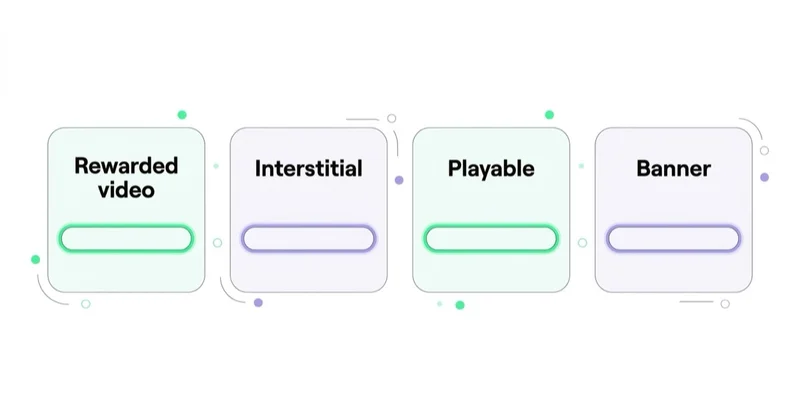
Reward design is a product decision. If the reward is too weak, take-up and ad revenue may be low. If it is too generous, it can distort progression, reduce purchase demand or make the non-ad experience feel deliberately frustrating. Test the effect on session length, retention, purchase conversion and economy inflation — not ad ARPDAU alone.
Rewarded interstitials
A rewarded interstitial appears automatically at a natural transition but must give the player a clear advance explanation and an unobstructed chance to opt out. It is not equivalent to a conventional opt-in rewarded placement. Google currently labels its AdMob rewarded-interstitial unit as beta, so availability and mediation support should be checked before planning around it.
Interstitials
Interstitials occupy the screen at a transition such as the end of a level. Google’s AdMob guidance says they should appear at logical breaks rather than unexpectedly during gameplay, on app exit or repeatedly after individual actions.
Set frequency and eligibility by player state. A new user learning the core loop may be more sensitive than a long-tenure ad-monetised player. Test holdout groups to measure whether short-term revenue is offset by lower retention or purchase value.
App-open ads
App-open ads are designed for loading or return-to-app moments, not arbitrary full-screen interruptions. Google advises integrating them into the loading experience and avoiding immediate conflicts with other ads. They may be unsuitable for a game where every launch is expected to resume time-sensitive play.
Banner and native placements
These formats can occupy persistent or integrated screen space. Their value depends on viewability, placement, device layout and interference with controls. Low revenue per impression can still be commercially useful at scale, but accidental-click risk and lost gameplay space must be included in the decision.
Offerwalls
Offerwalls present rewarded actions, which may include reaching a milestone in another app. They can create substantial volume, but incentive structures change user intent. Evaluate each source against retention, event completion, payer rate, ad behaviour, fraud indicators and incremental contribution. Do not infer quality from CPI alone.
Where the inventory is
Mobile game acquisition can run through several routes:
- Cross-network app campaigns: platforms such as Google combine assets and distribute ads across Search, Google Play, YouTube, Discover and Display inventory, including other apps.
- Social platforms: video, image and automated app campaigns can reach broad audiences and support install or event optimisation.
- App-store advertising: reaches users already searching or browsing in an app marketplace.
- In-app ad networks: aggregate or directly represent inventory in publisher apps, including other games.
- DSPs and programmatic buying: provide access to exchange supply with varying levels of placement and bidding control.
- Cross-promotion: uses a publisher’s own portfolio to move players between titles.
Our separate guide covers mobile game and app user acquisition across Google and Meta. The important point here is not to assume one route is categorically superior. Each source has a different mix of inventory transparency, optimisation events, creative support, attribution, minimum scale and geographic reach.
Ask every network or buying partner:
- Which exchanges, apps and placement types can the campaign use?
- Can app bundle, placement and sub-publisher reporting be exported?
- Are rewarded and non-rewarded impressions identifiable?
- Which optimisation events and attribution frameworks are supported?
- How are invalid traffic, click flooding, device farms and SDK spoofing detected?
- Which inventory is direct, resold or mediated?
- Can low-quality placements be excluded promptly?
- How are privacy consent, child-directed treatment and regional rules handled?
Traffic quality can vary within a platform. Placement-level controls and reporting are valuable where available, but some automated campaigns expose limited supply detail. Compensate with cohort analysis, experiment design and clear stop conditions.
The publisher-side stack: SDKs, mediation and bidding
A game monetising with ads may integrate several demand sources through a mediation layer. The mediator decides which eligible ad source gets an impression, using real-time bidding, a configured waterfall or a hybrid of both.
Revenue optimisation must be constrained by player experience and operational risk. Adding another SDK can increase demand, but also adds app size, consent dependencies, release QA, crash or latency risk and data-governance work.
Track at least:
- ad requests, match/fill rate and impressions;
- show rate and latency;
- eCPM and net revenue by country, platform, format and source;
- frequency per daily active user;
- rewarded-ad starts, completions and reward delivery failures;
- crashes and performance changes by app version;
- retention and purchase behaviour by ad-exposure band;
- policy violations and invalid-traffic adjustments.
Optimise the total game contribution, not the mediation dashboard in isolation.
The economics: two revenue lines, one user
A hybrid-monetised title can generate value from:
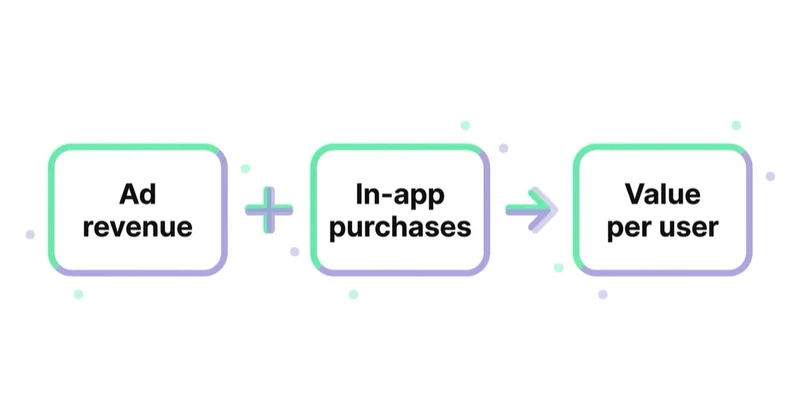
- in-app purchases;
- subscriptions or passes;
- advertising impressions;
- and, where applicable, other licensed or commerce revenue.
The mix varies by title, genre, market and cohort. Do not assume most players or most revenue follow one universal pattern. Build the model from the game’s own ledger and event data.
| Value model | What it includes | Limitation |
|---|---|---|
| Gross IAP ROAS | Purchase revenue divided by media spend | Ignores store fees, refunds, ad revenue and operating cost |
| Ad ROAS | In-app advertising revenue divided by media spend | Ignores purchases and the effect of ads on retention or IAP |
| Combined gross ROAS | Purchase plus advertising revenue divided by spend | Better revenue view, but still not contribution |
| Contribution LTV/CAC | Net cohort revenue less relevant variable costs, compared with acquisition cost | Stronger commercial view; requires finance and product data |
An operating formula is:
Cohort contribution LTV = net IAP + net subscription revenue + net ad revenue − variable serving, reward and live-operations costs
Allowable CAC = contribution LTV at the chosen payback horizon × risk or profit factor
“Net” needs a documented definition. Account for refunds, store commissions or programme terms, taxes where relevant, network adjustments and revenue-share agreements. Keep fully loaded studio overhead separate if the UA team needs a marginal scaling decision, then include it in wider title profitability.
Example
Assume a 10,000-player cohort generates by D90:
- £18,000 net purchase and pass revenue;
- £9,000 net advertising revenue;
- £2,000 in attributable variable cost.
Contribution before acquisition is £25,000, or £2.50 per acquired player. If the business requires a 20% contribution buffer at D90, the illustrative allowable CAC is £2.00. If spend was £17,000, the cohort produced £8,000 after media and variable cost at that checkpoint.
This is not a benchmark. The appropriate horizon and buffer depend on cash flow, retention uncertainty, platform reporting delay and title economics.
Glossary
- Playable ad: an interactive approximation of a game mechanic inside an ad experience.
- Rewarded video: an opt-in video ad exchanged for in-game currency or a benefit.
- Interstitial: a full-screen placement intended for a natural break in content.
- Offerwall: a list of incentivised actions that can grant an in-app reward.
- Mediation: a layer that allocates ad impressions across multiple networks to maximise yield.
- Hybrid monetisation: earning from purchases and advertising within the same title.
- D7 / D30 ROAS: return on ad spend measured at seven or thirty days after install, per cohort.
- ARPDAU: average revenue per daily active user.
- MMP: a mobile measurement partner that consolidates attribution and campaign data from supported sources.
Targets that reflect how revenue arrives
Same-day performance can be useful for delivery and data-quality checks, but it is rarely a complete profitability view. Use install-date cohorts and cumulative checkpoints:
- Define acquisition cohort, market, platform, campaign and creative dimensions.
- Track retention, progression, purchase and ad-revenue signals at consistent D0, D1, D3, D7, D14, D30 and later definitions.
- Build historical curves from early signals to the chosen payback horizon.
- Set early operating thresholds only where those curves are stable enough to support them.
- Recalibrate after material changes to onboarding, economy, monetisation, pricing, creative mix or attribution.
Retention is often a useful leading signal, but its relationship with value is title-specific. A cohort may retain well yet produce low revenue, or monetise early and churn. Use a set of leading indicators rather than treating D1 or D7 retention as a universal proxy.
Recommended decision views include:
- CPI and store conversion rate;
- tutorial and key-progression completion;
- D1/D7/D30 retention;
- payer conversion and purchase ARPU;
- ad-engaged user rate, impressions per user and ad ARPU;
- combined cumulative ROAS;
- contribution LTV/CAC and payback;
- refund, chargeback and invalid-traffic signals.
Creative testing without misleading the player
Creative is an important acquisition lever, but no single lever is always dominant. Product-market fit, onboarding, store conversion, event optimisation, bids, geo mix and monetisation determine whether creative success becomes profitable growth.
Build a concept matrix across:
- core mechanic or mode;
- player motivation, such as mastery, collection, competition or narrative;
- hook and first three seconds;
- difficulty and failure moment;
- character or world;
- proof, progression and reward;
- format, length and orientation;
- market and localisation.
Separate a new concept from minor variations of the same concept. Use naming that connects spend, installs and downstream cohort value to the creative hypothesis.
Most importantly, make the relationship to the real title clear. A stylised demonstration can be legitimate, but invented gameplay, impossible rewards or a misleading difficulty curve may optimise the ad toward users who will not value the installed experience. That damages efficiency beyond the initial CPI.
Our creative testing framework explains how to structure hypotheses and decision rules across paid channels.
Measurement under privacy constraints
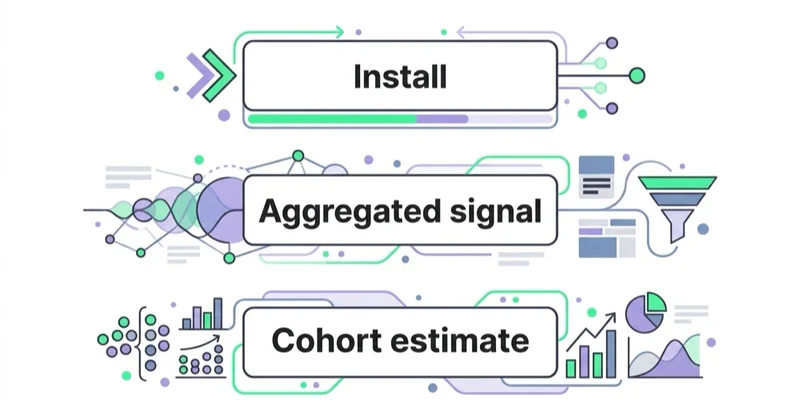
The measurement stack should reconcile four types of evidence:
- platform and network reporting;
- app-store and privacy-preserving attribution;
- MMP reporting where used;
- the game’s own events, revenue ledger and experiment results.
Apple
AdAttributionKit provides signed, privacy-preserving postbacks for eligible installs and re-engagement. Apple documents click-through and view-through attribution windows, delayed postbacks and data availability that can depend on privacy thresholds. It does not provide unrestricted person-level cross-app tracking.
Design conversion values and event priorities around decisions the team actually needs to make. Account for delay and incomplete granularity before setting automated stop rules.
Android
The Google Play Install Referrer API can provide referral information and timestamps for installs through Google Play. Platform, consent and emerging privacy mechanisms still affect what can be measured and joined. Keep implementation versions current and validate referrer, event and revenue ingestion after each material app release.
MMP and internal data
An MMP can simplify partner integrations and reporting, but it is not automatically mandatory and cannot create information that a platform does not disclose. Select one based on supported networks, privacy posture, raw-data access, cost, fraud tooling, deep linking, ad-revenue support and internal engineering capacity.
Use geo experiments, audience holdouts or other appropriate designs to test incrementality where scale and platform controls allow. Our guide to incrementality testing explains the principles.
A practical launch and scale plan
Phase 1: measurement and economics
- Define install, tutorial, progression, purchase and ad events.
- Reconcile store, ad-network and internal revenue.
- Document net revenue and contribution definitions.
- Choose attribution and consent architecture.
- Establish cohort checkpoints and minimum sample rules.
Phase 2: market and creative validation
- Select a limited group of representative markets.
- Test distinct creative concepts, not only cosmetic variants.
- Validate store-listing continuity and app stability.
- Compare cohorts on early quality signals, not CPI alone.
Phase 3: monetisation validation
- Test rewarded placement, reward value and frequency with holdouts.
- Introduce interstitials only at genuine natural breaks.
- Monitor retention, IAP, ad revenue, crashes and reviews together.
- Confirm policy compliance and correct reward delivery.
Phase 4: controlled scale
- Add channels or networks only with a clear incremental role.
- Set source, placement and creative stop rules.
- Update LTV curves as the player mix changes.
- Separate budget expansion tests from product and monetisation changes where possible.
How Space Ads approaches mobile game growth
We start with a measurement question: can the business connect acquisition spend to a consistent cohort view of retention, purchases and advertising revenue? If not, increasing install volume will make the uncertainty larger rather than solve it.
Our working approach is to:
- define net cohort value and payback with finance and product teams;
- audit events, attribution, store listings and privacy configuration;
- map each channel to the inventory and optimisation signals it can actually provide;
- create truthful concepts around the real game and player motivation;
- launch controlled cohorts with documented decision windows;
- return qualified value signals to supported bidding systems;
- evaluate monetisation and acquisition together, including holdouts for ad-experience changes.
Where a specialist SDK, network or game-economy decision falls outside the available evidence, we validate it with the publisher’s technical team and the platform’s current documentation rather than presenting a generic benchmark as a rule.
Common mistakes
| Mistake | Better practice |
|---|---|
| Optimising to CPI after value data is available | Use purchase, ad-revenue and retention-informed cohort outcomes |
| Treating rewarded video as both a creative and placement without distinction | Specify the creative, placement and buying route separately |
| Maximising ad ARPDAU in isolation | Measure effect on retention, purchases and total contribution |
| Assuming a playable guarantees quality | Test downstream value against video and static control concepts |
| Applying one D7 ROAS target to every market | Calibrate curves by platform, market and material cohort differences |
| Trusting network totals without reconciliation | Compare network, attribution, store and internal ledger views |
| Scaling before postbacks and revenue mature | Use defined decision windows and minimum sample thresholds |
| Adding many monetisation SDKs without governance | Weigh incremental demand against latency, privacy, app-size and QA risk |
FAQ
What is mobile game advertising? It includes paid acquisition and re-engagement for a mobile game, plus advertising sold inside games as a monetisation model. The two sides connect through ad networks, SDKs and mediation platforms.
What is a playable ad? A playable is an interactive ad that simulates part of a game mechanic before the store visit or install. Its value should be tested on retained cohort contribution, and the experience should represent the real title honestly.
Why is rewarded video so common in games? It creates an explicit value exchange: the player chooses an ad in return for an in-game benefit. That can align monetisation with player control, but reward size, frequency and placement still need testing because they can affect progression, purchases and retention.
How should mobile game UA be measured? Use install-date cohorts and track retention, progression, purchase revenue, ad revenue and contribution at consistent checkpoints. Reconcile platform, attribution and internal data, then use experiments to test incrementality where feasible.
Should ad revenue be included in LTV? Yes, when the title monetises players through ads. Use net, validated ad revenue at an appropriate cohort level and assess its relationship with purchases and retention. An IAP-only model is incomplete for a hybrid-monetised game.
Do I need networks beyond Google and Meta? Not automatically. Add app-store channels, in-app networks or DSPs when they offer incremental reach, formats, markets or economics that the current mix cannot provide. Test each source against comparable cohort value and data quality.
What is the difference between mediation and an ad network? An ad network provides demand or supply relationships. A mediation layer connects multiple ad sources and decides which eligible demand serves for a publisher impression through bidding, waterfall logic or both.
Key takeaways
- Distinguish creative formats, placement experiences, buying routes and publisher monetisation technology.
- Combine net purchase and ad revenue when modelling a hybrid title’s player value.
- Evaluate cohorts on retention, progression, monetisation and contribution — not installs alone.
- Rewarded and interstitial placements must respect player choice, natural breaks and platform policy.
- Playables should reflect the real game and earn their production cost through downstream value.
- Reconcile Apple, Android, network, MMP and internal data rather than treating one dashboard as complete truth.
- Scale channels and ad load only after controlled tests show incremental contribution.
How we approach paid acquisition and its measurement across channels is on our performance marketing page.
Sources and further reading
- About App campaigns — Google Ads Help
- App campaign formats and asset requirements — Google Ads Help
- Policies for ad units that offer rewards — Google AdMob Help
- Recommended interstitial implementations — Google AdMob Help
- Measuring ad performance with AdAttributionKit — Apple Developer
- Play Install Referrer API — Android Developers
- Gaming Ad Formats Framework — IAB
- Mobile game and app user acquisition
Continue reading
ChatGPT Ad Formats and Character Limits: What Actually Fits
A ChatGPT ad appears below the response and carries six elements, with specific limits: title 3–50 characters, body up to 100. The "24 / 48 character" figures in trade coverage do not match the documentation, so this guide gives the full limits table, shows how to fit a useful message, and covers the image, product ads and end-to-end consistency with the landing page.
OpenAI Ads Manager: How to Set Up Your First ChatGPT Ads Campaign
OpenAI Ads Manager has three campaign levels, but launch also requires advertiser verification, billing, landing-page checks, measurement and deliberate choices for settings that cannot be changed later. This guide covers the setup sequence, budgets, context hints, oCPC, targeting, review and Ads API workflows.

Switching Marketing Agencies Without Losing the Account
A safe agency switch protects client-owned accounts, billing, conversion signals, creative rights and operating knowledge. Use this transition plan to assign responsibility, validate access and change partners without avoidable disruption.