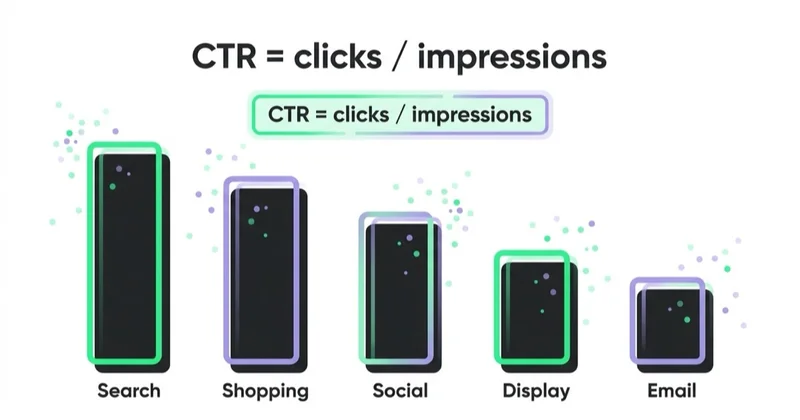
Click-through rate (CTR) is the percentage of eligible impressions that produce the type of click defined by the reporting system:

CTR = clicks ÷ impressions × 100%
If an ad receives 50 clicks from 5,000 impressions, its CTR is 1%. The arithmetic is easy; interpreting the result is not.
A search ad click, a social “click (all)”, a website-bound outbound click, a chargeable LinkedIn click, an organic Search Console click and an email unique click are not the same event. Their impression or delivery denominators also differ. Therefore a table claiming that one universal percentage is “good” across channels is methodologically weak.
A useful CTR benchmark has to match channel, metric definition, objective, format, audience, intent, placement, market, device and period. It must also be read with landing sessions, conversion quality, cost and contribution.
TL;DR
- CTR is clicks divided by impressions, but each platform defines the eligible click and impression.
- Compare like with like: branded Search with branded Search, cold prospecting with cold prospecting, email broadcasts with comparable broadcasts.
- Do not average row-level CTR percentages. Calculate total clicks divided by total impressions for the aggregate.
- Build internal P25, median and P75 benchmarks from stable cohorts with enough impressions.
- A higher CTR can be worse if clicks are accidental, misleading, unqualified or expensive downstream.
- A lower CTR can accompany better business performance when reach expands to a colder but incrementally valuable audience.
- Diagnose the full chain: impression → platform click → landing session → qualified action → customer → contribution.
- Treat published third-party ranges as directional only when their definitions, sample, market and dates are disclosed.
What does “good CTR” actually mean?
A CTR is good when it indicates appropriate response from the intended audience and contributes to the campaign's commercial or communication objective.
That definition avoids two traps:
- optimising the click instead of the outcome—using a broad or sensational message that attracts people unlikely to convert;
- penalising useful reach expansion—rejecting a campaign because CTR declined when it reached a larger, colder audience and generated more incremental contribution.
CTR is primarily a response and relevance diagnostic. In Google Ads, Google describes a good CTR as relative to what is being advertised and the network on which it appears. That is more defensible than a universal number.
Start by confirming what the numerator counts
The label “click” can include different behaviours.
| Environment | Useful CTR question | Definition risk |
|---|---|---|
| Google Search Ads | Did an eligible ad impression generate a Google Ads click? | Brand, query intent, ad prominence and network mix change the baseline |
| Shopping / Performance Max | Which inventory and click type are included in the report? | Aggregated campaign CTR can blend very different formats and placements |
| Display | Did the served/viewable impression produce a destination click? | Impression standard, placement quality and invalid or accidental clicks matter |
| Meta / TikTok | Did the impression generate an outbound or destination click? | CTR (all), link CTR and outbound CTR can produce very different values |
| LinkedIn Ads | What share of impressions produced chargeable clicks or landing-page clicks? | LinkedIn's Average CTR uses chargeable clicks; landing-page clicks are a separate metric |
| Organic Google Search | What share of Search Console impressions produced clicks to the property/page? | Query, position, device, result type and aggregation method dominate the result |
| What share of delivered messages produced a unique tracked click? | Total versus unique clicks and delivered versus sent denominator vary by provider |
Write the exact field name beside every benchmark. “Meta CTR” or “email CTR” is incomplete.
CTR benchmarks by channel: what to compare
Instead of unreliable universal ranges, use these benchmark cohorts.
Google Search Ads
Segment at minimum by:
- brand versus non-brand;
- search intent or theme;
- match type and query quality;
- campaign objective;
- country and language;
- device;
- Search versus Search Partners where relevant;
- top-versus-other placement diagnostics;
- new versus established ads and assets.
Branded CTR is often higher because the query already names the advertiser. That does not make brand activity more incremental or generic acquisition “bad”. It means the intent context differs.
Do not use Search CTR to evaluate Display delivery. Google explicitly notes that a good CTR is relative to the network and offering.
Shopping and Performance Max
Product price, image, availability, promotion, seller information and query relevance affect clicks. Performance Max can serve across several Google inventories, so one campaign-level CTR may blend formats with different user behaviour.
Benchmark:
- comparable product categories and price bands;
- campaign and asset-group purpose;
- new-customer versus remarketing settings where available;
- country, device and feed state;
- inventory or placement reporting that the product exposes;
- periods with similar promotion intensity.
Use CTR with conversion value, contribution, impression share and feed diagnostics. A cheap curiosity click on an uncompetitive product is not progress.
Meta and TikTok ads
For campaigns intended to send people to a website, prefer a website-bound definition such as outbound or destination CTR rather than an all-click metric that may include reactions, profile actions or other interactions. Confirm the current field definition in the platform.
Benchmark separately by:
- prospecting, retargeting and existing-customer audiences;
- objective and optimisation event;
- feed, Stories, Reels or other placement;
- image, video, carousel and creator-style formats;
- country, device and operating system;
- creative concept and age;
- audience breadth and frequency.
A high all-click CTR with a low outbound CTR may indicate engaging content that does not move users to the site. That can be appropriate for an engagement objective and weak for a direct-response objective.
LinkedIn Ads
LinkedIn defines Average CTR as chargeable clicks divided by impressions. Its reporting also includes Clicks to Landing Page and engagement metrics. Choose the click aligned with the objective before comparing campaigns.
Segment by:
- objective and billing event;
- format, including feed, document, video and messaging products;
- job function, seniority, company size and audience breadth;
- market and device;
- cold, account-based and retargeting audiences;
- landing-page versus native Lead Gen Form journey.
An engagement campaign and a lead-generation campaign do not share a meaningful CTR target simply because both run on LinkedIn.
Display advertising
CTR is typically interpreted on a different scale than high-intent Search, but do not substitute an internet-wide “under 1%” rule for analysis.
Benchmark by:
- prospecting versus remarketing;
- contextual, audience and placement strategy;
- device and format;
- viewability standard;
- inventory quality and exclusion set;
- creative size and message;
- frequency and campaign age.
Investigate unusually high CTR as carefully as unusually low CTR. Mobile-app placements, misleading buttons or low-quality inventory can create clicks that never become valid landing sessions.
Organic search in Google Search Console
Search Console calculates CTR as clicks divided by impressions, but the result depends heavily on:
- branded versus non-branded query;
- average position and actual search appearance;
- device and country;
- web, image, video, News or Discover surface;
- rich-result and SERP composition;
- page versus property aggregation;
- query mix over the period.
Google documents that property-level and page-level aggregation count impressions and clicks differently when several pages from one property appear. Compare the same aggregation mode.
Build cohorts such as:
- non-brand mobile queries in one country and position band;
- brand desktop queries;
- product pages for transactional queries;
- informational pages with a comparable search appearance.
Do not rewrite a title solely because a site-wide CTR fell while average position or query mix changed.
Email click rate
For email, the commonly useful rate is:
Unique click rate = unique recipients who clicked ÷ delivered messages × 100%
Some systems report total clicks, click-to-open rate (CTOR) or other variants. Open-based metrics require caution: Apple's Mail Privacy Protection prevents senders from learning some Mail activity, which makes opens a weaker common denominator.
Benchmark separately by:
- broadcast, triggered, transactional and lifecycle message;
- audience and lifecycle stage;
- promotional versus editorial purpose;
- number and placement of links;
- market and device mix;
- deliverability and list age;
- send frequency and recency.
A password reset, abandoned-cart message and monthly newsletter should not be placed in one benchmark pool. See email marketing benchmarks for the wider measurement set.
How to build your own CTR benchmark
1. Lock the metric definition
Record:
- platform and exact field name;
- click type;
- impression definition;
- filters and exclusions;
- attribution is not required for CTR itself, but downstream conversion windows are;
- data source and extraction method.
Do not change from all clicks to outbound clicks without annotating the reporting break.
2. Create comparable cohorts
Use dimensions that materially influence response. A practical cohort key can be:
channel × objective × audience stage × format × market × device
Add brand/query intent for Search and message type for email.
Avoid so many dimensions that every cohort contains one ad. The goal is to remove major structural differences while preserving enough data.
3. Choose a representative period
Use enough time to include normal weekday and campaign variation, but do not mix materially different platform, promotion or product regimes. Eight to twelve weeks may be useful for an always-on campaign; a seasonal campaign should compare with an equivalent seasonal period where possible.
Annotate:
- launches and promotions;
- tracking changes;
- budget or bidding changes;
- inventory or price changes;
- major creative refreshes;
- consent or platform changes.
4. Set a minimum data threshold
A CTR based on 20 impressions is unstable. Establish a minimum number of impressions or clicks appropriate to the decision before ranking rows.
There is no universal sample threshold because the expected rate and difference you need to detect vary. For consequential experiments, calculate power and a minimum detectable effect rather than using a fixed “1,000 impressions” rule.
5. Calculate weighted aggregate CTR correctly
Do not take the arithmetic mean of row-level percentages.
Example:
- Ad A: 10 clicks / 100 impressions = 10%
- Ad B: 90 clicks / 9,900 impressions ≈ 0.91%
The simple average of 10% and 0.91% is 5.46%, which is misleading. The aggregate is:
(10 + 90) ÷ (100 + 9,900) = 1%
Use total clicks divided by total impressions for rolled-up CTR.
6. Build a distribution, not one target
For eligible comparable units, calculate:
- P25: lower quartile;
- P50: median;
- P75: upper quartile;
- impression-weighted aggregate;
- range after removing documented tests or invalid traffic, not inconvenient results.
The median shows a typical unit; the weighted rate shows account delivery. Both matter. A small group of high-volume ads can dominate the aggregate.
7. Pair CTR with outcome guardrails
For each cohort, report:
- CPM and CPC;
- landing-page views or analytics sessions;
- click-to-session rate;
- conversion or qualified-action rate;
- CPA or CAC;
- lead quality, cancellation or return rate;
- contribution per impression, click and customer;
- reach and frequency where relevant.
This prevents the benchmark from rewarding cheap, unproductive clicks.
How CTR connects to CPC
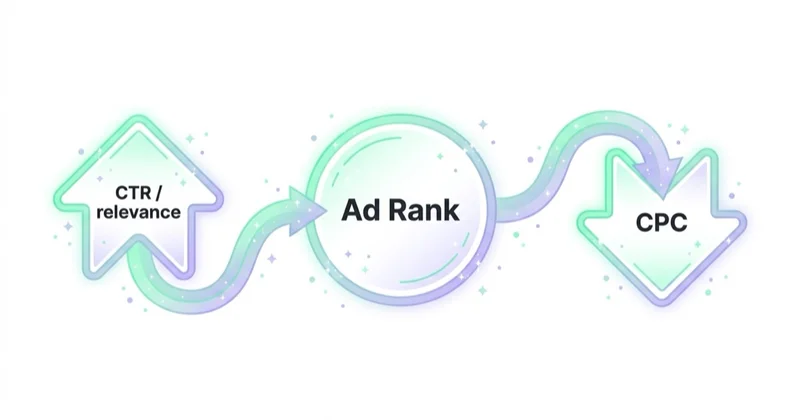
In impression-priced media, CTR affects the effective cost per click. A simplified relationship is:
CPC = CPM ÷ (1,000 × CTR as a decimal)
At a $10 CPM and 1% CTR, the effective CPC is $1. At the same CPM and 2% CTR, it is $0.50.
Real auctions are more complex. CPM can change with audience, placement, quality, competition and optimisation. Increasing CTR by broadening the promise may also reduce conversion. Use this formula to understand the relationship, not to predict auction prices in isolation.
Diagnose CTR in the full funnel
| Pattern | Possible interpretation | What to inspect next |
|---|---|---|
| Low CTR, strong post-click conversion | Message filters effectively or reach is broad | Contribution per impression, volume and missed qualified demand |
| High CTR, weak click-to-session rate | Accidental clicks, slow page, redirect or analytics loss | Landing-page views, page speed, placement and URL QA |
| High CTR, weak conversion | Promise/landing mismatch or wrong audience | Search terms, creative claim, landing intent and lead quality |
| Low CTR, weak conversion | Poor relevance, offer or delivery context | Audience, query, creative, price and product availability |
| CTR falls as spend grows | Expansion into colder inventory or fatigue | Incremental conversions, CPM, reach, frequency and marginal CPA |
| CTR rises while sales fall | Mix shifted to easy clicks or demand weakened | Audience/query mix, conversion tracking and backend outcomes |
| High platform clicks, low sessions | Click definition differs or technical loss | Outbound clicks, redirects, consent, page load and UTMs |
No row proves the cause. It identifies the next diagnostic branch.
How to improve CTR without damaging quality
Search Ads
- tighten query-to-ad relevance;
- separate brand and non-brand analysis;
- review search terms and exclusions;
- make the offer and qualification explicit;
- use assets that genuinely help the decision;
- test copy with conversion guardrails.
Paid social and display
- lead with a recognisable customer problem or outcome;
- make product and audience context clear early;
- adapt creative to placement and safe zones;
- test concepts, not only button colours;
- control frequency and creative fatigue;
- remove misleading or accidental-click placements;
- keep the click promise consistent with the landing page.
Organic search
- match the page to the query's intent;
- write accurate, specific titles;
- improve content and structured data where eligible;
- compare CTR within position, device and search-appearance cohorts;
- inspect the live result page rather than treating CTR as copy alone.
Google can generate or rewrite title links and snippets depending on the query, so a CMS meta-description change does not guarantee the exact result shown.
- make the message relevant to the lifecycle stage;
- use one clear primary action where appropriate;
- ensure linked content fulfils the message promise;
- test message and offer, not only the subject line;
- separate click rate from open-based metrics;
- measure downstream orders, leads or retention.
Test CTR changes correctly
A before/after comparison can be confounded by audience, auction, season or budget changes. Use platform experiments or randomised creative tests where feasible.
Define before launch:
- primary business metric;
- CTR as a diagnostic or secondary metric;
- guardrails such as conversion quality and CPA;
- eligible audience and placements;
- test duration and stopping rule;
- minimum detectable effect;
- whether the platform rotates and optimises variants unevenly.
Do not declare a creative winner on CTR if the stated objective is qualified leads or contribution and those outcomes have enough data to evaluate.
How Space Ads approaches CTR benchmarking
We treat CTR as one step in a measured customer journey. The working sequence is:
- confirm the platform's click and impression definitions;
- create comparable channel and audience cohorts;
- calculate weighted rate and cohort distribution;
- connect platform clicks to landing sessions;
- connect sessions to qualified commercial outcomes;
- identify whether the constraint is exposure, click, page or offer;
- test a specific hypothesis with downstream guardrails;
- update the internal benchmark after meaningful system changes.
A marketing audit can identify where a headline CTR hides poor traffic or tracking loss. Web analytics connects platform response with sessions and outcomes, while PPC landing-page analysis addresses the next step after the click.
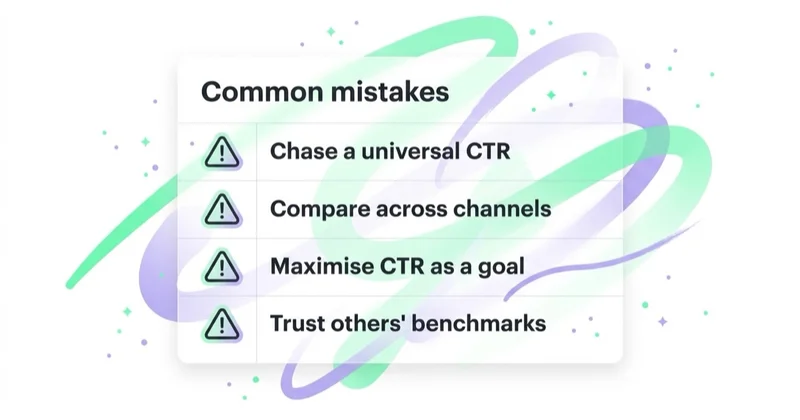
Common mistakes
| Mistake | Better approach |
|---|---|
| Asking for one “good CTR” | Define channel, click type, audience, format and objective |
| Comparing Meta CTR (all) with Google Ads CTR | Use comparable destination-click definitions and contexts |
| Averaging row percentages | Divide total clicks by total impressions |
| Ranking tiny samples | Set a decision-relevant data threshold |
| Combining brand and non-brand Search | Benchmark them separately |
| Mixing triggered and broadcast email | Segment by message purpose and lifecycle |
| Celebrating CTR without sessions | Check click-to-session loss and landing QA |
| Optimising CTR without conversion guardrails | Judge qualified outcomes, cost and contribution |
| Using an old third-party benchmark forever | Refresh cohorts after material market or system changes |
FAQ
What is a good CTR?
A good CTR is strong relative to a genuinely comparable cohort and supports the campaign objective. Define the platform metric, channel, audience stage, format, market, device and period, then check conversion quality and economics. There is no defensible universal percentage.
How do I calculate CTR?
Divide eligible clicks by impressions and multiply by 100. Fifty clicks from 5,000 impressions equals 1%. For an aggregate, add all clicks and all impressions first; do not average individual CTR percentages.
What is a good Google Ads Search CTR?
Google does not define one universal good percentage. Compare branded and non-branded activity separately, then segment by query intent, match type, network, device, market and placement context. Use conversion value, CPA and search-term quality as guardrails.
What is a good Meta or TikTok CTR?
First choose the correct click definition. For website campaigns, outbound or destination CTR is generally more relevant than all-click CTR. Compare the same objective, placement, format, audience stage, market and creative age, then verify landing sessions and outcomes.
What is a good LinkedIn CTR?
LinkedIn's Average CTR uses chargeable clicks divided by impressions. Compare like-for-like objective, format, audience and market. If the goal is website traffic, inspect landing-page clicks; if it is lead generation, prioritise qualified lead rate and cost over a universal CTR.
What is a good organic search CTR?
It depends primarily on query, position, device, country and search appearance. Separate brand and non-brand, use the same Search Console aggregation mode and compare pages or queries within position bands. A site-wide average is rarely a useful target.
What is a good email click rate?
Use unique clickers divided by delivered messages if that is the provider's definition, and benchmark comparable message types and audiences. Triggered, transactional and broadcast emails have different baselines. Read click rate with delivery and downstream conversion, not open rate alone.
Can CTR be too high?
Yes. An unusually high CTR can come from a broad promise, accidental placements, engagement clicks or misleading creative. If landing sessions, conversion rate, lead quality or contribution do not support it, the high number is not a commercial success.
Why did CTR fall after scaling?
Additional budget may reach colder audiences, lower-propensity queries or different placements; frequency and creative fatigue may also change. Evaluate marginal conversions, contribution, CPM, reach and audience mix before reversing the scale decision.
How often should CTR benchmarks be refreshed?
Review them after material changes in platform definitions, inventory, objectives, market, creative system or tracking, and on a regular cadence suitable for campaign volume. Preserve prior versions so a benchmark change is not mistaken for a performance change.
Key takeaways
- CTR definitions differ across platforms and channels.
- A benchmark must control for objective, audience, format, intent, market, device and period.
- Use weighted aggregation and cohort percentiles with enough data.
- Connect clicks with landing sessions, qualified conversion and contribution.
- Optimise the customer and commercial outcome; use CTR to locate friction.
Sources and further reading
- Google Ads Help — Click-through rate definition and context
- Google Search Console Help — How clicks, impressions and position are counted
- Google Search Console Help — Performance-report aggregation and data details
- LinkedIn Help — Engagement metrics and Average CTR in Campaign Manager
- Apple — Mail Privacy Protection
- Google Ads Help — Experiment Center and lift studies
Continue learning
Continue reading

Source / Medium and Traffic Sources in GA4, Explained
Source and medium describe traffic origin in GA4, but their meaning changes with user, session and event scope. Learn how UTMs, auto-tagging, channel groups, Direct, Unassigned and cross-domain tracking work.
Google Ads Benchmarks by Industry (CTR, CPC, Conversion Rate)
Google Ads benchmarks can provide context, but only when the campaign type, market, conversion action, attribution and time period match. Learn how to make a valid comparison and turn it into a useful decision.
Facebook and Meta Ads Benchmarks by Industry (CPM, CPC, CTR, ROAS)
Meta ads benchmarks are only comparable when objective, performance goal, placement, market, audience, attribution, and period align. Learn how CPM, CTR, CPC, CVR, CPA, and ROAS connect—and where they do not.