
DTC (direct-to-consumer) marketing acquires and retains customers for a brand's own sales channel. The customer buys from the brand rather than from a retailer or marketplace in that transaction. A DTC brand can still sell wholesale, through marketplaces or in retail stores; “direct” describes a route to market, not an ideology.
Selling direct gives the brand greater control over merchandising, price presentation, experience and customer insight. It also transfers work and risk: demand generation, individual fulfilment, payment processing, support, fraud, returns, consumer-law compliance and the technology that joins them. The model works when retained contribution from the direct relationship covers those costs and the cash needed to finance growth.
TL;DR
- Build a contribution waterfall. Retail price is not DTC margin. Deduct discounts, tax where applicable, product cost, pick/pack, shipping subsidy, payment, expected returns, fraud, support and variable platform cost.
- Separate first-order economics from cohort economics. A profitable first order and a customer who pays back CAC through repeat contribution are different growth models.
- CAC payback is important but not sufficient. Cash conversion, inventory commitments, return latency, working capital, retention uncertainty and fixed overhead also constrain scale.
- Use transaction-specific values where practical. Advertising platforms optimise the values they receive; gross revenue can send budget towards low-margin or high-return products.
- Treat first-party data as governed access, not unrestricted ownership. Collect what is needed, document purposes and follow consent, opt-out and privacy rules in each market.
- Match channels to the job. Search and Shopping capture expressed demand; paid social, creators and content may create or shape demand; lifecycle messaging develops an existing relationship. Test incrementality across them.
- Design hybrid distribution deliberately. Direct, retail and marketplaces can serve different customers, products and markets. Measure contribution and channel conflict rather than declaring one universally superior.
What selling direct actually changes
Retail and marketplaces do more than process a transaction. They aggregate demand, provide discovery and trust, merchandise categories, handle customer service and fulfilment, and sometimes absorb inventory or returns risk. The commercial terms paid by a brand compensate the channel for some of that work.
Direct selling brings more of that responsibility inside the brand. The benefit is control and a closer feedback loop: the brand sees the order, can test the journey, can provide support directly and can observe repeat behaviour within lawful measurement limits. The cost is that each capability needs people, software and operating process.
The strategic advantages are usually four:
- Commercial control: direct price, bundling, subscription, launch cadence and merchandising.
- Experience control: education, checkout, packaging, delivery communication, service and returns.
- Customer learning: product, order and support data that can reveal needs and repeat patterns.
- Faster experimentation: the ability to test an offer or product without waiting for a retail range review.
None is automatic. Poor identity resolution, fragmented systems or unclear consent can make a direct business as opaque as a wholesale one.
Build the DTC contribution waterfall
Start with the net amount the brand is entitled to retain, not the displayed product price.
First-order contribution = net product revenue − COGS − variable fulfilment − shipping subsidy − payment fees − expected returns/refunds − variable support/fraud/platform cost
| Cost or adjustment | Questions the model must answer |
|---|---|
| Net revenue | Are discounts, refunds, taxes and gift-card treatment consistent? |
| Product cost | Does it include inbound freight, duty, packaging and expected write-offs? |
| Fulfilment | What do storage, pick/pack, packaging and per-order handling cost? |
| Delivery | How much does the brand subsidise by zone, weight and service level? |
| Returns | What are return shipping, inspection, support, refurbishment and lost resale value? |
| Payments and fraud | What are processor fees, chargebacks, fraud tools and lost goods? |
| Service | Which contacts scale with orders, products or delivery failures? |
| Acquisition | Is CAC new-customer only, and does it include media, agency, affiliate and creator cost consistently? |
Then calculate contribution at SKU, order, new-customer and cohort level. A blended store average can hide a product whose shipping or return profile makes paid growth unviable.
Do not assume DTC always creates a better margin. Wholesale can produce lower revenue per unit but better inventory turns, larger shipments, simpler support and less paid acquisition. Compare like with like: retained contribution, cash timing and risk by channel.
CAC payback, cash and cohort value
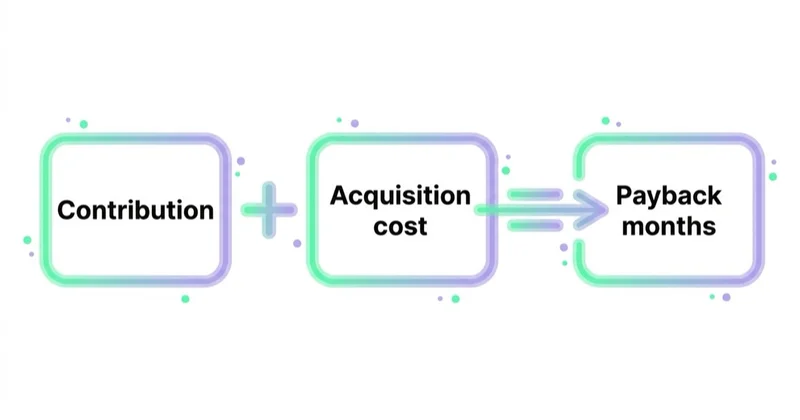
CAC payback asks how long cumulative customer contribution takes to recover acquisition cost.
CAC payback month = first month in which cumulative cohort contribution per acquired customer ≥ CAC
This is a cash question as well as a profitability question. Media may be paid before the order settles; inventory may have been committed months earlier; returns arrive later; repeat contribution may take quarters. Faster acquisition can widen the cash requirement even when predicted lifetime value exceeds CAC.
Payback is not the only guardrail. Track:
- inventory purchase and production lead time;
- cash conversion cycle and payment terms;
- return and refund delay;
- cohort repeat curve and uncertainty;
- fixed fulfilment and team capacity;
- concentration in one product, channel or promotion;
- contribution after discounts and service failures.
Several levers can shorten payback, but their ranking depends on category and evidence:
Improve first-order contribution. Better product mix, pricing, relevant bundles, shipping economics and lower avoidable returns can create more value. Raising average order value does not help if the extra units carry poor margin or cause returns.
Improve legitimate repeat demand. Replenishment, product satisfaction, range breadth and service can improve retention. A subscription changes timing but does not manufacture product-market fit; our subscription ecommerce economics guide explains churn and contribution.
Improve acquisition efficiency and incrementality. Creative, offer, landing pages, feed quality and channel mix can reduce wasted cost. Do not equate attributed CAC with incremental CAC when channels claim the same customer.
Reduce time to value. Faster delivery, clearer onboarding and effective post-purchase education can reduce early returns and bring forward the next relevant purchase.
First-party data: useful, governed and incomplete
Direct transactions can generate product, order, service and consent data. That evidence helps the brand understand cohorts and improve decisions, but it is not unrestricted property. Privacy, electronic marketing and platform rules govern collection, matching, retention and activation.
Build a simple data contract for each field:
- what is collected and at which event;
- why the business needs it and the lawful basis relied on;
- where consent is required and how it is recorded;
- which systems and partners receive it;
- how long it is retained;
- how access, correction, deletion and objection requests are handled;
- what happens when a person opts out of marketing.
For example, UK PECR generally requires consent for marketing email or text to individuals unless the limited existing-customer “soft opt-in” conditions are met. Those conditions include collecting the details during a sale or negotiation, marketing the brand's own similar products, and offering a clear opt-out both at collection and in each message. A receipt address is not automatically permission for promotions. Other markets differ, so obtain local advice.
Operational messages and marketing messages should be distinguished. Order, delivery, safety and contract information should not be used to conceal promotional content.
Send useful values to advertising platforms
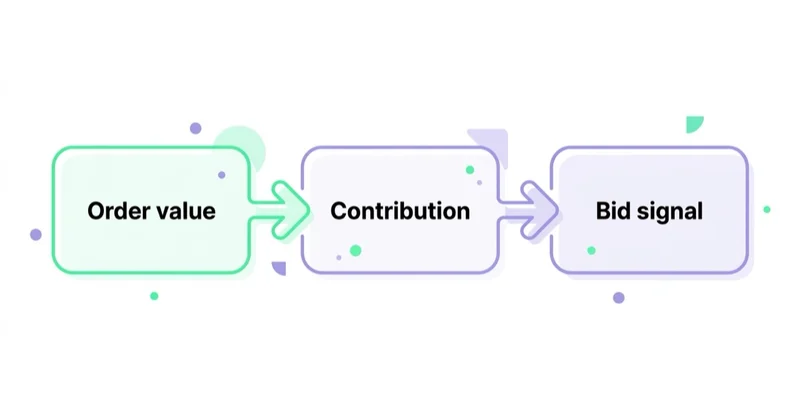
Revenue-based conversion tracking is a starting point, not a complete economic signal. If two orders have different gross profit or expected return cost, transaction-specific contribution values can give value-based bidding a better objective.
A practical maturity path is:
- Validate purchase deduplication, order IDs, currency, tax and refund handling.
- Pass transaction-specific net revenue rather than a flat order value.
- Introduce product cost and expected fulfilment/return adjustments using a documented model.
- Separate new and returning customers where identification is reliable.
- Reconcile predicted values with actual cohort contribution and update cautiously.
Google Ads supports transaction-specific conversion values and value-based bidding around revenue or profit-margin signals. This does not mean the platform knows true profit. It optimises the values supplied, subject to attribution and model limitations. Run the new value alongside the old metric long enough to validate volume and distribution before changing bidding.
When DTC is harder — and when hybrid wins
DTC attractiveness depends on product, demand and operating model rather than a simple category rule.
Direct is easier to support when the brand has a distinctive proposition, sufficient order contribution, a reachable audience, reliable fulfilment and either first-order profitability or evidence-based repeat value. Products that benefit from education, configuration, community or replenishment can gain from a direct relationship.
Direct is harder when orders are low-value and bulky or costly to ship, returns are high, purchase is infrequent, trust is held by established retailers, the category is bought mainly for immediate availability, or paid acquisition is the only plausible demand source. None makes DTC impossible; each raises the proof required.
A hybrid model can use retail for discovery and physical availability, marketplaces for category demand, and DTC for range depth, education, launches, bundles, service and retention. Define pricing, assortment, promotion, inventory and customer-service rules to reduce channel conflict. Our guide to building a private-label brand covers differentiation from a standing start.
Consumer rights and returns belong in the growth model
The checkout and returns policy are not post-purchase footnotes. They affect conversion, cost and legal compliance.
For EU distance sales, consumers generally have 14 days after delivery to withdraw from an online goods purchase without giving a reason, subject to exceptions. The customer may bear return postage only under applicable conditions and prior information; traders also have reimbursement and legal-guarantee obligations. Product type and country can change the rule, so legal review is required.
Marketing and merchandising should therefore:
- show total price and delivery information before payment;
- make recurring charges, trial terms and cancellation clear;
- present returns and refund conditions in plain language;
- avoid “final sale” or warranty claims that conflict with mandatory rights;
- collect structured return reasons and feed expected return cost into planning;
- distinguish a change-of-mind return from defective or misdescribed goods.
Reducing returns does not mean creating friction that suppresses legitimate rights. Improve sizing, imagery, specifications, compatibility, packaging and expectation-setting, then measure retained contribution.
Glossary
- DTC (D2C) — direct-to-consumer; a brand selling to end customers without a retail intermediary.
- CAC — customer acquisition cost; total acquisition spend divided by customers acquired.
- CAC payback period — the time taken for a customer's cumulative contribution to equal their acquisition cost.
- LTV — lifetime value; total contribution a customer produces over the relationship.
- Contribution margin — revenue minus the variable costs of producing, selling and delivering.
- First-party data — data a brand collects directly through people's interactions and transactions with the brand.
- Blended CAC — acquisition cost across all sources including organic, as distinct from paid-only CAC.
- Incremental CAC — additional acquisition spend divided by customers caused by that spend, estimated through controlled testing.
- Cash conversion cycle — time between paying for inventory/operations and collecting cash from sales.
How Space Ads approaches DTC growth
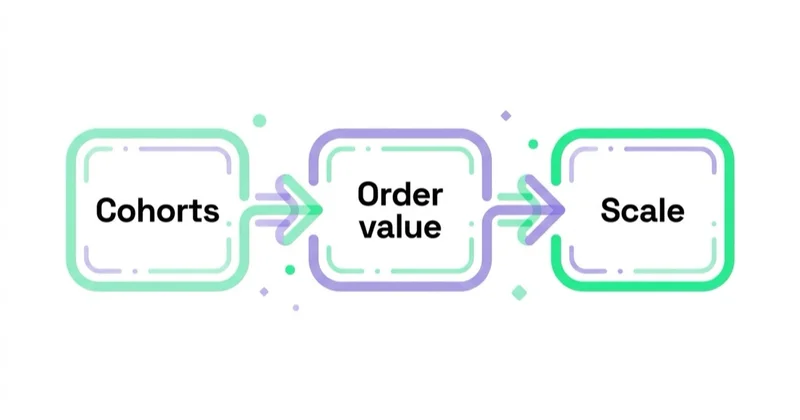
We start with an economic and measurement map: product/order contribution, first-order versus repeat revenue, return lag, channel cost, customer identity and available cash. Monthly revenue reporting is then paired with acquisition cohorts so later orders can be analysed against the customers and assumptions that originated them.
Next we define what the ad platforms should optimise: verified order value, contribution proxy, new-customer value or another outcome supported by sufficient volume. Forecast values are kept conservative and reconciled against actual cohorts. We do not label an attributed repeat order as incremental without a test.
Finally, we allocate channels by role and marginal return: demand capture, demand creation, retention or distribution. Where Space Ads-specific evidence is unavailable, the model is described as an industry-standard process and tested against the client's own data rather than supported with invented portfolio claims.
Building the plan, in order
- Define contribution consistently. Reconcile finance, ecommerce and advertising treatment of tax, discounts, shipping, COGS and returns.
- Build acquisition cohorts. Track cumulative contribution per acquired customer with clear source and identity limitations.
- Measure first-order economics and payback. Add inventory and cash constraints before setting the acquisition ceiling.
- Fix major conversion and return defects. Improve product information, offer, checkout, fulfilment promise and support.
- Validate conversion data. Order IDs, currency, refunds and new/returning classification must work before profit proxies enter bidding.
- Test channel roles and incrementality. Use holdouts, geo tests or other suitable designs where the decision warrants them.
- Build lawful retention. Replenishment, membership or lifecycle messaging should fit genuine customer need and consent. See email marketing and customer retention marketing.
- Scale on marginal contribution and cash capacity. A blended historic ROAS does not describe the return from the next unit of spend.
Where a brand wants this run rather than described, our DTC marketing engagement follows the same order.
Common mistakes
| Stop doing | Do instead |
|---|---|
| Treating the retail margin as pure gain | Model the costs that move onto your P&L with it |
| Optimising monthly ROAS in isolation | Track first-order contribution, cohort payback, cash and marginal return |
| Reporting revenue by month only | Report by acquisition cohort so spend links to return |
| Passing one flat conversion value | Validate transaction values, then test a documented contribution proxy |
| Raising AOV without checking margin | Optimise retained contribution, not basket size alone |
| Assuming DTC suits every category | Check proposition, fulfilment, contribution, demand access and cash needs |
| Treating first-party data as unrestricted | Define purpose, consent/opt-out, access, retention and lawful activation |
FAQ
What is DTC marketing? It is marketing for a brand's own customer and transaction channel. The brand controls the storefront and customer journey rather than relying on a retailer for that sale. The same brand can also use wholesale, marketplaces and physical retail.
Is DTC more profitable than wholesale? Not necessarily. Direct may retain more revenue per unit but adds individual fulfilment, payment, support, returns, technology and acquisition costs. Compare retained contribution, cash timing and risk by channel rather than wholesale and retail price alone.
What is a good CAC payback period? There is no universal benchmark. The acceptable period depends on first-order contribution, repeat certainty, inventory and return timing, working capital, financing cost and risk tolerance. Use observed cohorts and a conservative funding plan rather than a category average.
How is DTC different from ecommerce generally? Ecommerce means a transaction happens online. DTC means the customer buys through the brand's own channel. A marketplace order is ecommerce but not direct in the same commercial sense; a purchase in a brand-owned store can be direct without being ecommerce.
Do DTC brands need to avoid retail and marketplaces entirely? No. A hybrid model can use each route for different demand, assortment or markets. Define channel-specific contribution, pricing and promotion rules, inventory allocation and customer ownership so direct growth does not create avoidable conflict.
Why does average order value matter so much in DTC? Some per-order costs do not fall in proportion to basket value, so low-AOV orders can have weak contribution. But higher AOV is useful only when the extra items add retained margin and do not increase discount, shipping or return cost disproportionately.
What should a DTC brand measure first? Start with first-order contribution by product/order and cumulative contribution by acquisition cohort. Add CAC definition, returns, inventory cash timing and reliable new-versus-returning identification. Those inputs support payback and scaling decisions.
Sources and further reading
- Google Search Central — ecommerce documentation
- Google Ads Help — conversion values
- Google Ads Help — value-based bidding
- Electronic mail marketing — UK Information Commissioner's Office
- EU online returns and right of withdrawal — Your Europe
- EU ecommerce and distance-selling obligations — Your Europe
Key takeaways
- Selling direct adds control and transfers acquisition, fulfilment, support, returns, compliance and technology responsibility to the brand.
- Compare channels on retained contribution, cash timing and risk — not the wholesale-to-retail price gap.
- Use first-order economics, cohort payback, inventory commitments and cash capacity together when setting growth pace.
- Raise retained contribution, not AOV or repeat rate at any cost.
- First-party data is valuable only when accurate, connected and collected and activated lawfully.
- Feed platforms validated transaction-specific values or a conservative contribution proxy; they optimise what they receive, not true profit they cannot see.
- Hybrid distribution can outperform channel purity when roles, pricing, inventory and measurement are deliberately designed.
Continue reading
Auto Parts Ecommerce: Marketing Around the Fitment Problem
Auto parts marketing starts with fitment data. Learn how to connect the catalogue, vehicle selector, product feed, SEO and returns data so customers find parts that genuinely fit.
Local Inventory Ads: The Format Decided by Your Stockroom
Local inventory ads connect nearby demand with products available in physical stores. Learn how to prepare store data, pickup options, landing pages and offline measurement without promising stock the customer cannot buy.
The Shopify Marketing Stack: What to Install and What to Remove
A Shopify marketing stack should connect customer data, storefront experience, merchandising, lifecycle and acquisition without duplicating events or adding unmanaged risk. Use this framework to choose, govern and remove apps safely.


































