An ecommerce marketing strategy is a set of choices about which customers and markets to pursue, why they should buy, how the store will reach and retain them, and which capabilities receive scarce budget and attention. It links customer demand to contribution economics and an executable sequence of work.
It is not a list of channels with budgets beside them. Search, paid social, email and SEO are instruments. Strategy explains the commercial problem they are expected to solve, the role of each instrument and what the business will deliberately postpone or stop.
TL;DR
- Start with the business objective and contribution economics, not a favourite platform or a generic growth percentage.
- Choose where to play: priority customer, need, product category, geography and buying occasion. “Everyone who shops online” is not a target market.
- Define why the customer should choose you and prove that the promise survives the product page, price, delivery, returns and service experience.
- Diagnose several possible constraints—demand, offer, availability, conversion, retention, margin and measurement—then prioritise them by impact, evidence, feasibility and dependency.
- Give each channel a clear role in the customer journey and evaluate it with metrics suited to that role. Do not add platform-attributed revenue together.
- Manage performance through business outcomes, customer and journey diagnostics, and experiments. One dashboard number cannot answer every question.
- Translate the strategy into a 90-day operating plan with owners, inputs, milestones, guardrails and explicit stop-doing decisions.
What a useful ecommerce strategy must decide
A strategy should enable a team to make consistent decisions when the original author is not in the room. At minimum, it needs to answer six questions.
- What commercial outcome matters now? Contribution growth, new-customer growth, cash-efficient expansion, category penetration and retention are different objectives.
- Where will the business compete? Define the customer, need, category, market and occasion.
- Why should that customer buy here? State the value proposition and the evidence that makes it credible.
- What is preventing the outcome? Diagnose constraints across the whole commercial system, not only advertising.
- Which choices receive resources? Set priorities, channel roles, capabilities and a sequence.
- How will the team learn and adapt? Agree definitions, review cadence, experiments and conditions that trigger a change.
If a document cannot answer those questions, it is probably a marketing plan, forecast or activity calendar. Those are useful, but they are downstream of strategy.
Step 1: define the objective and economic guardrails
“Grow revenue by 30%” is incomplete. It does not say whether growth should come from new customers, price, repeat purchases, a new market or a larger range, and it can reward sales that destroy contribution or consume too much cash.
Turn the ambition into a measurable objective with constraints. For example:
Increase twelve-month contribution from first-time UK customers in the core category while keeping the six-month acquisition payback below the agreed ceiling and protecting gross margin and return rate.
The exact formulation will differ, but it should specify:
- the outcome and period;
- the customer, category or market in scope;
- whether the priority is acquisition, retention or both;
- the economic boundary, such as contribution or payback;
- operational guardrails such as stock, service capacity or return rate.
Build the baseline from net economics
Gross platform revenue is rarely enough. Create a baseline from the store, finance system and advertising costs using consistent definitions:
- gross and net revenue after discounts, cancellations and returns;
- gross margin and contribution after variable fulfilment, payment, marketplace and service costs;
- new and returning customer revenue;
- customer acquisition cost by a defined cohort;
- first-order contribution and acquisition payback;
- repeat-purchase rate and cohort value over relevant buying cycles;
- average order value, units per order and discount rate;
- product availability and lost-sales exposure;
- marketing spend, agency and production costs where relevant.
Contribution definitions differ between businesses. Finance, ecommerce and marketing should agree which costs are included before targets are set. Otherwise, the same campaign can appear profitable in a media report and loss-making in the management accounts.
Step 2: choose where to play
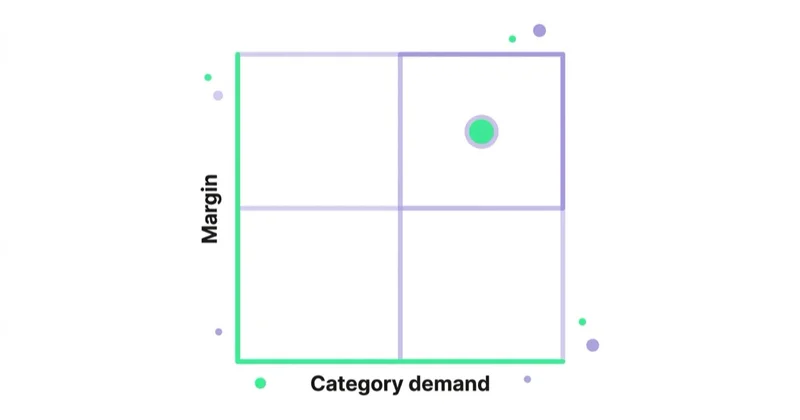
Most ecommerce plans are too broad at the point where specificity matters most. “Women aged 25–44” says little about motivation, buying context or the alternatives being considered.
A useful market choice combines:
- customer: who has the need and economic potential;
- problem or desire: what progress they are trying to make;
- occasion: what triggers the purchase and how urgent it is;
- category and range: which products solve it credibly;
- geography: where demand, logistics and economics work;
- route to market: owned store, marketplace, retail, app or a combination.
Research should mix declared and observed evidence: customer interviews, reviews, on-site search, customer-service contacts, search demand, competitive offers, cohort data, product returns and purchase paths. No single source is sufficient. Search volume reveals expressed demand, for example, but not all latent demand; customer interviews explain language and motivation but not market size.
Segment for decisions, not decoration
A segment is useful when the business will treat it differently. That could mean a different proposition, product range, creative message, landing experience, service promise or acquisition ceiling.
For an established store, commercial segmentation often combines customer status and behaviour:
- prospects with no prior relationship;
- first-time customers;
- active repeat customers;
- high-value or high-potential cohorts;
- lapsing customers based on the category's natural buying cycle;
- wholesale, professional or consumer buyers where needs differ.
Avoid labelling every customer who has not purchased recently as “churned”. A 90-day gap means something very different for supplements and furniture.
Step 3: define a proposition the operation can deliver
The value proposition answers why the chosen customer should buy this product from this store rather than choose an alternative or do nothing. It may combine product performance, curation, availability, expertise, price, convenience, delivery, service, community or status.
Strong propositions are:
- relevant to an important customer need;
- distinctive enough to influence choice;
- credible, with proof rather than adjectives;
- commercially sustainable, not dependent on permanent discounting;
- operationally deliverable across the full experience.
“Premium quality and excellent service” is not yet a proposition. A precise product claim, independently verifiable specification, specialist advice, a dependable delivery promise or a genuinely differentiated range is more useful.
Map the promise through the journey. If advertising says “delivered tomorrow” but the product page hides cut-off times and checkout shows a longer window, marketing creates disappointment rather than value. Product data, stock systems, fulfilment and customer service are therefore strategic inputs—not back-office details.
Step 4: diagnose what limits growth
Revenue can be expressed as traffic × conversion rate × average order value, with repeat purchases extending value over time. Profit then depends on margin and variable costs. This model is useful for organising questions, but it does not prove which lever to pull: the factors interact.
Review at least seven areas.
| Area | Evidence to inspect | Typical strategic response |
|---|---|---|
| Demand and reach | Brand and non-brand demand, audience penetration, qualified traffic, market share | Capture existing demand or invest in demand creation |
| Offer and proposition | Customer research, price comparison, reviews, promotion dependency | Improve positioning, proof, range or offer architecture |
| Availability and merchandising | Stock coverage, feed eligibility, category visibility, product discovery | Fix supply, product data and merchandising before scaling |
| Conversion | Journey by device and segment, usability evidence, payment and delivery friction | Prioritised CRO and development roadmap |
| Order economics | Contribution by product/order, discount and shipping effects, returns | Product mix, bundles, thresholds, pricing or cost action |
| Retention | Cohort repurchase, interval, churn reasons, lifecycle coverage | Product, service, replenishment and lifecycle programme |
| Measurement and capability | Data quality, consent, team capacity, creative output, decision speed | Remediation, operating model and skills investment |
A business may have multiple material constraints at once. An incomplete feed can restrict Shopping while a weak mobile experience suppresses every channel. Prioritise problems with a simple score:
- expected contribution impact;
- strength of evidence;
- time and cost to learn;
- feasibility and operational capacity;
- dependencies and reversibility;
- strategic value beyond the immediate result.
The output should be a small number of sequenced priorities, not a hundred-line audit. Our ecommerce audit guide provides a deeper diagnostic checklist.
Step 5: assign roles to channels
A channel can play more than one role, and its role can change by campaign and audience. The important point is to define the intended contribution rather than judging every activity by the same last-click target.
| Role | Possible channels | Useful evidence |
|---|---|---|
| Create or refresh demand | Video, creators, paid social, display, PR, content | Reach in target audience, search or direct response change, lift tests |
| Capture expressed demand | Search, Shopping, marketplaces, category SEO | Eligible coverage, impression share, new-customer contribution, query quality |
| Help evaluation | Product/category content, reviews, email, organic search, remarketing | Engaged journeys, product discovery, assisted paths, controlled tests |
| Convert intent | Product pages, onsite search, CRO, paid search, shopping | Net conversion, contribution per visit, checkout completion, guardrails |
| Develop the customer | Email, SMS, loyalty, app, service, community | Incremental repeat contribution, cohort retention, opt-out and complaint rate |
Search can introduce a new customer to a category and paid social can capture a warm prospect; channel labels do not determine customer intent. Separate campaigns and audiences sufficiently to understand the job being performed.
Organic discovery is part of the system
Ecommerce SEO is not merely a content calendar. Google advises retailers to make products discoverable through crawlable navigation, clear internal links and product data that machines can interpret. Category architecture, structured data, product information and site performance affect both customer discovery and search visibility.
That makes SEO, Merchant Center feeds and onsite merchandising connected capabilities. Decisions about ranges, categories and product content should not be made independently by three teams.
Product data and value signals guide automation
Advertising systems optimise toward the goals and values they receive. Google Ads supports transaction-specific conversion values and can use values such as revenue or profit margin for value-based bidding. It also provides new-customer acquisition goals when advertisers can identify and value new customers.
Those features do not remove the need for strategy. They make input quality more important. If a store sends gross revenue while the real priority is contribution from new customers, automation can efficiently pursue the wrong economic result.
Step 6: create a measurement hierarchy
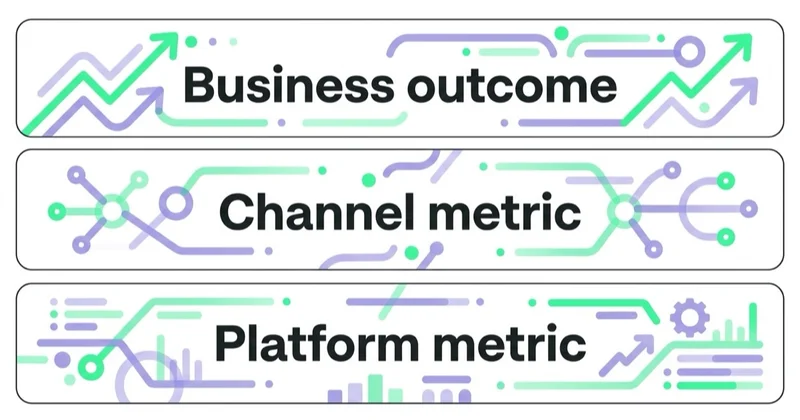
Different metrics answer different questions. Put them into three layers.
1. Business outcomes
Use finance- and store-reconciled measures such as net revenue, contribution, new customers, acquisition payback, cohort value and cash requirements. These decide whether the commercial model is working.
Blended CAC and MER can provide useful directional context when definitions remain stable. Neither proves causality. Both can move because of price, seasonality, promotions, retail distribution, organic demand or customer mix.
2. Customer, journey and channel diagnostics
Use product eligibility, non-brand reach, click cost, landing-page engagement, conversion steps, average order value, new-customer share and lifecycle engagement to understand where performance changed.
Google Analytics attribution models distribute credit across observed touchpoints using defined rules or modelling. Advertising platforms also apply their own settings and windows. These views help diagnose activity, but platform-reported revenue should not be added together and treated as total sales.
3. Causal learning
Use randomised campaign experiments, audience holdouts, geo tests or controlled site experiments for consequential decisions where volume and implementation allow. Agree the hypothesis, primary metric, guardrails, duration and decision rule before seeing results.
Not every decision warrants a sophisticated test. The standard of evidence should rise with spend, risk and reversibility. For a detailed methodology, see our guide to incrementality testing.
Step 7: decide the sequence and what stops
“Fix conversion before buying traffic” is sensible when a severe, fixable conversion problem is proven. It is not a universal ordering rule. A store may need traffic to produce enough observations for a test, may face a time-limited seasonal opportunity, or may have conversion economics that are already strong.
Sequence work using four practical rules:
- Resolve critical truth and trust failures first. Unsafe claims, broken checkout, severe measurement defects and inaccurate stock or price data can invalidate later work.
- Address dependencies before dependent activity. A Shopping expansion needs eligible products; a creative testing plan needs production capacity.
- Balance quick learning with compounding assets. Run near-term tests while building product content, customer data and organic discovery that take longer to mature.
- Protect the current engine. Do not rebuild every campaign or page simultaneously unless the evidence and risk justify it.
Every priority consumes budget, developer capacity, creative attention or management time. The strategy must therefore name what will pause, remain maintained rather than expanded, or not be attempted this cycle.
A practical 90-day ecommerce marketing plan
Days 1–30: align and establish the baseline
- agree the objective, scope, economic definitions and guardrails;
- reconcile material differences between finance, store, analytics and platforms;
- research priority customers, demand and competing alternatives;
- assess product economics, stock, feeds, journey and cohort behaviour;
- inventory active channels, creative, technology and team capacity;
- rank constraints and state the assumptions behind them.
Days 31–60: remove blockers and launch focused tests
- fix critical tracking, product-data or journey issues;
- translate the proposition into message and landing-page hypotheses;
- align campaigns and conversion values with customer and margin priorities;
- launch a small number of tests with owners and decision rules;
- create the content, creative or development pipeline needed for the next phase.
Days 61–90: evaluate and allocate
- compare results with baselines or controls and check guardrails;
- document what is known, likely and still uncertain;
- scale, revise or stop activity according to pre-agreed criteria;
- refresh the forecast using observed economics;
- set the next sequence and capacity plan.
The 90-day plan should not pretend that SEO, retention or lifetime value fully matures in one quarter. It should produce evidence, remove material blockers and create an operating rhythm that supports longer-term work.
The one-page strategy template
A useful strategy can be summarised without reducing it to slogans:
Objective: the commercial result, period and economic guardrails.
Where to play: priority customers, needs, products, occasions and markets.
How to win: proposition, proof and experience required to deliver it.
Diagnosis: the few constraints and opportunities supported by evidence.
Choices: what receives investment, what remains maintained and what stops.
Channel roles: the job of each major activity and the part of the journey it supports.
Measurement: business outcomes, diagnostics, experiments and definitions.
Execution: owners, dependencies, milestones, capacity and review cadence.
Change conditions: evidence that would invalidate an assumption or trigger reallocation.
The full plan can contain forecasts, calendars and briefs. This page remains the decision reference.
Common ecommerce strategy mistakes
| Avoid | Do instead |
|---|---|
| Listing channels and calling it strategy | Choose customer, market, proposition, economics and priorities first |
| Setting a revenue goal without margin or cash guardrails | Plan against net contribution and acquisition payback |
| Assuming there is always one isolated bottleneck | Map interactions, dependencies and multiple material constraints |
| Treating all customers and orders as equal | Separate new/returning customers, cohorts and product economics |
| Optimising automation to gross revenue by default | Send values and goals that reflect the commercial objective |
| Giving every channel the same ROAS test | Define roles and match evidence to the decision |
| Adding platform-reported sales together | Reconcile business outcomes to store and finance records |
| Launching many simultaneous changes | Prioritise tests and preserve an interpretable baseline |
| Adding initiatives without removing any | Make stop-doing and maintenance choices explicit |
How Space Ads approaches ecommerce strategy
We connect acquisition data with product economics, customer cohorts, product feeds, the onsite journey and operational reality. The purpose is to find the decisions most likely to improve sustainable contribution—not simply to generate a larger list of campaigns.
We then translate those decisions into defined channel roles, value signals, experiments and a roadmap with client dependencies. Reporting separates business outcomes from platform diagnostics and causal evidence so that each is used for the question it can actually answer.
For an explanation of delivery models and scopes, read what an ecommerce marketing agency does. Our DTC marketing playbook covers the additional demands placed on brands that carry responsibility for both demand creation and direct customer economics.
FAQ
What is an ecommerce marketing strategy?
It is a coherent set of choices about the customers and markets an online business will pursue, the value it will offer, the constraints it will address, the resources it will allocate and the way it will learn. Channels and campaign plans implement those choices.
What should an ecommerce marketing strategy include?
Include a commercial objective, economic baseline, target customers and markets, proposition, diagnosis, priorities, channel roles, measurement hierarchy, owners, dependencies, sequence and explicit exclusions. Record the assumptions that would cause the strategy to change.
How often should the strategy be reviewed?
Review execution frequently enough to manage risk, often weekly or monthly, but do not rewrite strategy in response to routine noise. Revisit strategic choices when material evidence changes: economics move, a constraint is relieved, the market shifts, a test invalidates an assumption or operational capacity changes.
Which ecommerce marketing channel should we start with?
There is no universal first channel. Start with the customer demand, proposition and constraint. Search or Shopping may suit existing intent; paid social or creators may help create demand; lifecycle marketing may be more important where a sizeable customer base has untapped repeat potential. The economics and evidence determine the choice.
How much should an ecommerce business spend on marketing?
A percentage of revenue is a weak universal rule because margins, growth stage, repeat behaviour and cash position differ. Model the spend the business can support from incremental contribution, new-customer value, payback requirements and operational capacity, then release budget in stages as evidence develops.
Is ROAS enough to judge an ecommerce strategy?
No. ROAS compares attributed revenue with ad cost and ignores product margin, returns, agency and creative cost, customer status and incrementality. It remains a useful diagnostic when consistently defined, but strategic decisions also need contribution, customer acquisition economics, cohort behaviour and experimental evidence.
Can a small store use this framework?
Yes. A smaller business can use fewer segments, simpler models and shorter documents. The essential choices remain the same, and explicit priorities are particularly valuable when budget and team capacity are limited.
Key takeaways
- Strategy begins with commercial and customer choices; the channel plan follows.
- Define growth using net contribution, acquisition payback and operational guardrails—not gross revenue alone.
- Choose specific customers, needs, products, markets and reasons to believe.
- Diagnose demand, proposition, availability, conversion, order economics, retention and capability as one connected system.
- Give channels intentional roles and feed automation values that reflect the business objective.
- Separate business outcomes, diagnostic attribution and causal experiments.
- Sequence work by risk, dependencies and learning value, then state what will not be done.
See how we turn this framework into coordinated ecommerce marketing and performance marketing programmes.
Sources and further reading
- Best practices for ecommerce sites in Google Search — Google Search Central
- Help Google understand your ecommerce site structure — Google Search Central
- About conversion values — Google Ads
- Performance Max and new-customer acquisition goals — Google Ads
- Get started with attribution — Google Analytics
- Understand Conversion Lift and incremental conversions — Google Ads
Continue reading

ChatGPT Ad Formats and Character Limits: What Actually Fits
A ChatGPT ad appears below the response and carries six elements, with specific limits: title 3–50 characters, body up to 100. The "24 / 48 character" figures in trade coverage do not match the documentation, so this guide gives the full limits table, shows how to fit a useful message, and covers the image, product ads and end-to-end consistency with the landing page.
OpenAI Ads Manager: How to Set Up Your First ChatGPT Ads Campaign
OpenAI Ads Manager has three campaign levels, but launch also requires advertiser verification, billing, landing-page checks, measurement and deliberate choices for settings that cannot be changed later. This guide covers the setup sequence, budgets, context hints, oCPC, targeting, review and Ads API workflows.
Switching Marketing Agencies Without Losing the Account
A safe agency switch protects client-owned accounts, billing, conversion signals, creative rights and operating knowledge. Use this transition plan to assign responsibility, validate access and change partners without avoidable disruption.