Google Ads management is the ongoing process of turning a commercial objective into campaign decisions, reliable measurement and controlled learning. It includes more than changing bids: the provider may need to govern conversion goals, search coverage, product data, creative inputs, budgets, experiments and the connection between platform results and actual sales or qualified leads.
The management fee is separate from the media budget paid to Google. It may also exclude work such as video production, landing-page development, product-feed engineering or analytics implementation. That is why a low headline fee can become expensive when important dependencies have no owner.
The best proposal makes the operating model testable: who does what, which accounts and markets are covered, what is delivered, how decisions are approved, which business outcomes are used and what happens when the scope changes.
TL;DR
- Google Ads management should cover strategy, measurement governance, campaign operation, budget allocation, creative and feed coordination, experimentation and reporting to the extent defined in the scope.
- Smart Bidding automates auction bids; it does not decide which business outcome matters, whether values are accurate, how much each market deserves or whether the offer is profitable.
- Work should follow risk and decision frequency, not a theatre of daily changes. Some checks need alerts and rapid response; structural changes may need weeks of stability.
- Separate the Google media budget from the service fee and the other costs required to make advertising work: creative, feed, analytics, landing pages, tools and internal time.
- Flat, percentage-of-spend, tiered and hybrid fees can all be legitimate. Compare the incentive, workload assumption, minimum fee, included services and change mechanism.
- Require the advertiser to retain administrator access and control of billing, data and linked assets. A manager account can have operational ownership privileges, but the client account still owns its data and can unlink it.
- Compare providers on the diagnosis, named team, deliverables, exclusions, measurement model, governance and evidence of relevant work—not the number of account changes promised.
- Expect the first 90 days to establish a baseline, correct material issues and begin prioritised tests. Do not accept guaranteed performance or an arbitrary universal deadline.
What Google Ads management should accomplish
The purpose is not to maximise activity inside the interface. It is to improve the quality and speed of commercial decisions while controlling spend and risk.
A management service should help answer:
- Which customers, products, services and markets should receive budget?
- Which Google inventory is appropriate for the objective?
- What outcome should automated bidding optimise, and what is it worth?
- Where is profitable or qualified demand being missed?
- Where is spend capturing existing demand without creating enough new value?
- Which changes have evidence behind them, and which require an experiment?
- What depends on the website, offer, sales team, stock or creative pipeline?
- What should be scaled, maintained, fixed or stopped?
If the relationship produces dashboards but not these decisions, it is reporting rather than management.
The core workstreams
1. Commercial strategy and forecasting
The provider needs enough business context to translate a revenue target into campaign guardrails. Depending on the model, that includes:
- gross and contribution margin by relevant product or service group;
- new versus existing customer priorities;
- average order value, returns, cancellations and repeat behaviour;
- lead-to-sale rate, sales value and sales-cycle delay;
- markets, stock, capacity and seasonality;
- promotions, launches and commercial constraints;
- budget scenarios and realistic response ranges.
A platform ROAS target is not a strategy. The same ROAS can be profitable for one category and loss-making for another. The manager should document how targets relate to the business model and where data remains uncertain.
2. Measurement governance
Automated campaigns learn from the conversion goals and values supplied to them. Management therefore includes governance of those inputs, even when a separate analytics team performs the technical implementation.
The work can include:
- defining primary and secondary conversion actions;
- checking that purchase IDs, values and currencies are plausible;
- preventing duplicate or test conversions from steering bids;
- distinguishing qualified leads or closed sales from form submissions;
- monitoring conversion diagnostics and sudden tracking changes;
- aligning Google Ads, analytics, CRM and store definitions;
- specifying enhanced conversions and offline data requirements;
- documenting consent, privacy and data-retention dependencies.
In 2026, Google unified enhanced-conversion settings for web and leads and moved current/future offline and enhanced-conversion-for-leads uploads toward Data Manager API. A provider maintaining these workflows must keep integrations and responsibilities current rather than treating measurement as a one-off launch task.
Google Ads, analytics, CRM and finance will not always report identical totals because they use different events, timing and attribution. The management service should explain material differences and assign one source to each business question—not promise impossible numerical identity.
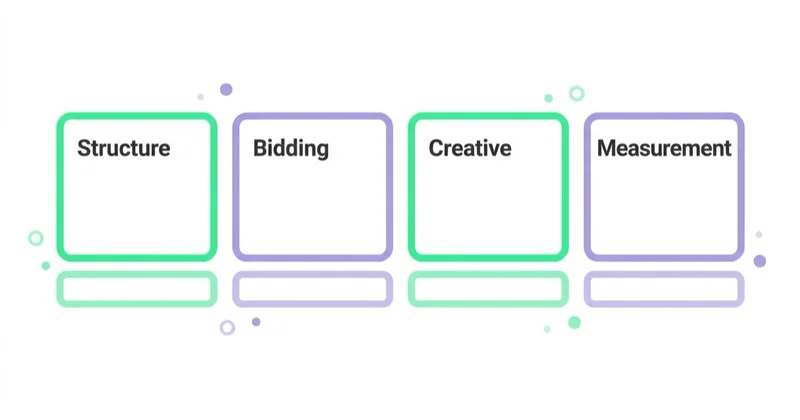
3. Account and campaign architecture
Structure should reflect meaningful differences in objective, budget control, language, geography, product economics and conversion signal. It should also provide enough data for automation to learn.
Typical decisions include:
- Search, Shopping, Performance Max, Demand Gen, YouTube or app campaign roles;
- brand demand versus broader acquisition measurement;
- market and language separation;
- high-margin, priority or capacity-limited product groups;
- shared versus isolated budgets and bidding portfolios;
- consolidation of fragments that cannot learn;
- negatives, brand controls, URL controls and content suitability;
- interaction between campaign types competing for similar queries.
There is no universal rule that every brand and non-brand query needs a completely separate campaign. The team needs a documented method to control and report branded traffic. Google currently provides campaign-level brand exclusions and negative keywords in Performance Max, plus account-level negatives for relevant Search and Shopping inventory. Those controls affect reach, so they should be tested and reviewed rather than enabled mechanically.
4. Search and query management
For Search and search inventory in other campaign types, managers assess which queries express relevant intent, which reveal new opportunities and which should be excluded.
The work may include:
- match-type and AI Max decisions;
- search-term and search-category analysis;
- negative keywords at the appropriate level;
- brand inclusion/exclusion strategy;
- competitor and trademark considerations;
- landing-page relevance and URL expansion controls;
- query themes informing ad, content and offer development.
Search-term reporting does not expose every query, and automation can use signals beyond manually selected keywords. Management should make decisions from the available evidence while acknowledging that visibility is incomplete.
5. Bidding and budget governance
Smart Bidding sets auction-level bids against configured goals. The operator remains responsible for the system around it:
- selecting the appropriate conversion or value objective;
- setting and revising CPA or ROAS targets where used;
- deciding which campaigns share a portfolio strategy;
- avoiding targets that constrain useful delivery or chase unprofitable volume;
- allocating budget across markets, products and funnel roles;
- planning seasonal or promotional changes;
- accounting for conversion delay and learning after material edits;
- documenting why budget moved.
Budget allocation is a commercial decision. An algorithm optimising one campaign does not know that another market needs strategic investment, that stock is about to run out or that a category has a different contribution margin unless those constraints are represented in inputs and structure.
6. Ecommerce product data
Shopping and Performance Max performance depends on Merchant Center and source product data. A management service may monitor the feed, but deep source-data engineering can be a separate scope.
Clarify who owns:
- item errors, warnings and policy disapprovals;
- price and availability consistency;
- GTIN, brand and category attributes;
- titles, descriptions, images and variants;
- custom labels used for commercial segmentation;
- promotions and shipping settings;
- Merchant Center account issues and appeals;
- feed rules, supplemental sources and API integrations.
“Feed optimisation included” should specify whether the provider only reports issues, edits rules in Merchant Center, or works in the ecommerce platform and product-information system to correct the source.
7. Creative and landing-page coordination
Search assets, Performance Max asset groups, Demand Gen and YouTube all need relevant creative. Management can include copy and briefs without including photography, design or video production.
Define:
- research and message development;
- number and type of concepts, assets and adaptations;
- who supplies product facts and approved claims;
- production and approval turnaround;
- language and market versions;
- landing-page recommendations versus design and development;
- test volume and replacement process;
- rights to source files and third-party content.
Creative “fatigue” is not governed by a universal monthly refresh. Replace or expand assets based on audience, reach, frequency, evidence and strategic need. A small Search account and a high-spend Demand Gen programme require very different production systems.
8. Experimentation and learning
Management should distinguish routine optimisation from controlled testing. A credible programme maintains a roadmap of hypotheses, prioritises them and records outcomes.
Possible tests include bidding, AI Max, landing pages, offers, message direction, customer-acquisition goals or campaign-type changes. Each needs a primary outcome, sufficient power, guardrails and a decision rule. See our guide to Google Ads experiments.
Not every account has enough volume for frequent A/B tests. In that case, the provider should say which questions remain uncertain rather than relabelling before-and-after changes as experiments.
9. Reporting, communication and governance
A useful report connects activity with decisions:
- business outcome and agreed platform diagnostics;
- change versus baseline, forecast or control;
- contribution of new versus returning customers where possible;
- spend and budget forecast;
- delivered work and experiment status;
- risks, data limitations and dependencies;
- decisions required from the client;
- next actions, owners and dates.
Meeting frequency should match the business. A launch or incident may require daily contact; a stable account may need a concise weekly update and deeper monthly review. Governance matters more than calendar volume.
A risk-based operating cadence
Fixed “daily/weekly/monthly” lists can reward unnecessary changes. Use monitoring and intervention thresholds.
Continuous or alert-based monitoring
- sudden spend or delivery deviations;
- conversion volume/value anomalies;
- account, campaign or item disapprovals;
- broken landing pages or stock/pricing mismatches;
- budget exhaustion during priority periods;
- unauthorised account changes.
Frequent operational review
- pacing against plan and forecast;
- query and placement quality;
- product or service mix;
- lead quality or returns feedback;
- experiment health;
- creative or landing-page issues;
- material competitor or demand changes.
Periodic strategic review
- targets and conversion values;
- campaign and portfolio structure;
- market/product allocation;
- customer acquisition versus retention;
- feed and creative roadmap;
- incrementality and attribution questions;
- upcoming seasonality and commercial events.
The scope should set response times for critical incidents, reporting deadlines and strategic review cadence. It should not require pointless edits simply so the change history looks busy.
What is usually included—and what must be explicit
There is no industry-wide standard package. Use this table as a scoping prompt, not an assumption.
| Work area | Often included in management | Frequently separate or limited |
|---|---|---|
| Campaign setup, structure and optimisation | Yes | New countries, brands or accounts may trigger a scope change |
| Budget pacing and bid-strategy governance | Yes | Finance forecasting beyond media may be separate |
| Search queries, negatives and account controls | Yes | Extensive competitor/legal review may be separate |
| Ad copy and asset management | Usually | Design, photography, UGC and video production |
| Merchant Center monitoring | For ecommerce scopes | Source-feed engineering, PIM and developer work |
| Conversion diagnostics | Usually | Full analytics rebuild, server-side tagging, CRM integration |
| Reporting and review meetings | Yes | Custom BI/data warehouse development |
| Landing-page recommendations | Often | UX research, design, copy and development |
| Experiments | Usually where volume permits | External research, CRO platform and development cost |
| Strategy outside Google Ads | Limited | Broader media, brand, SEO, CRM or commercial consultancy |
For every “included” item, specify volume and acceptance. “Creative included” may mean two text-ad iterations or a complete monthly video programme; the words alone do not reveal the value.
How much Google Ads management costs
There is no defensible universal fee because workload depends on more than media spend. Price is shaped by:
- number of accounts, markets, languages and legal entities;
- campaign types and catalogue or keyword complexity;
- ecommerce feed size and quality;
- lead-to-sale integration and conversion delay;
- creative and landing-page responsibilities;
- reporting, meetings and stakeholder count;
- regulatory and brand-risk requirements;
- launch, migration or turnaround intensity;
- seniority and composition of the team;
- expected response time and service coverage.
Ask providers to show the assumptions behind the quote. A stable single-market Search account and a multinational retail account with thousands of products, video inventory and offline sales should not be priced from media spend alone.
Common pricing models
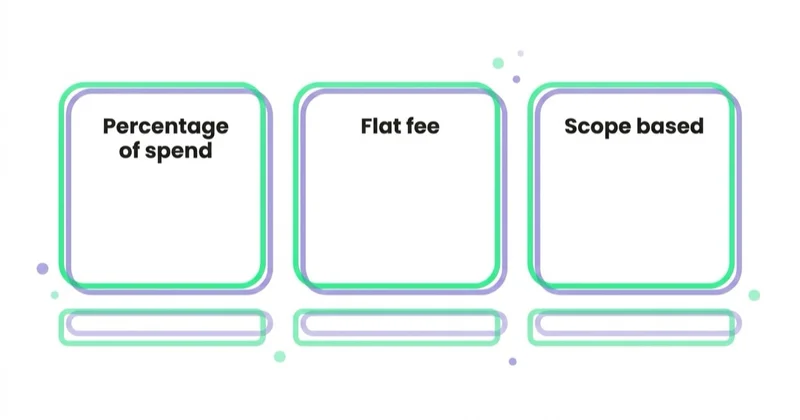
Flat monthly retainer
A fixed fee for an agreed scope and capacity. It provides predictability and does not automatically rise with spend. It needs a change mechanism for new markets, major launches or work that exceeds the assumptions.
Percentage of media spend
The fee increases with managed spend, often with a minimum. This can approximate growing responsibility and risk, but workload does not always scale linearly with spend and the provider earns more when budget increases. Require clear scope, tiers and a process that keeps budget recommendations independent of fee incentives.
Tiered fee
A fixed fee within spend or complexity bands. It can reduce month-to-month volatility while recognising that larger programmes require more governance. Check what triggers a tier change and whether services also change.
Hybrid fee
A base retainer plus a spend, project or performance component. It can fund core work while sharing upside. Performance components require precise definitions, baselines, exclusions, payment caps and treatment of seasonality, price, stock and organic demand.
Project plus ongoing management
A one-off charge covers audit, tracking, restructure or launch, followed by a lower recurring fee. This is transparent when initial remediation is substantial. Confirm which deliverables become client-owned and what recurring work begins after handover.
The arithmetic behind percentage fees
Do the calculation rather than comparing percentages in isolation. At a hypothetical monthly media budget of £50,000, a 10% fee is £5,000. If spend doubles to £100,000, the fee becomes £10,000. Ask what additional work and accountability the extra £5,000 buys. There may be a valid answer—more markets, creative, analysis or risk—but it should be explicit.
A lower percentage with a high minimum can cost more at the current budget than a higher percentage with no minimum. Model at the present spend, the expected spend and a downside scenario.
Calculate the total cost of running Google Ads
The management fee is only one component:
Total programme cost = Google media + management + creative + data/analytics + feed and development + tools + internal team time
Potential one-off costs include:
- account and measurement audit;
- campaign rebuild or migration;
- consent and tagging implementation;
- CRM/offline-conversion integration;
- product-feed remediation;
- landing pages and creative production;
- dashboard or data-warehouse work.
Ask which amounts are pass-through costs, whether the agency adds a markup, and who contracts with each supplier. Compare proposals over a realistic year rather than the first-month retainer alone.
How to compare two Google Ads management proposals
Normalise each proposal into the same table.
Scope and deliverables
- accounts, countries, languages and campaign types;
- onboarding, audit and launch deliverables;
- campaign, query, feed, creative and measurement responsibilities;
- number of concepts/assets and reports;
- experiment and strategic-planning expectations;
- explicit exclusions and change-request process.
Team and capacity
- named day-to-day lead and senior reviewer;
- relevant experience with the business model and markets;
- specialist access for data, feed, creative and policy;
- expected allocation and other responsibilities;
- subcontractors and offshoring where relevant;
- holiday, absence and incident cover.
Measurement and accountability
- commercial objective and target-setting method;
- primary conversions and value source;
- platform attribution versus business reporting;
- lead-quality or return/cancellation feedback;
- baselines, experiments and limitations;
- what the agency controls and what depends on the client.
Commercial terms
- fee model, minimum and billing frequency;
- what happens when spend, markets or workload change;
- one-off projects and third-party markups;
- notice period, exit support and data transfer;
- intellectual-property and working-file rights;
- liability and approval responsibilities.
A proposal that lists ten channels but cannot name the conversion value, client dependencies or delivery team is not more complete than a focused one.
Account ownership and access
The advertiser should have its own client account, billing visibility and at least two internal administrators where practical. Agencies should normally connect through a manager account rather than asking for shared credentials.
Google distinguishes manager-account ownership from ownership of client data. An owner manager can receive powerful administrative privileges, including managing users and links, but the client account still owns its data and can remove that ownership by unlinking. Google recommends giving a manager ownership only when those privileges are required.
Before signing, agree:
- who creates the client account and payment profile;
- whether the agency manager needs owner status or standard management access;
- who controls conversion actions, audiences and linked products;
- who may change billing and advertiser verification;
- how access is reviewed and removed;
- what is delivered at exit.
Read our detailed guide to account ownership when leaving an agency.
What to expect in the first 90 days
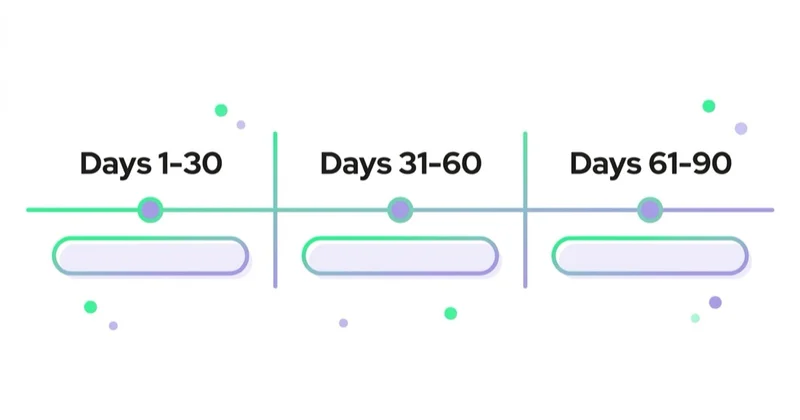
Days 1–30: access, baseline and risk
- confirm objectives, margins or lead values and constraints;
- audit account access, billing, policy and change history;
- validate primary conversion actions and data flows;
- review search coverage, campaign structure, feeds, assets and landing pages;
- identify critical issues and preserve what already works;
- agree the roadmap, reporting definitions and client dependencies.
Days 31–60: remediation and controlled change
- correct material measurement or policy issues;
- stop clear waste and resolve urgent feed/query problems;
- align conversion goals, values, budgets and campaign roles;
- implement prioritised changes in stages;
- establish creative, feed and sales-feedback workflows;
- launch experiments where volume and timing permit.
Days 61–90: learn and allocate
- assess changes after suitable learning and conversion lag;
- compare business outcomes with platform diagnostics;
- scale, revise or stop according to evidence and guardrails;
- document unresolved uncertainty;
- build the next-quarter forecast and test roadmap.
The exact pace depends on risk, data, conversion cycle and client implementation capacity. Rebuilding everything in week one can erase useful history and make the result impossible to attribute.
How to judge management quality
Good management is visible in reasoning and outcomes, not sheer edit volume.
Look for:
- conversion goals and values that can be explained commercially;
- a budget split tied to product, market and customer priorities;
- documented hypotheses and results;
- deliberate use of query, brand, URL and suitability controls;
- feed and creative dependencies with named owners;
- change history that matches reported work;
- reporting of uncertainty, attribution and business guardrails;
- timely escalation of tracking, stock, policy or sales-quality problems;
- clear recommendations for what not to change.
Warning signs include unexplained access, hidden billing, no agreed source for outcomes, reports that omit client dependencies, repeated large changes without evaluation, and guaranteed results.
The Google Ads change-history guide explains how to verify account activity without assuming every edit was valuable.
Common mistakes
| Avoid | Do instead |
|---|---|
| Comparing only the monthly fee | Compare total programme cost, scope, team and ownership |
| Treating “ongoing optimisation” as a deliverable | Define workstreams, cadence, volumes and acceptance criteria |
| Expecting daily manual changes | Require alert-based monitoring and evidence-led interventions |
| Assuming Smart Bidding removes strategic work | Govern objectives, values, budgets, boundaries and experiments |
| Marking every engagement as a primary conversion | Optimise to commercially meaningful outcomes |
| Assuming feed or creative work is included | Name the owner, output, volume and turnaround |
| Calling every percentage fee misaligned | Model incentives and require explicit workload/scaling logic |
| Giving the agency the only administrator login | Retain client admin access, billing control and exit rights |
| Applying one universal 90-day performance promise | Match evaluation to learning, conversion delay and business cycle |
How Space Ads manages Google Ads
We begin with the commercial objective and measurement inputs, then assess campaign architecture, search coverage, product data, creative, landing pages and budget as one operating system. The initial roadmap prioritises material risks and decisions rather than generating activity for its own sake.
Ongoing work combines alert-based monitoring, scheduled analysis and controlled experiments. Reporting distinguishes platform attribution, realised business outcomes and causal evidence, while making client dependencies—such as stock, sales follow-up, creative approval and development—visible.
The scope is defined around the actual account: markets, campaign types, data maturity, catalogue or lead complexity and required specialist work. That allows both sides to understand what the fee buys and when a new request changes the engagement.
FAQ
What does Google Ads management include?
It commonly includes commercial planning, conversion-goal governance, campaign setup and operation, query and brand controls, Smart Bidding oversight, budget allocation, ad copy and asset management, feed monitoring for ecommerce, testing and reporting. Production, development and deep data work may be separate, so the contract must state the boundary.
How much does Google Ads management cost?
There is no universal price. Cost depends on accounts, markets, campaign types, catalogue or lead complexity, data integration, creative volume, risk, service level and team seniority. Compare the total annual programme cost and explicit deliverables rather than a percentage or retainer alone.
Is the Google Ads management fee included in ad spend?
Usually no. Ad spend is paid to Google through the advertiser's billing setup; the management fee pays the provider. Creative, analytics, feed, landing-page and software costs may also be separate. The proposal should itemise them.
Which pricing model is best?
No model is always best. A flat fee offers predictability; a percentage can reflect larger responsibility but may outgrow workload; tiered pricing reduces volatility; hybrid models can share upside but need careful definitions. Choose the model whose assumptions and incentives fit the scope.
Do businesses still need Google Ads management with Smart Bidding?
Smart Bidding automates auction bids. It does not define profit, choose reliable conversion values, decide market budgets, fix product data, approve creative or determine whether attributed sales are incremental. Those remain management responsibilities.
How often should a manager change campaigns?
There is no useful universal frequency. Critical anomalies need rapid action, while bidding and structural changes may need stable observation. Judge the provider by monitoring coverage, reasoning, response and results—not a promised number of edits.
How long before Google Ads management improves results?
Some tracking, policy or obvious waste issues can be corrected quickly; bidding, creative, structure and downstream lead quality need longer observation. The evaluation window should reflect conversion lag, business cycles, test power and implementation dependencies. Guaranteed timelines are not credible.
Who should own the Google Ads account?
The advertiser should retain client-account administrator access, billing visibility and control of its data. An agency can connect through a manager account and may receive owner-manager privileges if genuinely needed, but those privileges and the exit process should be explicit.
What should a monthly Google Ads report contain?
It should show the agreed business outcome, platform diagnostics, spend versus plan, material changes, experiment status, risks, data limitations, client dependencies and the decisions required next. Impressions and clicks alone do not show commercial value.
Key takeaways
- Google Ads management is a commercial operating system, not bid adjustment or dashboard production.
- Scope measurement, campaigns, queries, budgets, feed, creative, experiments and reporting explicitly.
- Let risk and decisions determine cadence; activity volume is not quality.
- Compare media, management and enabling costs as one programme.
- Evaluate fee models by assumptions, incentives and scale—not a headline percentage.
- Retain client access, billing visibility, data and exit rights.
- Use the first 90 days to establish truth, fix material issues and create controlled learning.
Learn more about our Google Ads management and Google Ads audit services.
Sources and further reading
- About Smart Bidding — Google Ads Help
- About conversion measurement — Google Ads Help
- Updates to enhanced conversions settings — Google Ads Help
- Brand suitability and controls in Performance Max — Google Ads Help
- Negative keywords in Performance Max — Google Ads Help
- Manager-account ownership of client accounts — Google Ads Help
- How agencies bill: retainer, project or performance
- First 90 days of Google Ads
Continue reading
Gemini Ad Formats: When the Ad Is Generated, Not Written
Google is testing and announcing Gemini-powered ad experiences across AI Mode and Search. Learn what each format does, what remains uncertain and how to prepare data, content and measurement.
Google Ads Experiments: Testing That Produces a Decision
A useful Google Ads experiment starts with a decision, an effect worth detecting and enough statistical power. Learn how to choose the test, split, metric and interpretation.
Google Ads Account Suspended: Why It Happens and What to Do
A Google Ads suspension requires evidence, not panic. Learn how suspension differs from a hold or pause, what the strike system covers and how to diagnose and appeal safely.