Choosing an email marketing agency means evaluating a lifecycle programme, not only a design portfolio. The partner may be responsible for acquisition consent, campaign and automation strategy, copy and design, data integrations, sender compliance, experimentation and reporting. The right scope depends on the business model and internal team.
Email can contribute to retention, conversion, education and customer service, but it is not automatically incremental or high-margin. A sound agency distinguishes attributed revenue from additional revenue and balances short-term sends with subscriber trust, legal requirements and long-term customer value.
TL;DR
- Begin with lifecycle economics. Define repeat purchase, qualified pipeline, activation or renewal goals and the costs and guardrails around them.
- Balance flows and campaigns. Automation is valuable for repeatable triggers; broadcasts remain important for launches, promotions, education and editorial communication.
- Require sender and consent competence. Authentication, unsubscribe, volume management, complaints and market-specific direct-marketing rules belong in the operating model.
- Segment only when it changes a decision. RFM and behavioural groups can help, but unnecessary complexity reduces sample size and increases production and QA risk.
- Maintain advertiser control. The business should administer the platform, sending domain, consent records, integrations, templates and data exports.
- Measure subscriber and business outcomes. Include complaints, unsubscribes, qualified revenue, margin and cohort behaviour—not only opens or attributed revenue.
- Put scope and rights in writing. Clarify strategy, campaigns, flows, copy, design, coding, SMS, deliverability support, tools, approvals and source files.
Judge the agency on revenue, not on how it looks
Design matters because it affects comprehension, accessibility and brand recognition, but appearance alone does not demonstrate commercial impact. Ask how the agency selects the audience and offer, handles control groups, accounts for seasonality and evaluates downstream outcomes. A case study should state baseline, period, cohort, attribution method and what else changed.
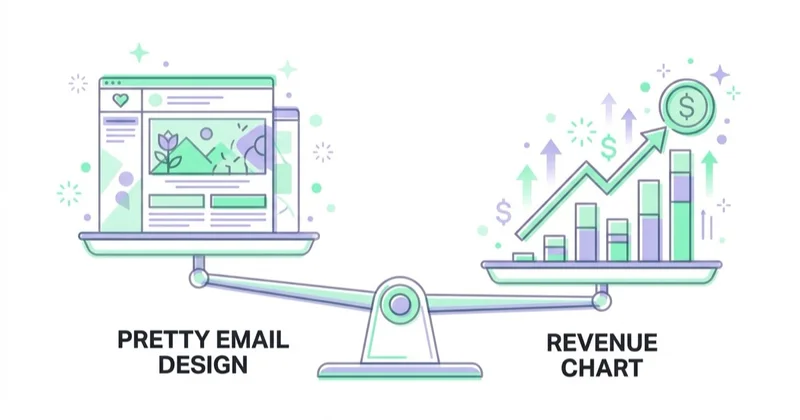
Do not make “email share of revenue” the objective by default. The ratio can rise because other channels decline or because the platform claims more orders under a longer attribution window. Define the actual business change: more profitable repeat purchases, activated users, qualified opportunities or reduced churn. Content and brand communication may support those goals even when no immediate click receives credit.
Flows: the question that reveals everything
Flows are automated sequences triggered by behaviour, profile data or time. Welcome, browse or cart recovery, post-purchase, replenishment and win-back are common examples, but they are not mandatory in every business and do not universally generate most email revenue. Prioritise them using reachable audience, customer need, expected value, consent and implementation effort.
Good answers cover entry and exit rules, frequency conflicts, purchase suppression, inventory and price changes, localisation, consent by channel, error monitoring and a measurement plan. SMS permission is distinct and market-dependent. Recovery messages should not promise stock or discounts that the store cannot honour. See Klaviyo flow planning and abandoned cart flows.
Deliverability: the skill nobody asks about
Deliverability is the ability to reach receiving systems and inboxes consistently; no agency can guarantee inbox placement. The team should understand authentication, DNS, sending infrastructure, complaint and bounce monitoring, volume changes, unsubscribe handling and provider diagnostics.
Gmail requires SPF or DKIM for all senders to personal Gmail accounts and adds SPF, DKIM, DMARC, alignment and one-click-unsubscribe requirements for qualifying bulk senders. Requirements vary by mailbox provider and can change. Ask who owns DNS changes, monitors Postmaster or provider feedback, investigates deferrals and controls sudden volume increases. A “sunset” policy should suppress or change treatment of persistently unengaged recipients according to evidence and legal retention needs—not delete people automatically.
Segmentation: the amateur tell
Segmentation is useful when a meaningful difference in need, eligibility, language, lifecycle or value changes the message or offer. RFM is one possible model, not a badge of quality. A small list divided into many segments can create weak samples, duplicated work and inconsistent customer treatment.
Ask the agency to justify each proposed segment, data source, refresh rule and expected decision. It should also explain exclusions, frequency caps and priority when a person qualifies for several flows. Sometimes one well-designed campaign to a broad eligible audience is the correct choice.
Glossary
- Flow / automation — a behaviour-triggered email/SMS sequence, as opposed to a manual campaign.
- Deliverability — the ability to reach recipient mail systems and inboxes; influenced by authentication, reputation, engagement, content, infrastructure and recipient controls.
- Sender authentication — SPF, DKIM and DMARC records that prove the sender is legitimate.
- Sunset policy — rules for re-engaging, suppressing or changing treatment of persistently unengaged recipients.
- RFM — segmentation by recency, frequency and monetary value.
- Revenue per recipient — attributed revenue divided by delivered or intended recipients, depending on the platform definition; not a measure of incrementality by itself.
- Attributed revenue — revenue the email platform credits to a message; needs sanity-checking against store revenue.
Ownership: your list, your platform, your data
“Owned channel” does not mean unrestricted ownership of personal data or guaranteed access to an inbox. The business controls the customer relationship subject to consent, privacy, platform and mailbox-provider rules. It should be the platform customer, control the sending domain and maintain internal administrators and data-processing records.
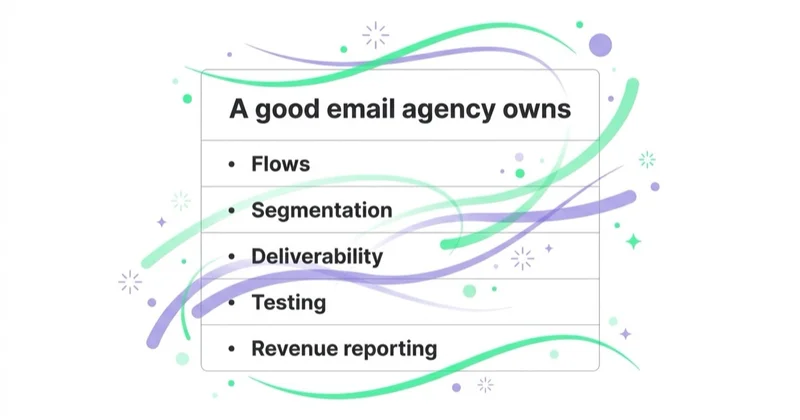
Before signing, test what can be exported: profiles, consent timestamps and source, suppression status, templates, flow logic, reports and source design or code files. Define secure transfer, deletion of agency copies and removal of access at offboarding. See who owns your accounts and data when you leave an agency.
Red flags and green flags
| Red flag | Green flag |
|---|---|
| Shows design without measurement context | Connects creative, audience, offer and business outcome |
| Promises more sends as the strategy | Explains lifecycle priorities, capacity and guardrails |
| Says “the platform handles deliverability” | Covers DNS, sender rules, complaints, volume and diagnostics |
| Uses RFM without a decision it changes | Justifies segments, conflicts and sample size |
| Builds in an agency-controlled account | Business administers platform, domain and integrations |
| Reports only platform-attributed revenue | Uses cohorts, contribution and holdouts where feasible |
| Opens every abandoned-cart flow with a discount | Leads with reminders; discount last, if at all |
How the priorities shift by business type
The core criteria hold, but emphasis moves with the model.
- Ecommerce (repeat purchase). Flows and retention dominate; ask about post-purchase, replenishment and win-back, and about reading revenue on cohorts.
- Ecommerce (considered / high-AOV). Segmentation and nurture matter more than volume; the agency should tailor to research-heavy buyers.
- B2B / SaaS. Email is nurture and lifecycle, tied to the CRM and sales follow-up; ask how they connect email to pipeline, not just opens. See CRM and marketing automation.
- Content / media. Engagement and list growth matter, but deliverability and sunset discipline become critical at scale.
How Space Ads approaches email
Our email work starts with lifecycle objectives, consent and data quality, sender configuration and the existing campaign and flow map. We prioritise opportunities by reachable audience, expected commercial value, customer experience, implementation effort and measurement feasibility.
We reconcile platform attribution with store or CRM outcomes and contribution economics, and use control groups where the platform, volume and decision allow. The client administers its account and domain, while access, source files and offboarding are documented. The work lives in email marketing, marketing automation and analytics.
Questions to ask before you sign
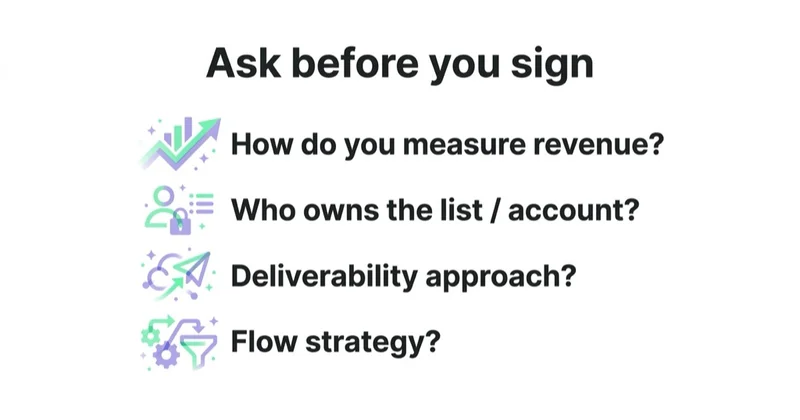
- Which lifecycle and business outcomes will you own? Define metrics and guardrails before the send calendar.
- Which flows and campaigns would you prioritise, and why? Expect audience, value, effort and risk—not a generic checklist.
- How will you verify consent and channel eligibility by market? Ask how source and withdrawal are recorded.
- What sender requirements will you monitor? Cover authentication, alignment, complaints, bounces, unsubscribe and volume changes.
- What decision does each segment change? Avoid complexity without a distinct treatment or hypothesis.
- How will you estimate incremental value? Ask about holdouts, cohort maturity and commercial contribution.
- What exactly is included? List campaign, flow, copy, design, coding, SMS, analytics, meetings, tools and source files.
- How do we leave? Document exports, knowledge transfer, access removal and deletion of agency-held data.
Common mistakes buyers make
Common mistakes include comparing retainers without production scope, paying a percentage of attributed email revenue without auditing the attribution window, overlooking consent and source-file rights, and confusing a larger send calendar with growth. Another is using open rate as the main quality metric despite privacy features that can distort opens. A limited diagnostic or pilot with acceptance criteria can expose these gaps before a long commitment.
FAQ
What does a good email marketing agency actually do?
A good agency designs the lifecycle programme, builds appropriate campaigns and automations, protects consent and sender requirements, maintains data and integrations, and measures customer and business outcomes. It cannot guarantee inbox placement or incremental revenue, but it should show how both are monitored and tested. Design, copy and production quality remain part of the system.
How much should an email marketing agency cost?
Pricing varies by market, database size, languages, channels and production scope. Compare written quantities and responsibilities for campaigns, flows, copy, design, coding, strategy, deliverability support, reporting, tools and SMS. If fees depend on attributed revenue, define the attribution window, eligible messages, refunds and baseline; otherwise the incentive can reward claiming existing demand.
Should I hire an email agency or do it in-house?
Map the required capabilities: lifecycle strategy, subject knowledge, copy, design, platform implementation, data, legal review, deliverability operations and analytics. In-house can be strongest where brand knowledge and speed dominate; an agency can add specialist capacity; a hybrid can keep strategy and approval internal while outsourcing production or technical work. Choose by the actual gap and management cost.
What questions should I ask an email marketing agency?
Ask about lifecycle priorities, consent by market, sender requirements, event and profile data, segment logic, conflict and frequency rules, measurement, exact deliverables, account administration and offboarding. Request an anonymised example that shows the original hypothesis, implementation, result and next decision—not only finished designs.
How do I know if my email agency is doing a good job?
Use an agreed scorecard: incremental or holdout lift where feasible, qualified revenue or pipeline, contribution, repeat or activation cohorts, complaints, unsubscribes, bounces and operational quality. Opens and clicks can help diagnose messages but are not sufficient business outcomes. Review what the agency learned and changed, not only the reporting totals.
Who should own the email list and platform account?
The business should be the platform customer, control the sending domain and maintain internal administrators. Personal data remains subject to consent, privacy and retention obligations; it is not property to use without restriction. The contract should cover processor roles, access, exports, source files, secure deletion and knowledge transfer.
Key takeaways
- Assess the whole lifecycle system: consent, data, campaigns, flows, creative, sender health and measurement.
- Prioritise automation and broadcasts by audience need and expected value, not universal revenue claims.
- Require current mailbox-provider knowledge and market-specific direct-marketing controls.
- Keep business control of the platform and domain, with data rights and offboarding documented.
- Use platform attribution for diagnosis and holdouts or experiments where incremental value must be estimated.
Sources and further reading
- Gmail — Email sender guidelines (authentication, spam rates)
- Gmail — Email sender guidelines FAQ
- UK Information Commissioner's Office — Direct marketing by electronic mail
- W3C Web Accessibility Initiative — Images and text alternatives
Continue learning
Continue reading

SMS & RCS Marketing: Revenue From a List You Already Own
SMS and RCS are permissioned direct channels with provider costs and platform dependencies. This guide explains consent, suppression, measurement, RCS capabilities and safe fallback design.

Lead Generation for Online Courses and Education Providers
Education lead generation must connect an honest promise with learner fit, enrolment and course starts—not just form volume. Learn how to design the journey, evidence claims and measure each intake.
Klaviyo Flows Every Ecommerce Store Needs (and the Order to Build Them)
Klaviyo flows automate relevant email and SMS messages around key customer actions. This guide explains which flows to prioritise, how to set their triggers and exclusions, and how to measure their real contribution to revenue.