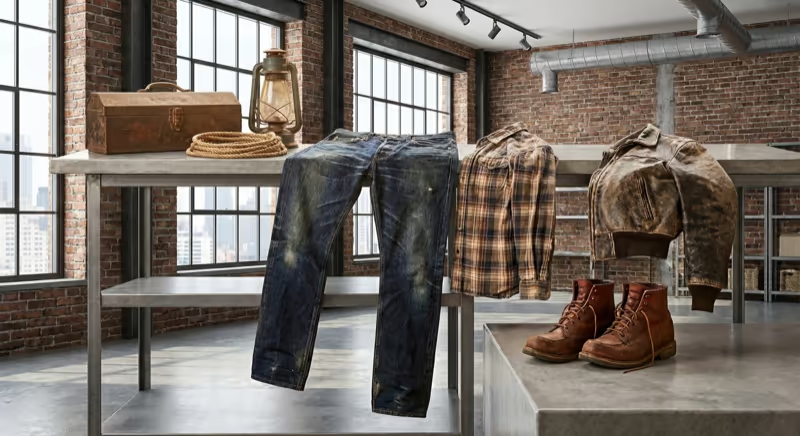
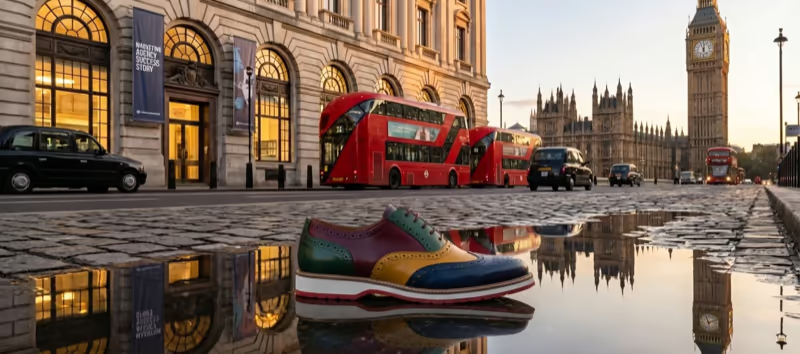
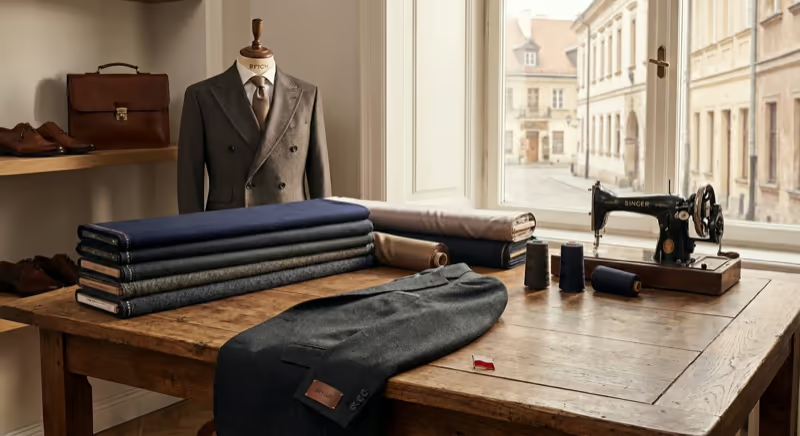
A fashion marketing agency runs the paid acquisition and growth for a clothing or footwear brand — media buying across Google, Meta and TikTok, product feed and creative, measurement and reporting — as an outside team rather than an in-house hire. For a premium or luxury brand, choosing one is less about the pitch deck and more about three things the pitch rarely covers: how the agency gets paid (and whether that aligns with your profit), how it measures (platform-reported ROAS versus real incremental revenue), and whether it understands that the right answer for a luxury brand is often less discounting — and sometimes less spend — not more. This is a buyer's guide to all three.
TL;DR
- A performance/paid-media agency is not a brand or PR agency. It owns media buying, feed, creative-for-performance, measurement and reporting — not your brand identity or press. Know which one you're hiring.
- In-house vs agency is the wrong question. 82% of large advertisers now have an in-house team, but 92% of them still use an external agency — the real model is hybrid. Media buying is the function brands find hardest to in-house well.
- In-housing under-delivers against its own promise. UK advertisers expected 93% cost-efficiency and 93% speed gains; they reported achieving 60% and 40%. The gap is the case for a good agency.
- How the agency is paid shapes what it recommends. A percentage-of-spend fee rewards more spend — the opposite of what a full-price luxury brand usually needs. Understand the incentive before the deck.
- The luxury-specific tests almost no one applies: brand suitability (not just safety), price-integrity discipline (an agency that reaches for discounts is wrong for premium), a real brand-plus-performance balance, and measurement that survives a long purchase cycle.
- Red flags: guaranteed ROAS, platform-reported numbers with no reconciliation, long lock-ins, the senior pitch team you never see again, and any agency that treats Google or Meta as the enemy.
What a fashion marketing agency actually does
"Agency" covers very different jobs, and hiring the wrong type is the most common and most expensive mistake. Three categories get confused:
A brand or creative agency builds identity, campaigns and art direction — the look, the lookbook, the film. A PR or communications agency manages press, talent and earned media. A performance or paid-media agency — the kind this guide is about — runs the commercial engine: paid acquisition across Google, Meta and TikTok, the product feed, performance creative, measurement, and the reporting that ties spend to revenue. The three overlap at the edges, but their core skills and their KPIs are different. A creative agency optimises for a feeling; a performance agency optimises for contribution.
For a premium fashion or footwear brand, a paid-media agency's real scope is narrower and deeper than "we do marketing." It is: own the feed and Merchant Center, structure the account so brand and performance don't cannibalise each other, run creative testing, reconcile platform numbers against the business, and protect the brand's context while it does all of that. If an agency's pitch is mostly mood boards, you're talking to the wrong category.
A quick glossary
- Retainer — a fixed monthly fee for an agreed scope, independent of how much you spend on ads.
- Percentage of spend — a fee calculated as a share of your media budget, so the agency's revenue rises with your spend.
- Performance / commission — payment tied to results (cost per acquisition, revenue share), usually requiring the agency to control more of the funnel.
- Hybrid — a smaller base fee plus a reduced percentage or a performance bonus; frequently the modern default.
- In-housing — building a marketing team inside the brand instead of (or alongside) an agency.
- Incrementality — the revenue a campaign actually caused, measured against a control group, versus the conversions a platform claims credit for.
- Blended ROAS / CAC — return or acquisition cost calculated across all channels against one reconciled revenue number, not each platform's self-report.
- Brand safety vs brand suitability — safety is avoiding harmful content; suitability is appearing only in environments appropriate to a premium brand. They are not the same bar.
In-house, agency, freelancer or fractional — the real decision
The framing "should we hire an agency or build in-house?" is a false binary, and the data says so. In-housing has climbed steadily — among large US advertisers, 82% now have an in-house agency, up from 58% in 2013 and 42% in 2008. But the same research found 92% of those brands still use an external agency. In-house and agency are complements, not substitutes; the question is what each should own.
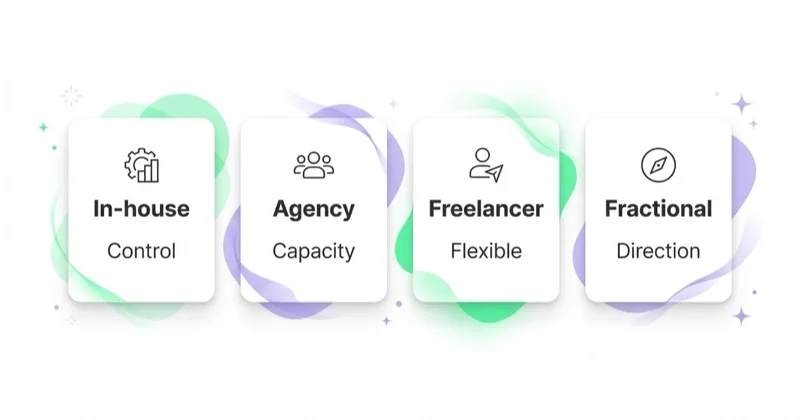
It matters because in-housing tends to under-deliver against its own business case. In a UK survey of large, retail-heavy advertisers, the gap between what brands expected from in-housing and what they reported achieving was stark:
| What in-housing promised | Expected | Achieved |
|---|---|---|
| Cost efficiency | 93% | 60% |
| Speed / nimbleness | 93% | 40% |
| Greater control | 90% | 53% |
| Less talent turnover | 47% | 20% |
The same study found only 42% see in-housing as a viable alternative to agencies — the prevailing belief is a hybrid model — and that media buying is the function brands find least suitable to bring in-house, even as they try to. That is the honest case for an agency: brand strategy, art direction and the customer relationship usually belong inside; cross-platform media buying, feed operations, and measurement rigour are where outside specialists and tooling earn their place.
Cost decides the rest. A senior in-house paid-media manager runs to roughly $134,000 a year in the US (around £32,000 for a UK PPC manager, on dated figures), and fully loaded — benefits, tools, recruiting, management — that's closer to 1.4× the base before a single ad runs. For that you get one person, on your channels only, and a single point of failure if they leave. An agency trades that for breadth across channels, elastic capacity for a fashion brand's drop-and-sale calendar, and benchmarks from other accounts — at a variable cost. There's also a quiet macro pressure worth naming: marketing budgets have fallen to about 7.7% of company revenue, and roughly a fifth of CMOs now say AI has reduced their reliance on outside agencies. The agencies that survive that are the ones doing work AI and a junior hire can't.
A rough decision rule: in-house the brand, the creative direction and the customer data; outsource the media buying, feed and measurement until your spend is large and stable enough that a loaded salary beats an agency fee — and even then, most keep a hybrid.
How agencies charge — and why it shapes their advice
Fee models look like a procurement detail. For a luxury brand they are a strategy detail, because how an agency is paid quietly shapes what it recommends.
| Model | How it works | Watch for |
|---|---|---|
| Retainer (flat monthly) | Fixed fee for agreed scope | Scope creep, or paying for hours not outcomes |
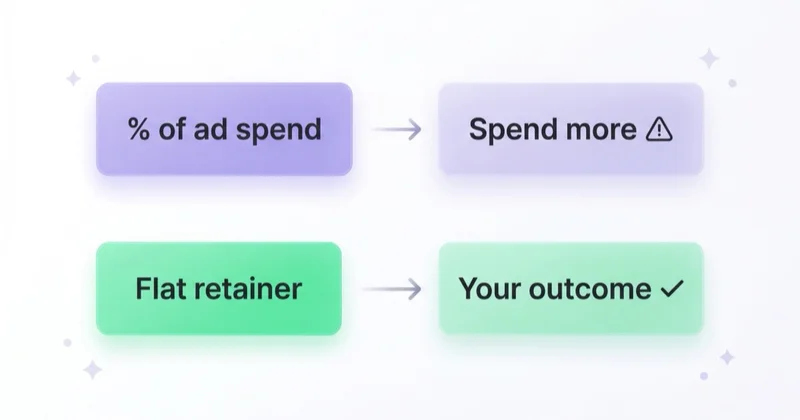
| Percentage of ad spend | Fee scales with your media budget | The incentive to spend more (below) |
| Performance / commission | Paid per result | Agency wanting control of funnel and landing pages |
| Hybrid | Base fee + reduced % or bonus | A diluted version of the %-of-spend incentive |
| Project | Flat fee for a defined deliverable | Good for audits/migrations, not ongoing management |
The fee bands you'll see quoted — often "10–20% of ad spend" — are industry convention, not measured benchmarks, so treat any specific number as a starting point for negotiation rather than a market rate. What deserves real scrutiny is the percentage-of-spend incentive. As Robert Glazer, who founded a large performance agency, has put it plainly: a fee "based on percentage of ad spend… motivates agencies to increase their revenue by spending more on paid advertising… Even if a customer could attract the same amount of revenue with a smaller ad spend, the agency may keep ad spend high to protect its profits."
For a mass-market brand that's a mild misalignment. For a luxury brand it is a direct conflict, because the right move is frequently to spend less at full-price margin, not more — and a percentage-of-spend agency is paid to do the opposite. This doesn't make the model unusable; it makes it something to price in. Ask any agency, including this one, what stops them recommending you spend more than you need to.
How to evaluate an agency
Most "how to choose an agency" advice stops at goals, portfolio and culture fit. Those matter, but they're table stakes. The criteria that actually separate a good premium-fashion agency from an expensive one are the ones rarely on the checklist:
- Category-specific proof, not "we've done e-commerce." Ask for premium or luxury fashion and footwear accounts they run now, and ask what full-price sell-through and AOV did — not just ROAS.
- Measurement rigour. Do they reconcile platform-reported ROAS against incremental revenue (geo-holdouts, conversion lift, MMM)? Are they returns-aware — does their reporting net out the returns that hit fashion hardest, or quote gross ROAS? A platform's self-reported number is not the business's number.
- Who actually does the work. The senior team in the pitch is often not the team on your account after signing. Contract for named people and ask to meet the pod.
- Account and data ownership. Who owns the ad accounts, pixels, audiences, feeds and creative if you part ways? The right answer is "you do."
- Reporting transparency. Ask to see a real, redacted monthly report before signing. Does it lead with profit and contribution, or with impressions?
Red flags
- Guaranteed results. No credible operator guarantees ROAS on auction-based media. A guarantee is a sales tactic, not a capability.
- Vanity metrics as performance. Impressions, reach and "engagement" presented as outcomes.
- Platform-reported ROAS with no reconciliation. Each platform attributes results inside its own rules and windows, so the number needs to be checked against GA4, ecommerce data, returns and incrementality. No mention of holdouts or reconciliation is a measurement red flag.
- Long lock-ins with no break clause. Confidence doesn't need a 12-month handcuff.
- The disappearing senior team. Impressive pitch, junior delivery.
- Anyone who fights the platforms. Treating Google or Meta as adversaries — "panels lie," "secret tactics they don't want you to know" — signals someone who doesn't operate the systems well. Operators work with the platforms; the edge is in how you run them, not in distrusting them.
- Opaque fees. Undisclosed markups, media arbitrage, or pure percentage-of-spend with no efficiency incentive.
What's different for a luxury or premium brand
This is the part most agency-selection advice skips entirely, and it's where a premium brand should concentrate its scrutiny.
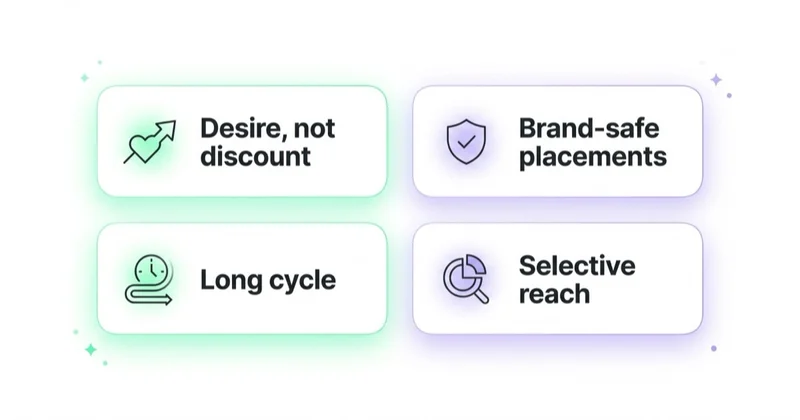
Brand suitability, not just brand safety. Programmatic and broad automated campaigns can place a luxury ad next to content that quietly cheapens it — the classic luxury handbag beside a low-quality or distressing article. Brand safety (avoiding harmful content) is the floor; brand suitability (appearing only in premium-appropriate environments) is the bar. It's a real barrier, too: in one European study, 31% of advertisers named brand safety and media quality as a key obstacle to programmatic investment. A good luxury agency uses allowlists, private deals and publisher vetting, and configures Performance Max placement and brand controls deliberately — not open-exchange spray.
Price-integrity discipline. An agency that reaches for a discount code to hit its ROAS target is the wrong agency for a luxury brand. Discounting trains customers to wait for sales and erodes the brand equity that justifies the price — and in a contracting luxury market where margins are already under pressure, that's expensive in two directions. The right answer is usually to build desire, not buy volume.
A real brand-plus-performance balance. Pure last-click activation cannibalises the brand demand someone else built. The well-documented effectiveness benchmark is roughly 60% brand-building to 40% activation — and premium brands skew further toward brand, because brand-building reduces price sensitivity. An agency that only talks lower-funnel ROAS doesn't understand a luxury brand's economics.
Measurement that survives a long cycle. Luxury is considered over weeks and months. Last-click attribution under-credits the upper funnel and brand search that did the early work. The agency should measure with longer windows, incrementality and marketing mix modelling — not a 7-day click window.
Questions to ask a prospective agency
A practical shortlist — the answers separate operators from order-takers:
- Show me two or three premium fashion or footwear accounts you run now. What did full-price sell-through and AOV do, not just ROAS?
- Who specifically will work on my account day to day — and can I meet them?
- How do you reconcile platform-reported ROAS with real incremental revenue? Have you run a geo-holdout or lift test?
- How do you handle returns in your performance numbers — net contribution or gross ROAS?
- What's your fee model, and if it's percentage of spend, what stops you recommending I spend more than I need to?
- Tell me about a time you told a client to cut spend or pause a channel.
- What's your position on discounting for a premium brand?
- Who owns the ad accounts, pixels and creative if we part ways?
- What's the contract length and the exit clause?
How we'd answer those questions
It's only fair to hold ourselves to the list above. We run as a paid-acquisition team across Google, Meta and TikTok for consumer and premium brands, and the work is less "running ads" than operating the system underneath them: daily audits across 25+ client accounts, roughly 14 million data points analysed a month through Space Ads OS, and daily reconciliation between platform numbers and the business so the budget lands where it actually delivers rather than where the last click fell.
On the work itself, the pattern in premium fashion is consistent: product data, measurement, brand suitability and returns-aware economics usually decide more than another round of lower-funnel optimisation. Public examples include Philipp Plein, Plein Sport, Billionaire and ZAXY, where the work sits across channels, feed quality, analytics and ecommerce reporting. On fit, we're deliberately selective. We work best with brands where paid is already meaningful and the scaling decisions carry real financial weight; if you're at the stage where every euro of spend still matters individually, we'll say so on the first call rather than take the retainer. If that's the kind of partner you're weighing, our luxury marketing agency practice — and the broader fashion and footwear paid media work behind it — is the place to start.
In short
- A fashion marketing agency runs paid acquisition, feed, creative and measurement — it's a different job from a brand, creative or PR agency.
- In-house vs agency is a false binary: most large brands run both, and media buying is the function hardest to in-house well.
- In-housing routinely under-delivers against its cost, speed and control promises — that gap is the case for a good agency.
- How an agency is paid shapes its advice; percentage-of-spend rewards more spend, which is the wrong incentive for a full-price luxury brand.
- For premium brands, weight your scrutiny toward brand suitability, price-integrity discipline, brand-plus-performance balance, and long-cycle measurement.
- Ask about incrementality, returns-aware reporting, who does the work, and account ownership — and treat guarantees and platform-bashing as red flags.
FAQ
What does a fashion marketing agency do?
A fashion (performance) marketing agency runs a clothing or footwear brand's paid acquisition and growth as an outside team: media buying across Google, Meta and TikTok, product-feed and Merchant Center management, performance creative, measurement and attribution, and reporting that ties spend to revenue. It's distinct from a brand or creative agency (identity and art direction) and a PR agency (press and earned media), though the three often work alongside each other.
Should a fashion brand hire an agency or build an in-house team?
Usually both, in some mix. Among large advertisers, 82% have an in-house team but 92% still use an external agency — the dominant model is hybrid. Brand strategy, creative direction and customer data tend to belong in-house; cross-platform media buying, feed operations and measurement are where an agency's breadth and tooling pay off. In-housing media buying specifically is what brands find hardest to do well.
How much does a luxury or fashion marketing agency cost?
It depends on the model. Retainers are a fixed monthly fee; percentage-of-spend fees scale with your budget (the often-quoted "10–20% of ad spend" is industry convention, not a measured benchmark); performance and hybrid models tie some pay to results. For comparison, a senior in-house paid-media manager costs roughly $134,000 a year in the US before benefits and tools — which is part of why many brands keep media buying with an agency until spend is large and stable.
What's the catch with percentage-of-spend agency fees?
The incentive. When an agency is paid a share of your media budget, its revenue rises when your spend rises — so it's structurally rewarded for recommending more spend, even when the same revenue could be had for less. For a luxury brand, where the right move is often to spend less at full-price margin, that's a direct conflict. The model is workable, but ask explicitly what stops the agency from inflating spend.
How do I choose a luxury fashion marketing agency?
Look past the pitch deck. Ask for premium fashion accounts they run now and what full-price sell-through and AOV did; check whether they reconcile platform ROAS against real incremental, returns-adjusted revenue; confirm who actually does the work after signing; and test their price-integrity discipline (do they reach for discounts?) and brand-suitability controls. The agency's fee model, measurement rigour and luxury judgement matter more than its portfolio gloss.
What are the red flags when hiring a marketing agency?
Guaranteed ROAS, vanity metrics presented as performance, platform-reported numbers with no incrementality or reconciliation, long lock-in contracts, a senior pitch team that vanishes after signing, opaque fees or undisclosed markups, and any agency that positions itself against the ad platforms rather than operating them well. For luxury specifically, an agency that defaults to discounting is a red flag in itself.
What questions should I ask a fashion marketing agency before signing?
Ask who will do the day-to-day work and to meet them; how they reconcile platform ROAS with incremental revenue; how they handle returns in reporting; what their fee model is and what stops them inflating spend; for an example of when they told a client to cut spend; their stance on discounting for a premium brand; who owns the accounts and creative on exit; and the contract length and break clause.
Sources and further reading
- ANA — The Continued Rise of the In-House Agency (2023)
- ISBA / Alchemists / CvE — State of In-housing Report 2023 (UK)
- Gartner — 2025 CMO Spend Survey
- Robert Glazer / MarketingProfs — Your agency's conflicts of interest may be costing you money
- IAB Europe — Attitudes to Programmatic Advertising 2024
Continue learning
- Luxury fashion marketing: how premium brands build desire (not discounts)
- Google Ads for fashion e-commerce: Search, Shopping, Performance Max & Demand Gen
- Incrementality testing and geo experiments with Meta, Google and Meridian
- Marketing mix modelling: Meridian, Robyn and MMM in 2026
- Marketing reporting in 2026: cross-channel client reports
Continue reading
How to Choose an Ecommerce PPC Agency (Margin, Feed and Blended Truth)
Choose an ecommerce PPC agency by examining product-data operations, contribution economics, customer acquisition, PMax controls, measurement, access and scope—not a headline ROAS alone.
How to Structure a Modern Marketing Team (In-House, Agency, Fractional)
There is no universal modern marketing org chart. Build the team from business outcomes, recurring work, decision rights and capacity, then choose the right mix of employees, agencies, freelancers and fractional leadership.

How to Hire a Digital Marketer — or Whether You Should at All
Before hiring a digital marketer, answer the prior question: should this be a hire, or an agency or fractional lead? Then hire for an outcome, not a task list — the most common mistake is one generalist expected to run every channel deeply, which sets the person up to fail.