A marketing request for proposal (RFP) asks shortlisted agencies to explain how they would approach a defined assignment, who would deliver it, what it would cost and why they are qualified to do it. A good RFP creates enough consistency to compare proposals without forcing every agency into an identical solution.
The distinction matters. If the brief is vague, agencies fill the gaps with different assumptions and the client ends up comparing unlike scopes, teams and fee models. If it is over-engineered, the process can reward compliance and presentation polish rather than judgement, working chemistry and the ability to create business value.
The aim is therefore not simply to collect “comparable answers”. It is to make a confident, evidence-based choice about a potential partner while respecting the time, intellectual property and information of everyone involved.
TL;DR
- Decide first whether an agency review is necessary. A formal pitch is expensive for both client and agencies, and it will not fix an unclear internal mandate.
- Define the business problem, desired outcomes and constraints before prescribing channels or deliverables.
- Give every agency the same baseline: business context, current performance, budget range, scope, data pack, timetable and decision criteria.
- Distinguish an RFI used to qualify a wider field from an RFP sent to a genuine shortlist.
- Keep speculative work proportionate. A full strategy or audit without access and research is unlikely to predict the quality of the eventual engagement.
- Score evidence, proposed team, operating model, commercial fit and working chemistry — not just the pitch deck.
- Address conflicts, data access, intellectual property, contract principles and transition requirements before the final decision.
- Tell unsuccessful agencies promptly and provide a useful debrief.
Before writing an RFP, decide whether you need one
Industry guidance from the WFA, IPA and ISBA starts before the pitch. The first question is whether changing or adding an agency is the right response to the problem.
A structured review may be justified when:
- the required capability does not exist in the current model;
- the assignment, markets or channels have materially changed;
- performance or service problems remain unresolved after a documented improvement process;
- governance requires a competitive review;
- the contract is ending and the business needs to test the market;
- the company is consolidating or separating agency responsibilities.
An RFP may be the wrong tool when stakeholders have not agreed on the objective, the incumbent has no realistic chance of retaining the work, funding is not approved, or the company only wants free ideas and market intelligence. In those cases, fix the internal decision or commission a defined discovery project first.
The WFA and VoxComm’s 2025 agency-selection principles place greater emphasis on partnership, stakeholder alignment, people, wellbeing and transition — not only on pitch mechanics. That is a useful test: will this process help identify a team the business can work with after the presentation ends?
RFI, RFP and paid discovery are different tools
| Tool | Primary purpose | Appropriate output |
|---|---|---|
| RFI: request for information | Reduce a wider field based on capability and fit | Relevant experience, resources, markets, conflicts, credentials and indicative commercial model |
| RFP: request for proposal | Compare a genuine shortlist against a defined assignment | Diagnosis based on supplied data, proposed approach, team, ways of working, scope, fees, assumptions and risks |
| Paid discovery | Investigate a problem that cannot responsibly be solved from pitch information | Account or data analysis, prioritised findings, measurement plan, strategic options and an implementation roadmap |
Do not turn the RFI into a second RFP. Ask only what is necessary to decide whether an agency should progress. The WFA/EACA guidance warns that information requests become burdensome when clients ask for everything that might be interesting rather than what is needed for selection.
Paid discovery is particularly useful when the problem is complex, access is restricted or diagnosis itself is the work. It gives the client a real sample of collaboration and gives the agency the evidence needed to make defensible recommendations.
What the brief must contain
| Section | What to include | Why it matters |
|---|---|---|
| Business context | Offer, markets, customer groups, sales model, unit economics, seasonality and strategic priorities | Shows what commercial system marketing must support |
| Reason for the review | What changed, what is not working and why a new partner or capability is being considered | Keeps proposals focused on the actual decision |
| Desired outcomes | Business and marketing results, baselines, target ranges and time horizon | Separates goals from activities and exposes unrealistic expectations |
| Current state | Channels, spend ranges, performance, technology, data quality, internal team and previous tests | Gives agencies evidence to reason from rather than inviting generic methodology |
| Audience and markets | Priority segments, buying journey, geography, languages and regulated groups | Determines research, channel, creative and operational requirements |
| Scope | Services, markets, brands, deliverables, responsibilities and explicit exclusions | Makes staffing and fees comparable |
| Budget | Media, agency and production ranges, plus whether taxes and third-party costs are included | Prevents proposals that are commercially impossible |
| Operating model | Stakeholders, approvals, meeting cadence, expected response times and internal dependencies | Tests whether the proposed team can work in the real organisation |
| Technology and access | Analytics, CRM, ad platforms, feed tools, consent environment and access restrictions | Reveals integration, measurement and onboarding complexity |
| Commercial and legal principles | Preferred fee structure, contract term, termination, data handling, conflicts and IP expectations | Surfaces deal-breakers before the pitch winner is announced |
| Selection process | Stages, timetable, Q&A, response format, evaluation criteria and decision-makers | Creates a fair and manageable process |
Write the problem before the deliverables
“We need a new paid media agency” states a procurement decision. It does not explain the business need. A more useful formulation is:
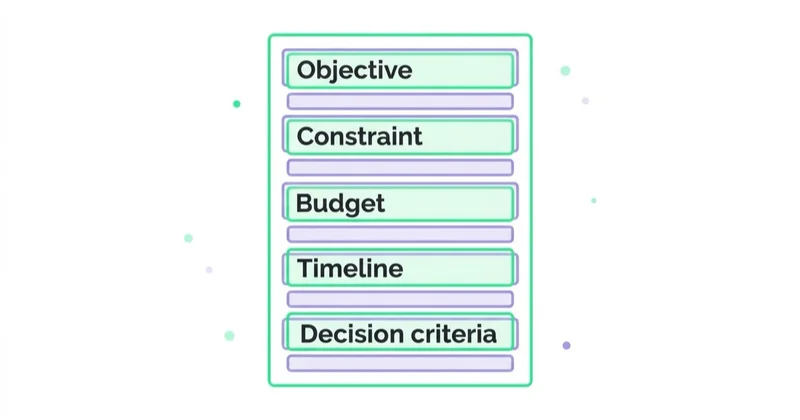
Customer acquisition cost increased by 32% year on year while conversion volume remained flat. Measurement confidence declined after the consent-platform migration, and the internal team cannot distinguish a media-efficiency problem from a tracking problem. We need a partner to establish a reliable baseline, restore profitable acquisition and define the conditions for scaling in the UK and Germany.
This gives agencies room to challenge the assumed solution while making the desired outcome clear. The RFP can still specify mandatory scope where the business genuinely knows it.
Share enough data for an informed response
Agencies cannot estimate opportunity, staffing or fees responsibly without context. A shortlist data pack might include:
- monthly media spend by channel and market;
- 12–24 months of performance at an agreed level of aggregation;
- primary conversion definitions and known measurement gaps;
- revenue, margin or lead-quality ranges where relevant;
- channel and campaign structure summaries;
- current agency and internal-team responsibilities;
- technology stack and access limitations;
- important seasonal events, promotions and operational constraints.
An NDA can protect commercially sensitive detail, but it is not a substitute for privacy and security review. Share the minimum data needed, remove personal data, restrict access, define retention and deletion, and involve legal or information-security teams where appropriate.
Make scope boundaries explicit
If one agency prices media management only and another includes creative production, feed management, analytics engineering and landing-page optimisation, their fees are not comparable.
Use a responsibility matrix:
| Workstream | Client | Agency | Third party | Out of scope |
|---|---|---|---|---|
| Media strategy and planning | C | A/R | I | |
| Campaign execution | I | A/R | ||
| Creative production | A | C | R | |
| Analytics implementation | R | C | A | |
| CRM and sales follow-up | A/R | I |
In this example, R means responsible, A accountable, C consulted and I informed. Adapt the matrix to the organisation; its value is forcing hidden dependencies into the open.
What not to demand without a good reason
A complete strategy based on limited information
It is reasonable to assess strategic thinking. It is less useful to demand a finished 12-month strategy before the agency has account access, research and stakeholder interviews. Ask finalists to explain hypotheses, diagnostic priorities, trade-offs and what evidence would change their recommendation. If a detailed strategy is necessary, define and pay for the work.
A full free audit
A short observation based on supplied material can demonstrate judgement. A credible multi-platform audit takes access, time and context. Treat extensive diagnostic work as a paid stage, and do not use an RFP primarily to collect free recommendations.
Speculative creative far beyond the value of the appointment
Industry guidance encourages clients to avoid costly full creative pitches where another selection method will work. If a creative exercise is necessary, keep it proportionate, state whether a pitch fee applies and define ownership. Work created during a pitch does not automatically become the client’s property; usage rights should be agreed explicitly.
Guarantees detached from assumptions
Ask for scenarios, forecast methodology and sensitivities — not certainty. A responsible forecast states the baseline, data limitations, client dependencies, market assumptions and confidence range. Results affected by pricing, product, inventory, sales follow-up and competitors cannot be guaranteed by an agency alone.
Large volumes of irrelevant credentials
Request only experience that helps evaluate the assignment. Relevant cases should explain the starting point, agency responsibility, constraints, intervention and evidence of impact. A logo wall does not show what the proposed team can do for this client.
Sharing numbers without exposing yourself
Commercial sensitivity is legitimate. It can usually be managed without starving the RFP of context:
- Ranges: for example, monthly media spend of £80,000–£100,000.
- Indexed trends: for example, acquisition cost at 132 versus a prior-year index of 100.
- Aggregation: performance by market or channel rather than customer or campaign-level records.
- Staged disclosure: capability information first, more detailed data only for the contracted shortlist.
- Controlled access: a time-limited data room with named users and a documented deletion date.
State where figures are incomplete or disputed. Honest limitations are more useful than false precision.
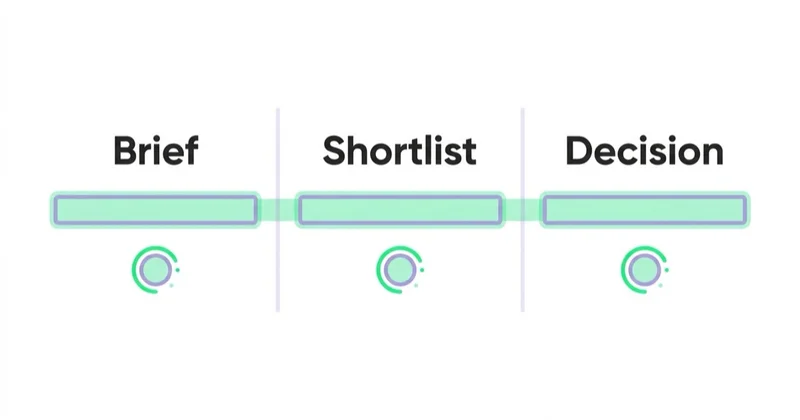
How to structure the selection process
1. Align the internal decision team
Bring marketing, procurement and the relevant commercial, analytics, legal, IT or operational stakeholders together before launch. Agree:
- the reason for the review;
- mandatory and desirable requirements;
- budget authority;
- evaluation criteria and weights;
- who scores each area;
- who makes the final decision;
- what happens if no proposal meets the threshold.
Final decision-makers should see the same agencies and participate consistently. Otherwise the result can be overturned by someone who did not observe the process.
2. Qualify before inviting a proposal
Use desk research, credentials, an RFI or introductory meetings to create a manageable shortlist. Confirm conflicts, market coverage, relevant capabilities, capacity and willingness to participate before issuing the RFP.
There is no universal correct number. The shortlist should be large enough to provide a real choice and small enough to justify the effort asked of each agency. More participants do not automatically produce a better decision.
3. Issue one brief and one source of truth
Give every participant the same RFP, appendices, data pack and contract principles. Set a question deadline and circulate material answers to all agencies, anonymised where necessary. If the brief changes, issue a versioned update and adjust the timetable where the change affects the work.
4. Request a standard response structure
A practical response template is:
- executive summary and understanding of the challenge;
- assumptions, questions and material risks;
- proposed diagnostic and strategic approach;
- delivery plan and first 90 days;
- proposed team, allocation and governance;
- relevant evidence and references;
- measurement and reporting approach;
- scope, dependencies and exclusions;
- itemised fees and third-party costs;
- contract or data-handling exceptions.
Set a sensible page limit but allow appendices for information that genuinely needs detail. The purpose is to make evaluation easier, not to test an agency’s ability to compress caveats into tiny text.
5. Use working sessions, not presentation theatre alone
A polished presentation shows communication skill, but the day-to-day relationship will involve questions, incomplete evidence and disagreement. Include a structured working or chemistry session with the people who would actually run the account.
Useful prompts include:
- What would you investigate before changing spend?
- Which part of our brief do you disagree with, and why?
- What information would materially change your plan?
- Where does the client team need to contribute for this model to work?
- How would you handle a month in which the primary KPI deteriorates unexpectedly?
Clarify whether the named team is committed, how much time each person will allocate and how substitutions are handled.
6. Score independently before discussing
Each evaluator should record scores and evidence before the group discussion. This reduces the risk that the most senior or enthusiastic voice anchors everyone else.
An illustrative scorecard could be:
| Criterion | Weight | Evidence to assess |
|---|---|---|
| Understanding and quality of diagnosis | 20% | Use of supplied evidence, assumptions, prioritisation |
| Proposed approach and measurement | 20% | Logic, feasibility, learning plan, treatment of uncertainty |
| Team and operating model | 20% | Relevant expertise, senior access, capacity, collaboration |
| Relevant evidence | 15% | Comparable challenges, clear agency contribution, verified outcomes |
| Commercial value | 15% | Transparent scope, staffing, fees, flexibility and total cost |
| Chemistry, values and risk | 10% | Constructive challenge, communication, conflicts, data and transition risk |
The weights are an example, not a default. A creative, media, analytics or technology assignment should not use the same model automatically. Define what a score of 1, 3 and 5 means for each criterion so evaluators apply the scale consistently.
Once responses arrive, our guide to choosing a performance marketing agency covers deeper due diligence.
If there is an incumbent
Be explicit about why the incumbent is or is not participating.
- If the incumbent cannot realistically win, do not ask it to perform unpaid pitch work for appearance’s sake.
- If it can win, recognise that it knows the account better than challengers. Give all agencies the same approved data pack and score the incumbent’s evidence without pretending the information position is identical.
- Protect confidential information and intellectual property belonging to both the incumbent and competing agencies.
- Plan access, asset ownership and handover requirements before selecting a replacement.
Before launching the review, document the issues raised with the incumbent and the response. WFA and industry-body guidance recommends trying to repair a viable relationship before defaulting to a disruptive pitch.
Contract, intellectual property and transition
Do not wait until after the winner is announced to discover that the commercial or legal models are incompatible. Include a short term sheet or contract principles covering:
- term, renewal and termination;
- fee model, expenses and third-party costs;
- data processing and security obligations;
- confidentiality and conflicts;
- ownership and licensing of work, platform accounts and source files;
- use of subcontractors and AI tools where relevant;
- liability, insurance and compliance requirements;
- transition assistance and access handover.
Specialist legal advice may be necessary, especially for public procurement, regulated categories, cross-border data or complex intellectual-property arrangements.
Create a transition outline as part of the evaluation. It should identify account ownership, administrator access, data exports, creative and source files, tracking documentation, consent settings, active commitments, historical learning and the responsibilities of outgoing and incoming teams.
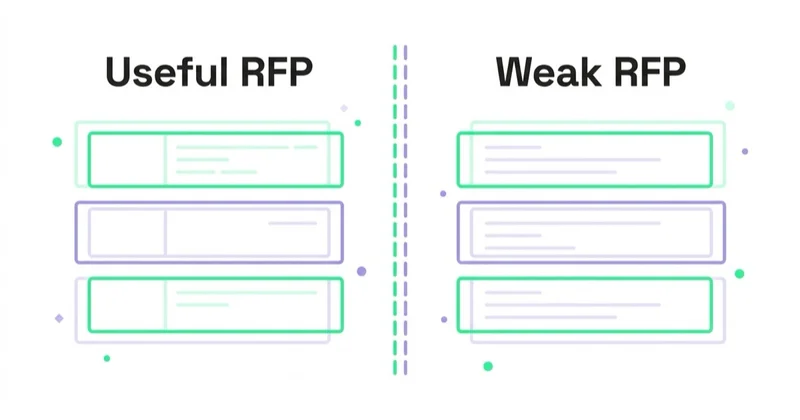
How Space Ads responds to a useful RFP
We look for a clear business objective, enough evidence to understand the starting point and an honest description of constraints. Where information is missing, we state assumptions rather than presenting guesses as facts.
Our preferred proposal separates:
- what can be concluded from the supplied evidence;
- what remains a hypothesis;
- what we would validate during discovery or onboarding;
- what Space Ads would own;
- what depends on the client or another supplier;
- how scope, fees and expected outcomes change under different scenarios.
That structure is less theatrical than a false “complete strategy”, but more useful for deciding whether the partnership can work. It also creates a clearer starting point for the statement of work after appointment.
Marketing RFP template
Use this outline as a starting point:
- Company and assignment overview
- Reason for the review
- Business problem and desired outcomes
- Customers, markets and buying journey
- Current marketing, performance and data limitations
- Scope, deliverables and responsibility matrix
- Budget ranges and commercial preferences
- Technology, data, privacy and access environment
- Internal stakeholders and ways of working
- Required agency team and capabilities
- Response questions and format
- Evaluation criteria and weights
- Process, Q&A and decision timetable
- Contract, IP and transition principles
- Appendices and data dictionary
Before issue, ask someone outside the project team to read it. Can they identify the problem, the decision to be made, what is in scope, what success means and which information is an assumption? If not, agencies will interpret those gaps differently too.
FAQ
What should a marketing RFP include? Include the business context, reason for the review, problem, desired outcomes, current performance, scope, budget, operating model, data environment, required team, response format, evaluation criteria, timetable and key contract principles. Give all shortlisted agencies the same baseline information.
How long should a marketing RFP be? There is no ideal page count. It should be concise enough to navigate and complete enough to remove material ambiguity. Put detailed data, technical requirements and contract terms in appendices rather than turning the main brief into a long questionnaire.
Should I ask agencies for a strategy in the RFP? Ask agencies to demonstrate strategic thinking through hypotheses, trade-offs, diagnostic priorities and relevant evidence. Do not mistake a finished strategy produced without access or research for a reliable plan. Commission paid discovery if detailed diagnosis is essential to the decision.
How many agencies should be invited? Use a genuine, manageable shortlist rather than inviting every possible supplier to complete a full proposal. The right number depends on assignment complexity, procurement requirements and the work requested. Tell agencies how many participants remain so they can make an informed decision.
Should the current agency be included? Include the incumbent only if it has a genuine opportunity to win or governance requires participation. First consider whether the existing relationship can be repaired. If it participates, give challengers the same approved data pack and account for the incumbent’s information advantage transparently.
How do I keep responses comparable? Use a common response structure, scope and pricing template; circulate substantive answers to all participants; publish the criteria; and give agencies the same time and information. Compare both total cost and what each price includes.
What if we cannot share performance data? Use ranges, indexed trends, aggregation, redaction or staged disclosure under an NDA. Explain known gaps. Do not share personal data simply because an NDA exists, and involve privacy or security specialists when access carries material risk.
What is the difference between an RFI and an RFP? An RFI gathers concise qualification information from a wider field. An RFP asks a smaller, qualified shortlist to propose an approach, team, scope and commercial model for a defined assignment. Keeping the stages separate reduces wasted work.
Key takeaways
- Confirm that a pitch is necessary and align stakeholders before issuing an RFP.
- Lead with the business problem and outcomes, then define scope and constraints.
- Share enough data for agencies to make defensible assumptions while protecting privacy and confidentiality.
- Use an RFI for qualification, an RFP for a genuine shortlist and paid discovery for work that needs real access.
- Evaluate the proposed team, evidence, operating model, commercial value and working chemistry — not only presentation polish.
- Make questions, information, evaluation and timing fair and consistent.
- Resolve contract principles, IP, conflicts and transition risk before appointment.
How we run diagnostic work before an engagement is on our marketing audit page.
Sources and further reading
- Finding an Agency — IPA and ISBA
- Agency Selection Guiding Principles — World Federation of Advertisers
- ANA and 4A’s Guidelines for Agency Search — ANA
- How to choose a performance marketing agency
- How to tell if your marketing agency is doing a good job
- PPC agency vs in-house
- What is a marketing audit
Continue reading
ChatGPT Ad Formats and Character Limits: What Actually Fits
A ChatGPT ad appears below the response and carries six elements, with specific limits: title 3–50 characters, body up to 100. The "24 / 48 character" figures in trade coverage do not match the documentation, so this guide gives the full limits table, shows how to fit a useful message, and covers the image, product ads and end-to-end consistency with the landing page.
OpenAI Ads Manager: How to Set Up Your First ChatGPT Ads Campaign
OpenAI Ads Manager has three campaign levels, but launch also requires advertiser verification, billing, landing-page checks, measurement and deliberate choices for settings that cannot be changed later. This guide covers the setup sequence, budgets, context hints, oCPC, targeting, review and Ads API workflows.
Switching Marketing Agencies Without Losing the Account
A safe agency switch protects client-owned accounts, billing, conversion signals, creative rights and operating knowledge. Use this transition plan to assign responsibility, validate access and change partners without avoidable disruption.