Marketing a medical or private practice is not ordinary lead generation. The information must help people understand the service and make an informed choice without exaggerating outcomes, exploiting vulnerability or exposing health data. The exact rules depend on the country, profession, treatment and platform, so a campaign that is acceptable for one clinic may be prohibited for another.

This guide provides a decision framework, not legal or clinical advice. It covers accurate local listings, review practices, accessible patient information, paid media and privacy-safe measurement. Before launch, the practice should have its professional, regulatory and data-protection requirements reviewed for every market it serves.
TL;DR
- Start with jurisdiction and scope. Map professional rules, advertising law, platform policy, licensing and privacy obligations before writing claims.
- Publish accurate patient information. Explain provider credentials, service scope, location, access, pricing where appropriate and what happens next.
- Local discovery matters for location-based care, but national, remote, referral-led and rare-specialty services need a different mix.
- Reviews require a neutral process. Do not incentivise reviews, request only positive feedback or reveal a reviewer's patient status in a response.
- Paid media is conditional. Treatment category, target country, certification and personalisation rules determine what can run.
- Health-data measurement needs privacy-by-design. Do not send appointment, condition or treatment data to advertising tools by default.
- Measure capacity and care outcomes as well as demand. More enquiries are not useful if the practice cannot respond or provide appropriate care.
Trust and local intent come first
People need enough information to judge whether a provider is legitimate, appropriately qualified, accessible and relevant to their need. For location-based care, proximity, opening hours and availability can strongly affect the choice. For telehealth, specialist referrals or rare conditions, geography may be less important than expertise, eligibility and continuity of care.
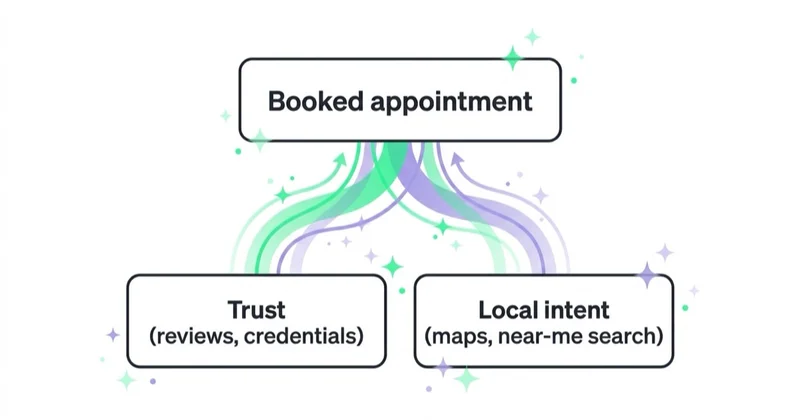
Audit the complete patient-information path before buying traffic: directory or map listing, service page, provider profile, contact or booking process and response. Fix factual errors, broken forms, inaccessible content and unclear service boundaries first. There is no fixed investment order for every practice, but paid traffic cannot compensate for an unusable booking journey or information that a patient cannot verify.
Advertising rules are foundational, not an afterthought
Create a compliance matrix for each service and country. It should cover who is licensed to provide the service, which claims can be substantiated, required disclosures, rules for testimonials or outcome imagery, price and finance promotion, age restrictions, platform certification, audience restrictions and where the service can legally be offered.
Google's healthcare policy prohibits some content and permits other categories only in approved locations or for certified advertisers. Its personalised-advertising policy restricts targeting based on sensitive health interests. Meta maintains separate advertising standards that also change over time. Platform approval is not proof of legal or professional compliance, and a rejected ad is not the only risk.
Claims must be accurate in both wording and overall impression. A disclaimer cannot repair a headline that promises a cure or guaranteed result. Keep a claim register showing the exact statement, evidence, owner, applicable market and review date. Patient stories and testimonials do not establish typical clinical effectiveness. The same compliance-by-design principle applies to other regulated fields, including financial services marketing.
Local search: the workhorse
For care delivered at a physical location, local discovery is an important route. Maintain an accurate Google Business Profile where the practice is eligible: name, category, address or service area, phone, hours and booking link should match the real operation. Google says local results are mainly based on relevance, distance and prominence; no provider can buy or request a better organic local ranking.
Build useful service and location pages that state who provides the care, where it is available, eligibility or referral requirements, likely next steps and how to contact the practice. Avoid doorway pages that merely swap city names. Keep clinical content reviewed by an appropriately qualified person and show authorship or review information where it helps users assess the source.
Ask for reviews through a neutral process open to genuine patients where permitted. Google prohibits incentives and selective solicitation of positive reviews. When responding, do not confirm that the reviewer is a patient or discuss care; invite an appropriate private contact route instead. Reviews can help discovery and decision-making, but they should not be presented as evidence that another patient will achieve the same outcome.
Glossary
- Local intent — a search for a provider or service in a specified area.
- Google Business Profile — the local listing that drives map/"near me" discovery and reviews.
- Healthcare ad policy — platform and professional-body restrictions on medical advertising.
- Cost per appropriate new patient — marketing cost divided by eligible new patients, interpreted with capacity and treatment economics.
- Call tracking — technology used to attribute calls; recording and data processing can create additional legal and privacy duties.
- Downstream event — a later outcome used for internal measurement; sharing it with an ad platform requires a separate privacy and policy assessment.
Paid ads within the rules
Paid search can capture existing demand for an eligible service. Social and video can communicate general information or introduce a practice where the platform, profession and market permit it. Neither channel is universally strongest. Referral pathways, insurer directories, professional directories, community outreach and organic information may be more important in some specialties.
Before launch, confirm that the service and destination are allowed, the provider can accept patients in the targeted area, and the language does not imply knowledge of an individual's condition. Avoid creating urgency that conflicts with informed choice. Set budgets from appropriate-patient value, capacity, expected show rate, treatment cost and contribution—not headline treatment price alone.
The website and the funnel: measure booked appointments
The website should help a person decide whether and how to seek care. Show verifiable provider credentials, service scope, locations, accessibility information, fees or insurance information where appropriate, what to expect and clear contact routes. Distinguish general information from medical advice and provide appropriate instructions for urgent or emergency situations. Use accessible forms and do not ask for clinical details in a general marketing form unless the practice has approved a secure and lawful process for them.
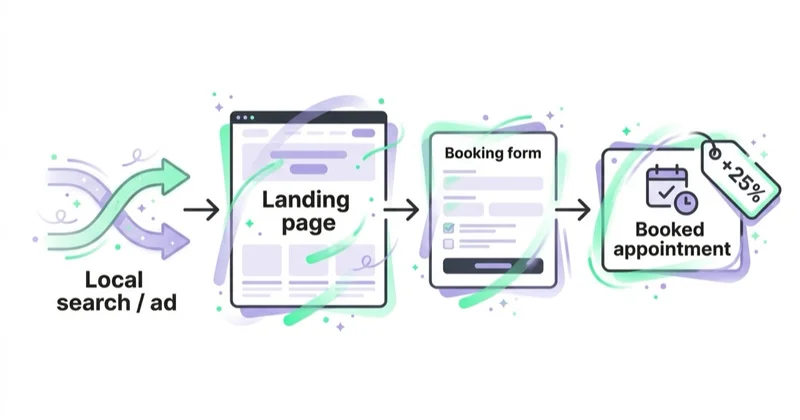
Measure internally from enquiry to eligible booking, attendance and appropriate new patient, while also monitoring no-shows, wait times, capacity and patient access. But do not automatically send those stages to advertising platforms. Appointment details, treatment selections, call recordings, page paths and identifiers can reveal health information. In the UK, health data is special-category data; in the US, HIPAA obligations apply to covered entities and business associates in defined circumstances, and other privacy rules may also apply.
Inventory every tag, call-tracking tool, form, scheduler, CRM connector and analytics vendor. Document what data it receives, why, where it goes, retention, access and applicable contracts or consent. Minimise event names and parameters, avoid clinical content in URLs, and obtain specialist privacy advice before deploying advertising pixels or uploading downstream health-related events. A cookie banner or privacy-policy sentence is not automatically sufficient authorisation under every regime.
Specialties differ — use the specific playbooks
Practice types differ in regulation, referral patterns, urgency, capacity and patient journey. These guides provide more specific starting points, but each still requires a current jurisdiction review:
- Dental practice marketing
- Physical therapy marketing
- Chiropractor marketing
- Optometry practice marketing
- Aesthetic clinic and med spa marketing
Channel mix should follow eligible demand, referral pathways, location, capacity, evidence requirements and acquisition economics. A high treatment price does not automatically justify a high advertising budget, and essential care is not automatically a local-SEO problem.
How Space Ads approaches medical practice marketing
We begin with a market-by-service control sheet: licence and service area, claim approval, platform eligibility, required disclosures, data sensitivity, patient capacity and escalation owner. Marketing does not go live until the practice has approved the clinical statements and the responsible privacy or legal reviewer has cleared the data flow where required.
We then fix the information and access journey, choose channels from demand and policy, and define privacy-safe reporting. Ad-platform events are limited to what has been explicitly assessed and approved; internal practice reporting can retain a more complete funnel in an appropriate system. Reviews cover claims, policy changes, rejected ads, search terms, patient capacity and data flows—not just campaign efficiency. This lives in performance marketing and, for a full diagnosis, a marketing audit.
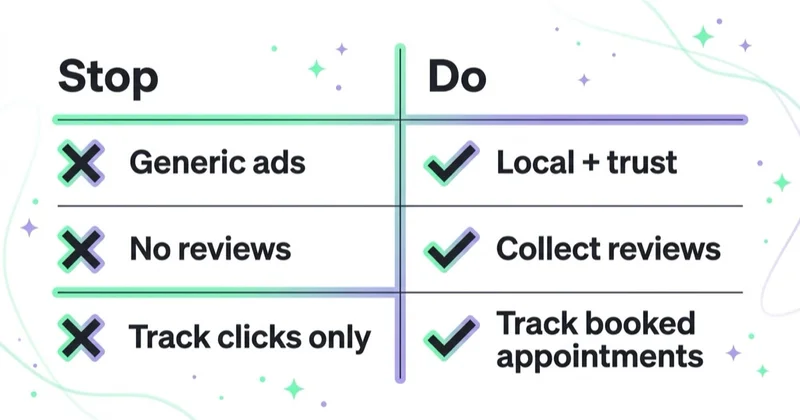
Stop doing / Do instead
| Stop doing | Do instead |
|---|---|
| Copying one healthcare campaign across countries | Build a service-by-market compliance matrix |
| Using reviews only from satisfied patients | Request genuine feedback neutrally and never incentivise it |
| Treating platform approval as compliance | Obtain the required professional, legal and privacy review |
| Publishing generic provider claims | Show verifiable credentials, scope and substantiated claims |
| Sending appointment events to ad tools by default | Audit and minimise health-related data before any disclosure |
| Buying more demand than the clinic can handle | Align spend with capacity, access and appropriate-patient economics |
Common mistakes
Common mistakes include using treatment claims without a documented basis, copying testimonials across markets, selectively requesting positive reviews, confirming patient status in a public reply, and targeting people as though the advertiser knows their condition. On the technical side, health information can leak through URLs, form fields, schedulers, call recordings and advertising events. These are governance failures, not merely media-optimisation issues.
FAQ
How do you market a medical or private practice?
Start with the applicable professional, advertising and privacy rules. Publish accurate information about providers, scope, location, access, fees and next steps. Maintain eligible local listings and a neutral review process where relevant. Choose paid or organic channels from actual demand and referral patterns, then measure appropriate patient progression in systems designed for the sensitivity of the data.
What are the advertising rules for medical practices?
Rules may come from national or regional law, professional and licensing bodies, medicines or medical-device regulators, consumer-protection authorities, data-protection law and each advertising platform. The applicable combination depends on the service, provider, country and audience. Use a current jurisdiction-specific review; this article cannot determine whether a particular campaign is lawful.
Is local SEO or paid advertising better for a clinic?
Neither is universally better. Local search is important when care is location-dependent and people actively search for it. Paid media can add reach or capture demand when the service, market and platform permit. Compare incremental appropriate bookings, acquisition cost, capacity and access—not rankings or clicks alone. Referral-led and highly specialised services may need a different mix.
How should a medical practice measure marketing results?
Track the internal journey from enquiry through eligibility, booking, attendance and appropriate new patient, plus response time, no-shows and capacity. Keep health-data privacy central. Call tracking, recording, schedulers, pixels and conversion uploads require a documented assessment of data, vendors, permissions and applicable law. Do not expose diagnosis, treatment or appointment details merely to improve ad attribution.
Can medical practices run Facebook and Instagram ads?
Sometimes. Eligibility depends on the service, location, advertiser, content and current Meta standards. Ads must not imply that the advertiser knows a person's health status, and some products, services, claims or targeting approaches are restricted. Check the live policy and local professional rules before launch; approval does not remove the advertiser's responsibility.
How much should a practice spend on marketing?
Set the budget from the number of appropriate new patients the practice can safely serve, expected eligibility and attendance, contribution after treatment delivery, referral or repeat value where ethically relevant, and the uncertainty in acquisition cost. Start at a level that can generate useful evidence without overwhelming care or administrative capacity. Revenue alone is not a sufficient budget rule.
Key takeaways
- Build a current service-by-market compliance and data-governance matrix before promotion.
- Publish accurate, accessible information and substantiate every express or implied health claim.
- Use eligible local listings and a genuine, non-incentivised review process where location matters.
- Choose channels from policy, demand, referral patterns, capacity and appropriate-patient economics.
- Measure the patient journey internally, but never send health-related data to ad tools by default.
Sources and further reading
- Google Ads Help — Healthcare and medicines advertising policy
- Google Ads Help — Personalised advertising restrictions
- Meta Transparency Center — Advertising Standards
- Google Business Profile Help — Improve your local ranking
- Google Business Profile Help — Tips to get more reviews
- UK Information Commissioner's Office — What is special-category health data?
- US HHS — Use of online tracking technologies by HIPAA-regulated entities
Continue learning
Continue reading

Consumer Lending and BNPL Marketing: Rules and Channels
Consumer lending and BNPL marketing requires clear information about the obligation, costs and terms. Campaigns should be judged by originated-loan quality — not application volume.

Wealth Management and Investment Firm Marketing
Investment firm marketing requires clear communication of risk, costs and past performance. Success is a client who fits the service and retains assets — not simply a lead or account opening.

Bank Marketing: Acquisition and Campaigns for Retail and Business Banks
Bank marketing combines continuous customer acquisition with time-limited product and seasonal campaigns. Success is an active, funded customer relationship — not simply an account opening.