Vendor lock-in in e-commerce is the accumulated cost and risk of leaving a supplier or platform: code you cannot reuse, data you cannot export cleanly, infrastructure controlled through somebody else's account, or integrations that cannot be reconfigured without the incumbent vendor. It is rarely one clause in a contract. It is a set of legal, technical and operational dependencies across code, data, infrastructure, integrations, content, commercial records and measurement. A team can inventory those dependencies quickly; a lawyer should review ownership, licensing, privacy and termination rights where the consequences are material.
TL;DR
- Lock-in is a cost, not a moral failing of the platform. Convenience is bought with control, and for some businesses that is a good trade.
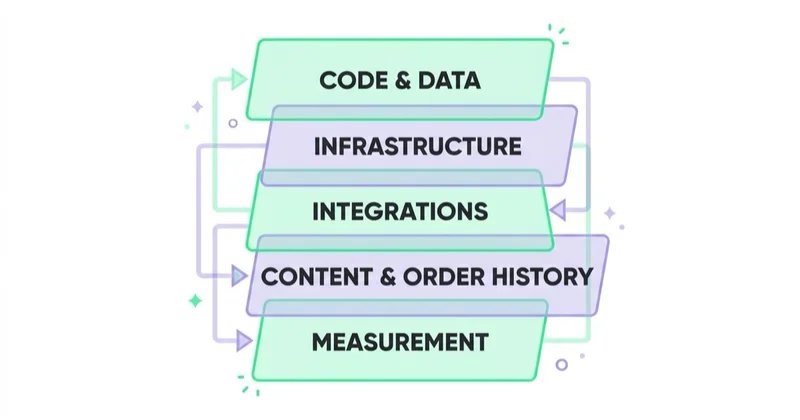
- Audit seven layers separately: code, database, infrastructure and domains, integration credentials, content and templates, order and customer records, measurement history.
- Separate legal ownership from operational control and portability. A repository you cannot build, an export you cannot reconcile and an account you cannot administer may still exist on paper but will not support a safe handover.
- Ask for the export before you need it. Format, completeness and delivery time decide whether an exit is a project or an incident.
- Exit cost grows with integration debt, catalogue size, order history and how long your team has worked in one admin panel.
- On build projects the contract defines the rights each party receives: assignment or licence of work product, treatment of pre-existing components, repository access, data return, infrastructure control and migration cooperation.
- Some lock-in is rational — a small catalogue, a standard process and a deadline next month beat a custom build on most measures.
- Ad and analytics accounts are a separate question, covered in who owns your Google Ads, Meta and GA4 when you leave an agency.
What vendor lock-in actually means in an e-commerce stack
Lock-in is usually described as a contractual trap. In practice it is arithmetic: the cost of leaving turns out to be larger than the business can justify, and nothing dishonest has to happen for that to be true. Three mechanisms produce it, and each needs a different remedy:
- Technical dependency. The store runs on a codebase or app ecosystem that exists only inside one platform. Leaving means rebuilding, not moving.
- Data dependency. Orders, customers, product data and invoices live in a system you can read through an interface but cannot extract in a usable shape.
- Organisational dependency. Your team knows one admin panel and one set of workarounds, so even a clean technical migration costs weeks of internal capacity.
Ownership is therefore not one answer about the store. Record four answers for every layer: who owns the asset or rights, who controls the account, what can be exported, and what a successor needs to operate it. A business can hold broad rights to its source code and still face lock-in because payment, fulfilment and ERP connections depend on accounts or middleware controlled by the supplier.
The seven layers: run this audit on your own store
Take each layer in turn and answer honestly. "I assume so" counts as no.
1. Code — whose repository, under what licence
Ask whose account hosts the repository, whether you can access the full history, which rights and licences cover each component, and whether a qualified third party could build and deploy the current version. A deployed site is not the same deliverable as a maintainable repository. History, build instructions, environment requirements, tests, dependency manifests and architecture notes all reduce handover risk. Separate newly commissioned code from open-source packages, commercial plugins, fonts, stock media and the supplier's pre-existing libraries: the agency cannot assign rights it does not own, and the store may depend on licences that must be renewed or replaced.
2. Data — can you read and export the database
Several capabilities hide behind “we have access to our data”: viewing records, exporting them, understanding their schema, importing them elsewhere and reconciling the result. Direct database access is useful on some architectures but neither necessary nor sufficient on every SaaS platform. Ask which formats and APIs cover products, variants, customers, orders, invoices, content, consent evidence and identifiers; whether relationships and timestamps survive; how long a full export takes; and which fields are excluded. Request a representative export while the relationship is healthy, store it securely and test it against a documented sample. Do not copy personal data into an uncontrolled test environment merely to prove that a file opens.
3. Infrastructure — whose accounts is it deployed to
Inventory hosting, the domain registrar, DNS, storage, CDN, certificates, secrets management and deployment services. For each, record the contracting entity, billing owner, administrators, recovery method and termination process. The domain should be registered for the business and controlled through an organization account with more than one trusted administrator; public WHOIS data may be redacted, so verify it in the registrar rather than through a lookup alone. Keep least-privilege supplier access, multifactor authentication and a tested recovery path. Domain and DNS control is critical, but so is knowing how to rotate credentials without taking the store offline.
4. Integrations — whose API keys
Payments, couriers, ERP or order management, warehouse software, invoicing, messaging, reviews, product feeds and consent management all depend on provider accounts, credentials and configuration. The business should normally hold the provider relationship, while suppliers receive scoped access. Secrets should live in an approved secrets manager rather than a handover spreadsheet, and a transition should include revocation or rotation. Record mandatory middleware, webhooks, IP allowlists, data mappings, rate limits and renewal terms. For every connection, answer: who can administer it, what documentation exists, and how would a successor reproduce or replace it?
5. Content and templates — what is actually transferable
Copy and images usually move; presentation rarely does, because templates are written for one platform's rendering model. Check whether you hold the source files — design files, full-resolution originals, video masters — what licence covers stock media and fonts, and whether photography rights are broad enough for a different platform, marketplaces and paid media. Also check whether structured content lives in fields that export cleanly, or is trapped inside page-builder blocks that come out as unusable markup.
6. Order and customer history
Orders, returns, invoices, subscription state, loyalty balances, gift-card liabilities, addresses and consent records are commercial and legal records, not just rows in a table. Define which records must be migrated, retained in a compliant archive or deleted; moving every historical field into the new production system is not automatically necessary or lawful. Ask how identifiers and relationships export, whether invoices arrive as documents or data, and how consent evidence and timestamps travel. Where a supplier is a processor, the processing agreement should cover return or deletion after the service ends, subject to applicable retention law. Payment credentials or subscription tokens may be deliberately non-portable and require a provider-supported migration or customer re-authorisation.
7. Measurement and analytics history
Analytics history normally lives in the measurement platform rather than in the store, so changing platforms does not itself delete a GA4 property. What must be rebuilt and verified is the implementation: events, parameters, consent signals, server-side tagging and feed identifiers. Preserve the measurement plan and event definitions so pre- and post-migration periods remain interpretable. GA4's user- and event-level retention setting limits explorations and certain granular analysis; it does not remove the standard aggregated reports in the same way. If long-term event-level analysis matters, design an appropriate export and retention policy before the oldest data expires. Store-native reports, saved audiences and attribution logic may not transfer at all.
Glossary
- Vendor lock-in — the total economic and operational cost of moving away from a supplier, platform or hosting provider.
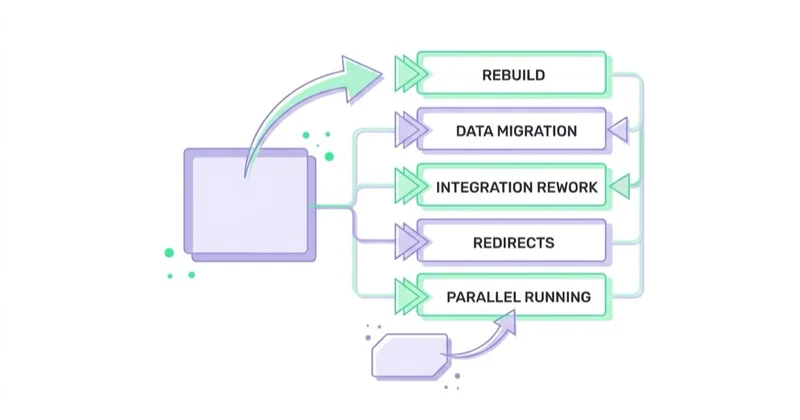
- Exit cost — the one-off cost of leaving: rebuild, data migration, integration rework, redirects, retraining and parallel running.
- Integration debt — the accumulated work needed to reproduce every connection a store has grown, on a different platform.
- Source code escrow — a third-party deposit arrangement releasing code to the client if defined conditions occur.
- Operational data portability — the practical ability to extract agreed records in a documented, machine-readable form and use them in a successor system. Contract terms are central, while privacy and data-service rules may create additional rights and obligations in specific cases.
- Reversibility — whether a decision can be undone, and at what cost; the property that makes lock-in tolerable.
The cost of exit — what it is made of, and why it grows
Exit cost is never only the rebuild. It has six components, each estimable well enough to make a decision:
- Rebuild of whatever cannot move: templates, custom logic, admin workflows.
- Data migration and reconciliation — products, variants, customers, orders, invoices, plus proving what arrived matches what left.
- Integration rework — every connector re-onboarded, re-keyed and re-tested, including the ones nobody remembered.
- URL and search continuity — a redirect map, structured data, feeds, and monitoring that catches what broke.
- Retraining and lost productivity — the weeks in which your team is slower because the admin panel changed.
- Parallel running — paying for two systems while both are live, usually the item missing from the business case.
These costs often grow as catalogues, custom workflows and integration counts expand, but they can be controlled. Retire unused apps, archive records under a documented retention policy, standardise identifiers, document mappings, rehearse exports and keep integrations modular. The point is not to predict a perfect exit cost on day one; it is to preserve options and revisit the estimate when the architecture or commercial model changes.
The ownership audit: what to ask, and what a good answer sounds like
Send this as a list and ask for answers in writing. A supplier who works this way answers in a day, and that response time is itself part of the diagnosis.
| Layer | Question to your supplier | Good answer | Warning sign |
|---|---|---|---|
| Code | Whose repository, what licence, can another developer take over? | Repository in your account, full history, conventional documented stack | No repository you can log into |
| Database | Direct access or documented full export, in what format? | Documented schema, self-service export, relationships intact | Export only as a bespoke project or paid tier |
| Infrastructure | Who contracts, pays for and administers hosting, domain, DNS, storage and CDN? | Business organization is the account holder; named admins, MFA and recovery are documented | Domain or production access depends on one supplier identity |
| Integrations | Who holds the provider relationship and can rotate access? | Business controls the provider account; suppliers receive scoped access; mappings are documented | Credentials, middleware or configuration cannot be transferred or reproduced |
| Content and templates | Do we hold source files, and what licence covers media? | Design sources, originals and licence terms handed over | Content only inside page-builder blocks; no licences |
| Order history | How does history export, and what happens at termination? | Documented export with invoices and consent records; return-or-delete written down | "It is all in the panel", no export path |
| Measurement | Who owns the analytics property and tag configuration? | Property and containers owned by you, event design documented | Analytics in a supplier property, undocumented events |
Two rules keep the table honest. Ask for evidence, not assurances — a login, an export file, an account list. And treat time-to-answer as data: the layers a supplier cannot describe quickly are the layers where an exit will hurt.
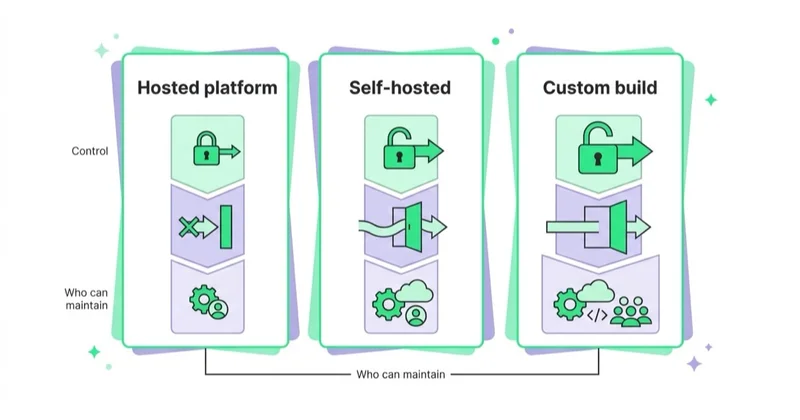
Hosted, self-hosted or custom: what you trade in each direction
None of these columns is the villain. They are three bets about where you want your constraints to sit.
| Dimension | Hosted platform (SaaS) | Self-hosted open source | Custom build |
|---|---|---|---|
| Time to first sale | Fastest | Medium | Slowest — discovery first |
| Who runs infrastructure | The vendor | You or a hosting partner | The party and account model defined by the project |
| Fit to a non-standard process | Constrained by the platform model | Extendable within the framework | Designed around your process |
| Control over URLs and templates | Platform-dependent | Usually high | Defined by architecture and contract |
| Code ownership question | Applies to apps and themes | Platform licence public; custom layer negotiable | Fully contractual — must be written down |
| Export path out | Vendor exports and APIs; scope varies | Database and application-level exports | Must be designed and documented |
| Cost shape | Subscription, apps, sometimes per-order fees | Hosting plus maintenance capacity | Build investment, then maintenance |
| Who can maintain it | Qualified platform specialists | Qualified developers in that ecosystem | A capable successor, if code and operations are documented |
| Where lock-in concentrates | Platform model, apps, per-order economics | Plugin sprawl and hosting decisions | The supplier relationship, unless ownership is explicit |
On hosted platforms lock-in comes mostly from the platform's model; on custom builds it comes almost entirely from the contract and from how the work was written. The same audit question therefore sounds different on each — "what does the platform let us export" versus "what did we agree we own".
For the platform-by-platform version of that decision we have is it worth building a WordPress store with WooCommerce, is it worth building an online store on Magento and how to start an online store. This article is the layer underneath them: what you hold at the end of whichever you choose.
Contract clauses worth checking on a build project
Contract review is a lawyer's job, and the wording depends on your jurisdiction and on the deal. What an operator can do is arrive with the right list, so legal review is spent on substance rather than discovery. On e-commerce builds, ownership is decided in these clauses:
- Work product rights — what is assigned, what is licensed, when those rights take effect and which territories, uses or modification rights are covered. List pre-existing and third-party components separately: open-source packages, stock media, fonts, commercial plugins and supplier libraries.
- Repository and history handover — where the code lives during the project, who owns the account, and that history and documentation come with it.
- Data access during and after the engagement — documented exports or APIs, named formats and fields, delivery time, security method and support for reconciliation. Treat personal data according to roles, lawful basis, retention requirements and the processing agreement.
- Infrastructure control — which services should be contracted through the client's organization, which remain vendor-managed, who has administrator access, and how recovery, billing and transfer work. The domain, DNS and critical provider relationships should not depend on one supplier identity.
- Integration credentials — API keys and provider contracts held by you; where a supplier account must be used, why, and what happens to it at the end.
- Termination, notice and migration cooperation — notice period, and what the supplier will do for a successor, for how long and at what rate. Cooperation priced in advance is cheaper than cooperation negotiated during a dispute.
- Personal data at termination — return or deletion of personal data processed on your behalf.
Two neighbouring checklists are already written up: the general marketing agency contract checklist, and for search work what to look for in an SEO contract — including why "no lock-in" as a slogan proves nothing on its own.
When lock-in is an acceptable trade
Most writing on this subject argues in one direction. The decision does not behave that way in practice. Accepting a degree of lock-in is the right answer when:
- You are validating demand. Selling next month on a hosted platform beats owning a codebase you may not need. Prove demand, then rebuild when the constraints are real and priced.
- Your catalogue is small and your process is standard. If a platform's model of products, shipping and payment matches how you operate, control you never use has no value.
- Speed is the binding constraint. A seasonal launch or a market test can make three months of build time the more expensive option.
- Nobody internal can own the technology. A custom store with no decision owner and no maintenance budget degrades faster than a constrained platform does.
- The constraint is cheaper than the fix. Per-order fees and app subscriptions are irritating, and routinely smaller than a build plus its maintenance.
What makes those trades safe is not optimism but reversibility: the domain and DNS in your own accounts, provider relationships and API keys in your company's name, a full export taken on a schedule and confirmed readable, the analytics property yours. Then a platform choice stays a decision you can revisit — and when the constraints do start costing real money, the move itself is a project with its own rules: e-commerce replatforming without losing search visibility.
How Space Ads approaches ownership
At Space Ads, an ownership review starts before architecture is chosen. We map which assets the client should own, which services remain licensed, who controls each production account and what evidence a successor would need. The target is not “zero dependency” — no useful commerce stack has that — but dependencies that are understood, documented and proportionate to their value. This principle also shapes our e-commerce development scope.
The same review applies to marketing infrastructure: analytics properties, tag containers, advertising business accounts, product feeds, consent configuration and data destinations. We document access, recovery and handover instead of relying on one employee or supplier login. The cheapest time to close a control gap is while the system is stable and no emergency migration is under way.
Run the audit: a one-afternoon plan
- List the layers — code, database, infrastructure and domains, integrations, content and templates, order and customer history, measurement.
- Log in to everything yourself, as an administrator, from your own account. Record what you could not open.
- Request a full export of products, customers, orders and content, and note the format and how long it took.
- Try to read it. Check that variants, relationships, invoices and consent records survived. An export nobody can parse is not an export.
- Check the domain and DNS inside the registrar and DNS provider, including the organization, administrators, MFA and recovery path. Do not rely on a spreadsheet or public WHOIS alone.
- Inventory integration credentials — provider, whose account, who can log in, whether middleware sits in the path.
- Write the exit paragraph. If this relationship ended in 30 days: what would we do, in what order, and what could we not do at all?
- Fix the cheap gaps now — account holders, admin seats, registrar transfers, scheduled exports — and put the rest in the contract at renewal, with a lawyer reviewing the wording.
Common mistake, and what to do instead
| Common mistake | What to do instead |
|---|---|
| Treating "we own our website" as one answer | Answer per layer; the weakest layer sets your exit cost |
| Accepting a verbal assurance about exports | Request a full export while the relationship is good, and open the files |
| Letting a supplier register the domain to keep it simple | Register the domain and manage DNS in your own accounts |
| Assuming code delivery means a repository | Ask for the repository, with history and documentation, in your account |
| Reading only the contract term | Read term, notice, migration cooperation and data return together |
| Discovering the export path during an exit | Test the export path on a schedule, before it is needed |
| Judging suppliers on the phrase "no lock-in" | Judge them on evidence: account inventories, export files, admin seats |
| Rebuilding custom without specifying ownership | Put assignment, repository, database access, infrastructure and keys in the contract |
FAQ
What is vendor lock-in in e-commerce?
Vendor lock-in in e-commerce is the total cost of moving away from a platform, agency or hosting provider: rebuilding what cannot transfer, migrating and reconciling data, re-onboarding integrations, keeping URLs and search visibility intact, retraining the team and running two systems in parallel. It comes from technical, data and organisational dependencies rather than from one contract clause, and it grows with catalogue size, order history and integration count.
Is a custom store always better than a SaaS platform for ownership?
No. A custom build gives you code, database and infrastructure only if the contract says so and the code is conventional enough for someone else to maintain. A custom project with no ownership clauses, on a private framework, in a supplier's repository and hosting account, produces stronger lock-in than a hosted platform does. Hosted platforms concentrate lock-in in their commercial model; custom builds concentrate it in the supplier relationship.
Do we have a legal right to get our store data exported?
Do not assume that one general “data portability” right guarantees a complete store migration. Your contract should define the datasets, formats, frequency, security and transition assistance you need. GDPR Article 20 gives qualifying rights to data subjects, not a general business right to export every database, while processor terms under Article 28 should address return or deletion of personal data at the controller's choice after the service ends, subject to applicable retention law. The EU Data Act also imposes switching obligations on covered data-processing services, but its scope and the data included depend on the service. Have counsel apply these rules to the actual stack and agreement.
Who should own the API keys for payments, couriers and the ERP?
Your company should normally hold the provider relationship and organization account, with the agency or developer receiving scoped access. API keys themselves are secrets to provision, restrict, rotate and revoke — not assets to email around. When a connection exists only inside an agency account, changing supplier may require re-onboarding instead of simply issuing new credentials. If a vendor-managed account is necessary, document why, what data it contains and how transition or replacement will work.
Is source code escrow worth it?
Escrow is worth considering when the code cannot be held directly by the client for a defensible reason, and the store is critical enough to justify the cost. It is a fallback rather than a substitute: a release condition that triggers on insolvency does not help with the ordinary case of wanting to change supplier. Direct ownership of the repository, with history and documentation, solves the same problem earlier and more cheaply.
Does changing platform mean losing our analytics history?
Not by itself — analytics history normally lives in the measurement platform, so a platform change does not delete a GA4 property. The risk is implementation continuity: events, parameters, consent signals, server-side tagging and feed identifiers must be rebuilt and verified, and changed definitions can break comparability. GA4's retention setting affects user- and event-level data used in explorations; standard aggregated reports are not affected in the same way. Plan an appropriate export before migration if long-term granular analysis matters.
Sources and further reading
- EUR-Lex — Regulation (EU) 2023/2854 (Data Act), including Chapter VI on switching between data processing services
- EUR-Lex — GDPR Article 28: processor obligations, including return or deletion of personal data
- Open Source Initiative — OSI-approved licences
- Google Analytics Help — Data retention settings and differences between reports and explorations
- Google Search Central — Site moves with URL changes
Documentation checked July 2026. Vendors and legislators revise these pages — verify against the current version before relying on a detail, and take contract and data protection questions to a lawyer.
Continue learning
- Who owns your Google Ads, Meta and GA4 when you leave an agency?
- E-commerce replatforming without losing search visibility
- How to audit an e-commerce store
- What is a product feed and how to use it
- E-commerce development with full ownership of code, database and infrastructure
In short
- Vendor lock-in is arithmetic: the cost of leaving against the cost of staying, across seven separate layers of the stack.
- Ownership of one layer proves nothing about the others; the weakest layer sets the exit cost.
- The decisive test is usability, not paperwork — a repository you can deploy, an export you can read, an account you can log into.
- Exit cost often grows with catalogue, history and integrations, but documentation, tested exports and deliberate simplification can contain it.
- On build projects the contract should define work-product rights, third-party licences, repository and data access, infrastructure control and migration cooperation.
- Accepting lock-in is rational for small catalogues and hard deadlines — provided you keep the domain, the keys, the exports and the analytics property.
Continue reading
Auto Parts Ecommerce: Marketing Around the Fitment Problem
Auto parts marketing starts with fitment data. Learn how to connect the catalogue, vehicle selector, product feed, SEO and returns data so customers find parts that genuinely fit.
Local Inventory Ads: The Format Decided by Your Stockroom
Local inventory ads connect nearby demand with products available in physical stores. Learn how to prepare store data, pickup options, landing pages and offline measurement without promising stock the customer cannot buy.
The Shopify Marketing Stack: What to Install and What to Remove
A Shopify marketing stack should connect customer data, storefront experience, merchandising, lifecycle and acquisition without duplicating events or adding unmanaged risk. Use this framework to choose, govern and remove apps safely.