Google Ads for fashion e-commerce means running Search, Shopping, Performance Max and Demand Gen together so the channels do two different jobs: capturing the demand that already exists and creating new demand for what's next. For an apparel or footwear brand, two things decide whether it works — the product feed, because Google reads your catalogue through it and apparel has its own required attributes, and returns-aware bidding, because optimising to raw revenue on a category that returns roughly a fifth of its units online quietly rewards your worst-selling SKUs. Get those two right and the campaign types are mostly delivery.

TL;DR
- The feed is the campaign. For Shopping and Performance Max, apparel and footwear have required attributes —
color,age_group,gender,size,item_group_id,brand— and shoes additionally need agtinormpn. Feed quality decides which queries a SKU surfaces for and how it renders next to mass-market rivals. - Returns-aware bidding is the difference between profit and a flattering ROAS. Google has no native "profit" toggle; you pass profit as the conversion value and feed returns back via conversion adjustments (retract/restate) so Smart Bidding learns net-of-returns value.
- Performance Max is now controllable enough for premium. Brand exclusion lists, up to 10,000 negative keywords, inventory-type and sensitive-content controls, and — new in 2025 — channel-level and search-terms reporting answer the "black box" objection.
- Split the four campaign types by job. Search and Shopping capture demand; Performance Max captures and extends it; Demand Gen creates it on YouTube, Shorts, Discover and Gmail.
- Demand Gen is the demand-creation lever. With a product feed attached, Google reports established Demand Gen campaigns see a ~33% lift in conversions; Lookalike segments reach beyond existing brand demand.
- AI Max for Search is a layer, not a campaign type — in open beta since May 2025 and expanding through 2026; treat it as an enhancement on existing Search, not a silver bullet.
- UK/EEA caveat: since March 2024, Customer Match lists no longer serve on Google partner / third-party inventory in the EEA, including the UK.
Why fashion e-commerce on Google is its own problem
Most "Google Ads for e-commerce" advice treats every catalogue the same. Fashion isn't every catalogue, and three differences change the whole setup.
The first is returns. Online apparel returns run near 24% and footwear higher, largely on fit and sizing. A campaign reporting a healthy ROAS where a quarter of the units come back is not running at that ROAS — and a bidding strategy optimising to gross revenue will happily pour budget into the exact SKUs that get returned most. On fashion, ignoring returns isn't a reporting nuance; it's the difference between scaling profit and scaling a leak.
The second is the feed. Shopping and Performance Max don't read your website; they read your product feed. For apparel and footwear, Google requires attributes it doesn't require elsewhere — and gets opinionated about images. The feed isn't plumbing you set up once; it's the surface that decides which searches your product shows for and whether a £400 coat renders like a £400 coat.
The third is the demand split. Fashion is both high-intent ("black wool overcoat") and discovery-led (someone who didn't know they wanted it until the scroll). That means Google can't only capture demand for you — for a brand whose growth is capped by existing search volume, it has to create some. Those are different campaign types with different metrics, and running only the capture half is the most common reason a fashion account plateaus.
A quick glossary
- Merchant Center — where your product feed lives; it supplies the catalogue data Shopping and Performance Max advertise from.
- Product feed — the structured file/source describing each product (title, price, image, and the apparel-specific attributes below).
item_group_id— the attribute that groups every colour/size/material variant of one garment so Google treats them as a single product with selectable options.- Performance Max (PMax) — Google's automated campaign that serves across Search, Shopping, YouTube, Display, Discover and Gmail toward a goal, organised into asset groups and listing groups.
- Demand Gen — Google's visual campaign across YouTube, Shorts, Discover and Gmail, built to create demand; it replaced Discovery campaigns.
- Value-based bidding (tROAS / Max Conversion Value) — Smart Bidding that optimises to whatever conversion value you supply, which can be revenue or a profit proxy.
- Conversion adjustment — a retraction (sets a conversion's value to zero) or restatement (reduces it) you upload after a return, so bidding learns net-of-returns value.
- AI Max for Search — an optional AI enhancement layer applied on top of existing Search campaigns (broader matching, asset and URL expansion), not a separate campaign type.
The four campaign types and the job each one does
The cleanest way to plan a fashion account is to assign each campaign type one job and one primary metric, then stop asking it to do the others.
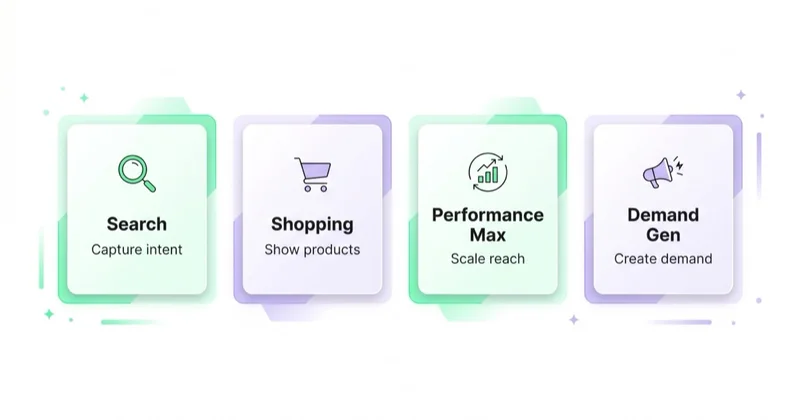
| Campaign type | Job | What it's good at for fashion | Primary metric |
|---|---|---|---|
| Search | Capture demand | High-intent queries, brand defence, generic terms with brand support | Incremental conversions / value |
| Shopping | Capture demand | Putting the product image + price in front of in-market shoppers | Returns-adjusted ROAS |
| Performance Max | Capture + extend | Cross-surface coverage from one feed; finds demand Search misses | Returns-adjusted ROAS |
| Demand Gen | Create demand | Visual discovery on YouTube/Shorts/Discover; new audiences via Lookalikes | Assisted demand, branded-search lift |
The trap is judging Demand Gen on last-click ROAS — it will always look weak, because its job is to create the demand a Search campaign later claims credit for. Hold it to the metric that matches the job.
The feed is the campaign: apparel and footwear attributes
For the Apparel & Accessories category, Google's required-attribute set is the same in the US and the UK — both sit in the same six-country apparel list (Brazil, France, Germany, Japan, UK, US), so there's no transatlantic divergence to manage. What's required goes beyond the universal id / image_link / availability:
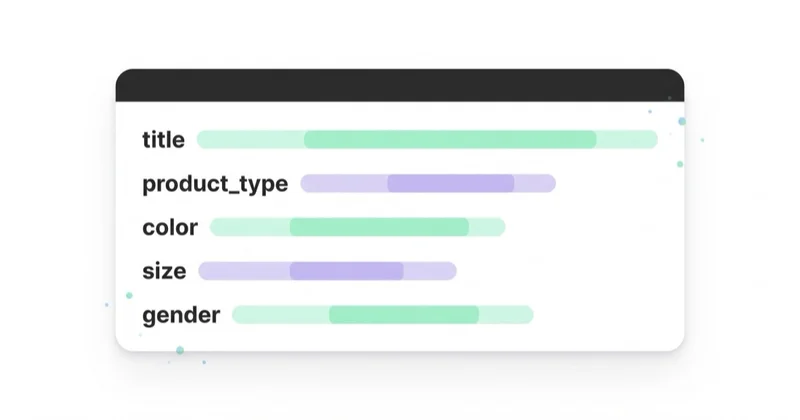
| Attribute | Status for apparel | What it does |
|---|---|---|
brand |
Required (all apparel) | Identifies the maker; load-bearing for premium positioning |
color |
Required | Powers the colour filter and variant selection |
age_group |
Required | newborn / infant / toddler / kids / adult |
gender |
Required | male / female / unisex |
size |
Required (Clothing, Shoes) | The single biggest fit/returns signal |
item_group_id |
Required (variants) | Groups colour/size variants into one product |
gtin or mpn |
Required for Shoes (and bags, watches, sunglasses) | Footwear's extra rule most guides miss |
material, pattern |
Conditionally required | Required when the product varies by them |
size_type, size_system |
Optional | size_type defaults to "regular" if omitted — a trap for petite/plus/tall lines |
product_highlight |
Optional | 4–6 selling-benefit bullets |
Two things matter more for premium brands than the checklist. First, images: Google's clothing best practices ask for products worn by people, with no head or feet cropped, no watermark or promo overlay, and a minimum of 500×500px (1500px width is the practical target for editorial-grade rendering). Second, variant hygiene — colour and size values that match the product page exactly, grouped under one item_group_id. On more than one luxury apparel account we've worked on, fixing variant structure and availability accuracy delivered more lift than any creative change. The feed sets the ceiling; everything else operates under it.
Performance Max for fashion — now controllable enough for premium
Performance Max earned its "black box" reputation, and for a luxury brand the fear was reasonable: a campaign that serves everywhere, with no say over context. That has changed enough to recommend it — provided you actually use the controls.
| Control | What it protects | Surfaces |
|---|---|---|
| Brand exclusion lists | Stop serving on competitor/own-brand queries; avoid over-paying for loyal brand demand | Search, Shopping, YouTube search |
| Negative keywords (up to 10,000) | Exclude unwanted/unsuitable queries | Search & Shopping |
| Inventory type (Maximum / Moderate / Limited) | Content suitability of placements | YouTube / Display / Video partners |
| Sensitive-content exclusions | Keep the brand away from tragedy, conflict, suggestive content | Display / Video |
| Account-level placement exclusions | Block specific sites, apps, channels (cover Search Partners since March 2024) | Display / Video / SPN |
For a premium brand, the brand exclusion list earns its keep twice: it stops Performance Max quietly charging you for demand your loyal customers were always going to convert on, and it keeps you out of auctions next to discount or counterfeit-adjacent brands. The inventory and sensitive-content controls protect the editorial context a luxury label can't afford to sit beside.
Just as important for a brand that demands transparency: 2025 brought channel-level performance reporting (see how PMax delivers across each surface), full search-terms reporting inside PMax, asset-level metrics, and search themes raised to 50 per asset group. The accountability gap that used to disqualify PMax for premium advertisers is largely closed — link Merchant Center, build asset groups by category (outerwear, tailoring, footwear), and use listing groups to control which SKUs each group promotes. For the fundamentals, our guide to Performance Max and Google Shopping covers the setup.
Demand Gen: the demand-creation layer
For a fashion brand whose growth is capped by how many people already search its name, Demand Gen is the primary Google lever to manufacture new consideration. It serves across YouTube (including Shorts), Discover and Gmail — the visual, scroll-native surfaces where aspirational fashion discovery actually happens — with image, video and carousel formats.
Two features make it more than a brand-awareness play. Attaching the product feed turns the ads into a shoppable storefront; Google reports that established Demand Gen campaigns adding product feeds see roughly a 33% increase in conversions. And Lookalike segments let you reach qualified audiences beyond your existing customer base, seeded from your first-party data. Judge it on assisted demand and branded-search lift, not last-click — it's building the top of a funnel that Search and Shopping harvest later. (Note: Google Display campaigns begin migrating into Demand Gen from June 2026, so this is also where Display spend is heading.)
Search: capture, defend, and the AI layer
Search is the demand-capture core. Three things matter for fashion specifically.
Brand defence and generic strategy. Defend your brand terms, and bid on generic, non-brand queries ("women's cashmere jumper") with the brand-building from Demand Gen and YouTube giving those generic clicks something to convert against. Generic search bought without upper-funnel support is expensive demand harvesting for whoever built the brand — ideally you.
First-party audiences. RLSA lets you bid more for past visitors (membership needs at least 1,000 users), and Customer Match puts your CRM lists to work across Search, Shopping, Gmail, YouTube and Display — plus audiences like them. UK/EEA caveat: since March 2024, Customer Match lists no longer serve on Google partner / third-party-exchange inventory in the EEA, including the UK, so plan around owned-and-operated surfaces there.
Broad match + Smart Bidding + AI Max. Google's recommended pairing is broad match with value-based Smart Bidding (it reports +25% conversions on tCPA, +12% conversion value on tROAS). On top of that, AI Max for Search is an optional enhancement layer — broader search-term matching, asset and final-URL expansion, AI-assisted messaging — that Google says drives ~14% more conversions or value at a similar ROAS. It has been in open beta since May 2025 and is expanding and moving out of beta through 2026, with Dynamic Search Ads upgrading into it from September. Treat it as a layer to test on existing Search, with the matching and brand controls watched closely — not a hands-off switch.
Returns-aware bidding: the part that decides profit
This is where fashion accounts are won or lost, and where almost every competing guide goes quiet. The honest, four-part answer:
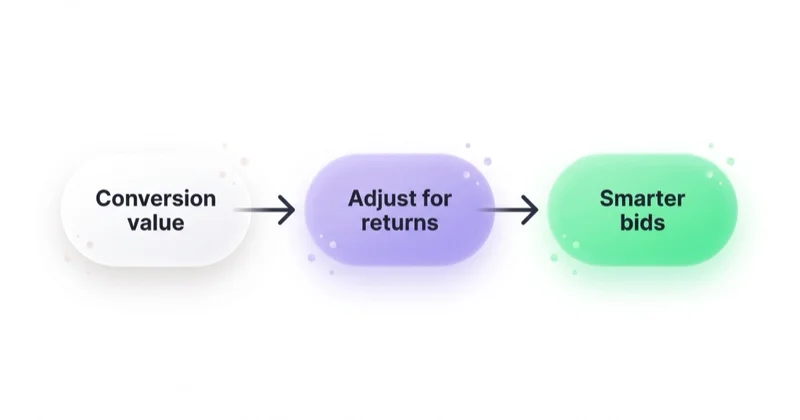
1. You can optimise to profit — but only if you compute it and pass it as the value. Value-based Smart Bidding maximises whatever conversion value you supply; Google's own documentation says these "can be real economic values, like revenue or proxy values." There is no native "profit" toggle. So you calculate profit per order (price − COGS − expected return cost) and send that as the conversion value, not revenue.
2. There's no native POAS from Merchant Center COGS. You can submit cost_of_goods_sold and use conversions-with-cart-data, but Google uses that combination for gross-profit reporting only — it is not a bid input. Useful for insight; it won't bid to profit on its own.
3. Returns feed back through conversion adjustments — this is the mechanism that matters at 20–24% return rates. When an item is returned, you upload a retraction (sets that conversion's value to zero) or a restatement (reduces it for a partial return). Over time, Smart Bidding learns net-of-returns value and stops over-investing in high-return SKUs. The windows matter: adjustments are accepted up to 54 days after the conversion, but only adjustments within roughly 7 days feed back into the bidding model's learning — so the returns-data pipeline has to be fast, not monthly.
4. Conversion value rules adjust by audience, location and device — not by margin or return likelihood. Useful for "this region/customer is worth more," but they won't make bidding margin-aware on their own.
Put together: pass profit (not revenue) as value, wire returns back through conversion adjustments quickly, use cart-data COGS for reporting, and layer value rules for geo/audience differences. That pipeline is unglamorous and it is the single highest-leverage thing a premium fashion brand can do in Google Ads.
How we approach this at Space Ads
We run daily audits across 25+ client accounts and analyse roughly 14 million data points a month through Space Ads OS, and several of those are fashion and footwear brands. In practice, the Google Ads work starts before the first bid change: product data, conversion value, returns, seasonality and category structure decide whether automation has anything reliable to optimise toward.
The feed is treated as a commercial input, not a file. For premium fashion, we check variant grouping, size systems, colour naming, availability, editorial imagery and whether the product set in Merchant Center matches how the business actually thinks about margin and seasonality. In public work such as Philipp Plein, Plein Sport and ZAXY, campaign performance depended on connecting Google Ads, Meta Ads, GA4, feed quality and ecommerce reality rather than managing each channel in isolation.
Headline ROAS and real ROAS diverge once returns are in. We reconcile platform-reported conversions against GA4, ecommerce data and the order book so the brand can see what landed as contribution, not just what Google attributed. Reporting returns-adjusted, blended ROAS is not optional in this category.
Signal quality sets the ceiling on automation. Smart Bidding, Performance Max and AI Max only get as smart as the data feeding them. Clean conversion tracking, server-side measurement, and a fast returns pipeline usually do more for decision quality than another round of bid tweaks. This is the quiet layer under the campaigns, but it is where premium fashion accounts either become scalable or stay dependent on headline ROAS.
If you want the channel-by-channel version for premium fashion and footwear specifically, that's what our fashion & footwear paid media practice is built around.
A build order for a premium fashion Google Ads account
- Foundation first. Fix the feed (variants, sizing, images, footwear GTIN/MPN) and conversion tracking before spending scales. Pass profit as conversion value and stand up the returns → conversion-adjustment pipeline.
- Capture, with controls. Launch Search (brand + supported generic) and Shopping/Performance Max with brand exclusions, negative keywords and inventory controls set deliberately. Watch channel-level and search-terms reporting.
- Create demand. Add Demand Gen with the product feed and Lookalike segments to grow beyond existing brand search, measured on assisted demand and branded-search lift.
- Reconcile and reallocate. Report returns-adjusted, blended ROAS against the order book; reallocate by contribution, not platform-claimed ROAS; test AI Max as a layer on Search.
Stop doing / do instead
| Stop doing | Do instead |
|---|---|
| Optimising to gross revenue | Pass profit as the conversion value; feed returns back via adjustments |
| Treating the feed as setup-once plumbing | Treat the feed as the campaign — variants, sizing, images, footwear GTIN/MPN |
| Avoiding Performance Max as a black box | Use brand exclusions, inventory controls, and 2025 channel-level/search-terms reporting |
| Judging Demand Gen on last-click ROAS | Hold it to assisted demand and branded-search lift |
| Buying generic search with no brand support | Pair generic Search with Demand Gen / YouTube demand creation |
| Reporting platform ROAS | Reconcile against GA4 and the order book; report returns-adjusted blended ROAS |
Common mistakes
- Revenue-optimised bidding on a high-return category — it systematically funds the SKUs that come back most.
- A thin or sloppy feed — missing
item_group_id, wrong sizes, cropped or studio-flat imagery cap performance before any bid strategy can help. - Performance Max on defaults — no brand exclusions or inventory controls means uncontrolled context and over-paying for brand demand.
- Demand Gen judged as direct response — it's a demand-creation channel; last-click will always under-credit it.
- Forgetting the UK/EEA Customer Match restriction — planning audience reach on inventory that no longer serves those lists.
- A slow returns pipeline — returns reported monthly miss the ~7-day window where adjustments actually retrain bidding.
FAQ
Does Google Shopping work for clothing and fashion brands?
Yes — Shopping (and Performance Max, which includes Shopping inventory) is usually the highest-volume channel for fashion e-commerce, because it puts the product image and price directly in front of in-market shoppers. Its performance is governed almost entirely by the product feed: accurate color, size, item_group_id variant grouping, and editorial imagery decide which queries a garment surfaces for and how it renders against competitors.
What product feed attributes are required for apparel in Google?
For the Apparel & Accessories category in the US and UK, Google requires brand, color, age_group, gender, size (for clothing and shoes), and item_group_id for variants, on top of the universal id, image_link and availability. Shoes (and bags, watches, sunglasses) additionally require a gtin or mpn. material and pattern are required when the product varies by them; size_type and size_system are optional but worth setting, since size_type defaults to "regular".
Is Performance Max safe for a luxury or premium fashion brand?
It can be, if you use the controls. Brand exclusion lists keep you out of competitor and own-brand auctions, negative keywords (up to 10,000) and inventory-type settings control where ads appear, and sensitive-content exclusions protect brand context. Since 2025, channel-level and search-terms reporting make Performance Max transparent enough to recommend to brands that demand it. On defaults, it's a risk; configured deliberately, it's a strong demand-capture engine.
Can Google Ads bid on profit and handle returns for fashion?
Not natively, but you can engineer it. Google has no profit toggle, so you compute profit per order and pass it as the conversion value for value-based bidding. For returns — critical at fashion's 20–24% online return rates — you upload conversion adjustments (retractions and restatements) as items come back, so Smart Bidding learns net-of-returns value. Submitting cost_of_goods_sold with cart data gives gross-profit reporting, but it isn't a bid input on its own.
What's the difference between Performance Max and Demand Gen for fashion?
Performance Max captures and extends existing demand across Search, Shopping, YouTube and more, optimised toward conversions. Demand Gen creates new demand on visual surfaces (YouTube, Shorts, Discover, Gmail) for people who weren't searching yet. A fashion brand needs both: PMax to harvest intent efficiently, Demand Gen to grow the pool of people who want the brand in the first place.
Should a fashion brand use AI Max for Search?
AI Max is worth testing as a layer on existing Search campaigns — it broadens matching and expands assets and URLs, and Google reports roughly 14% more conversions or value at a similar ROAS. It's been in open beta since May 2025 and is expanding through 2026, with Dynamic Search Ads upgrading into it. Test it with brand controls and search-term reporting watched closely, rather than enabling it and walking away.
How do return rates change Google Ads strategy for footwear?
Footwear has higher return rates than most apparel because of sizing, so the returns-aware pipeline matters even more. Submit accurate size, size_system and gtin/mpn, pass net-of-returns profit as the conversion value, and wire returns into conversion adjustments quickly — within the roughly 7-day window where they retrain bidding — so the campaign stops over-investing in styles that come back.
In short
- Google Ads for fashion e-commerce works when the feed and returns-aware bidding are right; the campaign types are delivery on top of those.
- Apparel requires
brand,color,age_group,gender,sizeanditem_group_id; shoes also needgtin/mpn. - Pass profit (not revenue) as conversion value, and feed returns back through conversion adjustments so bidding learns net-of-returns value.
- Performance Max is controllable enough for premium now — use brand exclusions, inventory controls, and 2025 channel-level/search-terms reporting.
- Split the four campaign types by job: Search and Shopping capture, PMax captures and extends, Demand Gen creates.
- Reconcile against GA4 and the order book and report returns-adjusted, blended ROAS — not platform-claimed ROAS.
Sources and further reading
- Google Merchant Center — Product data specification
- Google Merchant Center — Best practices for advertising clothing & accessories
- Google Ads — Brand suitability features in Performance Max
- Google Ads — Highlights of 2025 (PMax reporting, AI Max, negatives)
- Google Ads — About conversion adjustments (returns: retract/restate)
- Google Ads — Create a Demand Gen campaign
- Google — AI Max for Search
Continue learning
- Luxury fashion marketing: how premium brands build desire (not discounts)
- Performance Max campaigns: what to know and how to create them
- What is a Demand Gen campaign in Google Ads and how to launch one
- What is a product feed and how to use it
- How to use Google Shopping campaigns effectively
- Customer Match in Google Ads: what it is and how to use it
Continue reading

Luxury Fashion Marketing in 2026: How Premium Brands Build Desire (Not Discounts)
Luxury fashion marketing should protect desire, price integrity and customer quality while still converting demand efficiently. This guide covers brand building, performance marketing, CRM, clienteling, product data, AEO and measurement without relying on discounts.

How to Choose an Ecommerce PPC Agency (Margin, Feed and Blended Truth)
Choose an ecommerce PPC agency by examining product-data operations, contribution economics, customer acquisition, PMax controls, measurement, access and scope—not a headline ROAS alone.

Custom Labels in Google Shopping and Performance Max: How to Segment Products
Custom labels let ecommerce teams segment Merchant Center products by margin, season, stock, bestseller status, lifecycle and return risk. Used well, custom_label_0-4 make Shopping, Performance Max and Demand Gen easier to report, filter and optimise by business priority.